

SUBSCRIBE TO OUR FREE NEWSLETTER
Daily news & progressive opinion—funded by the people, not the corporations—delivered straight to your inbox.
5
#000000
#FFFFFF
To donate by check, phone, or other method, see our More Ways to Give page.
Daily news & progressive opinion—funded by the people, not the corporations—delivered straight to your inbox.
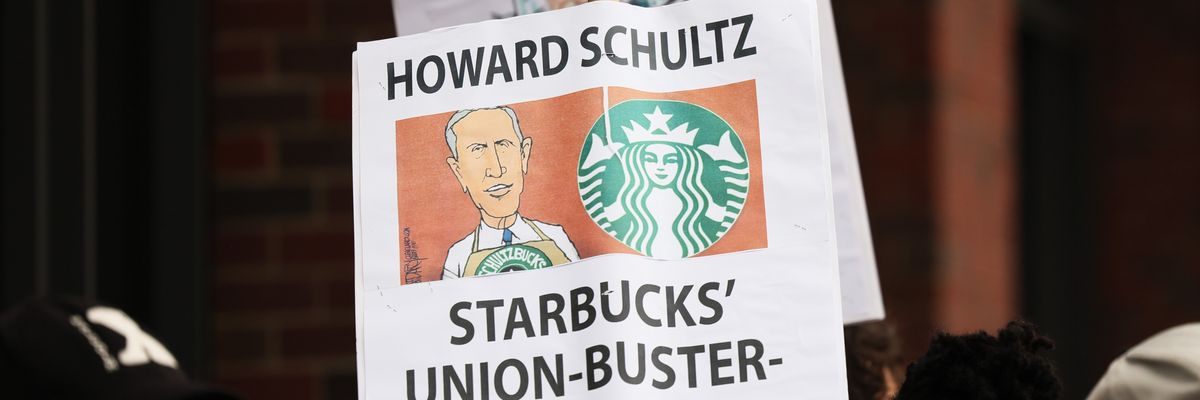
Demonstrators hold signs while protesting in front of a Starbucks shop on April 14, 2022 in New York City.
"This is the kind of pressure that could force the company to the bargaining table," said one reporter.
Dozens of white-collar Starbucks employees have endorsed a petition calling out the Seattle-based coffee chain for requiring them to return to the office and interfering with a national unionization push by baristas, Bloomberg revealed Wednesday.
"Starbucks is making headlines and attracting Senate attention for tampering with the federal right of store partners to have fair elections, free from fear, coercion, and intimidation," says the letter, reportedly sent to senior executives and board members.
As the push to organize continues—407 U.S. stores have voted for elections and 292 have voted to unionize—so does the company's forceful response, Starbucks Workers United said in an email Wednesday. While Starbucks has continuously denied any law-breaking, the National Labor Relations Board has issued over 70 complaints against the company, which faces more than 1,200 alleged violations.
"This behavior of not listening to partners has also impacted us, the support partners," the letter stresses. "An unforeseen and poorly planned 'return to office' mandate is making our lives more difficult, prioritizing corporate control over productivity, diversity, and inclusion, and individual job satisfaction, effectively reducing our ability to positively impact store partner experience."
"We love Starbucks, but these actions are fracturing trust in Starbucks leadership," adds the petition—signed by 44 named individuals and another 22 who wish to remain anonymous—advocating for a commitment to "a policy of neutrality and respect for federal labor laws" and a reversal of the return to office mandate for those who were able to work remotely.
As Bloomberg detailed:
In January, Starbucks CEO Howard Schultz sent a memo requiring workers within commuting distance to return to the office three days a week. He told white-collar staff that baristas "are asking us to do the transformative work that I believe can only be done effectively when we are physically together."
Employees say their protest letter emerged from online discussions over the past couple months that were triggered in part by Schultz's January email. It also reflects long-running frustration by some white-collar staff with Starbucks' response to the union campaign, which U.S. labor board prosecutors have alleged included illegal threats and terminations of around 50 activists. Workers United barista-activists and organizers have been advising the white-collar workers' nascent efforts.
"After Howard issued his edict, I definitely did not feel good working for Starbucks anymore—it felt like I am working for a dictator," Starbucks app developer and letter signatory Peter de Jesus told the outlet. "I feel like this is not the Starbucks that I signed on for."
"A lot of people just want to have their grievances and their demands aired, and hope for change," de Jesus added. "If it doesn't lead to any meaningful change, then the next step is obviously to think about possibly unionizing."
According to Bloomberg:
A Starbucks spokesperson confirmed that the letter was received and said that the company has already been responding to feedback by making adjustments to its office return policy, such as boosting commuter benefits. The spokesperson shared a Wednesday Slack exchange in which a manager, in response to an employee's link to the open letter, said that he would not be clicking the link but would instead like to schedule a meeting to hear the worker's perspective.
The letter—support for which carries risks for members of management, given limits of federal labor laws—not only could be "a precursor to eventual unionization efforts by white-collar Starbucks staff themselves," as Bloomberg noted, it also could aid organizers fighting for contracts and union elections at Starbucks locations across the country.
In response to the new reporting, journalist Bryce Covert
tweeted: "Hundreds of Starbucks stores have unionized but none have a contract. This is the kind of pressure that could force the company to the bargaining table."
The letter from Starbucks' white-collar workers came as Sen. Bernie Sanders (I-Vt.)—a supporter of the unionization effort at the company—announced that since Schultz has declined a recent
invitation to testify before the Senate Health, Education, Labor, and Pensions Committee, which he chairs, members will vote next week on whether to subpoena the CEO, who is set to be replaced on April 1 by Laxman Narasimhan.
This country and this world are at a monumental crossroads. US voters have an opportunity to beat back the forces of fascism and confront the billionaires who are rigging the economy, our media system, and our democracy, making it increasingly impossible for ordinary people to get by. We’re not just talking about the election. We’re talking about what must be done once these fascist elements are vanquished from power. We need a bolder set of solutions than what either major party has so far been willing to offer and a working-class movement ready to fight like hell for it. Trump didn't emerge from nowhere. The conditions that fueled MAGA authoritarianism were created by decades of radical neoliberal economic policies and a corrupt political system dominated by corporate interests. They slashed taxes on the super-rich, promising that the benefits would trickle down. They said giveaways to the corporate titans would make life more affordable for the rest of us. It was all bullshit. And when a bitter, betrayed populace searches for someone to blame, right-wing demagogues have little trouble finding scapegoats. People know when they're being lied to, but you won't hear any of this from the corporate media. Only independent journalism—powered and funded by people who believe in building a better world—can deliver truly trustworthy daily news. If you share our vision, please contribute whatever you can to sustain our work. |
Dozens of white-collar Starbucks employees have endorsed a petition calling out the Seattle-based coffee chain for requiring them to return to the office and interfering with a national unionization push by baristas, Bloomberg revealed Wednesday.
"Starbucks is making headlines and attracting Senate attention for tampering with the federal right of store partners to have fair elections, free from fear, coercion, and intimidation," says the letter, reportedly sent to senior executives and board members.
As the push to organize continues—407 U.S. stores have voted for elections and 292 have voted to unionize—so does the company's forceful response, Starbucks Workers United said in an email Wednesday. While Starbucks has continuously denied any law-breaking, the National Labor Relations Board has issued over 70 complaints against the company, which faces more than 1,200 alleged violations.
"This behavior of not listening to partners has also impacted us, the support partners," the letter stresses. "An unforeseen and poorly planned 'return to office' mandate is making our lives more difficult, prioritizing corporate control over productivity, diversity, and inclusion, and individual job satisfaction, effectively reducing our ability to positively impact store partner experience."
"We love Starbucks, but these actions are fracturing trust in Starbucks leadership," adds the petition—signed by 44 named individuals and another 22 who wish to remain anonymous—advocating for a commitment to "a policy of neutrality and respect for federal labor laws" and a reversal of the return to office mandate for those who were able to work remotely.
As Bloomberg detailed:
In January, Starbucks CEO Howard Schultz sent a memo requiring workers within commuting distance to return to the office three days a week. He told white-collar staff that baristas "are asking us to do the transformative work that I believe can only be done effectively when we are physically together."
Employees say their protest letter emerged from online discussions over the past couple months that were triggered in part by Schultz's January email. It also reflects long-running frustration by some white-collar staff with Starbucks' response to the union campaign, which U.S. labor board prosecutors have alleged included illegal threats and terminations of around 50 activists. Workers United barista-activists and organizers have been advising the white-collar workers' nascent efforts.
"After Howard issued his edict, I definitely did not feel good working for Starbucks anymore—it felt like I am working for a dictator," Starbucks app developer and letter signatory Peter de Jesus told the outlet. "I feel like this is not the Starbucks that I signed on for."
"A lot of people just want to have their grievances and their demands aired, and hope for change," de Jesus added. "If it doesn't lead to any meaningful change, then the next step is obviously to think about possibly unionizing."
According to Bloomberg:
A Starbucks spokesperson confirmed that the letter was received and said that the company has already been responding to feedback by making adjustments to its office return policy, such as boosting commuter benefits. The spokesperson shared a Wednesday Slack exchange in which a manager, in response to an employee's link to the open letter, said that he would not be clicking the link but would instead like to schedule a meeting to hear the worker's perspective.
The letter—support for which carries risks for members of management, given limits of federal labor laws—not only could be "a precursor to eventual unionization efforts by white-collar Starbucks staff themselves," as Bloomberg noted, it also could aid organizers fighting for contracts and union elections at Starbucks locations across the country.
In response to the new reporting, journalist Bryce Covert
tweeted: "Hundreds of Starbucks stores have unionized but none have a contract. This is the kind of pressure that could force the company to the bargaining table."
The letter from Starbucks' white-collar workers came as Sen. Bernie Sanders (I-Vt.)—a supporter of the unionization effort at the company—announced that since Schultz has declined a recent
invitation to testify before the Senate Health, Education, Labor, and Pensions Committee, which he chairs, members will vote next week on whether to subpoena the CEO, who is set to be replaced on April 1 by Laxman Narasimhan.

