SUBSCRIBE TO OUR FREE NEWSLETTER
Daily news & progressive opinion—funded by the people, not the corporations—delivered straight to your inbox.
5
#000000
#FFFFFF
To donate by check, phone, or other method, see our More Ways to Give page.
Daily news & progressive opinion—funded by the people, not the corporations—delivered straight to your inbox.
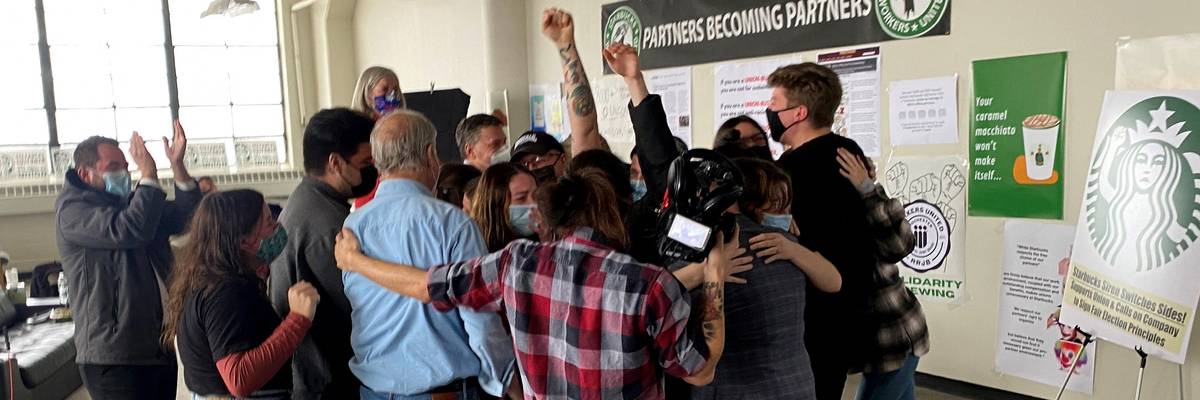
Starbucks employees celebrate after the votes are counted for a union election on December 9, 2021 in Buffalo, New York.
"This ruling proves what we have been saying all along—Starbucks is the poster child of union-busting in the United States," said one organizer, vowing to "fight until every Starbucks worker wins the right to organize."
Building on a series of blows to Starbucks on Wednesday, a federal administrative law judge found the coffee giant "committed hundreds of unfair labor practices" at stores in and near Buffalo, New York, the origin of a national unionization wave.
In a lengthy ruling, the National Labor Relations Board (NLRB) judge, Michael A. Rosas, called out the Seattle-based company for "egregious and widespread misconduct demonstrating a general disregard for the employees' fundamental rights."
The judge ordered Starbucks to cease a long list of anti-union activities, rehire illegally fired employees, reimburse those impacted by unlawful conduct, rescind disciplinary actions, and reopen closed stores.
Rebecca Givan, an associate professor of labor studies at Rutgers University, told The Washington Post that "to order a company to reopen stores that it's closed should be embarrassing for Starbucks."
Rosas also ordered "a meeting or meetings scheduled to ensure the widest possible attendance," during which a notice to the employees and an explanation of rights will be read by CEO Howard Schultz, senior vice president of U.S. operations Denise Nelson, or an NLRB agent. A video of the reading must be distributed to workers electronically or by mail.
In an emailed statement to Bloomberg, Starbucks said that "we believe the decision and the remedies ordered are inappropriate given the record in this matter and are considering all options to obtain further legal review."
The outlet noted that "rulings by NLRB judges can be appealed to labor board members in Washington, and can then be appealed into federal appeals court. The agency can order policies changed and workers reinstated, but lacks authority to hold executives personally liable or make companies pay punitive damages for violations."
Meanwhile, Starbucks employees from the area and across the United States celebrated the "historic" ruling. Local organizer and barista Michael Sanabria declared that "after waiting through months of stalling tactics and the slow wheel of justice to turn, this will reinvigorate and re-energize the momentum of this movement."
Gary Bonadonna Jr., manager of the Starbucks Workers United Rochester regional joint board, said that "when workers launched their organizing campaign in the summer of 2021, we never could have imagined the lengths Starbucks would go to try to stop employees from exercising their legal right to organize."
"This ruling proves what we have been saying all along—Starbucks is the poster child of union-busting in the United States," Bonadonna added. "We are thrilled that the company is being held accountable for their actions and we will continue to fight until every Starbucks worker wins the right to organize."
The ruling came after dozens of white-collar Starbucks workers on Wednesday endorsed a letter calling out the company for requiring them to return to the office and interfering with the unionization efforts at stores nationwide.
Also on Wednesday, Senate Health, Education, Labor, and Pensions Committee Chair Bernie Sanders (I-Vt.) announced that next week the panel will vote on whether to subpoena Schultz, who has refused to testify voluntarily.
"Tough day for Starbucks and its CEO," More Perfect Union tweeted Wednesday night. "They might want to consider not engaging in constant, illegal union-busting."
Dear Common Dreams reader, It’s been nearly 30 years since I co-founded Common Dreams with my late wife, Lina Newhouser. We had the radical notion that journalism should serve the public good, not corporate profits. It was clear to us from the outset what it would take to build such a project. No paid advertisements. No corporate sponsors. No millionaire publisher telling us what to think or do. Many people said we wouldn't last a year, but we proved those doubters wrong. Together with a tremendous team of journalists and dedicated staff, we built an independent media outlet free from the constraints of profits and corporate control. Our mission has always been simple: To inform. To inspire. To ignite change for the common good. Building Common Dreams was not easy. Our survival was never guaranteed. When you take on the most powerful forces—Wall Street greed, fossil fuel industry destruction, Big Tech lobbyists, and uber-rich oligarchs who have spent billions upon billions rigging the economy and democracy in their favor—the only bulwark you have is supporters who believe in your work. But here’s the urgent message from me today. It's never been this bad out there. And it's never been this hard to keep us going. At the very moment Common Dreams is most needed, the threats we face are intensifying. We need your support now more than ever. We don't accept corporate advertising and never will. We don't have a paywall because we don't think people should be blocked from critical news based on their ability to pay. Everything we do is funded by the donations of readers like you. When everyone does the little they can afford, we are strong. But if that support retreats or dries up, so do we. Will you donate now to make sure Common Dreams not only survives but thrives? —Craig Brown, Co-founder |
Building on a series of blows to Starbucks on Wednesday, a federal administrative law judge found the coffee giant "committed hundreds of unfair labor practices" at stores in and near Buffalo, New York, the origin of a national unionization wave.
In a lengthy ruling, the National Labor Relations Board (NLRB) judge, Michael A. Rosas, called out the Seattle-based company for "egregious and widespread misconduct demonstrating a general disregard for the employees' fundamental rights."
The judge ordered Starbucks to cease a long list of anti-union activities, rehire illegally fired employees, reimburse those impacted by unlawful conduct, rescind disciplinary actions, and reopen closed stores.
Rebecca Givan, an associate professor of labor studies at Rutgers University, told The Washington Post that "to order a company to reopen stores that it's closed should be embarrassing for Starbucks."
Rosas also ordered "a meeting or meetings scheduled to ensure the widest possible attendance," during which a notice to the employees and an explanation of rights will be read by CEO Howard Schultz, senior vice president of U.S. operations Denise Nelson, or an NLRB agent. A video of the reading must be distributed to workers electronically or by mail.
In an emailed statement to Bloomberg, Starbucks said that "we believe the decision and the remedies ordered are inappropriate given the record in this matter and are considering all options to obtain further legal review."
The outlet noted that "rulings by NLRB judges can be appealed to labor board members in Washington, and can then be appealed into federal appeals court. The agency can order policies changed and workers reinstated, but lacks authority to hold executives personally liable or make companies pay punitive damages for violations."
Meanwhile, Starbucks employees from the area and across the United States celebrated the "historic" ruling. Local organizer and barista Michael Sanabria declared that "after waiting through months of stalling tactics and the slow wheel of justice to turn, this will reinvigorate and re-energize the momentum of this movement."
Gary Bonadonna Jr., manager of the Starbucks Workers United Rochester regional joint board, said that "when workers launched their organizing campaign in the summer of 2021, we never could have imagined the lengths Starbucks would go to try to stop employees from exercising their legal right to organize."
"This ruling proves what we have been saying all along—Starbucks is the poster child of union-busting in the United States," Bonadonna added. "We are thrilled that the company is being held accountable for their actions and we will continue to fight until every Starbucks worker wins the right to organize."
The ruling came after dozens of white-collar Starbucks workers on Wednesday endorsed a letter calling out the company for requiring them to return to the office and interfering with the unionization efforts at stores nationwide.
Also on Wednesday, Senate Health, Education, Labor, and Pensions Committee Chair Bernie Sanders (I-Vt.) announced that next week the panel will vote on whether to subpoena Schultz, who has refused to testify voluntarily.
"Tough day for Starbucks and its CEO," More Perfect Union tweeted Wednesday night. "They might want to consider not engaging in constant, illegal union-busting."
Building on a series of blows to Starbucks on Wednesday, a federal administrative law judge found the coffee giant "committed hundreds of unfair labor practices" at stores in and near Buffalo, New York, the origin of a national unionization wave.
In a lengthy ruling, the National Labor Relations Board (NLRB) judge, Michael A. Rosas, called out the Seattle-based company for "egregious and widespread misconduct demonstrating a general disregard for the employees' fundamental rights."
The judge ordered Starbucks to cease a long list of anti-union activities, rehire illegally fired employees, reimburse those impacted by unlawful conduct, rescind disciplinary actions, and reopen closed stores.
Rebecca Givan, an associate professor of labor studies at Rutgers University, told The Washington Post that "to order a company to reopen stores that it's closed should be embarrassing for Starbucks."
Rosas also ordered "a meeting or meetings scheduled to ensure the widest possible attendance," during which a notice to the employees and an explanation of rights will be read by CEO Howard Schultz, senior vice president of U.S. operations Denise Nelson, or an NLRB agent. A video of the reading must be distributed to workers electronically or by mail.
In an emailed statement to Bloomberg, Starbucks said that "we believe the decision and the remedies ordered are inappropriate given the record in this matter and are considering all options to obtain further legal review."
The outlet noted that "rulings by NLRB judges can be appealed to labor board members in Washington, and can then be appealed into federal appeals court. The agency can order policies changed and workers reinstated, but lacks authority to hold executives personally liable or make companies pay punitive damages for violations."
Meanwhile, Starbucks employees from the area and across the United States celebrated the "historic" ruling. Local organizer and barista Michael Sanabria declared that "after waiting through months of stalling tactics and the slow wheel of justice to turn, this will reinvigorate and re-energize the momentum of this movement."
Gary Bonadonna Jr., manager of the Starbucks Workers United Rochester regional joint board, said that "when workers launched their organizing campaign in the summer of 2021, we never could have imagined the lengths Starbucks would go to try to stop employees from exercising their legal right to organize."
"This ruling proves what we have been saying all along—Starbucks is the poster child of union-busting in the United States," Bonadonna added. "We are thrilled that the company is being held accountable for their actions and we will continue to fight until every Starbucks worker wins the right to organize."
The ruling came after dozens of white-collar Starbucks workers on Wednesday endorsed a letter calling out the company for requiring them to return to the office and interfering with the unionization efforts at stores nationwide.
Also on Wednesday, Senate Health, Education, Labor, and Pensions Committee Chair Bernie Sanders (I-Vt.) announced that next week the panel will vote on whether to subpoena Schultz, who has refused to testify voluntarily.
"Tough day for Starbucks and its CEO," More Perfect Union tweeted Wednesday night. "They might want to consider not engaging in constant, illegal union-busting."