

SUBSCRIBE TO OUR FREE NEWSLETTER
Daily news & progressive opinion—funded by the people, not the corporations—delivered straight to your inbox.
5
#000000
#FFFFFF
To donate by check, phone, or other method, see our More Ways to Give page.
Daily news & progressive opinion—funded by the people, not the corporations—delivered straight to your inbox.
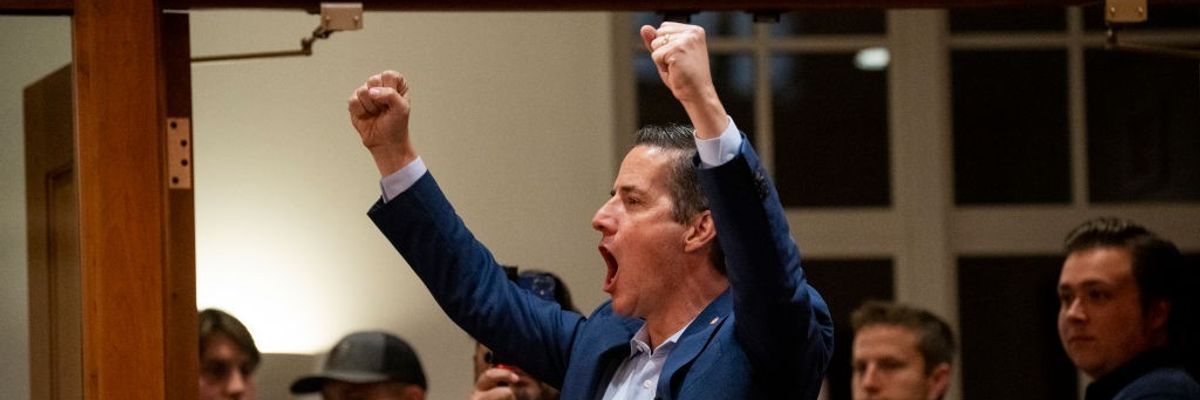
Republican Sen.-elect Bernie Moreno arrives to address supporters on November 4, 2024 in Brecksville, Ohio.
The Ohio Democrat lost his seat because "the billionaire-backed crypto industry donated $40 million to his right-wing opponent," lamented one labor journalist.
The Republican Party's capture of the U.S. Senate this week was made possible in part by massive spending from the nascent but increasingly influential cryptocurrency industry, which pumped more than $40 million into a successful effort to topple pro-worker progressive Sen. Sherrod Brown in favor of luxury car dealer Bernie Moreno.
Crypto industry spending helped make Ohio's closely watched Senate race the most expensive in the state's history, with Moreno's campaign boosted by around $40.1 million from the super PAC Defend American Jobs—part of what OpenSecrets described as the "triad" of allied pro-crypto groups pouring cash into the 2024 election.
The Washington Post noted that Moreno "founded a blockchain firm called Ownum in 2018" and "has long immersed himself in blockchain technology, a registry of ownership that essentially underpins all cryptocurrency."
A spokesman for Fairshake, another member of the crypto PAC triad, took credit for Moreno's victory in a statement after the election was called in the Republican's favor and condemned Brown's
support for regulating the industry. Fairshake received tens of millions of dollars in donations from the cryptocurrency exchange giant Coinbase—some of which may have been illegal spending, according to the watchdog group Public Citizen, given that the company is a federal contractor.
"Sherrod Brown was a top opponent of cryptocurrency and thanks to our efforts, he will be leaving the Senate," said Fairshake's Josh Vlasto. "Senator-elect Moreno's come-from-behind win shows that Ohio voters want a leader who prioritizes innovation."
Crypto executive Tyler Winklevoss boasted in a social media post, "The crypto army is striking!"
"Sherrod Brown—crypto public enemy, Elizabeth Warren co-conspirator, and Gary Gensler crony—was just ousted by Bernie Moreno for Ohio Senate," wrote Winklevoss, the co-founder of Gemini.
Labor reporter Steven Greenhouse wrote Wednesday that it is "obscene" that Brown lost his seat because "the billionaire-backed crypto industry donated $40 million to his right-wing opponent."
"Sherrod Brown is one of the most pro-worker, pro-middle-class members of the U.S. Senate," Greenhouse added. "He truly fights for workers."
"The strategy was a brazen attempt to buy influence while keeping the public unaware of what they were supporting."
While the Ohio Senate contest was "the biggest single target of crypto money this cycle," as CNBC put it, the industry spread its money widely, backing both Republicans and Democrats in races across the country—underscoring its attempt to gain influence over future regulatory fights in Congress.
Overall, crypto groups spent more than $130 million in support of candidates for federal office this cycle. A tracker created by the Stand With Crypto Alliance estimates that 263 "pro-crypto candidates" were elected to the House and 18 to the Senate in Tuesday's contest.
Former President Donald Trump's victory over Vice President Kamala Harris was also seen as a win for the industry, with Bitcoin's price
spiking to a new all-time high on Wednesday. During his campaign, Trump vowed to make the U.S. "the crypto capital of the planet."
"Tonight the crypto voter has spoken decisively—across party lines and in key races across the country," gushed Brian Armstrong, the CEO of Coinbase. "Americans disproportionately care about crypto and want clear rules of the road for digital assets. We look forward to working with the new Congress to deliver it."
But one critic, Better Markets president Dennis Kelleher, cast doubt on the industry's self-serving narrative that the 2024 results amounted to a ringing endorsement of cryptocurrency.
In an op-ed for the San Francisco Chronicle on Thursday, Kelleher pointed out that pro-crypto PACs adopted "generic anodyne names" and bankrolled ads that didn't even mention cryptocurrency.
"It's as if Ford ran an ad campaign and never mentioned its cars," Kelleher wrote. "The strategy was a brazen attempt to buy influence while keeping the public unaware of what they were supporting. This way, the industry can claim the now-elected officials they backed have a mandate from the public to support crypto interests—even though they don't."
Dear Common Dreams reader, It’s been nearly 30 years since I co-founded Common Dreams with my late wife, Lina Newhouser. We had the radical notion that journalism should serve the public good, not corporate profits. It was clear to us from the outset what it would take to build such a project. No paid advertisements. No corporate sponsors. No millionaire publisher telling us what to think or do. Many people said we wouldn't last a year, but we proved those doubters wrong. Together with a tremendous team of journalists and dedicated staff, we built an independent media outlet free from the constraints of profits and corporate control. Our mission has always been simple: To inform. To inspire. To ignite change for the common good. Building Common Dreams was not easy. Our survival was never guaranteed. When you take on the most powerful forces—Wall Street greed, fossil fuel industry destruction, Big Tech lobbyists, and uber-rich oligarchs who have spent billions upon billions rigging the economy and democracy in their favor—the only bulwark you have is supporters who believe in your work. But here’s the urgent message from me today. It's never been this bad out there. And it's never been this hard to keep us going. At the very moment Common Dreams is most needed, the threats we face are intensifying. We need your support now more than ever. We don't accept corporate advertising and never will. We don't have a paywall because we don't think people should be blocked from critical news based on their ability to pay. Everything we do is funded by the donations of readers like you. When everyone does the little they can afford, we are strong. But if that support retreats or dries up, so do we. Will you donate now to make sure Common Dreams not only survives but thrives? —Craig Brown, Co-founder |
The Republican Party's capture of the U.S. Senate this week was made possible in part by massive spending from the nascent but increasingly influential cryptocurrency industry, which pumped more than $40 million into a successful effort to topple pro-worker progressive Sen. Sherrod Brown in favor of luxury car dealer Bernie Moreno.
Crypto industry spending helped make Ohio's closely watched Senate race the most expensive in the state's history, with Moreno's campaign boosted by around $40.1 million from the super PAC Defend American Jobs—part of what OpenSecrets described as the "triad" of allied pro-crypto groups pouring cash into the 2024 election.
The Washington Post noted that Moreno "founded a blockchain firm called Ownum in 2018" and "has long immersed himself in blockchain technology, a registry of ownership that essentially underpins all cryptocurrency."
A spokesman for Fairshake, another member of the crypto PAC triad, took credit for Moreno's victory in a statement after the election was called in the Republican's favor and condemned Brown's
support for regulating the industry. Fairshake received tens of millions of dollars in donations from the cryptocurrency exchange giant Coinbase—some of which may have been illegal spending, according to the watchdog group Public Citizen, given that the company is a federal contractor.
"Sherrod Brown was a top opponent of cryptocurrency and thanks to our efforts, he will be leaving the Senate," said Fairshake's Josh Vlasto. "Senator-elect Moreno's come-from-behind win shows that Ohio voters want a leader who prioritizes innovation."
Crypto executive Tyler Winklevoss boasted in a social media post, "The crypto army is striking!"
"Sherrod Brown—crypto public enemy, Elizabeth Warren co-conspirator, and Gary Gensler crony—was just ousted by Bernie Moreno for Ohio Senate," wrote Winklevoss, the co-founder of Gemini.
Labor reporter Steven Greenhouse wrote Wednesday that it is "obscene" that Brown lost his seat because "the billionaire-backed crypto industry donated $40 million to his right-wing opponent."
"Sherrod Brown is one of the most pro-worker, pro-middle-class members of the U.S. Senate," Greenhouse added. "He truly fights for workers."
"The strategy was a brazen attempt to buy influence while keeping the public unaware of what they were supporting."
While the Ohio Senate contest was "the biggest single target of crypto money this cycle," as CNBC put it, the industry spread its money widely, backing both Republicans and Democrats in races across the country—underscoring its attempt to gain influence over future regulatory fights in Congress.
Overall, crypto groups spent more than $130 million in support of candidates for federal office this cycle. A tracker created by the Stand With Crypto Alliance estimates that 263 "pro-crypto candidates" were elected to the House and 18 to the Senate in Tuesday's contest.
Former President Donald Trump's victory over Vice President Kamala Harris was also seen as a win for the industry, with Bitcoin's price
spiking to a new all-time high on Wednesday. During his campaign, Trump vowed to make the U.S. "the crypto capital of the planet."
"Tonight the crypto voter has spoken decisively—across party lines and in key races across the country," gushed Brian Armstrong, the CEO of Coinbase. "Americans disproportionately care about crypto and want clear rules of the road for digital assets. We look forward to working with the new Congress to deliver it."
But one critic, Better Markets president Dennis Kelleher, cast doubt on the industry's self-serving narrative that the 2024 results amounted to a ringing endorsement of cryptocurrency.
In an op-ed for the San Francisco Chronicle on Thursday, Kelleher pointed out that pro-crypto PACs adopted "generic anodyne names" and bankrolled ads that didn't even mention cryptocurrency.
"It's as if Ford ran an ad campaign and never mentioned its cars," Kelleher wrote. "The strategy was a brazen attempt to buy influence while keeping the public unaware of what they were supporting. This way, the industry can claim the now-elected officials they backed have a mandate from the public to support crypto interests—even though they don't."
The Republican Party's capture of the U.S. Senate this week was made possible in part by massive spending from the nascent but increasingly influential cryptocurrency industry, which pumped more than $40 million into a successful effort to topple pro-worker progressive Sen. Sherrod Brown in favor of luxury car dealer Bernie Moreno.
Crypto industry spending helped make Ohio's closely watched Senate race the most expensive in the state's history, with Moreno's campaign boosted by around $40.1 million from the super PAC Defend American Jobs—part of what OpenSecrets described as the "triad" of allied pro-crypto groups pouring cash into the 2024 election.
The Washington Post noted that Moreno "founded a blockchain firm called Ownum in 2018" and "has long immersed himself in blockchain technology, a registry of ownership that essentially underpins all cryptocurrency."
A spokesman for Fairshake, another member of the crypto PAC triad, took credit for Moreno's victory in a statement after the election was called in the Republican's favor and condemned Brown's
support for regulating the industry. Fairshake received tens of millions of dollars in donations from the cryptocurrency exchange giant Coinbase—some of which may have been illegal spending, according to the watchdog group Public Citizen, given that the company is a federal contractor.
"Sherrod Brown was a top opponent of cryptocurrency and thanks to our efforts, he will be leaving the Senate," said Fairshake's Josh Vlasto. "Senator-elect Moreno's come-from-behind win shows that Ohio voters want a leader who prioritizes innovation."
Crypto executive Tyler Winklevoss boasted in a social media post, "The crypto army is striking!"
"Sherrod Brown—crypto public enemy, Elizabeth Warren co-conspirator, and Gary Gensler crony—was just ousted by Bernie Moreno for Ohio Senate," wrote Winklevoss, the co-founder of Gemini.
Labor reporter Steven Greenhouse wrote Wednesday that it is "obscene" that Brown lost his seat because "the billionaire-backed crypto industry donated $40 million to his right-wing opponent."
"Sherrod Brown is one of the most pro-worker, pro-middle-class members of the U.S. Senate," Greenhouse added. "He truly fights for workers."
"The strategy was a brazen attempt to buy influence while keeping the public unaware of what they were supporting."
While the Ohio Senate contest was "the biggest single target of crypto money this cycle," as CNBC put it, the industry spread its money widely, backing both Republicans and Democrats in races across the country—underscoring its attempt to gain influence over future regulatory fights in Congress.
Overall, crypto groups spent more than $130 million in support of candidates for federal office this cycle. A tracker created by the Stand With Crypto Alliance estimates that 263 "pro-crypto candidates" were elected to the House and 18 to the Senate in Tuesday's contest.
Former President Donald Trump's victory over Vice President Kamala Harris was also seen as a win for the industry, with Bitcoin's price
spiking to a new all-time high on Wednesday. During his campaign, Trump vowed to make the U.S. "the crypto capital of the planet."
"Tonight the crypto voter has spoken decisively—across party lines and in key races across the country," gushed Brian Armstrong, the CEO of Coinbase. "Americans disproportionately care about crypto and want clear rules of the road for digital assets. We look forward to working with the new Congress to deliver it."
But one critic, Better Markets president Dennis Kelleher, cast doubt on the industry's self-serving narrative that the 2024 results amounted to a ringing endorsement of cryptocurrency.
In an op-ed for the San Francisco Chronicle on Thursday, Kelleher pointed out that pro-crypto PACs adopted "generic anodyne names" and bankrolled ads that didn't even mention cryptocurrency.
"It's as if Ford ran an ad campaign and never mentioned its cars," Kelleher wrote. "The strategy was a brazen attempt to buy influence while keeping the public unaware of what they were supporting. This way, the industry can claim the now-elected officials they backed have a mandate from the public to support crypto interests—even though they don't."

