SUBSCRIBE TO OUR FREE NEWSLETTER
Daily news & progressive opinion—funded by the people, not the corporations—delivered straight to your inbox.
5
#000000
#FFFFFF
To donate by check, phone, or other method, see our More Ways to Give page.
Daily news & progressive opinion—funded by the people, not the corporations—delivered straight to your inbox.
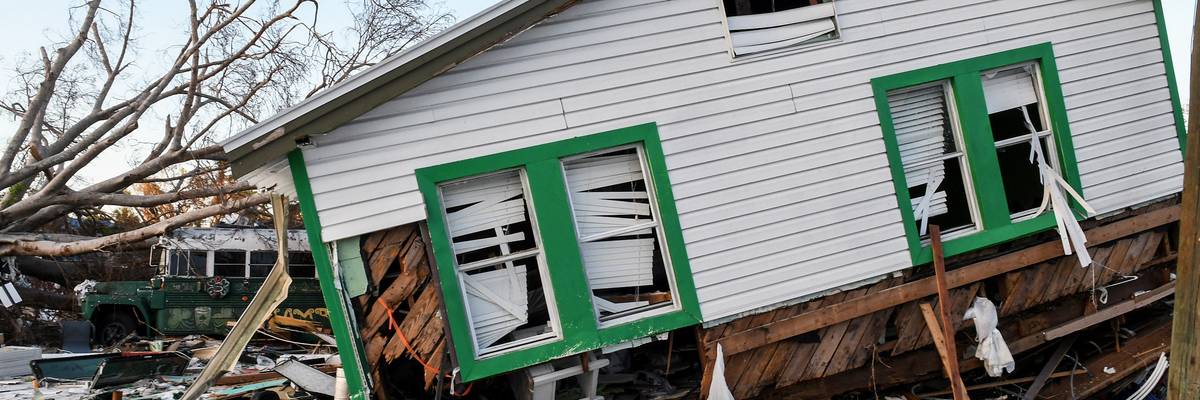
A home ripped off its foundation is seen in Fort Myers Beach, Florida on October 30, 2022, roughly one month after Hurricane Ian made landfall.
"By underwriting and investing in new and expanded fossil fuel projects, U.S. insurers are helping Big Oil bring us closer to the worst runaway climate scenarios," said Democratic Sen. Sheldon Whitehouse.
As insurance giants limit coverage in hundreds of disaster-prone areas across the United States, a Senate panel on Friday launched an investigation into seven major carriers' continued backing of planet-heating fossil fuel projects that are driving increasingly frequent and severe extreme weather.
Senate Budget Committee Chair Sheldon Whitehouse (D-R.I.) sent letters to the executives of seven companies—American Insurance Group (AIG), Berkshire Hathaway, Chubb, Liberty Mutual Group, Starr Wright USA, State Farm, and Travelers Insurance—demanding that each firm disclose how it underwrites, invests in, and profits from coal, oil, and gas.
The letters—also signed by Sens. Ron Wyden (D-Ore.) and Bernie Sanders (I-Vt.), both members of the committee—further ask the companies to explain what plans, if any, they have to reduce, wind down, or eliminate support for current and proposed fossil fuel projects in accordance with the Paris agreement's goal of limiting temperature rise to 1.5°C above preindustrial levels. In addition, the letters seek information about the insurers' climate-related lobbying activities and human rights policies, including methods for securing free, prior, and informed consent from Indigenous communities affected by drilling or pipelines. The companies have until June 23 to respond to the questions.
"By underwriting and investing in new and expanded fossil fuel projects, U.S. insurers are helping Big Oil bring us closer to the worst runaway climate scenarios, which threaten lives, livelihoods, and the federal budget," Whitehouse said in a statement. "This information is especially relevant as some of these companies begin to pull out of certain markets because they see the coming catastrophic climate risks—despite continuing to provide services to the fossil fuel industry."
As The Wall Street Journal reported Thursday, AIG is planning to scale back home insurance sales in roughly 200 ZIP codes around the country at elevated risk of floods or wildfires, affecting parts of Colorado, Delaware, Florida, Idaho, Montana, New York, and Wyoming.
"The U.S. insurance industry continues to dismiss the urgency of eliminating support for fossil fuel expansion and implementing credible, science-based plans to phase out their underwriting and investments in coal, oil, and gas."
Earlier this year, Farmers Group stopped accepting new applications for home insurance policies in Florida, citing hurricane exposure and soaring rebuilding costs. AIG and Chubb had already begun to restrict coverage in California last year. Two weeks ago, State Farm halted the sale of new residential and commercial property insurance policies in the state. Earlier this week, Allstate confirmed it did the same thing last year.
Unmitigated global warming is fueling larger and more frequent blazes in the U.S. West and elsewhere, intensifying hurricanes and typhoons, and causing sea-level rise, which increases the likelihood of flooding and damaging storm surge events in coastal areas.
With an estimated $582 billion invested in fossil fuels, meanwhile, U.S. insurers are making the problem worse, progressive lawmakers and advocates argue. Despite mounting evidence of the climate emergency's growing toll of death and destruction as well as abundant warnings from scientists who have made clear that exploiting new oil and gas fields is incompatible with preserving a habitable planet, U.S. insurers have yet to rule out support for increased fossil fuel extraction and combustion.
"The U.S. insurance industry continues to dismiss the urgency of eliminating support for fossil fuel expansion and implementing credible, science-based plans to phase out their underwriting and investments in coal, oil, and gas," Deanna Noël, climate campaigns director at Public Citizen, said Friday in a statement.
"AIG executives need only look out the windows of their New York City board rooms to see the realities of an unfolding climate crisis," said Noël, alluding to smoke-filled skies brought about by wildfires still raging in Canada. "Empty climate promises do nothing but set entire regions of the country on course to be deemed too risky to insure and communities everywhere to grapple with an uncertain future. Inaction and inadequate action are unacceptable."
Referring to the budget committee's recent hearings examining how "climate change poses multiple 'systemic risks' to the economy," Whitehouse, Wyden, and Sanders wrote:
Witnesses have warned that sea-level rise and wetter, more intense storms could eventually make more than $1 trillion in coastal real estate uninsurable, and therefore unmortgageable, leading to a coastal property values crash; that more frequent and intense wildfires could result in a similar death spiral for Western property in the wildland-urban interface; that climate-related losses are making it harder for the insurance industry to price risk, already resulting in insolvencies among regional insurers; and that, as demand for oil and gas declines, hundreds of billions of dollars in fossil fuel assets may be stranded (the "carbon bubble"). Each of these disruptions could become "systemic," and more than one could occur simultaneously.
The trio proceeded to ask each company how it "evaluates these climate-related risks, decides to invest in or underwrite fossil fuel expansion projects that drive such risks, and prices policies insuring such projects." As the senators observed, "Underwriting dangerous fossil fuel projects makes it harder to achieve global climate goals, and there is little transparency about how the myriad risks factor into industry decisions."
"Given the threat that climate change poses to both the insurance industry and its policyholders, it is difficult to understand how the industry can carefully price and manage climate risk in some areas of its business while simultaneously having no apparent plan to phase out its underwriting of and investment in the projects and companies generating the emissions that are causing these very harms," the letter says. "Many fossil fuel projects would not be able to move forward without insurance, and all industries and sectors in civil society have a role to play in meeting the United States' international climate goals."
Dear Common Dreams reader, It’s been nearly 30 years since I co-founded Common Dreams with my late wife, Lina Newhouser. We had the radical notion that journalism should serve the public good, not corporate profits. It was clear to us from the outset what it would take to build such a project. No paid advertisements. No corporate sponsors. No millionaire publisher telling us what to think or do. Many people said we wouldn't last a year, but we proved those doubters wrong. Together with a tremendous team of journalists and dedicated staff, we built an independent media outlet free from the constraints of profits and corporate control. Our mission has always been simple: To inform. To inspire. To ignite change for the common good. Building Common Dreams was not easy. Our survival was never guaranteed. When you take on the most powerful forces—Wall Street greed, fossil fuel industry destruction, Big Tech lobbyists, and uber-rich oligarchs who have spent billions upon billions rigging the economy and democracy in their favor—the only bulwark you have is supporters who believe in your work. But here’s the urgent message from me today. It's never been this bad out there. And it's never been this hard to keep us going. At the very moment Common Dreams is most needed, the threats we face are intensifying. We need your support now more than ever. We don't accept corporate advertising and never will. We don't have a paywall because we don't think people should be blocked from critical news based on their ability to pay. Everything we do is funded by the donations of readers like you. When everyone does the little they can afford, we are strong. But if that support retreats or dries up, so do we. Will you donate now to make sure Common Dreams not only survives but thrives? —Craig Brown, Co-founder |
As insurance giants limit coverage in hundreds of disaster-prone areas across the United States, a Senate panel on Friday launched an investigation into seven major carriers' continued backing of planet-heating fossil fuel projects that are driving increasingly frequent and severe extreme weather.
Senate Budget Committee Chair Sheldon Whitehouse (D-R.I.) sent letters to the executives of seven companies—American Insurance Group (AIG), Berkshire Hathaway, Chubb, Liberty Mutual Group, Starr Wright USA, State Farm, and Travelers Insurance—demanding that each firm disclose how it underwrites, invests in, and profits from coal, oil, and gas.
The letters—also signed by Sens. Ron Wyden (D-Ore.) and Bernie Sanders (I-Vt.), both members of the committee—further ask the companies to explain what plans, if any, they have to reduce, wind down, or eliminate support for current and proposed fossil fuel projects in accordance with the Paris agreement's goal of limiting temperature rise to 1.5°C above preindustrial levels. In addition, the letters seek information about the insurers' climate-related lobbying activities and human rights policies, including methods for securing free, prior, and informed consent from Indigenous communities affected by drilling or pipelines. The companies have until June 23 to respond to the questions.
"By underwriting and investing in new and expanded fossil fuel projects, U.S. insurers are helping Big Oil bring us closer to the worst runaway climate scenarios, which threaten lives, livelihoods, and the federal budget," Whitehouse said in a statement. "This information is especially relevant as some of these companies begin to pull out of certain markets because they see the coming catastrophic climate risks—despite continuing to provide services to the fossil fuel industry."
As The Wall Street Journal reported Thursday, AIG is planning to scale back home insurance sales in roughly 200 ZIP codes around the country at elevated risk of floods or wildfires, affecting parts of Colorado, Delaware, Florida, Idaho, Montana, New York, and Wyoming.
"The U.S. insurance industry continues to dismiss the urgency of eliminating support for fossil fuel expansion and implementing credible, science-based plans to phase out their underwriting and investments in coal, oil, and gas."
Earlier this year, Farmers Group stopped accepting new applications for home insurance policies in Florida, citing hurricane exposure and soaring rebuilding costs. AIG and Chubb had already begun to restrict coverage in California last year. Two weeks ago, State Farm halted the sale of new residential and commercial property insurance policies in the state. Earlier this week, Allstate confirmed it did the same thing last year.
Unmitigated global warming is fueling larger and more frequent blazes in the U.S. West and elsewhere, intensifying hurricanes and typhoons, and causing sea-level rise, which increases the likelihood of flooding and damaging storm surge events in coastal areas.
With an estimated $582 billion invested in fossil fuels, meanwhile, U.S. insurers are making the problem worse, progressive lawmakers and advocates argue. Despite mounting evidence of the climate emergency's growing toll of death and destruction as well as abundant warnings from scientists who have made clear that exploiting new oil and gas fields is incompatible with preserving a habitable planet, U.S. insurers have yet to rule out support for increased fossil fuel extraction and combustion.
"The U.S. insurance industry continues to dismiss the urgency of eliminating support for fossil fuel expansion and implementing credible, science-based plans to phase out their underwriting and investments in coal, oil, and gas," Deanna Noël, climate campaigns director at Public Citizen, said Friday in a statement.
"AIG executives need only look out the windows of their New York City board rooms to see the realities of an unfolding climate crisis," said Noël, alluding to smoke-filled skies brought about by wildfires still raging in Canada. "Empty climate promises do nothing but set entire regions of the country on course to be deemed too risky to insure and communities everywhere to grapple with an uncertain future. Inaction and inadequate action are unacceptable."
Referring to the budget committee's recent hearings examining how "climate change poses multiple 'systemic risks' to the economy," Whitehouse, Wyden, and Sanders wrote:
Witnesses have warned that sea-level rise and wetter, more intense storms could eventually make more than $1 trillion in coastal real estate uninsurable, and therefore unmortgageable, leading to a coastal property values crash; that more frequent and intense wildfires could result in a similar death spiral for Western property in the wildland-urban interface; that climate-related losses are making it harder for the insurance industry to price risk, already resulting in insolvencies among regional insurers; and that, as demand for oil and gas declines, hundreds of billions of dollars in fossil fuel assets may be stranded (the "carbon bubble"). Each of these disruptions could become "systemic," and more than one could occur simultaneously.
The trio proceeded to ask each company how it "evaluates these climate-related risks, decides to invest in or underwrite fossil fuel expansion projects that drive such risks, and prices policies insuring such projects." As the senators observed, "Underwriting dangerous fossil fuel projects makes it harder to achieve global climate goals, and there is little transparency about how the myriad risks factor into industry decisions."
"Given the threat that climate change poses to both the insurance industry and its policyholders, it is difficult to understand how the industry can carefully price and manage climate risk in some areas of its business while simultaneously having no apparent plan to phase out its underwriting of and investment in the projects and companies generating the emissions that are causing these very harms," the letter says. "Many fossil fuel projects would not be able to move forward without insurance, and all industries and sectors in civil society have a role to play in meeting the United States' international climate goals."
As insurance giants limit coverage in hundreds of disaster-prone areas across the United States, a Senate panel on Friday launched an investigation into seven major carriers' continued backing of planet-heating fossil fuel projects that are driving increasingly frequent and severe extreme weather.
Senate Budget Committee Chair Sheldon Whitehouse (D-R.I.) sent letters to the executives of seven companies—American Insurance Group (AIG), Berkshire Hathaway, Chubb, Liberty Mutual Group, Starr Wright USA, State Farm, and Travelers Insurance—demanding that each firm disclose how it underwrites, invests in, and profits from coal, oil, and gas.
The letters—also signed by Sens. Ron Wyden (D-Ore.) and Bernie Sanders (I-Vt.), both members of the committee—further ask the companies to explain what plans, if any, they have to reduce, wind down, or eliminate support for current and proposed fossil fuel projects in accordance with the Paris agreement's goal of limiting temperature rise to 1.5°C above preindustrial levels. In addition, the letters seek information about the insurers' climate-related lobbying activities and human rights policies, including methods for securing free, prior, and informed consent from Indigenous communities affected by drilling or pipelines. The companies have until June 23 to respond to the questions.
"By underwriting and investing in new and expanded fossil fuel projects, U.S. insurers are helping Big Oil bring us closer to the worst runaway climate scenarios, which threaten lives, livelihoods, and the federal budget," Whitehouse said in a statement. "This information is especially relevant as some of these companies begin to pull out of certain markets because they see the coming catastrophic climate risks—despite continuing to provide services to the fossil fuel industry."
As The Wall Street Journal reported Thursday, AIG is planning to scale back home insurance sales in roughly 200 ZIP codes around the country at elevated risk of floods or wildfires, affecting parts of Colorado, Delaware, Florida, Idaho, Montana, New York, and Wyoming.
"The U.S. insurance industry continues to dismiss the urgency of eliminating support for fossil fuel expansion and implementing credible, science-based plans to phase out their underwriting and investments in coal, oil, and gas."
Earlier this year, Farmers Group stopped accepting new applications for home insurance policies in Florida, citing hurricane exposure and soaring rebuilding costs. AIG and Chubb had already begun to restrict coverage in California last year. Two weeks ago, State Farm halted the sale of new residential and commercial property insurance policies in the state. Earlier this week, Allstate confirmed it did the same thing last year.
Unmitigated global warming is fueling larger and more frequent blazes in the U.S. West and elsewhere, intensifying hurricanes and typhoons, and causing sea-level rise, which increases the likelihood of flooding and damaging storm surge events in coastal areas.
With an estimated $582 billion invested in fossil fuels, meanwhile, U.S. insurers are making the problem worse, progressive lawmakers and advocates argue. Despite mounting evidence of the climate emergency's growing toll of death and destruction as well as abundant warnings from scientists who have made clear that exploiting new oil and gas fields is incompatible with preserving a habitable planet, U.S. insurers have yet to rule out support for increased fossil fuel extraction and combustion.
"The U.S. insurance industry continues to dismiss the urgency of eliminating support for fossil fuel expansion and implementing credible, science-based plans to phase out their underwriting and investments in coal, oil, and gas," Deanna Noël, climate campaigns director at Public Citizen, said Friday in a statement.
"AIG executives need only look out the windows of their New York City board rooms to see the realities of an unfolding climate crisis," said Noël, alluding to smoke-filled skies brought about by wildfires still raging in Canada. "Empty climate promises do nothing but set entire regions of the country on course to be deemed too risky to insure and communities everywhere to grapple with an uncertain future. Inaction and inadequate action are unacceptable."
Referring to the budget committee's recent hearings examining how "climate change poses multiple 'systemic risks' to the economy," Whitehouse, Wyden, and Sanders wrote:
Witnesses have warned that sea-level rise and wetter, more intense storms could eventually make more than $1 trillion in coastal real estate uninsurable, and therefore unmortgageable, leading to a coastal property values crash; that more frequent and intense wildfires could result in a similar death spiral for Western property in the wildland-urban interface; that climate-related losses are making it harder for the insurance industry to price risk, already resulting in insolvencies among regional insurers; and that, as demand for oil and gas declines, hundreds of billions of dollars in fossil fuel assets may be stranded (the "carbon bubble"). Each of these disruptions could become "systemic," and more than one could occur simultaneously.
The trio proceeded to ask each company how it "evaluates these climate-related risks, decides to invest in or underwrite fossil fuel expansion projects that drive such risks, and prices policies insuring such projects." As the senators observed, "Underwriting dangerous fossil fuel projects makes it harder to achieve global climate goals, and there is little transparency about how the myriad risks factor into industry decisions."
"Given the threat that climate change poses to both the insurance industry and its policyholders, it is difficult to understand how the industry can carefully price and manage climate risk in some areas of its business while simultaneously having no apparent plan to phase out its underwriting of and investment in the projects and companies generating the emissions that are causing these very harms," the letter says. "Many fossil fuel projects would not be able to move forward without insurance, and all industries and sectors in civil society have a role to play in meeting the United States' international climate goals."