SUBSCRIBE TO OUR FREE NEWSLETTER
Daily news & progressive opinion—funded by the people, not the corporations—delivered straight to your inbox.
5
#000000
#FFFFFF
To donate by check, phone, or other method, see our More Ways to Give page.
Daily news & progressive opinion—funded by the people, not the corporations—delivered straight to your inbox.

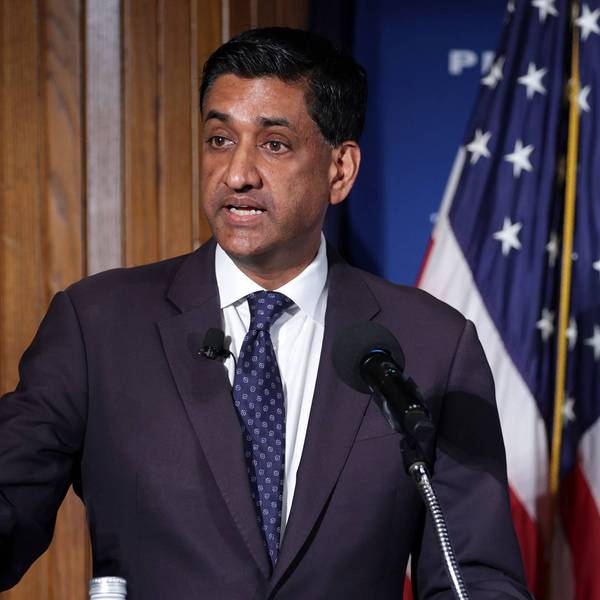
Rep. Ro Khanna (D-Calif.) speaks in his office on June 23, 2022.
The California Democrat said he opposes a military budget "nearing $1 trillion while we are cutting relief for the poor, for students with loans, and for the working class."
Rep. Ro Khanna on Wednesday was the only member of the House Armed Services Committee to vote against legislation that would authorize an $886 billion military budget for the coming fiscal year, a sum the California Democrat decried as outrageous amid cuts to social spending and attacks on aid programs for vulnerable Americans.
"I was proud to cast the lone NO vote against a defense budget nearing $1 trillion while we are cutting relief for the poor, for students with loans, and for the working class," Khanna wrote on Twitter. "The Beltway is not with me, but many Americans—particularly the young—want us to improve their lives."
The 58-1 vote on the House committee's version of the National Defense Authorization Act (NDAA) came after a marathon markup session replete with Republican hysteria over Pentagon diversity programs and funding for drag shows, which the Defense Department has already banned.
But in a tweet following the committee vote, which sends the NDAA to the full House for consideration, Khanna focused his attention on the massive costs of price gouging by private military contractors and other abuses.
"How is it that '60 Minutes' has done better oversight of the Pentagon and found more waste and fraud than our Congressional committees tasked with that very responsibility?" Khanna asked, referring to a recent CBS News investigation detailing rampant profiteering by some of the world's largest military contractors, including Raytheon and Lockheed Martin.
Last year, nearly three-quarters of Lockheed Martin's net sales were from the U.S. government. The weapon manufacturer's CEO recently welcomed the proposed $886 billion military spending topline in the recently approved debt ceiling agreement, calling it "as good an outcome as our industry or our company could ask for at this point."
Lockheed and other major military contractors spend big on lobbying and campaign contributions each year, often targeting key congressional panels such as the House Armed Services Committee.
During the 2022 election cycle, according to OpenSecrets, the military sector donated millions to the 59 members of the panel. Rep. Mike Rogers (R-Ala.), the chair of the committee, received the most from the sector last year at $517,700.
"Pentagon contractors consistently contribute heavily to House Armed Services Committee members, Senate counterparts, and appropriations committee members in both chambers," OpenSecrets found. "The top 20 House Armed Services Committee members received almost $2.3 million from the defense sector, and 12 of those members serve in leadership roles on the committee or related subcommittees."
Eric Eikenberry, government relations director at Win Without War, said in a statement Thursday that the committee's approval of an $886 billion military budget was a vote "for military contractor profits and against the climate, against parents trying to provide for their families, and against diplomacy."
"The people of the United States are dealing with real issues," said Eikenberry. "Climate change, which our gas-guzzling military accelerates, causes wildfires that clog our skylines. Inflation and the looming restart of student loan payments cut into our personal and family budgets. Inequality—racial, gender, and economic—keeps many communities off-kilter and on the margins."
"Instead of addressing these enduring sources of insecurity," Eikenberry added, "Congress decided to grease the wheels of the war machine and its profiteers."
Dear Common Dreams reader, It’s been nearly 30 years since I co-founded Common Dreams with my late wife, Lina Newhouser. We had the radical notion that journalism should serve the public good, not corporate profits. It was clear to us from the outset what it would take to build such a project. No paid advertisements. No corporate sponsors. No millionaire publisher telling us what to think or do. Many people said we wouldn't last a year, but we proved those doubters wrong. Together with a tremendous team of journalists and dedicated staff, we built an independent media outlet free from the constraints of profits and corporate control. Our mission has always been simple: To inform. To inspire. To ignite change for the common good. Building Common Dreams was not easy. Our survival was never guaranteed. When you take on the most powerful forces—Wall Street greed, fossil fuel industry destruction, Big Tech lobbyists, and uber-rich oligarchs who have spent billions upon billions rigging the economy and democracy in their favor—the only bulwark you have is supporters who believe in your work. But here’s the urgent message from me today. It's never been this bad out there. And it's never been this hard to keep us going. At the very moment Common Dreams is most needed, the threats we face are intensifying. We need your support now more than ever. We don't accept corporate advertising and never will. We don't have a paywall because we don't think people should be blocked from critical news based on their ability to pay. Everything we do is funded by the donations of readers like you. When everyone does the little they can afford, we are strong. But if that support retreats or dries up, so do we. Will you donate now to make sure Common Dreams not only survives but thrives? —Craig Brown, Co-founder |
Rep. Ro Khanna on Wednesday was the only member of the House Armed Services Committee to vote against legislation that would authorize an $886 billion military budget for the coming fiscal year, a sum the California Democrat decried as outrageous amid cuts to social spending and attacks on aid programs for vulnerable Americans.
"I was proud to cast the lone NO vote against a defense budget nearing $1 trillion while we are cutting relief for the poor, for students with loans, and for the working class," Khanna wrote on Twitter. "The Beltway is not with me, but many Americans—particularly the young—want us to improve their lives."
The 58-1 vote on the House committee's version of the National Defense Authorization Act (NDAA) came after a marathon markup session replete with Republican hysteria over Pentagon diversity programs and funding for drag shows, which the Defense Department has already banned.
But in a tweet following the committee vote, which sends the NDAA to the full House for consideration, Khanna focused his attention on the massive costs of price gouging by private military contractors and other abuses.
"How is it that '60 Minutes' has done better oversight of the Pentagon and found more waste and fraud than our Congressional committees tasked with that very responsibility?" Khanna asked, referring to a recent CBS News investigation detailing rampant profiteering by some of the world's largest military contractors, including Raytheon and Lockheed Martin.
Last year, nearly three-quarters of Lockheed Martin's net sales were from the U.S. government. The weapon manufacturer's CEO recently welcomed the proposed $886 billion military spending topline in the recently approved debt ceiling agreement, calling it "as good an outcome as our industry or our company could ask for at this point."
Lockheed and other major military contractors spend big on lobbying and campaign contributions each year, often targeting key congressional panels such as the House Armed Services Committee.
During the 2022 election cycle, according to OpenSecrets, the military sector donated millions to the 59 members of the panel. Rep. Mike Rogers (R-Ala.), the chair of the committee, received the most from the sector last year at $517,700.
"Pentagon contractors consistently contribute heavily to House Armed Services Committee members, Senate counterparts, and appropriations committee members in both chambers," OpenSecrets found. "The top 20 House Armed Services Committee members received almost $2.3 million from the defense sector, and 12 of those members serve in leadership roles on the committee or related subcommittees."
Eric Eikenberry, government relations director at Win Without War, said in a statement Thursday that the committee's approval of an $886 billion military budget was a vote "for military contractor profits and against the climate, against parents trying to provide for their families, and against diplomacy."
"The people of the United States are dealing with real issues," said Eikenberry. "Climate change, which our gas-guzzling military accelerates, causes wildfires that clog our skylines. Inflation and the looming restart of student loan payments cut into our personal and family budgets. Inequality—racial, gender, and economic—keeps many communities off-kilter and on the margins."
"Instead of addressing these enduring sources of insecurity," Eikenberry added, "Congress decided to grease the wheels of the war machine and its profiteers."
Rep. Ro Khanna on Wednesday was the only member of the House Armed Services Committee to vote against legislation that would authorize an $886 billion military budget for the coming fiscal year, a sum the California Democrat decried as outrageous amid cuts to social spending and attacks on aid programs for vulnerable Americans.
"I was proud to cast the lone NO vote against a defense budget nearing $1 trillion while we are cutting relief for the poor, for students with loans, and for the working class," Khanna wrote on Twitter. "The Beltway is not with me, but many Americans—particularly the young—want us to improve their lives."
The 58-1 vote on the House committee's version of the National Defense Authorization Act (NDAA) came after a marathon markup session replete with Republican hysteria over Pentagon diversity programs and funding for drag shows, which the Defense Department has already banned.
But in a tweet following the committee vote, which sends the NDAA to the full House for consideration, Khanna focused his attention on the massive costs of price gouging by private military contractors and other abuses.
"How is it that '60 Minutes' has done better oversight of the Pentagon and found more waste and fraud than our Congressional committees tasked with that very responsibility?" Khanna asked, referring to a recent CBS News investigation detailing rampant profiteering by some of the world's largest military contractors, including Raytheon and Lockheed Martin.
Last year, nearly three-quarters of Lockheed Martin's net sales were from the U.S. government. The weapon manufacturer's CEO recently welcomed the proposed $886 billion military spending topline in the recently approved debt ceiling agreement, calling it "as good an outcome as our industry or our company could ask for at this point."
Lockheed and other major military contractors spend big on lobbying and campaign contributions each year, often targeting key congressional panels such as the House Armed Services Committee.
During the 2022 election cycle, according to OpenSecrets, the military sector donated millions to the 59 members of the panel. Rep. Mike Rogers (R-Ala.), the chair of the committee, received the most from the sector last year at $517,700.
"Pentagon contractors consistently contribute heavily to House Armed Services Committee members, Senate counterparts, and appropriations committee members in both chambers," OpenSecrets found. "The top 20 House Armed Services Committee members received almost $2.3 million from the defense sector, and 12 of those members serve in leadership roles on the committee or related subcommittees."
Eric Eikenberry, government relations director at Win Without War, said in a statement Thursday that the committee's approval of an $886 billion military budget was a vote "for military contractor profits and against the climate, against parents trying to provide for their families, and against diplomacy."
"The people of the United States are dealing with real issues," said Eikenberry. "Climate change, which our gas-guzzling military accelerates, causes wildfires that clog our skylines. Inflation and the looming restart of student loan payments cut into our personal and family budgets. Inequality—racial, gender, and economic—keeps many communities off-kilter and on the margins."
"Instead of addressing these enduring sources of insecurity," Eikenberry added, "Congress decided to grease the wheels of the war machine and its profiteers."