SUBSCRIBE TO OUR FREE NEWSLETTER
Daily news & progressive opinion—funded by the people, not the corporations—delivered straight to your inbox.
5
#000000
#FFFFFF
To donate by check, phone, or other method, see our More Ways to Give page.
Daily news & progressive opinion—funded by the people, not the corporations—delivered straight to your inbox.
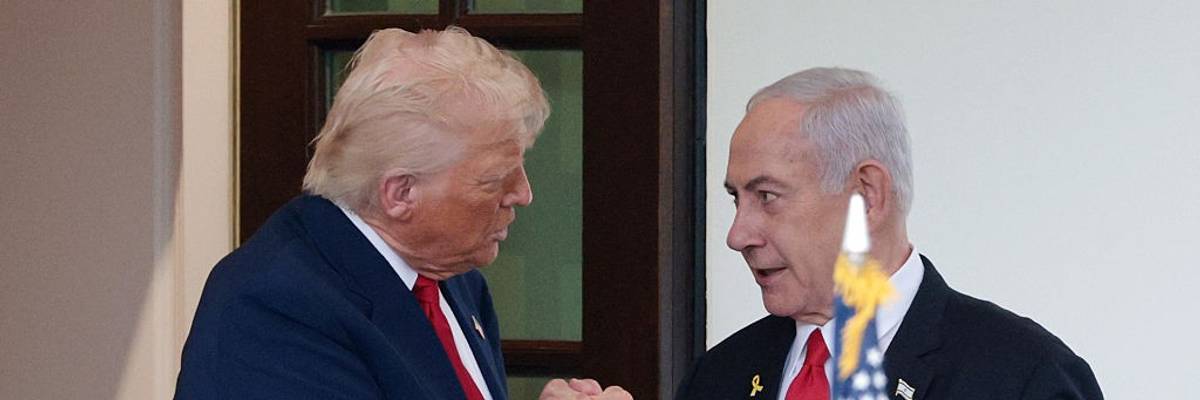
US President Donald Trump (L) bids farewell to Israeli Prime Minister Benjamin Netanyahu as he leaves the White House after a meeting on April 7, 2025 in Washington, DC.
One policy expert called the bombing "an attack on diplomacy itself" that could do long-term harm to US credibility.
Following Israel's assassination attempt against members of Hamas' negotiating team in Doha, Qatar on Tuesday, Qatari officials announced the country's mediation efforts aimed at reaching a ceasefire deal to end Israel's bombardment of Gaza would be suspended—suggesting the Israeli military is now entering "full ethnic cleansing mode," according to one academic.
The total breakdown of the ceasefire talks comes after Israel's bombing in Doha, which Israeli officials claimed responsibility for on Tuesday and said was aimed at assassinating the negotiators—but ultimately killed six people who were not involved with Hamas' team.
The Trump administration said Tuesday it had been aware of the attack before it was carried out and claimed it had warned Qatari officials—which Qatar denied.
Analysts suggested the lead-up to the bombing—with the US securing Hamas and Israeli support for a vague ceasefire proposal that was to be discussed in Doha—pointed to a scenario in which the US helped orchestrate the attack and aided "an attack on diplomacy itself," as Center for International Policy executive vice president Matt Duss said.
Duss, a former foreign policy adviser to US Sen. Bernie Sanders (I-Vt.), warned the assassination attempt could cause long-lasting harm to the United States' reputation.
"This is an attack in the capital of a major non-NATO US ally in the midst of US-supported negotiations—against officials who were originally hosted there at the United States' request," said Duss. "If it was conducted with the approval of the US, it's the latest nail in the coffin of [President Donald] Trump's claim to be a 'peacemaker.' This will have disastrous consequences for future peace efforts, and for US security."
"This collaboration is evidenced by the blatant plan to lure ceasefire negotiators into a single location under the pretense of peace talks, only to attempt to assassinate them."
The Trump administration's response to the attack was ambiguous, with press secretary Karoline Leavitt saying the bombing did not "advance Israel or America's goals" but adding that "eliminating Hamas... is a worthy goal."
The attack, said Duss, makes clear that Israeli Prime Minister Benjamin Netanyahu intends to see Israel's accelerating campaign of ethnic cleansing in Gaza through to the end," and has no intention of reaching a ceasefire deal.
Gregg Carlstrom of The Economist said that as far as countries in the Gulf region are concerned, the question of whether Trump knew about the attack ahead of time "is somewhat irrelevant."
"If yes, he approved a strike on a country under an American security guarantee," said Carlstrom. "If no, he couldn't prevent said strike. Either way, the question for Gulf leaders is the same: What is the value of American security guarantees?"
Condemnation of the attacks poured in from global leaders including United Nations Secretary General António Guterres, who said Israel's actions were "a clear violation of [Qatar's] sovereignty and territorial integrity" and accused Israeli officials of "destroying" efforts for a permanent ceasefire.
Other countries including Algeria, Jordan, and Egypt also decried the attack on Qatar's "sovereignty" and accused Israel of undermining the talks.
The peace group CodePink asserted that "the US is fully aware of Israel's intentions and actively collaborates with it" to reach the "true objective" of "the ethnic cleansing of Palestinians."
"This collaboration is evidenced by the blatant plan to lure ceasefire negotiators into a single location under the pretense of peace talks, only to attempt to assassinate them," said CodePink. "This is a complete rejection of a diplomatic solution—something Israel has no intention of reaching. This attack on foreign soil also serves as a direct challenge to Qatar, proving that neither its borders, laws, nor financial influence can deter Israeli strikes."
The assassination attempt proves, said the group, that "peace negotiations are essentially antithetical to Israel and a trap for more assassinations and attacks on sovereign nations."
"It is time world leaders take a principled stand in defense of the people of Gaza," said the group. "The more the international community fails to hold Israel accountable, the more brazen it becomes in their war crimes."
Dear Common Dreams reader, It’s been nearly 30 years since I co-founded Common Dreams with my late wife, Lina Newhouser. We had the radical notion that journalism should serve the public good, not corporate profits. It was clear to us from the outset what it would take to build such a project. No paid advertisements. No corporate sponsors. No millionaire publisher telling us what to think or do. Many people said we wouldn't last a year, but we proved those doubters wrong. Together with a tremendous team of journalists and dedicated staff, we built an independent media outlet free from the constraints of profits and corporate control. Our mission has always been simple: To inform. To inspire. To ignite change for the common good. Building Common Dreams was not easy. Our survival was never guaranteed. When you take on the most powerful forces—Wall Street greed, fossil fuel industry destruction, Big Tech lobbyists, and uber-rich oligarchs who have spent billions upon billions rigging the economy and democracy in their favor—the only bulwark you have is supporters who believe in your work. But here’s the urgent message from me today. It's never been this bad out there. And it's never been this hard to keep us going. At the very moment Common Dreams is most needed, the threats we face are intensifying. We need your support now more than ever. We don't accept corporate advertising and never will. We don't have a paywall because we don't think people should be blocked from critical news based on their ability to pay. Everything we do is funded by the donations of readers like you. When everyone does the little they can afford, we are strong. But if that support retreats or dries up, so do we. Will you donate now to make sure Common Dreams not only survives but thrives? —Craig Brown, Co-founder |
Following Israel's assassination attempt against members of Hamas' negotiating team in Doha, Qatar on Tuesday, Qatari officials announced the country's mediation efforts aimed at reaching a ceasefire deal to end Israel's bombardment of Gaza would be suspended—suggesting the Israeli military is now entering "full ethnic cleansing mode," according to one academic.
The total breakdown of the ceasefire talks comes after Israel's bombing in Doha, which Israeli officials claimed responsibility for on Tuesday and said was aimed at assassinating the negotiators—but ultimately killed six people who were not involved with Hamas' team.
The Trump administration said Tuesday it had been aware of the attack before it was carried out and claimed it had warned Qatari officials—which Qatar denied.
Analysts suggested the lead-up to the bombing—with the US securing Hamas and Israeli support for a vague ceasefire proposal that was to be discussed in Doha—pointed to a scenario in which the US helped orchestrate the attack and aided "an attack on diplomacy itself," as Center for International Policy executive vice president Matt Duss said.
Duss, a former foreign policy adviser to US Sen. Bernie Sanders (I-Vt.), warned the assassination attempt could cause long-lasting harm to the United States' reputation.
"This is an attack in the capital of a major non-NATO US ally in the midst of US-supported negotiations—against officials who were originally hosted there at the United States' request," said Duss. "If it was conducted with the approval of the US, it's the latest nail in the coffin of [President Donald] Trump's claim to be a 'peacemaker.' This will have disastrous consequences for future peace efforts, and for US security."
"This collaboration is evidenced by the blatant plan to lure ceasefire negotiators into a single location under the pretense of peace talks, only to attempt to assassinate them."
The Trump administration's response to the attack was ambiguous, with press secretary Karoline Leavitt saying the bombing did not "advance Israel or America's goals" but adding that "eliminating Hamas... is a worthy goal."
The attack, said Duss, makes clear that Israeli Prime Minister Benjamin Netanyahu intends to see Israel's accelerating campaign of ethnic cleansing in Gaza through to the end," and has no intention of reaching a ceasefire deal.
Gregg Carlstrom of The Economist said that as far as countries in the Gulf region are concerned, the question of whether Trump knew about the attack ahead of time "is somewhat irrelevant."
"If yes, he approved a strike on a country under an American security guarantee," said Carlstrom. "If no, he couldn't prevent said strike. Either way, the question for Gulf leaders is the same: What is the value of American security guarantees?"
Condemnation of the attacks poured in from global leaders including United Nations Secretary General António Guterres, who said Israel's actions were "a clear violation of [Qatar's] sovereignty and territorial integrity" and accused Israeli officials of "destroying" efforts for a permanent ceasefire.
Other countries including Algeria, Jordan, and Egypt also decried the attack on Qatar's "sovereignty" and accused Israel of undermining the talks.
The peace group CodePink asserted that "the US is fully aware of Israel's intentions and actively collaborates with it" to reach the "true objective" of "the ethnic cleansing of Palestinians."
"This collaboration is evidenced by the blatant plan to lure ceasefire negotiators into a single location under the pretense of peace talks, only to attempt to assassinate them," said CodePink. "This is a complete rejection of a diplomatic solution—something Israel has no intention of reaching. This attack on foreign soil also serves as a direct challenge to Qatar, proving that neither its borders, laws, nor financial influence can deter Israeli strikes."
The assassination attempt proves, said the group, that "peace negotiations are essentially antithetical to Israel and a trap for more assassinations and attacks on sovereign nations."
"It is time world leaders take a principled stand in defense of the people of Gaza," said the group. "The more the international community fails to hold Israel accountable, the more brazen it becomes in their war crimes."
Following Israel's assassination attempt against members of Hamas' negotiating team in Doha, Qatar on Tuesday, Qatari officials announced the country's mediation efforts aimed at reaching a ceasefire deal to end Israel's bombardment of Gaza would be suspended—suggesting the Israeli military is now entering "full ethnic cleansing mode," according to one academic.
The total breakdown of the ceasefire talks comes after Israel's bombing in Doha, which Israeli officials claimed responsibility for on Tuesday and said was aimed at assassinating the negotiators—but ultimately killed six people who were not involved with Hamas' team.
The Trump administration said Tuesday it had been aware of the attack before it was carried out and claimed it had warned Qatari officials—which Qatar denied.
Analysts suggested the lead-up to the bombing—with the US securing Hamas and Israeli support for a vague ceasefire proposal that was to be discussed in Doha—pointed to a scenario in which the US helped orchestrate the attack and aided "an attack on diplomacy itself," as Center for International Policy executive vice president Matt Duss said.
Duss, a former foreign policy adviser to US Sen. Bernie Sanders (I-Vt.), warned the assassination attempt could cause long-lasting harm to the United States' reputation.
"This is an attack in the capital of a major non-NATO US ally in the midst of US-supported negotiations—against officials who were originally hosted there at the United States' request," said Duss. "If it was conducted with the approval of the US, it's the latest nail in the coffin of [President Donald] Trump's claim to be a 'peacemaker.' This will have disastrous consequences for future peace efforts, and for US security."
"This collaboration is evidenced by the blatant plan to lure ceasefire negotiators into a single location under the pretense of peace talks, only to attempt to assassinate them."
The Trump administration's response to the attack was ambiguous, with press secretary Karoline Leavitt saying the bombing did not "advance Israel or America's goals" but adding that "eliminating Hamas... is a worthy goal."
The attack, said Duss, makes clear that Israeli Prime Minister Benjamin Netanyahu intends to see Israel's accelerating campaign of ethnic cleansing in Gaza through to the end," and has no intention of reaching a ceasefire deal.
Gregg Carlstrom of The Economist said that as far as countries in the Gulf region are concerned, the question of whether Trump knew about the attack ahead of time "is somewhat irrelevant."
"If yes, he approved a strike on a country under an American security guarantee," said Carlstrom. "If no, he couldn't prevent said strike. Either way, the question for Gulf leaders is the same: What is the value of American security guarantees?"
Condemnation of the attacks poured in from global leaders including United Nations Secretary General António Guterres, who said Israel's actions were "a clear violation of [Qatar's] sovereignty and territorial integrity" and accused Israeli officials of "destroying" efforts for a permanent ceasefire.
Other countries including Algeria, Jordan, and Egypt also decried the attack on Qatar's "sovereignty" and accused Israel of undermining the talks.
The peace group CodePink asserted that "the US is fully aware of Israel's intentions and actively collaborates with it" to reach the "true objective" of "the ethnic cleansing of Palestinians."
"This collaboration is evidenced by the blatant plan to lure ceasefire negotiators into a single location under the pretense of peace talks, only to attempt to assassinate them," said CodePink. "This is a complete rejection of a diplomatic solution—something Israel has no intention of reaching. This attack on foreign soil also serves as a direct challenge to Qatar, proving that neither its borders, laws, nor financial influence can deter Israeli strikes."
The assassination attempt proves, said the group, that "peace negotiations are essentially antithetical to Israel and a trap for more assassinations and attacks on sovereign nations."
"It is time world leaders take a principled stand in defense of the people of Gaza," said the group. "The more the international community fails to hold Israel accountable, the more brazen it becomes in their war crimes."