SUBSCRIBE TO OUR FREE NEWSLETTER
Daily news & progressive opinion—funded by the people, not the corporations—delivered straight to your inbox.
5
#000000
#FFFFFF
To donate by check, phone, or other method, see our More Ways to Give page.
Daily news & progressive opinion—funded by the people, not the corporations—delivered straight to your inbox.
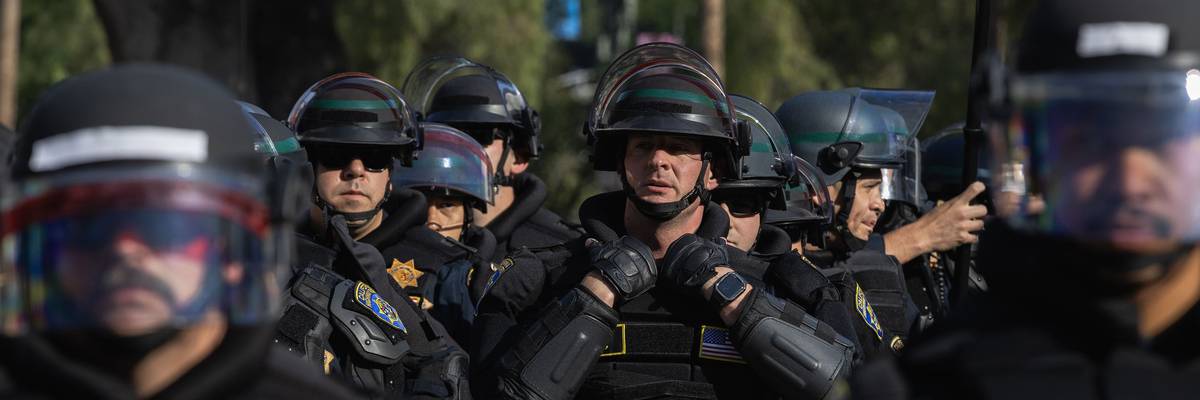
Police in riot gear block off an on-ramp that leads to the 101 freeway on June 11, 2025, in downtown Los Angeles, California.
“Our tax dollars are being weaponized against us,” said the head of the Center for International Policy.
State and local governments have spent hundreds of millions of taxpayer dollars helping cops wage “war” against their own residents under a secretive and opaque program that allows the police to purchase discounted military-style equipment from the federal government.
Over the past three decades, the obscure 1122 Program has let states and cities equip local cops with everything from armored vehicles to military grade rifles to video surveillance tech, according to a report published Thursday by Women for Weapons Trade Transparency, part of the Center for International Policy.
Using open records requests, which were necessary due to the lack of any standardized auditing or record-keeping system for the program, the group obtained over $126 million worth of purchasing data across 13 states, four cities, and two counties since the program's creation in 1994. Based on these figures, they projected the total spending across all 50 states was likely in the "upper hundreds of millions of dollars."
“The 1122 Program diverts public money from essential community needs and public goods into military-style equipment for local police,” said Rosie Khan, the co-founder of Women for Weapons Trade Transparency. “The $126.87 million spent on militarized police equipment and surveillance technology could have instead provided housing support for 10,000+ people for a year, supplied 43 million school meals, or repaired roads and bridges in dozens of communities.”
Congress created the 1122 Program at the height of the War on Drugs, authorizing it under the 1994 National Defense Authorization Act to provide police departments with equipment to carry out counter-drug operations. It was not the first program of its kind, but followed in the footsteps of the more widely known 1033 Program, which has funneled over $7 billion of excess military equipment to police departments.
But there are a few critical differences: 1033 is subject to rigorous federal record-keeping, while 1122 has no such requirement. And unlike 1033, which transfers equipment that was already purchased but not needed, 1122 allows states and cities to spend money to purchase new equipment.
The program's scope ballooned dramatically in 2009 after another NDAA added "homeland security" and "emergency response" missions to its purview. As the report explains, "no regulatory mechanisms are ensuring that equipment is used for counter-drug, homeland security, or emergency response purposes. In fact, the scope of these missions was never defined."
Increasingly, it has been used to provide police with equipment that has often been deployed against protesters, including $6.2 million for weapons, weapons training, and riot gear. Among the equipment purchased in this category was pepper spray, batons, gas masks, and riot shields.
By far, the largest expenditures under the program have been the more than $85 million spent on various armored trucks, vans, and sedans.
Police departments have spent an additional $6 million to purchase at least 16 Lenco BearCats, which cost around $300,000 apiece. These were among the military vehicles used by police to suppress the racial justice protests following the murder of George Floyd by Minneapolis police in 2020.
As recently as October 3, 2025, Immigration and Customs Enforcement (ICE) officers were documented aboard a Bearcat in full military garb and menacing protesters with sniper rifles outside the notorious immigrant detention facility in Broadview, Illinois.
In July, Los Angeles ICE agents were filmed using a vehicle to run over multiple protesters who attempted to block their path.
Another $9.6 million was spent on surveillance equipment, including license plate readers, video and audio recording devices, and subscriptions to spying software that uses sophisticated facial recognition and social media monitoring technology to track people's movements and associations.
The report highlights the increasing use of this technology by college police departments, like Northern Virginia Community College, which spent over $2.7 million on surveillance tech through 1122. College police departments have used this sort of technology to go after student protesters and activists, especially amid last year's nationwide explosion of pro-Palestine demonstrations across campuses.
At Yale, which has made "surveillance cameras, drones, and social media tracking... standard tools in the police department's arsenal," one student was apprehended last year and charged with a felony for removing an American flag from its pole using the school's surveillance system.
The report's authors call for Congress to sunset the 1122 Program and direct its funding toward "a version of public safety that prioritizes care, accountability, and community well-being rather than militarized force."
“Lawmakers, including federal and state legislators and city council representatives," it says, "must act with the urgency that this moment requires to prevent a catastrophically violent takeover of civil society by police, federal agents, and corporations profiting from exponentially increasing surveillance, criminalization, and brute force.”
They note the increasing urgency to end the program under President Donald Trump, who—on the first day of his second term—reversed an executive order from former President Joe Biden that restricted the sale of some of the most aggressive weaponry to local police forces.
“Local police have been given more avenues to arm themselves with military-style equipment during an era of heightened arrests, forced removals, and crackdowns on free speech. These disturbing political shifts have undermined the crucial work of coalitions for police accountability," the report says.
Nancy Okail, president and CEO of the Center for International Policy said: "Our tax dollars are being weaponized against us under the guise of ‘domestic terrorism.'”
"As talk of a ‘war from within’ grows louder," she says, the new report "exposes how this rhetoric fuels real assaults on democracy and civil rights.”
Dear Common Dreams reader, It’s been nearly 30 years since I co-founded Common Dreams with my late wife, Lina Newhouser. We had the radical notion that journalism should serve the public good, not corporate profits. It was clear to us from the outset what it would take to build such a project. No paid advertisements. No corporate sponsors. No millionaire publisher telling us what to think or do. Many people said we wouldn't last a year, but we proved those doubters wrong. Together with a tremendous team of journalists and dedicated staff, we built an independent media outlet free from the constraints of profits and corporate control. Our mission has always been simple: To inform. To inspire. To ignite change for the common good. Building Common Dreams was not easy. Our survival was never guaranteed. When you take on the most powerful forces—Wall Street greed, fossil fuel industry destruction, Big Tech lobbyists, and uber-rich oligarchs who have spent billions upon billions rigging the economy and democracy in their favor—the only bulwark you have is supporters who believe in your work. But here’s the urgent message from me today. It's never been this bad out there. And it's never been this hard to keep us going. At the very moment Common Dreams is most needed, the threats we face are intensifying. We need your support now more than ever. We don't accept corporate advertising and never will. We don't have a paywall because we don't think people should be blocked from critical news based on their ability to pay. Everything we do is funded by the donations of readers like you. When everyone does the little they can afford, we are strong. But if that support retreats or dries up, so do we. Will you donate now to make sure Common Dreams not only survives but thrives? —Craig Brown, Co-founder |
State and local governments have spent hundreds of millions of taxpayer dollars helping cops wage “war” against their own residents under a secretive and opaque program that allows the police to purchase discounted military-style equipment from the federal government.
Over the past three decades, the obscure 1122 Program has let states and cities equip local cops with everything from armored vehicles to military grade rifles to video surveillance tech, according to a report published Thursday by Women for Weapons Trade Transparency, part of the Center for International Policy.
Using open records requests, which were necessary due to the lack of any standardized auditing or record-keeping system for the program, the group obtained over $126 million worth of purchasing data across 13 states, four cities, and two counties since the program's creation in 1994. Based on these figures, they projected the total spending across all 50 states was likely in the "upper hundreds of millions of dollars."
“The 1122 Program diverts public money from essential community needs and public goods into military-style equipment for local police,” said Rosie Khan, the co-founder of Women for Weapons Trade Transparency. “The $126.87 million spent on militarized police equipment and surveillance technology could have instead provided housing support for 10,000+ people for a year, supplied 43 million school meals, or repaired roads and bridges in dozens of communities.”
Congress created the 1122 Program at the height of the War on Drugs, authorizing it under the 1994 National Defense Authorization Act to provide police departments with equipment to carry out counter-drug operations. It was not the first program of its kind, but followed in the footsteps of the more widely known 1033 Program, which has funneled over $7 billion of excess military equipment to police departments.
But there are a few critical differences: 1033 is subject to rigorous federal record-keeping, while 1122 has no such requirement. And unlike 1033, which transfers equipment that was already purchased but not needed, 1122 allows states and cities to spend money to purchase new equipment.
The program's scope ballooned dramatically in 2009 after another NDAA added "homeland security" and "emergency response" missions to its purview. As the report explains, "no regulatory mechanisms are ensuring that equipment is used for counter-drug, homeland security, or emergency response purposes. In fact, the scope of these missions was never defined."
Increasingly, it has been used to provide police with equipment that has often been deployed against protesters, including $6.2 million for weapons, weapons training, and riot gear. Among the equipment purchased in this category was pepper spray, batons, gas masks, and riot shields.
By far, the largest expenditures under the program have been the more than $85 million spent on various armored trucks, vans, and sedans.
Police departments have spent an additional $6 million to purchase at least 16 Lenco BearCats, which cost around $300,000 apiece. These were among the military vehicles used by police to suppress the racial justice protests following the murder of George Floyd by Minneapolis police in 2020.
As recently as October 3, 2025, Immigration and Customs Enforcement (ICE) officers were documented aboard a Bearcat in full military garb and menacing protesters with sniper rifles outside the notorious immigrant detention facility in Broadview, Illinois.
In July, Los Angeles ICE agents were filmed using a vehicle to run over multiple protesters who attempted to block their path.
Another $9.6 million was spent on surveillance equipment, including license plate readers, video and audio recording devices, and subscriptions to spying software that uses sophisticated facial recognition and social media monitoring technology to track people's movements and associations.
The report highlights the increasing use of this technology by college police departments, like Northern Virginia Community College, which spent over $2.7 million on surveillance tech through 1122. College police departments have used this sort of technology to go after student protesters and activists, especially amid last year's nationwide explosion of pro-Palestine demonstrations across campuses.
At Yale, which has made "surveillance cameras, drones, and social media tracking... standard tools in the police department's arsenal," one student was apprehended last year and charged with a felony for removing an American flag from its pole using the school's surveillance system.
The report's authors call for Congress to sunset the 1122 Program and direct its funding toward "a version of public safety that prioritizes care, accountability, and community well-being rather than militarized force."
“Lawmakers, including federal and state legislators and city council representatives," it says, "must act with the urgency that this moment requires to prevent a catastrophically violent takeover of civil society by police, federal agents, and corporations profiting from exponentially increasing surveillance, criminalization, and brute force.”
They note the increasing urgency to end the program under President Donald Trump, who—on the first day of his second term—reversed an executive order from former President Joe Biden that restricted the sale of some of the most aggressive weaponry to local police forces.
“Local police have been given more avenues to arm themselves with military-style equipment during an era of heightened arrests, forced removals, and crackdowns on free speech. These disturbing political shifts have undermined the crucial work of coalitions for police accountability," the report says.
Nancy Okail, president and CEO of the Center for International Policy said: "Our tax dollars are being weaponized against us under the guise of ‘domestic terrorism.'”
"As talk of a ‘war from within’ grows louder," she says, the new report "exposes how this rhetoric fuels real assaults on democracy and civil rights.”
State and local governments have spent hundreds of millions of taxpayer dollars helping cops wage “war” against their own residents under a secretive and opaque program that allows the police to purchase discounted military-style equipment from the federal government.
Over the past three decades, the obscure 1122 Program has let states and cities equip local cops with everything from armored vehicles to military grade rifles to video surveillance tech, according to a report published Thursday by Women for Weapons Trade Transparency, part of the Center for International Policy.
Using open records requests, which were necessary due to the lack of any standardized auditing or record-keeping system for the program, the group obtained over $126 million worth of purchasing data across 13 states, four cities, and two counties since the program's creation in 1994. Based on these figures, they projected the total spending across all 50 states was likely in the "upper hundreds of millions of dollars."
“The 1122 Program diverts public money from essential community needs and public goods into military-style equipment for local police,” said Rosie Khan, the co-founder of Women for Weapons Trade Transparency. “The $126.87 million spent on militarized police equipment and surveillance technology could have instead provided housing support for 10,000+ people for a year, supplied 43 million school meals, or repaired roads and bridges in dozens of communities.”
Congress created the 1122 Program at the height of the War on Drugs, authorizing it under the 1994 National Defense Authorization Act to provide police departments with equipment to carry out counter-drug operations. It was not the first program of its kind, but followed in the footsteps of the more widely known 1033 Program, which has funneled over $7 billion of excess military equipment to police departments.
But there are a few critical differences: 1033 is subject to rigorous federal record-keeping, while 1122 has no such requirement. And unlike 1033, which transfers equipment that was already purchased but not needed, 1122 allows states and cities to spend money to purchase new equipment.
The program's scope ballooned dramatically in 2009 after another NDAA added "homeland security" and "emergency response" missions to its purview. As the report explains, "no regulatory mechanisms are ensuring that equipment is used for counter-drug, homeland security, or emergency response purposes. In fact, the scope of these missions was never defined."
Increasingly, it has been used to provide police with equipment that has often been deployed against protesters, including $6.2 million for weapons, weapons training, and riot gear. Among the equipment purchased in this category was pepper spray, batons, gas masks, and riot shields.
By far, the largest expenditures under the program have been the more than $85 million spent on various armored trucks, vans, and sedans.
Police departments have spent an additional $6 million to purchase at least 16 Lenco BearCats, which cost around $300,000 apiece. These were among the military vehicles used by police to suppress the racial justice protests following the murder of George Floyd by Minneapolis police in 2020.
As recently as October 3, 2025, Immigration and Customs Enforcement (ICE) officers were documented aboard a Bearcat in full military garb and menacing protesters with sniper rifles outside the notorious immigrant detention facility in Broadview, Illinois.
In July, Los Angeles ICE agents were filmed using a vehicle to run over multiple protesters who attempted to block their path.
Another $9.6 million was spent on surveillance equipment, including license plate readers, video and audio recording devices, and subscriptions to spying software that uses sophisticated facial recognition and social media monitoring technology to track people's movements and associations.
The report highlights the increasing use of this technology by college police departments, like Northern Virginia Community College, which spent over $2.7 million on surveillance tech through 1122. College police departments have used this sort of technology to go after student protesters and activists, especially amid last year's nationwide explosion of pro-Palestine demonstrations across campuses.
At Yale, which has made "surveillance cameras, drones, and social media tracking... standard tools in the police department's arsenal," one student was apprehended last year and charged with a felony for removing an American flag from its pole using the school's surveillance system.
The report's authors call for Congress to sunset the 1122 Program and direct its funding toward "a version of public safety that prioritizes care, accountability, and community well-being rather than militarized force."
“Lawmakers, including federal and state legislators and city council representatives," it says, "must act with the urgency that this moment requires to prevent a catastrophically violent takeover of civil society by police, federal agents, and corporations profiting from exponentially increasing surveillance, criminalization, and brute force.”
They note the increasing urgency to end the program under President Donald Trump, who—on the first day of his second term—reversed an executive order from former President Joe Biden that restricted the sale of some of the most aggressive weaponry to local police forces.
“Local police have been given more avenues to arm themselves with military-style equipment during an era of heightened arrests, forced removals, and crackdowns on free speech. These disturbing political shifts have undermined the crucial work of coalitions for police accountability," the report says.
Nancy Okail, president and CEO of the Center for International Policy said: "Our tax dollars are being weaponized against us under the guise of ‘domestic terrorism.'”
"As talk of a ‘war from within’ grows louder," she says, the new report "exposes how this rhetoric fuels real assaults on democracy and civil rights.”