SUBSCRIBE TO OUR FREE NEWSLETTER
Daily news & progressive opinion—funded by the people, not the corporations—delivered straight to your inbox.
5
#000000
#FFFFFF
To donate by check, phone, or other method, see our More Ways to Give page.
Daily news & progressive opinion—funded by the people, not the corporations—delivered straight to your inbox.
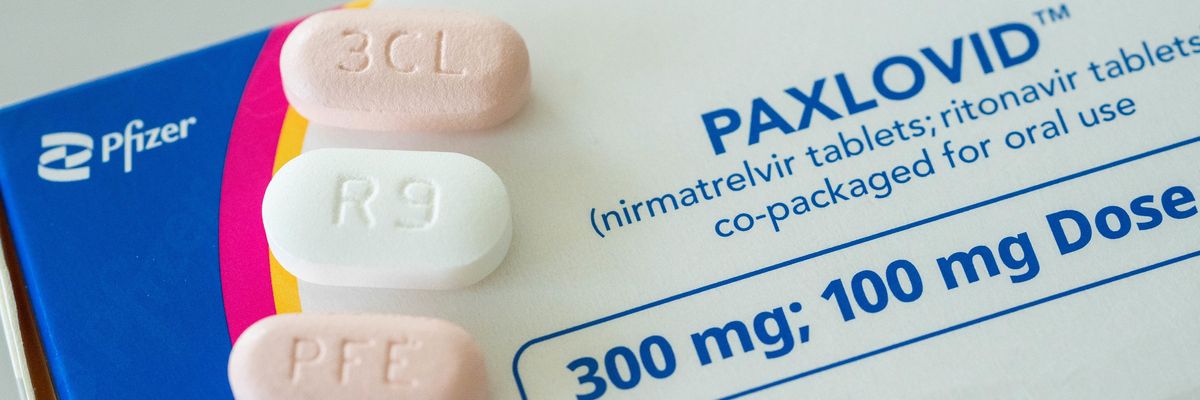
A three-pill dose of Pfizer's Paxlovid treatment for Covid-19 sits atop a box of the drug on May 25, 2023.
"Pfizer treats Paxlovid like a Prada handbag; a luxury for the few rather than a treatment for the many," said one consumer advocate.
U.S. consumer watchdog Public Citizen on Thursday excoriated Pfizer after the pharmaceutical giant announced it would more than double the price of a lifesaving Covid-19 treatment, which will soon sell for an estimated 100 times the cost of production.
Pfizer said Wednesday that it will price its patented Covid treatment nirmatrelvir-ritonavir—sold under the brand name Paxlovid—at $1,390 for a five-day course. Researchers Melissa J. Barber and Dzintars Gotham recently estimated it costs Pfizer $13 to produce five days' worth of the drug, which is taken in three-pill doses.
"Pfizer's new price is an estimated 100 times the cost of production," Peter Maybarduk, director of Public Citizen's Access to Medicines program, said in a statement.
"Pfizer chose to double its U.S. price just as pandemic funding falters and the precarious winter viral season begins."
It's also more than 2.5 times the federal government's purchase price for Paxlovid. The government has bought and distributed the antiviral drug to the public free of charge since December 2021, when the U.S. Food and Drug Administration approved the treatment. Starting next year, Pfizer will sell Paxlovid directly to health insurance companies.
"Pfizer has made tens of billions in Paxlovid sales, largely through major government purchases," Maybarduk noted. "Pfizer could choose now to support the fight against Covid and ease treatment access by lowering its already inflated prices."
"Instead, Pfizer chose to double its U.S. price just as pandemic funding falters and the precarious winter viral season begins," he continued. "This will strain health budgets and contribute to further treatment rationing."
"Pfizer treats Paxlovid like a Prada handbag; a luxury for the few rather than a treatment for the many," Maybarduk added. "For shame."
Medical professionals and patient advocates have voiced concerns that increasing the price of Paxlovid could leave at-risk people without access to the lifesaving drug, which is proven to reduce the risk of death or severe illness from Covid-19 for patients with weakened immune systems or ailments like diabetes and heart conditions.
News of the Paxlovid price hike came a day after Public Citizen and the Health Global Access Project (Health GAP) published an analysis revealing that more than 8 million people with high-risk Covid-19 infections in low- and middle-income nations could not access the drug last year, leaving over 90% of the need for the treatment unmet.
"At a minimum, 10 times more people needed Paxlovid than had any chance to receive it in developing countries, and that almost certainly significantly understates the problem," Maybarduk said on Tuesday.
In addition to Paxlovid, Pfizer manufactures one of the two available mRNA vaccines for Covid-19. The company reported $56 billion in sales of its Covid-19 vaccine and Paxlovid last year. However, projecting a sales slump in 2023, Pfizer late last year announced a plan to significantly hike the price of its publicly funded Covid-19 shot.
Pfizer reported profits of $31.4 billion in 2022, a 43% increase over the previous year. Pfizer CEO Albert Bourla took home $33 million in compensation last year, a 36% raise from 2021.
Dear Common Dreams reader, It’s been nearly 30 years since I co-founded Common Dreams with my late wife, Lina Newhouser. We had the radical notion that journalism should serve the public good, not corporate profits. It was clear to us from the outset what it would take to build such a project. No paid advertisements. No corporate sponsors. No millionaire publisher telling us what to think or do. Many people said we wouldn't last a year, but we proved those doubters wrong. Together with a tremendous team of journalists and dedicated staff, we built an independent media outlet free from the constraints of profits and corporate control. Our mission has always been simple: To inform. To inspire. To ignite change for the common good. Building Common Dreams was not easy. Our survival was never guaranteed. When you take on the most powerful forces—Wall Street greed, fossil fuel industry destruction, Big Tech lobbyists, and uber-rich oligarchs who have spent billions upon billions rigging the economy and democracy in their favor—the only bulwark you have is supporters who believe in your work. But here’s the urgent message from me today. It's never been this bad out there. And it's never been this hard to keep us going. At the very moment Common Dreams is most needed, the threats we face are intensifying. We need your support now more than ever. We don't accept corporate advertising and never will. We don't have a paywall because we don't think people should be blocked from critical news based on their ability to pay. Everything we do is funded by the donations of readers like you. When everyone does the little they can afford, we are strong. But if that support retreats or dries up, so do we. Will you donate now to make sure Common Dreams not only survives but thrives? —Craig Brown, Co-founder |
U.S. consumer watchdog Public Citizen on Thursday excoriated Pfizer after the pharmaceutical giant announced it would more than double the price of a lifesaving Covid-19 treatment, which will soon sell for an estimated 100 times the cost of production.
Pfizer said Wednesday that it will price its patented Covid treatment nirmatrelvir-ritonavir—sold under the brand name Paxlovid—at $1,390 for a five-day course. Researchers Melissa J. Barber and Dzintars Gotham recently estimated it costs Pfizer $13 to produce five days' worth of the drug, which is taken in three-pill doses.
"Pfizer's new price is an estimated 100 times the cost of production," Peter Maybarduk, director of Public Citizen's Access to Medicines program, said in a statement.
"Pfizer chose to double its U.S. price just as pandemic funding falters and the precarious winter viral season begins."
It's also more than 2.5 times the federal government's purchase price for Paxlovid. The government has bought and distributed the antiviral drug to the public free of charge since December 2021, when the U.S. Food and Drug Administration approved the treatment. Starting next year, Pfizer will sell Paxlovid directly to health insurance companies.
"Pfizer has made tens of billions in Paxlovid sales, largely through major government purchases," Maybarduk noted. "Pfizer could choose now to support the fight against Covid and ease treatment access by lowering its already inflated prices."
"Instead, Pfizer chose to double its U.S. price just as pandemic funding falters and the precarious winter viral season begins," he continued. "This will strain health budgets and contribute to further treatment rationing."
"Pfizer treats Paxlovid like a Prada handbag; a luxury for the few rather than a treatment for the many," Maybarduk added. "For shame."
Medical professionals and patient advocates have voiced concerns that increasing the price of Paxlovid could leave at-risk people without access to the lifesaving drug, which is proven to reduce the risk of death or severe illness from Covid-19 for patients with weakened immune systems or ailments like diabetes and heart conditions.
News of the Paxlovid price hike came a day after Public Citizen and the Health Global Access Project (Health GAP) published an analysis revealing that more than 8 million people with high-risk Covid-19 infections in low- and middle-income nations could not access the drug last year, leaving over 90% of the need for the treatment unmet.
"At a minimum, 10 times more people needed Paxlovid than had any chance to receive it in developing countries, and that almost certainly significantly understates the problem," Maybarduk said on Tuesday.
In addition to Paxlovid, Pfizer manufactures one of the two available mRNA vaccines for Covid-19. The company reported $56 billion in sales of its Covid-19 vaccine and Paxlovid last year. However, projecting a sales slump in 2023, Pfizer late last year announced a plan to significantly hike the price of its publicly funded Covid-19 shot.
Pfizer reported profits of $31.4 billion in 2022, a 43% increase over the previous year. Pfizer CEO Albert Bourla took home $33 million in compensation last year, a 36% raise from 2021.
U.S. consumer watchdog Public Citizen on Thursday excoriated Pfizer after the pharmaceutical giant announced it would more than double the price of a lifesaving Covid-19 treatment, which will soon sell for an estimated 100 times the cost of production.
Pfizer said Wednesday that it will price its patented Covid treatment nirmatrelvir-ritonavir—sold under the brand name Paxlovid—at $1,390 for a five-day course. Researchers Melissa J. Barber and Dzintars Gotham recently estimated it costs Pfizer $13 to produce five days' worth of the drug, which is taken in three-pill doses.
"Pfizer's new price is an estimated 100 times the cost of production," Peter Maybarduk, director of Public Citizen's Access to Medicines program, said in a statement.
"Pfizer chose to double its U.S. price just as pandemic funding falters and the precarious winter viral season begins."
It's also more than 2.5 times the federal government's purchase price for Paxlovid. The government has bought and distributed the antiviral drug to the public free of charge since December 2021, when the U.S. Food and Drug Administration approved the treatment. Starting next year, Pfizer will sell Paxlovid directly to health insurance companies.
"Pfizer has made tens of billions in Paxlovid sales, largely through major government purchases," Maybarduk noted. "Pfizer could choose now to support the fight against Covid and ease treatment access by lowering its already inflated prices."
"Instead, Pfizer chose to double its U.S. price just as pandemic funding falters and the precarious winter viral season begins," he continued. "This will strain health budgets and contribute to further treatment rationing."
"Pfizer treats Paxlovid like a Prada handbag; a luxury for the few rather than a treatment for the many," Maybarduk added. "For shame."
Medical professionals and patient advocates have voiced concerns that increasing the price of Paxlovid could leave at-risk people without access to the lifesaving drug, which is proven to reduce the risk of death or severe illness from Covid-19 for patients with weakened immune systems or ailments like diabetes and heart conditions.
News of the Paxlovid price hike came a day after Public Citizen and the Health Global Access Project (Health GAP) published an analysis revealing that more than 8 million people with high-risk Covid-19 infections in low- and middle-income nations could not access the drug last year, leaving over 90% of the need for the treatment unmet.
"At a minimum, 10 times more people needed Paxlovid than had any chance to receive it in developing countries, and that almost certainly significantly understates the problem," Maybarduk said on Tuesday.
In addition to Paxlovid, Pfizer manufactures one of the two available mRNA vaccines for Covid-19. The company reported $56 billion in sales of its Covid-19 vaccine and Paxlovid last year. However, projecting a sales slump in 2023, Pfizer late last year announced a plan to significantly hike the price of its publicly funded Covid-19 shot.
Pfizer reported profits of $31.4 billion in 2022, a 43% increase over the previous year. Pfizer CEO Albert Bourla took home $33 million in compensation last year, a 36% raise from 2021.