SUBSCRIBE TO OUR FREE NEWSLETTER
Daily news & progressive opinion—funded by the people, not the corporations—delivered straight to your inbox.
5
#000000
#FFFFFF
To donate by check, phone, or other method, see our More Ways to Give page.
Daily news & progressive opinion—funded by the people, not the corporations—delivered straight to your inbox.
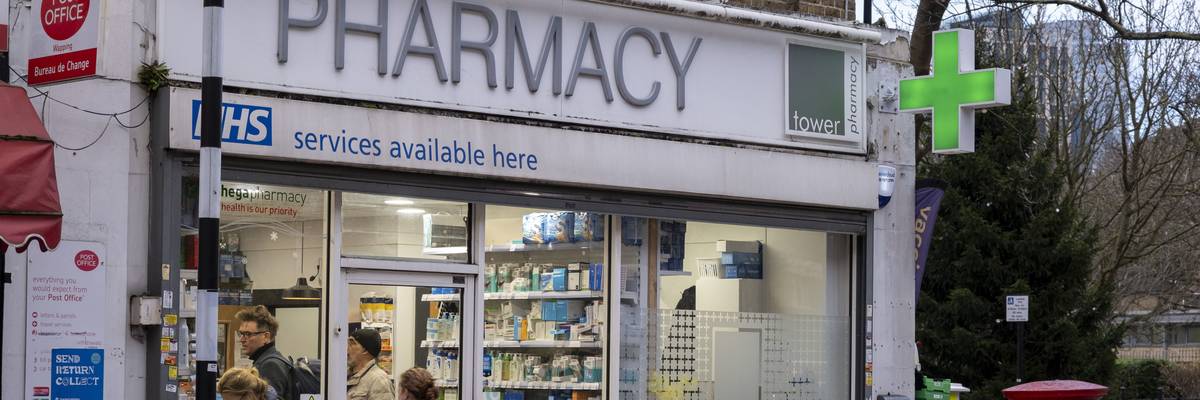
National Health Service pharmacy on Wapping Lane on December, 2 2024 in London, United Kingdom.
One British lawmaker condemned the agreement as "a Trump shakedown of the NHS."
The government of British Prime Minister Keir Starmer faced swift backlash on Monday after the Trump administration announced a deal under which the United Kingdom's prized National Health Service would pay higher prices for new medicines in exchange for tariff exemptions.
The agreement in principle, outlined in a statement by the Office of the United States Trade Representative, was seen by UK lawmakers and advocacy groups as a gross capitulation to US President Donald Trump and the pharmaceutical industry that would harm the NHS and British patients for years to come.
"Giving in to Big Pharma’s demands to hike the price of medicines spells disaster for our NHS, and for the lives of ordinary people," said Global Justice Now, a UK-based group. "We are being held to ransom. Our government must stand up to Big Pharma and for our NHS by reversing course."
Under the three-year deal, the NHS would boost the net price it pays for new pharmaceutical drugs, many of which emerge from the US, by 25%—a change that's expected to cost British taxpayers roughly £3 billion. In return, Trump has agreed not to impose tariffs on UK pharmaceuticals.
Helen Morgan, the Liberal Democrat MP for North Shropshire, denounced the new agreement as "a Trump shakedown of the NHS." As evidence, she pointed to US Health and Human Services Secretary Robert F. Kennedy Jr.'s celebration of the bilateral deal.
"It cannot go ahead," said Morgan. "RFK Jr. has put it in black and white: Trump demanded these pay rises to put Americans first, and our government rolled over. Patients stuck on crammed hospital corridors, or unable to get an ambulance, won’t forget it."
"The British people didn’t vote for this," Morgan added. "The government must put this agreement to a vote in parliament.”
Andrew Hill, a visiting health economics researcher at the University of Liverpool, similarly criticized the deal.
“The UK hasn’t benefited from this at all, but we’re having to pay all this extra money," said Hill. "More money spent on drugs means less money spent on ambulances, doctors, nurses, simple health interventions."
In addition to facing the threat of Trump tariffs, the UK government was under pressure from the powerful pharmaceutical industry to jack up NHS drug spending. The Guardian reported in September that "big pharmaceutical companies have ditched or paused nearly £2 billion in planned UK investments so far this year" as the firms "accused the government of not spending enough on new medicines."
Survey data released just ahead of Monday's deal announcement shows that 64% of the British public is opposed to the NHS paying higher prices for medicines.
"This is a betrayal of NHS patients," said Diarmaid McDonald, executive director of the advocacy group Just Treatment. "Big Pharma have got what they want. Donald Trump has got what he wants. In the face of their coordinated threats, the government has folded and thousands of patients will pay for this with their lives, as precious funds get stripped from other parts of the health service to line the pockets of rich pharmaceutical execs."
"MPs need to urgently hold the government to account," McDonald added, "and demand they publish the evidence showing the impact of this catastrophic move.”
"This outrageous giveaway to Big Pharma does nothing to lower prices in the United States. It only hurts UK patients."
Asked at a Monday press briefing if the deal would actually benefit US patients and consumers, as the Trump administration has claimed, or if the alleged revenue generated by the agreement would just be "sucked up" by the drug companies, White House Press Secretary Karoline Leavitt did not have an immediate answer.
"I'm going to be honest with you, Ed," Leavitt told the reporter: "I'll get you an answer to that question after the briefing."
Peter Maybarduk, Public Citizen’s Access to Medicines director, argued in a statement that the agreement wouldn't help Americans or Britons.
" Drug prices are far too high everywhere, including in the UK, backed by patent monopolies and contributing to rationing and preventable suffering," said Maybarduk. "This outrageous giveaway to Big Pharma does nothing to lower prices in the United States. It only hurts UK patients while distracting from the serious action needed at home to hold Pharma accountable and make medicine affordable and available for all.”
Dear Common Dreams reader, It’s been nearly 30 years since I co-founded Common Dreams with my late wife, Lina Newhouser. We had the radical notion that journalism should serve the public good, not corporate profits. It was clear to us from the outset what it would take to build such a project. No paid advertisements. No corporate sponsors. No millionaire publisher telling us what to think or do. Many people said we wouldn't last a year, but we proved those doubters wrong. Together with a tremendous team of journalists and dedicated staff, we built an independent media outlet free from the constraints of profits and corporate control. Our mission has always been simple: To inform. To inspire. To ignite change for the common good. Building Common Dreams was not easy. Our survival was never guaranteed. When you take on the most powerful forces—Wall Street greed, fossil fuel industry destruction, Big Tech lobbyists, and uber-rich oligarchs who have spent billions upon billions rigging the economy and democracy in their favor—the only bulwark you have is supporters who believe in your work. But here’s the urgent message from me today. It's never been this bad out there. And it's never been this hard to keep us going. At the very moment Common Dreams is most needed, the threats we face are intensifying. We need your support now more than ever. We don't accept corporate advertising and never will. We don't have a paywall because we don't think people should be blocked from critical news based on their ability to pay. Everything we do is funded by the donations of readers like you. When everyone does the little they can afford, we are strong. But if that support retreats or dries up, so do we. Will you donate now to make sure Common Dreams not only survives but thrives? —Craig Brown, Co-founder |
The government of British Prime Minister Keir Starmer faced swift backlash on Monday after the Trump administration announced a deal under which the United Kingdom's prized National Health Service would pay higher prices for new medicines in exchange for tariff exemptions.
The agreement in principle, outlined in a statement by the Office of the United States Trade Representative, was seen by UK lawmakers and advocacy groups as a gross capitulation to US President Donald Trump and the pharmaceutical industry that would harm the NHS and British patients for years to come.
"Giving in to Big Pharma’s demands to hike the price of medicines spells disaster for our NHS, and for the lives of ordinary people," said Global Justice Now, a UK-based group. "We are being held to ransom. Our government must stand up to Big Pharma and for our NHS by reversing course."
Under the three-year deal, the NHS would boost the net price it pays for new pharmaceutical drugs, many of which emerge from the US, by 25%—a change that's expected to cost British taxpayers roughly £3 billion. In return, Trump has agreed not to impose tariffs on UK pharmaceuticals.
Helen Morgan, the Liberal Democrat MP for North Shropshire, denounced the new agreement as "a Trump shakedown of the NHS." As evidence, she pointed to US Health and Human Services Secretary Robert F. Kennedy Jr.'s celebration of the bilateral deal.
"It cannot go ahead," said Morgan. "RFK Jr. has put it in black and white: Trump demanded these pay rises to put Americans first, and our government rolled over. Patients stuck on crammed hospital corridors, or unable to get an ambulance, won’t forget it."
"The British people didn’t vote for this," Morgan added. "The government must put this agreement to a vote in parliament.”
Andrew Hill, a visiting health economics researcher at the University of Liverpool, similarly criticized the deal.
“The UK hasn’t benefited from this at all, but we’re having to pay all this extra money," said Hill. "More money spent on drugs means less money spent on ambulances, doctors, nurses, simple health interventions."
In addition to facing the threat of Trump tariffs, the UK government was under pressure from the powerful pharmaceutical industry to jack up NHS drug spending. The Guardian reported in September that "big pharmaceutical companies have ditched or paused nearly £2 billion in planned UK investments so far this year" as the firms "accused the government of not spending enough on new medicines."
Survey data released just ahead of Monday's deal announcement shows that 64% of the British public is opposed to the NHS paying higher prices for medicines.
"This is a betrayal of NHS patients," said Diarmaid McDonald, executive director of the advocacy group Just Treatment. "Big Pharma have got what they want. Donald Trump has got what he wants. In the face of their coordinated threats, the government has folded and thousands of patients will pay for this with their lives, as precious funds get stripped from other parts of the health service to line the pockets of rich pharmaceutical execs."
"MPs need to urgently hold the government to account," McDonald added, "and demand they publish the evidence showing the impact of this catastrophic move.”
"This outrageous giveaway to Big Pharma does nothing to lower prices in the United States. It only hurts UK patients."
Asked at a Monday press briefing if the deal would actually benefit US patients and consumers, as the Trump administration has claimed, or if the alleged revenue generated by the agreement would just be "sucked up" by the drug companies, White House Press Secretary Karoline Leavitt did not have an immediate answer.
"I'm going to be honest with you, Ed," Leavitt told the reporter: "I'll get you an answer to that question after the briefing."
Peter Maybarduk, Public Citizen’s Access to Medicines director, argued in a statement that the agreement wouldn't help Americans or Britons.
" Drug prices are far too high everywhere, including in the UK, backed by patent monopolies and contributing to rationing and preventable suffering," said Maybarduk. "This outrageous giveaway to Big Pharma does nothing to lower prices in the United States. It only hurts UK patients while distracting from the serious action needed at home to hold Pharma accountable and make medicine affordable and available for all.”
The government of British Prime Minister Keir Starmer faced swift backlash on Monday after the Trump administration announced a deal under which the United Kingdom's prized National Health Service would pay higher prices for new medicines in exchange for tariff exemptions.
The agreement in principle, outlined in a statement by the Office of the United States Trade Representative, was seen by UK lawmakers and advocacy groups as a gross capitulation to US President Donald Trump and the pharmaceutical industry that would harm the NHS and British patients for years to come.
"Giving in to Big Pharma’s demands to hike the price of medicines spells disaster for our NHS, and for the lives of ordinary people," said Global Justice Now, a UK-based group. "We are being held to ransom. Our government must stand up to Big Pharma and for our NHS by reversing course."
Under the three-year deal, the NHS would boost the net price it pays for new pharmaceutical drugs, many of which emerge from the US, by 25%—a change that's expected to cost British taxpayers roughly £3 billion. In return, Trump has agreed not to impose tariffs on UK pharmaceuticals.
Helen Morgan, the Liberal Democrat MP for North Shropshire, denounced the new agreement as "a Trump shakedown of the NHS." As evidence, she pointed to US Health and Human Services Secretary Robert F. Kennedy Jr.'s celebration of the bilateral deal.
"It cannot go ahead," said Morgan. "RFK Jr. has put it in black and white: Trump demanded these pay rises to put Americans first, and our government rolled over. Patients stuck on crammed hospital corridors, or unable to get an ambulance, won’t forget it."
"The British people didn’t vote for this," Morgan added. "The government must put this agreement to a vote in parliament.”
Andrew Hill, a visiting health economics researcher at the University of Liverpool, similarly criticized the deal.
“The UK hasn’t benefited from this at all, but we’re having to pay all this extra money," said Hill. "More money spent on drugs means less money spent on ambulances, doctors, nurses, simple health interventions."
In addition to facing the threat of Trump tariffs, the UK government was under pressure from the powerful pharmaceutical industry to jack up NHS drug spending. The Guardian reported in September that "big pharmaceutical companies have ditched or paused nearly £2 billion in planned UK investments so far this year" as the firms "accused the government of not spending enough on new medicines."
Survey data released just ahead of Monday's deal announcement shows that 64% of the British public is opposed to the NHS paying higher prices for medicines.
"This is a betrayal of NHS patients," said Diarmaid McDonald, executive director of the advocacy group Just Treatment. "Big Pharma have got what they want. Donald Trump has got what he wants. In the face of their coordinated threats, the government has folded and thousands of patients will pay for this with their lives, as precious funds get stripped from other parts of the health service to line the pockets of rich pharmaceutical execs."
"MPs need to urgently hold the government to account," McDonald added, "and demand they publish the evidence showing the impact of this catastrophic move.”
"This outrageous giveaway to Big Pharma does nothing to lower prices in the United States. It only hurts UK patients."
Asked at a Monday press briefing if the deal would actually benefit US patients and consumers, as the Trump administration has claimed, or if the alleged revenue generated by the agreement would just be "sucked up" by the drug companies, White House Press Secretary Karoline Leavitt did not have an immediate answer.
"I'm going to be honest with you, Ed," Leavitt told the reporter: "I'll get you an answer to that question after the briefing."
Peter Maybarduk, Public Citizen’s Access to Medicines director, argued in a statement that the agreement wouldn't help Americans or Britons.
" Drug prices are far too high everywhere, including in the UK, backed by patent monopolies and contributing to rationing and preventable suffering," said Maybarduk. "This outrageous giveaway to Big Pharma does nothing to lower prices in the United States. It only hurts UK patients while distracting from the serious action needed at home to hold Pharma accountable and make medicine affordable and available for all.”