SUBSCRIBE TO OUR FREE NEWSLETTER
Daily news & progressive opinion—funded by the people, not the corporations—delivered straight to your inbox.
5
#000000
#FFFFFF
To donate by check, phone, or other method, see our More Ways to Give page.
Daily news & progressive opinion—funded by the people, not the corporations—delivered straight to your inbox.
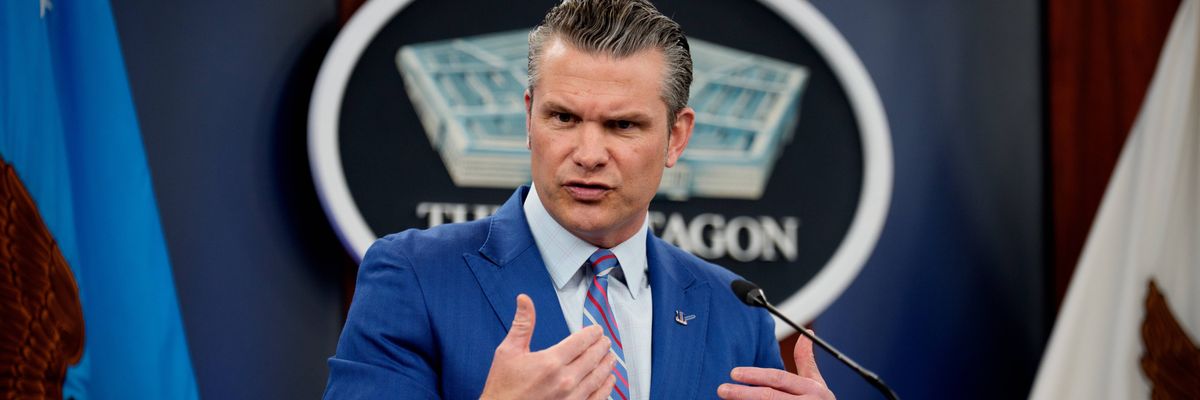
US Defense Secretary Pete Hegseth speaks during a news conference on June 26, 2025 in Arlington, Virginia.
"Congress cannot continue funneling hundreds of billions of dollars to a completely unaccountable agency while American families can’t afford food or healthcare," said one House Democrat.
Two days after the US Senate voted on a bipartisan basis to authorize just over $900 billion in military spending for the coming fiscal year, the chief recipient of that taxpayer money—the Department of Defense—announced it failed an audit of its books for the eighth consecutive year.
The now-predictable audit result was announced Friday by the Pentagon's Office of Inspector General (OIG) after an examination of the agency's roughly $4.6 trillion in assets. The OIG said it identified 26 "material weaknesses"—major flaws in internal controls over financial reports—in the Pentagon's accounting.
Auditors also uncovered "five instances of noncompliance with laws, regulations, contracts, and grant agreements," OIG said.
The Military Times reported that "among the shortcomings were omissions in the Joint Strike Fighter Program, the Pentagon’s multifaceted effort to develop an affordable strike aircraft for the Air Force, Marine Corps, Navy, and allied nations."
"Auditors determined the Pentagon failed to report assets in the program’s Global Spares Pool, and did not accurately record the property," the outlet noted.
Jules W. Hurst III, the Pentagon's chief financial officer, said in response to the findings that the department is "committed to resolving its critical issues and achieving an unmodified audit opinion by 2028.
The Pentagon remains the only US federal agency that has yet to pass an independent, department-wide audit, as required by law. But its repeated failures to return a clean audit haven't deterred Congress from adding to its coffers each year.
With the passage of the 2026 National Defense Authorization Act (NDAA), which President Donald Trump signed into law last week, Congress has backed over $1 trillion in military spending this year.
"Congress cannot continue funneling hundreds of billions of dollars to a completely unaccountable agency while American families can’t afford food or healthcare," said Rep. Pramila Jayapal (D-Wash.), who voted against the NDAA.
Dear Common Dreams reader, It’s been nearly 30 years since I co-founded Common Dreams with my late wife, Lina Newhouser. We had the radical notion that journalism should serve the public good, not corporate profits. It was clear to us from the outset what it would take to build such a project. No paid advertisements. No corporate sponsors. No millionaire publisher telling us what to think or do. Many people said we wouldn't last a year, but we proved those doubters wrong. Together with a tremendous team of journalists and dedicated staff, we built an independent media outlet free from the constraints of profits and corporate control. Our mission has always been simple: To inform. To inspire. To ignite change for the common good. Building Common Dreams was not easy. Our survival was never guaranteed. When you take on the most powerful forces—Wall Street greed, fossil fuel industry destruction, Big Tech lobbyists, and uber-rich oligarchs who have spent billions upon billions rigging the economy and democracy in their favor—the only bulwark you have is supporters who believe in your work. But here’s the urgent message from me today. It's never been this bad out there. And it's never been this hard to keep us going. At the very moment Common Dreams is most needed, the threats we face are intensifying. We need your support now more than ever. We don't accept corporate advertising and never will. We don't have a paywall because we don't think people should be blocked from critical news based on their ability to pay. Everything we do is funded by the donations of readers like you. When everyone does the little they can afford, we are strong. But if that support retreats or dries up, so do we. Will you donate now to make sure Common Dreams not only survives but thrives? —Craig Brown, Co-founder |
Two days after the US Senate voted on a bipartisan basis to authorize just over $900 billion in military spending for the coming fiscal year, the chief recipient of that taxpayer money—the Department of Defense—announced it failed an audit of its books for the eighth consecutive year.
The now-predictable audit result was announced Friday by the Pentagon's Office of Inspector General (OIG) after an examination of the agency's roughly $4.6 trillion in assets. The OIG said it identified 26 "material weaknesses"—major flaws in internal controls over financial reports—in the Pentagon's accounting.
Auditors also uncovered "five instances of noncompliance with laws, regulations, contracts, and grant agreements," OIG said.
The Military Times reported that "among the shortcomings were omissions in the Joint Strike Fighter Program, the Pentagon’s multifaceted effort to develop an affordable strike aircraft for the Air Force, Marine Corps, Navy, and allied nations."
"Auditors determined the Pentagon failed to report assets in the program’s Global Spares Pool, and did not accurately record the property," the outlet noted.
Jules W. Hurst III, the Pentagon's chief financial officer, said in response to the findings that the department is "committed to resolving its critical issues and achieving an unmodified audit opinion by 2028.
The Pentagon remains the only US federal agency that has yet to pass an independent, department-wide audit, as required by law. But its repeated failures to return a clean audit haven't deterred Congress from adding to its coffers each year.
With the passage of the 2026 National Defense Authorization Act (NDAA), which President Donald Trump signed into law last week, Congress has backed over $1 trillion in military spending this year.
"Congress cannot continue funneling hundreds of billions of dollars to a completely unaccountable agency while American families can’t afford food or healthcare," said Rep. Pramila Jayapal (D-Wash.), who voted against the NDAA.
Two days after the US Senate voted on a bipartisan basis to authorize just over $900 billion in military spending for the coming fiscal year, the chief recipient of that taxpayer money—the Department of Defense—announced it failed an audit of its books for the eighth consecutive year.
The now-predictable audit result was announced Friday by the Pentagon's Office of Inspector General (OIG) after an examination of the agency's roughly $4.6 trillion in assets. The OIG said it identified 26 "material weaknesses"—major flaws in internal controls over financial reports—in the Pentagon's accounting.
Auditors also uncovered "five instances of noncompliance with laws, regulations, contracts, and grant agreements," OIG said.
The Military Times reported that "among the shortcomings were omissions in the Joint Strike Fighter Program, the Pentagon’s multifaceted effort to develop an affordable strike aircraft for the Air Force, Marine Corps, Navy, and allied nations."
"Auditors determined the Pentagon failed to report assets in the program’s Global Spares Pool, and did not accurately record the property," the outlet noted.
Jules W. Hurst III, the Pentagon's chief financial officer, said in response to the findings that the department is "committed to resolving its critical issues and achieving an unmodified audit opinion by 2028.
The Pentagon remains the only US federal agency that has yet to pass an independent, department-wide audit, as required by law. But its repeated failures to return a clean audit haven't deterred Congress from adding to its coffers each year.
With the passage of the 2026 National Defense Authorization Act (NDAA), which President Donald Trump signed into law last week, Congress has backed over $1 trillion in military spending this year.
"Congress cannot continue funneling hundreds of billions of dollars to a completely unaccountable agency while American families can’t afford food or healthcare," said Rep. Pramila Jayapal (D-Wash.), who voted against the NDAA.