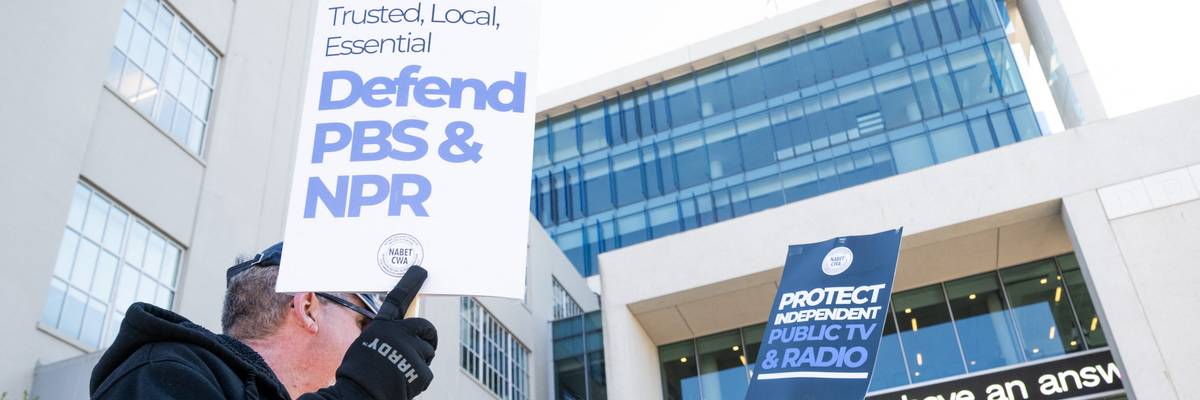
Demonstrators call on Congress to protect funding for U.S. public broadcasters in Washington, D.C. on March 26, 2025.
'A Clear Violation of the Constitution': NPR Sues Trump Over Attack on Funding
"The order is textbook retaliation and viewpoint-based discrimination in violation of the First Amendment."
NPR sued U.S. President Donald Trump on Tuesday over his recent executive order aiming to end federal funding for the outlet, a move that the lawsuit calls an illegal attack that "threatens the existence of a public radio system that millions of Americans across the country rely on for vital news and information."
Colorado Public Radio, KSUT Public Radio, and Roaring Fork Public Radio joined NPR in filing the legal challenge, which also names White House Office of Management and Budget Director Russell Vought and Treasury Secretary Scott Bessent.
"The order is unlawful in multiple ways," the lawsuit states. "It flatly contravenes statutes duly enacted by Congress and violates the Separation of Powers and the Spending Clause by disregarding Congress' express commands. It also violates the First Amendment's guarantees of freedom of speech and of the press."
"The order aims to punish NPR for the content of news and other programming the president dislikes and chill the exercise of First Amendment rights by NPR and individual public radio stations across the country," the suit continues. "The order is textbook retaliation and viewpoint-based discrimination in violation of the First Amendment."
"NPR will never agree to this infringement of our constitutional rights, or the constitutional rights of our member stations."
Trump's May 1 executive order instructed the Corporation for Public Broadcasting (CPB), which is funded by Congress, to end both direct and indirect funding to NPR and PBS, accusing the outlets of "biased and partisan news coverage."
The lawsuit demands court action barring the Trump administration from implementing the president's order.
Roughly 1% of NPR's funding comes directly from the federal government, and its member stations across the U.S. receive around 10% of their funds from the CPB. NPR says more than 43 million Americans consume its articles, podcasts, and other content on a weekly basis.
Katherine Maher, NPR's president and CEO, said in a statement Tuesday that Trump's order "is a clear violation of the Constitution and the First Amendment's protections for freedom of speech and association, and freedom of the press."
"The Supreme Court has ruled numerous times over the past 80 years that the government does not have the right to determine what counts as 'biased,'" said Maher. "NPR will never agree to this infringement of our constitutional rights, or the constitutional rights of our member stations, and NPR will not compromise our commitment to an independent free press and journalistic integrity."
Press freedom organizations have issued dire warnings about the consequences of federal funding cuts for NPR and PBS, arguing they could result in the closure of hundreds of local radio and television stations nationwide.
"The harm of these cuts will disproportionately befall rural American communities," a coalition of advocacy groups wrote in a letter to congressional leaders last month. "Less densely populated parts of the country tend to have fewer options for reliable news sources. These markets are often less viable for commercial media, making it unlikely that the gap left by shuttered public media stations will be adequately filled."
We are at a crossroads
This country and this world are at a monumental crossroads. In a few short weeks, US voters will have an opportunity to beat back the forces of fascism and confront the billionaires who are rigging the economy, our media system, and our democracy, making it increasingly impossible for ordinary people to get by. We’re not just talking about the election. We’re talking about what must be done once these fascist elements are vanquished from power. We need a bolder set of solutions than what either major party has so far been willing to offer and a working-class movement ready to fight like hell for it. Trump didn't emerge from nowhere. The conditions that fueled MAGA authoritarianism were created by decades of radical neoliberal economic policies and a corrupt political system dominated by corporate interests. They slashed taxes on the super-rich, promising that the benefits would trickle down. They said giveaways to the corporate titans would make life more affordable for the rest of us. It was all bullshit. And when a bitter, betrayed populace searches for someone to blame, right-wing demagogues have little trouble finding scapegoats. People know when they're being lied to, but you won't hear any of this from the corporate media. Only independent journalism—powered and funded by people who believe in building a better world—can deliver truly trustworthy daily news. Our Fall Campaign is underway, and we need your help. To power our newsroom through the rest of the year, we need to raise $125,000 by midnight on October 31. So if you share our vision, please contribute whatever you can to sustain our work. |
NPR sued U.S. President Donald Trump on Tuesday over his recent executive order aiming to end federal funding for the outlet, a move that the lawsuit calls an illegal attack that "threatens the existence of a public radio system that millions of Americans across the country rely on for vital news and information."
Colorado Public Radio, KSUT Public Radio, and Roaring Fork Public Radio joined NPR in filing the legal challenge, which also names White House Office of Management and Budget Director Russell Vought and Treasury Secretary Scott Bessent.
"The order is unlawful in multiple ways," the lawsuit states. "It flatly contravenes statutes duly enacted by Congress and violates the Separation of Powers and the Spending Clause by disregarding Congress' express commands. It also violates the First Amendment's guarantees of freedom of speech and of the press."
"The order aims to punish NPR for the content of news and other programming the president dislikes and chill the exercise of First Amendment rights by NPR and individual public radio stations across the country," the suit continues. "The order is textbook retaliation and viewpoint-based discrimination in violation of the First Amendment."
"NPR will never agree to this infringement of our constitutional rights, or the constitutional rights of our member stations."
Trump's May 1 executive order instructed the Corporation for Public Broadcasting (CPB), which is funded by Congress, to end both direct and indirect funding to NPR and PBS, accusing the outlets of "biased and partisan news coverage."
The lawsuit demands court action barring the Trump administration from implementing the president's order.
Roughly 1% of NPR's funding comes directly from the federal government, and its member stations across the U.S. receive around 10% of their funds from the CPB. NPR says more than 43 million Americans consume its articles, podcasts, and other content on a weekly basis.
Katherine Maher, NPR's president and CEO, said in a statement Tuesday that Trump's order "is a clear violation of the Constitution and the First Amendment's protections for freedom of speech and association, and freedom of the press."
"The Supreme Court has ruled numerous times over the past 80 years that the government does not have the right to determine what counts as 'biased,'" said Maher. "NPR will never agree to this infringement of our constitutional rights, or the constitutional rights of our member stations, and NPR will not compromise our commitment to an independent free press and journalistic integrity."
Press freedom organizations have issued dire warnings about the consequences of federal funding cuts for NPR and PBS, arguing they could result in the closure of hundreds of local radio and television stations nationwide.
"The harm of these cuts will disproportionately befall rural American communities," a coalition of advocacy groups wrote in a letter to congressional leaders last month. "Less densely populated parts of the country tend to have fewer options for reliable news sources. These markets are often less viable for commercial media, making it unlikely that the gap left by shuttered public media stations will be adequately filled."
NPR sued U.S. President Donald Trump on Tuesday over his recent executive order aiming to end federal funding for the outlet, a move that the lawsuit calls an illegal attack that "threatens the existence of a public radio system that millions of Americans across the country rely on for vital news and information."
Colorado Public Radio, KSUT Public Radio, and Roaring Fork Public Radio joined NPR in filing the legal challenge, which also names White House Office of Management and Budget Director Russell Vought and Treasury Secretary Scott Bessent.
"The order is unlawful in multiple ways," the lawsuit states. "It flatly contravenes statutes duly enacted by Congress and violates the Separation of Powers and the Spending Clause by disregarding Congress' express commands. It also violates the First Amendment's guarantees of freedom of speech and of the press."
"The order aims to punish NPR for the content of news and other programming the president dislikes and chill the exercise of First Amendment rights by NPR and individual public radio stations across the country," the suit continues. "The order is textbook retaliation and viewpoint-based discrimination in violation of the First Amendment."
"NPR will never agree to this infringement of our constitutional rights, or the constitutional rights of our member stations."
Trump's May 1 executive order instructed the Corporation for Public Broadcasting (CPB), which is funded by Congress, to end both direct and indirect funding to NPR and PBS, accusing the outlets of "biased and partisan news coverage."
The lawsuit demands court action barring the Trump administration from implementing the president's order.
Roughly 1% of NPR's funding comes directly from the federal government, and its member stations across the U.S. receive around 10% of their funds from the CPB. NPR says more than 43 million Americans consume its articles, podcasts, and other content on a weekly basis.
Katherine Maher, NPR's president and CEO, said in a statement Tuesday that Trump's order "is a clear violation of the Constitution and the First Amendment's protections for freedom of speech and association, and freedom of the press."
"The Supreme Court has ruled numerous times over the past 80 years that the government does not have the right to determine what counts as 'biased,'" said Maher. "NPR will never agree to this infringement of our constitutional rights, or the constitutional rights of our member stations, and NPR will not compromise our commitment to an independent free press and journalistic integrity."
Press freedom organizations have issued dire warnings about the consequences of federal funding cuts for NPR and PBS, arguing they could result in the closure of hundreds of local radio and television stations nationwide.
"The harm of these cuts will disproportionately befall rural American communities," a coalition of advocacy groups wrote in a letter to congressional leaders last month. "Less densely populated parts of the country tend to have fewer options for reliable news sources. These markets are often less viable for commercial media, making it unlikely that the gap left by shuttered public media stations will be adequately filled."