SUBSCRIBE TO OUR FREE NEWSLETTER
Daily news & progressive opinion—funded by the people, not the corporations—delivered straight to your inbox.
5
#000000
#FFFFFF
To donate by check, phone, or other method, see our More Ways to Give page.
Daily news & progressive opinion—funded by the people, not the corporations—delivered straight to your inbox.
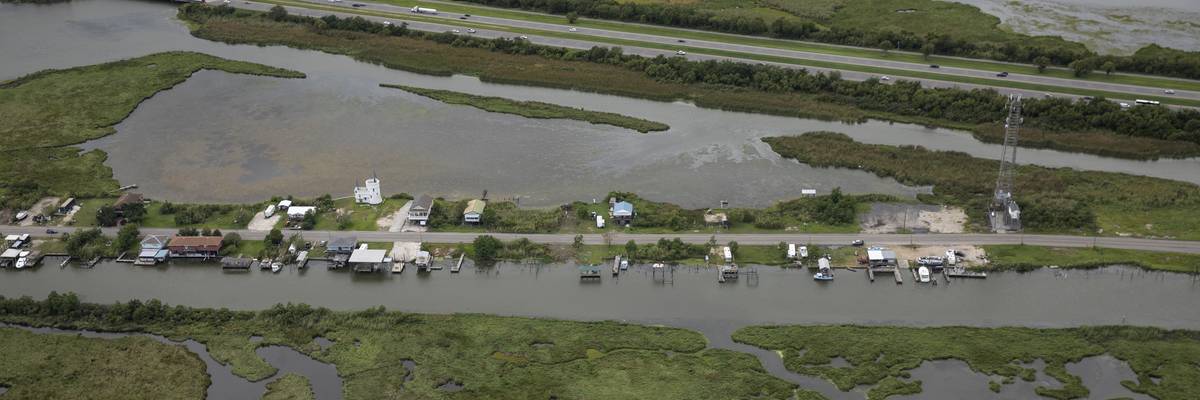
Homes in New Orleans are surrounded by rising waters on August 23, 2019 amid the worsening climate emergency.
"Coastal Louisiana has evidently already crossed the point of no return," says new research.
A study published Monday warns that New Orleans must immediately begin planning and gradually implementing its permanent evacuation to avert a dangerously rushed exodus later, because it has passed a "point of no return" as climate-driven sea-level rise slowly swallows the storied city.
"With global temperatures poised to exceed the 1.5°C Paris Agreement threshold—a level that triggered substantial ice sheet collapse during the Last Interglacial—low-elevation coastal zones face sea-level commitments far beyond current planning horizons," says the study, which was published by the journal Nature Sustainability.
"With this geological frame of reference, we examine the impact of sea-level rise on what may be the most physically vulnerable coastal zone in the world using prehistoric and contemporary patterns of human mobility," the publication continues. "We highlight the positive aspects of the recently commenced out-migration in this region and argue that the fate of communities landwards of this coastal zone will be decided in the next few decades."
"While climate mitigation should remain the first step to prevent the worst outcomes, coastal Louisiana has evidently already crossed the point of no return,” the paper adds.
That's because rising waters are slowly eroding Louisiana's coast, including New Orleans, which “may well be surrounded by the Gulf of Mexico before the end of this century," according to the study's authors.
“Louisiana is a canary in the coal mine. It is one of the rare places where we’re already clearly seeing climate-motivated depopulation combined with other social and economic factors,” said Yale School of the Environment professor and study co-author Brianna Castro.
The authors argued that by acknowledging the inevitability of New Orleans' underwater future, government and residents can avert a fraught rushed retreat by planning and executing a managed multigenerational relocation and set an example for other threatened coastal communities.
According to one widely cited study published a decade ago, around 13 million Americans living in coastal areas could be forced to relocate to higher ground by the end of the century due climate-driven sea-level rise, with the Gulf Coast and Florida expected lose the most livable land. Globally, hundreds of millions of people are expected to be displaced by 2100 due to rising seas.
After Hurricane Katrina—which inundated the city and killed nearly 1,000 people in the New Orleans metro area—billions of dollars were spent fortifying the city's levee system, which failed catastrophically during the 2005 storm. However, experts warn that in the long term, levees won't be able to stop the rising waters any longer.
That's why the study's authors said officials must begin the city's orderly depopulation as soon as possible.
"What kind of retreat do you want?" asked Castro. "Do you want to incentivize it and then people go naturally for jobs, housing, and lifestyle amenities—or do you want people to wait and then have to leave abruptly in crisis?”
Dear Common Dreams reader, It’s been nearly 30 years since I co-founded Common Dreams with my late wife, Lina Newhouser. We had the radical notion that journalism should serve the public good, not corporate profits. It was clear to us from the outset what it would take to build such a project. No paid advertisements. No corporate sponsors. No millionaire publisher telling us what to think or do. Many people said we wouldn't last a year, but we proved those doubters wrong. Together with a tremendous team of journalists and dedicated staff, we built an independent media outlet free from the constraints of profits and corporate control. Our mission has always been simple: To inform. To inspire. To ignite change for the common good. Building Common Dreams was not easy. Our survival was never guaranteed. When you take on the most powerful forces—Wall Street greed, fossil fuel industry destruction, Big Tech lobbyists, and uber-rich oligarchs who have spent billions upon billions rigging the economy and democracy in their favor—the only bulwark you have is supporters who believe in your work. But here’s the urgent message from me today. It's never been this bad out there. And it's never been this hard to keep us going. At the very moment Common Dreams is most needed, the threats we face are intensifying. We need your support now more than ever. We don't accept corporate advertising and never will. We don't have a paywall because we don't think people should be blocked from critical news based on their ability to pay. Everything we do is funded by the donations of readers like you. When everyone does the little they can afford, we are strong. But if that support retreats or dries up, so do we. Will you donate now to make sure Common Dreams not only survives but thrives? —Craig Brown, Co-founder |
A study published Monday warns that New Orleans must immediately begin planning and gradually implementing its permanent evacuation to avert a dangerously rushed exodus later, because it has passed a "point of no return" as climate-driven sea-level rise slowly swallows the storied city.
"With global temperatures poised to exceed the 1.5°C Paris Agreement threshold—a level that triggered substantial ice sheet collapse during the Last Interglacial—low-elevation coastal zones face sea-level commitments far beyond current planning horizons," says the study, which was published by the journal Nature Sustainability.
"With this geological frame of reference, we examine the impact of sea-level rise on what may be the most physically vulnerable coastal zone in the world using prehistoric and contemporary patterns of human mobility," the publication continues. "We highlight the positive aspects of the recently commenced out-migration in this region and argue that the fate of communities landwards of this coastal zone will be decided in the next few decades."
"While climate mitigation should remain the first step to prevent the worst outcomes, coastal Louisiana has evidently already crossed the point of no return,” the paper adds.
That's because rising waters are slowly eroding Louisiana's coast, including New Orleans, which “may well be surrounded by the Gulf of Mexico before the end of this century," according to the study's authors.
“Louisiana is a canary in the coal mine. It is one of the rare places where we’re already clearly seeing climate-motivated depopulation combined with other social and economic factors,” said Yale School of the Environment professor and study co-author Brianna Castro.
The authors argued that by acknowledging the inevitability of New Orleans' underwater future, government and residents can avert a fraught rushed retreat by planning and executing a managed multigenerational relocation and set an example for other threatened coastal communities.
According to one widely cited study published a decade ago, around 13 million Americans living in coastal areas could be forced to relocate to higher ground by the end of the century due climate-driven sea-level rise, with the Gulf Coast and Florida expected lose the most livable land. Globally, hundreds of millions of people are expected to be displaced by 2100 due to rising seas.
After Hurricane Katrina—which inundated the city and killed nearly 1,000 people in the New Orleans metro area—billions of dollars were spent fortifying the city's levee system, which failed catastrophically during the 2005 storm. However, experts warn that in the long term, levees won't be able to stop the rising waters any longer.
That's why the study's authors said officials must begin the city's orderly depopulation as soon as possible.
"What kind of retreat do you want?" asked Castro. "Do you want to incentivize it and then people go naturally for jobs, housing, and lifestyle amenities—or do you want people to wait and then have to leave abruptly in crisis?”
A study published Monday warns that New Orleans must immediately begin planning and gradually implementing its permanent evacuation to avert a dangerously rushed exodus later, because it has passed a "point of no return" as climate-driven sea-level rise slowly swallows the storied city.
"With global temperatures poised to exceed the 1.5°C Paris Agreement threshold—a level that triggered substantial ice sheet collapse during the Last Interglacial—low-elevation coastal zones face sea-level commitments far beyond current planning horizons," says the study, which was published by the journal Nature Sustainability.
"With this geological frame of reference, we examine the impact of sea-level rise on what may be the most physically vulnerable coastal zone in the world using prehistoric and contemporary patterns of human mobility," the publication continues. "We highlight the positive aspects of the recently commenced out-migration in this region and argue that the fate of communities landwards of this coastal zone will be decided in the next few decades."
"While climate mitigation should remain the first step to prevent the worst outcomes, coastal Louisiana has evidently already crossed the point of no return,” the paper adds.
That's because rising waters are slowly eroding Louisiana's coast, including New Orleans, which “may well be surrounded by the Gulf of Mexico before the end of this century," according to the study's authors.
“Louisiana is a canary in the coal mine. It is one of the rare places where we’re already clearly seeing climate-motivated depopulation combined with other social and economic factors,” said Yale School of the Environment professor and study co-author Brianna Castro.
The authors argued that by acknowledging the inevitability of New Orleans' underwater future, government and residents can avert a fraught rushed retreat by planning and executing a managed multigenerational relocation and set an example for other threatened coastal communities.
According to one widely cited study published a decade ago, around 13 million Americans living in coastal areas could be forced to relocate to higher ground by the end of the century due climate-driven sea-level rise, with the Gulf Coast and Florida expected lose the most livable land. Globally, hundreds of millions of people are expected to be displaced by 2100 due to rising seas.
After Hurricane Katrina—which inundated the city and killed nearly 1,000 people in the New Orleans metro area—billions of dollars were spent fortifying the city's levee system, which failed catastrophically during the 2005 storm. However, experts warn that in the long term, levees won't be able to stop the rising waters any longer.
That's why the study's authors said officials must begin the city's orderly depopulation as soon as possible.
"What kind of retreat do you want?" asked Castro. "Do you want to incentivize it and then people go naturally for jobs, housing, and lifestyle amenities—or do you want people to wait and then have to leave abruptly in crisis?”