SUBSCRIBE TO OUR FREE NEWSLETTER
Daily news & progressive opinion—funded by the people, not the corporations—delivered straight to your inbox.
5
#000000
#FFFFFF
To donate by check, phone, or other method, see our More Ways to Give page.
Daily news & progressive opinion—funded by the people, not the corporations—delivered straight to your inbox.
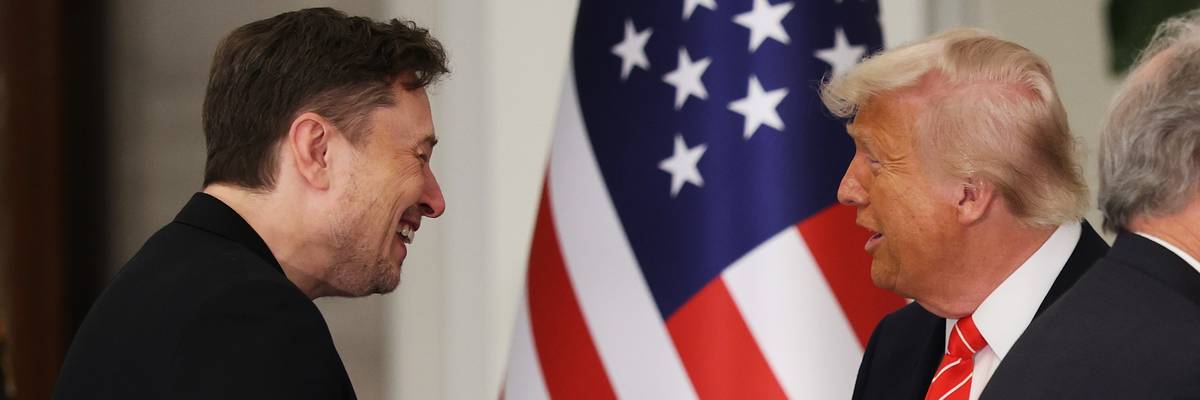
U.S. President Donald J. Trump greets Tesla CEO Elon Musk before a state dinner at the Lusail Palace on May 14, 2025, in Doha, Qatar.
Democratic senators said diplomatic discussions with numerous foreign governments about Elon Musk's satellite service appear to be "a textbook case of corruption."
Amid the news that billionaire tech mogul Elon Musk secured a new deal with Saudia Arabia for his satellite internet service just as U.S. President Donald Trump was visiting the Middle Eastern country, Democratic senators are intensifying their demand for an investigation into how Musk has directly benefited from the president's policies and actions since taking office.
Sens. Elizabeth Warren (D-Mass.), Mark Warner (D-Va.), and Jeanne Shaheen (D-N.H.) wrote to top Trump administration officials demanding a probe into what they called "a textbook case of corruption."
Musk, a "special government employee" who has led Trump's efforts to slash public spending via the Department of Government Efficiency, said at an investment forum in Riyadh Tuesday that Starlink, the satellite service owned by his aerospace company, SpaceX, had gotten approval to operate in Saudi Arabia.
The service has struggled to gain traction in international markets, relying on permits from foreign governments—but its trajectory has changed since Trump took office.
"Starlink has seen a rush of new countries permitting the company to enter their markets," wrote the senators. "Soon after President Trump announced tariffs, Lesotho 'awarded Musk's firm the nation's first-ever satellite internet service license,' and 'is far from the only country that has decided to assist Musk's firm while trying to fend off U.S. tariffs.'"
India, Vietnam, and Bangladesh have also agreed to work with Musk's company in recent weeks as Trump was threatening to impose tariffs.
On Thursday, ProPublica detailed some of the discussions the administration has had with foreign governments in recent weeks, about trade as well as foreign aid, with an apparent goal: "Get business for Elon Musk."
In Gambia, where Musk had tried for months to secure approval for Starlink, U.S. Ambassador Sharon Cromer—an appointee of former President Joe Biden—met with the country's top communications official, Lamin Jabbi, in February.
"We ask that the DOJ and the White House investigate whether any officials have pursued a quid pro quo exchange of Starlink access for tariff favors in violation of federal ethics law."
"The administration had already begun freezing foreign aid projects, and early in the meeting, Cromer... said something that rattled Gambian officials in the room," reported ProPublica. "She listed the ways that the U.S. was supporting the country, according to two people present and contemporaneous notes, noting that key initiatives—like one that funds a $25 million project to improve the electrical system—were currently under review."
Hassan Jallow, a top deputy to Jabbi, told ProPublica that the clear implication in Cromer's comments "was that they were connected."
Similar discussions have taken place between U.S. officials and the government of Cameroon—where leaders were told they could prove their "commitment to Trump's agenda by letting Starlink expand its presence there" and warned of the potential "impact of U.S. aid cuts and deportations."
In Lesotho, Starlink finalized a deal with officials after Trump imposed 50% tariffs on the landlocked country.
Kenneth Fairfax, who served as U.S. ambassador to Kazakhstan, told ProPublica the conversations pushing countries to approve deals with Musk "could lead to the impression that the U.S. is engaging in a form of crony capitalism."
The Saudi deal announced Tuesday was finalized just as Trump secured a $600 billion investment deal with the country and agreed to sell the government a $142 billion arms package.
As Common Dreams reported last week, internal government messages have shown how U.S. embassies and the State Department have mentioned Starlink by name in numerous communications with foreign governments about satellite companies.
"Secretary of State Marco Rubio has increasingly instructed officials to push for regulatory approvals for Musk's satellite firm at a moment when the White House is calling for wide-ranging talks on trade," The Washington Post reported.
Warren, Warner, and Shaheen wrote that the Public Integrity Section at the Department of Justice (DOJ) "is responsible for investigating
potentially criminal conflicts of interest like this," and called on Attorney General Pam Bondi to initiate a probe.
"The White House's Designated Agency Ethics Official can similarly investigate potential ethics violations by White House officials," they wrote. "We ask that the DOJ and the White House investigate whether any officials have pursued a quid pro quo exchange of Starlink access for tariff favors in violation of federal ethics law."
The lawmakers also called on the State Department inspector general to investigate whether department officials "may be subverting the public's interests in favor of Mr. Musk's personal financial interests as they negotiate new tariff agreements—and whether they have been directed by Mr. Musk or President Trump to do so."
Dear Common Dreams reader, It’s been nearly 30 years since I co-founded Common Dreams with my late wife, Lina Newhouser. We had the radical notion that journalism should serve the public good, not corporate profits. It was clear to us from the outset what it would take to build such a project. No paid advertisements. No corporate sponsors. No millionaire publisher telling us what to think or do. Many people said we wouldn't last a year, but we proved those doubters wrong. Together with a tremendous team of journalists and dedicated staff, we built an independent media outlet free from the constraints of profits and corporate control. Our mission has always been simple: To inform. To inspire. To ignite change for the common good. Building Common Dreams was not easy. Our survival was never guaranteed. When you take on the most powerful forces—Wall Street greed, fossil fuel industry destruction, Big Tech lobbyists, and uber-rich oligarchs who have spent billions upon billions rigging the economy and democracy in their favor—the only bulwark you have is supporters who believe in your work. But here’s the urgent message from me today. It's never been this bad out there. And it's never been this hard to keep us going. At the very moment Common Dreams is most needed, the threats we face are intensifying. We need your support now more than ever. We don't accept corporate advertising and never will. We don't have a paywall because we don't think people should be blocked from critical news based on their ability to pay. Everything we do is funded by the donations of readers like you. When everyone does the little they can afford, we are strong. But if that support retreats or dries up, so do we. Will you donate now to make sure Common Dreams not only survives but thrives? —Craig Brown, Co-founder |
Amid the news that billionaire tech mogul Elon Musk secured a new deal with Saudia Arabia for his satellite internet service just as U.S. President Donald Trump was visiting the Middle Eastern country, Democratic senators are intensifying their demand for an investigation into how Musk has directly benefited from the president's policies and actions since taking office.
Sens. Elizabeth Warren (D-Mass.), Mark Warner (D-Va.), and Jeanne Shaheen (D-N.H.) wrote to top Trump administration officials demanding a probe into what they called "a textbook case of corruption."
Musk, a "special government employee" who has led Trump's efforts to slash public spending via the Department of Government Efficiency, said at an investment forum in Riyadh Tuesday that Starlink, the satellite service owned by his aerospace company, SpaceX, had gotten approval to operate in Saudi Arabia.
The service has struggled to gain traction in international markets, relying on permits from foreign governments—but its trajectory has changed since Trump took office.
"Starlink has seen a rush of new countries permitting the company to enter their markets," wrote the senators. "Soon after President Trump announced tariffs, Lesotho 'awarded Musk's firm the nation's first-ever satellite internet service license,' and 'is far from the only country that has decided to assist Musk's firm while trying to fend off U.S. tariffs.'"
India, Vietnam, and Bangladesh have also agreed to work with Musk's company in recent weeks as Trump was threatening to impose tariffs.
On Thursday, ProPublica detailed some of the discussions the administration has had with foreign governments in recent weeks, about trade as well as foreign aid, with an apparent goal: "Get business for Elon Musk."
In Gambia, where Musk had tried for months to secure approval for Starlink, U.S. Ambassador Sharon Cromer—an appointee of former President Joe Biden—met with the country's top communications official, Lamin Jabbi, in February.
"We ask that the DOJ and the White House investigate whether any officials have pursued a quid pro quo exchange of Starlink access for tariff favors in violation of federal ethics law."
"The administration had already begun freezing foreign aid projects, and early in the meeting, Cromer... said something that rattled Gambian officials in the room," reported ProPublica. "She listed the ways that the U.S. was supporting the country, according to two people present and contemporaneous notes, noting that key initiatives—like one that funds a $25 million project to improve the electrical system—were currently under review."
Hassan Jallow, a top deputy to Jabbi, told ProPublica that the clear implication in Cromer's comments "was that they were connected."
Similar discussions have taken place between U.S. officials and the government of Cameroon—where leaders were told they could prove their "commitment to Trump's agenda by letting Starlink expand its presence there" and warned of the potential "impact of U.S. aid cuts and deportations."
In Lesotho, Starlink finalized a deal with officials after Trump imposed 50% tariffs on the landlocked country.
Kenneth Fairfax, who served as U.S. ambassador to Kazakhstan, told ProPublica the conversations pushing countries to approve deals with Musk "could lead to the impression that the U.S. is engaging in a form of crony capitalism."
The Saudi deal announced Tuesday was finalized just as Trump secured a $600 billion investment deal with the country and agreed to sell the government a $142 billion arms package.
As Common Dreams reported last week, internal government messages have shown how U.S. embassies and the State Department have mentioned Starlink by name in numerous communications with foreign governments about satellite companies.
"Secretary of State Marco Rubio has increasingly instructed officials to push for regulatory approvals for Musk's satellite firm at a moment when the White House is calling for wide-ranging talks on trade," The Washington Post reported.
Warren, Warner, and Shaheen wrote that the Public Integrity Section at the Department of Justice (DOJ) "is responsible for investigating
potentially criminal conflicts of interest like this," and called on Attorney General Pam Bondi to initiate a probe.
"The White House's Designated Agency Ethics Official can similarly investigate potential ethics violations by White House officials," they wrote. "We ask that the DOJ and the White House investigate whether any officials have pursued a quid pro quo exchange of Starlink access for tariff favors in violation of federal ethics law."
The lawmakers also called on the State Department inspector general to investigate whether department officials "may be subverting the public's interests in favor of Mr. Musk's personal financial interests as they negotiate new tariff agreements—and whether they have been directed by Mr. Musk or President Trump to do so."
Amid the news that billionaire tech mogul Elon Musk secured a new deal with Saudia Arabia for his satellite internet service just as U.S. President Donald Trump was visiting the Middle Eastern country, Democratic senators are intensifying their demand for an investigation into how Musk has directly benefited from the president's policies and actions since taking office.
Sens. Elizabeth Warren (D-Mass.), Mark Warner (D-Va.), and Jeanne Shaheen (D-N.H.) wrote to top Trump administration officials demanding a probe into what they called "a textbook case of corruption."
Musk, a "special government employee" who has led Trump's efforts to slash public spending via the Department of Government Efficiency, said at an investment forum in Riyadh Tuesday that Starlink, the satellite service owned by his aerospace company, SpaceX, had gotten approval to operate in Saudi Arabia.
The service has struggled to gain traction in international markets, relying on permits from foreign governments—but its trajectory has changed since Trump took office.
"Starlink has seen a rush of new countries permitting the company to enter their markets," wrote the senators. "Soon after President Trump announced tariffs, Lesotho 'awarded Musk's firm the nation's first-ever satellite internet service license,' and 'is far from the only country that has decided to assist Musk's firm while trying to fend off U.S. tariffs.'"
India, Vietnam, and Bangladesh have also agreed to work with Musk's company in recent weeks as Trump was threatening to impose tariffs.
On Thursday, ProPublica detailed some of the discussions the administration has had with foreign governments in recent weeks, about trade as well as foreign aid, with an apparent goal: "Get business for Elon Musk."
In Gambia, where Musk had tried for months to secure approval for Starlink, U.S. Ambassador Sharon Cromer—an appointee of former President Joe Biden—met with the country's top communications official, Lamin Jabbi, in February.
"We ask that the DOJ and the White House investigate whether any officials have pursued a quid pro quo exchange of Starlink access for tariff favors in violation of federal ethics law."
"The administration had already begun freezing foreign aid projects, and early in the meeting, Cromer... said something that rattled Gambian officials in the room," reported ProPublica. "She listed the ways that the U.S. was supporting the country, according to two people present and contemporaneous notes, noting that key initiatives—like one that funds a $25 million project to improve the electrical system—were currently under review."
Hassan Jallow, a top deputy to Jabbi, told ProPublica that the clear implication in Cromer's comments "was that they were connected."
Similar discussions have taken place between U.S. officials and the government of Cameroon—where leaders were told they could prove their "commitment to Trump's agenda by letting Starlink expand its presence there" and warned of the potential "impact of U.S. aid cuts and deportations."
In Lesotho, Starlink finalized a deal with officials after Trump imposed 50% tariffs on the landlocked country.
Kenneth Fairfax, who served as U.S. ambassador to Kazakhstan, told ProPublica the conversations pushing countries to approve deals with Musk "could lead to the impression that the U.S. is engaging in a form of crony capitalism."
The Saudi deal announced Tuesday was finalized just as Trump secured a $600 billion investment deal with the country and agreed to sell the government a $142 billion arms package.
As Common Dreams reported last week, internal government messages have shown how U.S. embassies and the State Department have mentioned Starlink by name in numerous communications with foreign governments about satellite companies.
"Secretary of State Marco Rubio has increasingly instructed officials to push for regulatory approvals for Musk's satellite firm at a moment when the White House is calling for wide-ranging talks on trade," The Washington Post reported.
Warren, Warner, and Shaheen wrote that the Public Integrity Section at the Department of Justice (DOJ) "is responsible for investigating
potentially criminal conflicts of interest like this," and called on Attorney General Pam Bondi to initiate a probe.
"The White House's Designated Agency Ethics Official can similarly investigate potential ethics violations by White House officials," they wrote. "We ask that the DOJ and the White House investigate whether any officials have pursued a quid pro quo exchange of Starlink access for tariff favors in violation of federal ethics law."
The lawmakers also called on the State Department inspector general to investigate whether department officials "may be subverting the public's interests in favor of Mr. Musk's personal financial interests as they negotiate new tariff agreements—and whether they have been directed by Mr. Musk or President Trump to do so."