
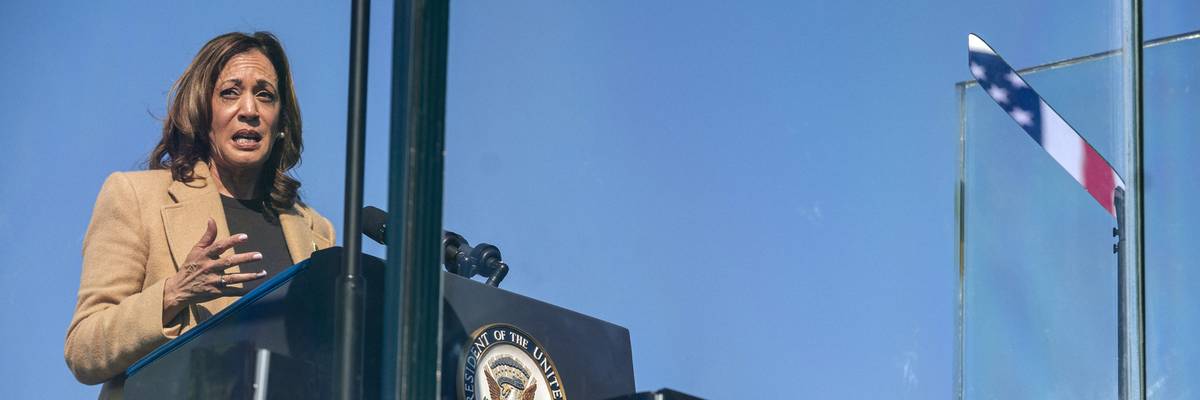
Democratic presidential nominee Kamala Harris speaks during a campaign stop on September 4, 2024 in North Hampton, New Hampshire.
'Baffling Capitulation to Wall Street': Harris Breaks With Biden on Capital Gains Tax
"Harris seems to be making a policy choice based on the disproven, failed ideology of trickle-down economics, and giving petulant billionaires a gift in the process," said one progressive advocacy group.
Democratic nominee Kamala Harris broke with President Joe Biden on Wednesday by proposing a smaller capital gains tax increase for wealthy Americans, a decision that one progressive advocacy group decried as a "baffling capitulation to Wall Street billionaires" who have vocally complained about the vice president's embrace of higher taxes on the ultra-rich.
Harris said at a campaign event in New Hampshire on Wednesday that "if you earn a million dollars a year or more, the tax rate on your long-term capital gains will be 28% under my plan," broadly confirming earlier reporting by The Wall Street Journal.
"We know when the government encourages investment, it leads to broad-based economic growth and it creates jobs, which makes our economy stronger," said Harris, who previously signaled support for Biden's tax agenda.
A 28% top tax rate on long-term capital gains—profits from the sale of an asset held for more than a year—would be significantly lower than the 39.6% rate that Biden proposed in his most recent budget.
The Patriotic Millionaires, a group of rich Americans that advocates for a more progressive tax system, said it was "appalled" by Harris' decision to pare back Biden's proposed capital gains tax increase.
"Vice President Harris is making a catastrophic mistake by capitulating to the petulant whining of the billionaire class," said Morris Pearl, the group's chair. "Harris seems to be making a policy choice based on the disproven, failed ideology of trickle-down economics, and giving petulant billionaires a gift in the process."
"Both on the economics and on the politics, this is a serious unforced error."
Details of Harris' capital gains tax plan began to emerge days after ultra-rich investors and other major donors to the vice president's 2024 campaign took to the pages of The New York Times to express concerns about Harris' support for Biden's tax agenda, which also calls for taxing the unrealized capital gains of households worth over $100 million.
The Financial Times described Harris' break with Biden on long-term capital gains as "an olive branch to Wall Street"; The New York Times similarly characterized the move as a message to the business community that she is "friendlier than Biden."
But Pearl of the Patriotic Millionaires warned that the policy shift "demonstrates a concerning lack of commitment to reversing destabilizing economic inequality."
"Both on the economics and on the politics, this is a serious unforced error," said Pearl, the former managing director at the investment behemoth BlackRock. "You don't need my years of experience on Wall Street to grasp the obvious. Big investors invest to make serious money, not to save a few percentage points on their tax bill. No one has ever made a lucrative investment decision based on a preferential tax rate. The incentive to invest is making money, not lowering tax rates."
"This ill-advised, destructive policy is a giveaway to the ultra-rich," he added. "We hope Vice President Harris will reconsider her position."
Even with a smaller proposed capital gains tax increase, Harris' tax agenda stands in stark contrast to that of Republican presidential nominee Donald Trump, who has called for massive additional tax cuts for the rich and large corporations while attacking Harris' support for progressive—and widely popular—tax proposals.
While Trump has not yet outlined a capital gains proposal during the 2024 campaign, the former president said in the final year of his first term that he would propose cutting the top capital gains rate to 15% in a second term.
Steve Wamhoff of the Institute on Taxation and Economic Policy noted at the time that 99% of the benefits of such a cut "would go to the richest 1% of taxpayers."
We are at a crossroads
This country and this world are at a monumental crossroads. In a few short weeks, US voters will have an opportunity to beat back the forces of fascism and confront the billionaires who are rigging the economy, our media system, and our democracy, making it increasingly impossible for ordinary people to get by. We’re not just talking about the election. We’re talking about what must be done once these fascist elements are vanquished from power. We need a bolder set of solutions than what either major party has so far been willing to offer and a working-class movement ready to fight like hell for it. Trump didn't emerge from nowhere. The conditions that fueled MAGA authoritarianism were created by decades of radical neoliberal economic policies and a corrupt political system dominated by corporate interests. They slashed taxes on the super-rich, promising that the benefits would trickle down. They said giveaways to the corporate titans would make life more affordable for the rest of us. It was all bullshit. And when a bitter, betrayed populace searches for someone to blame, right-wing demagogues have little trouble finding scapegoats. People know when they're being lied to, but you won't hear any of this from the corporate media. Only independent journalism—powered and funded by people who believe in building a better world—can deliver truly trustworthy daily news. Our Fall Campaign is underway, and we need your help. To power our newsroom through the rest of the year, we need to raise $125,000 by midnight on October 31. So if you share our vision, please contribute whatever you can to sustain our work. |
Democratic nominee Kamala Harris broke with President Joe Biden on Wednesday by proposing a smaller capital gains tax increase for wealthy Americans, a decision that one progressive advocacy group decried as a "baffling capitulation to Wall Street billionaires" who have vocally complained about the vice president's embrace of higher taxes on the ultra-rich.
Harris said at a campaign event in New Hampshire on Wednesday that "if you earn a million dollars a year or more, the tax rate on your long-term capital gains will be 28% under my plan," broadly confirming earlier reporting by The Wall Street Journal.
"We know when the government encourages investment, it leads to broad-based economic growth and it creates jobs, which makes our economy stronger," said Harris, who previously signaled support for Biden's tax agenda.
A 28% top tax rate on long-term capital gains—profits from the sale of an asset held for more than a year—would be significantly lower than the 39.6% rate that Biden proposed in his most recent budget.
The Patriotic Millionaires, a group of rich Americans that advocates for a more progressive tax system, said it was "appalled" by Harris' decision to pare back Biden's proposed capital gains tax increase.
"Vice President Harris is making a catastrophic mistake by capitulating to the petulant whining of the billionaire class," said Morris Pearl, the group's chair. "Harris seems to be making a policy choice based on the disproven, failed ideology of trickle-down economics, and giving petulant billionaires a gift in the process."
"Both on the economics and on the politics, this is a serious unforced error."
Details of Harris' capital gains tax plan began to emerge days after ultra-rich investors and other major donors to the vice president's 2024 campaign took to the pages of The New York Times to express concerns about Harris' support for Biden's tax agenda, which also calls for taxing the unrealized capital gains of households worth over $100 million.
The Financial Times described Harris' break with Biden on long-term capital gains as "an olive branch to Wall Street"; The New York Times similarly characterized the move as a message to the business community that she is "friendlier than Biden."
But Pearl of the Patriotic Millionaires warned that the policy shift "demonstrates a concerning lack of commitment to reversing destabilizing economic inequality."
"Both on the economics and on the politics, this is a serious unforced error," said Pearl, the former managing director at the investment behemoth BlackRock. "You don't need my years of experience on Wall Street to grasp the obvious. Big investors invest to make serious money, not to save a few percentage points on their tax bill. No one has ever made a lucrative investment decision based on a preferential tax rate. The incentive to invest is making money, not lowering tax rates."
"This ill-advised, destructive policy is a giveaway to the ultra-rich," he added. "We hope Vice President Harris will reconsider her position."
Even with a smaller proposed capital gains tax increase, Harris' tax agenda stands in stark contrast to that of Republican presidential nominee Donald Trump, who has called for massive additional tax cuts for the rich and large corporations while attacking Harris' support for progressive—and widely popular—tax proposals.
While Trump has not yet outlined a capital gains proposal during the 2024 campaign, the former president said in the final year of his first term that he would propose cutting the top capital gains rate to 15% in a second term.
Steve Wamhoff of the Institute on Taxation and Economic Policy noted at the time that 99% of the benefits of such a cut "would go to the richest 1% of taxpayers."
Democratic nominee Kamala Harris broke with President Joe Biden on Wednesday by proposing a smaller capital gains tax increase for wealthy Americans, a decision that one progressive advocacy group decried as a "baffling capitulation to Wall Street billionaires" who have vocally complained about the vice president's embrace of higher taxes on the ultra-rich.
Harris said at a campaign event in New Hampshire on Wednesday that "if you earn a million dollars a year or more, the tax rate on your long-term capital gains will be 28% under my plan," broadly confirming earlier reporting by The Wall Street Journal.
"We know when the government encourages investment, it leads to broad-based economic growth and it creates jobs, which makes our economy stronger," said Harris, who previously signaled support for Biden's tax agenda.
A 28% top tax rate on long-term capital gains—profits from the sale of an asset held for more than a year—would be significantly lower than the 39.6% rate that Biden proposed in his most recent budget.
The Patriotic Millionaires, a group of rich Americans that advocates for a more progressive tax system, said it was "appalled" by Harris' decision to pare back Biden's proposed capital gains tax increase.
"Vice President Harris is making a catastrophic mistake by capitulating to the petulant whining of the billionaire class," said Morris Pearl, the group's chair. "Harris seems to be making a policy choice based on the disproven, failed ideology of trickle-down economics, and giving petulant billionaires a gift in the process."
"Both on the economics and on the politics, this is a serious unforced error."
Details of Harris' capital gains tax plan began to emerge days after ultra-rich investors and other major donors to the vice president's 2024 campaign took to the pages of The New York Times to express concerns about Harris' support for Biden's tax agenda, which also calls for taxing the unrealized capital gains of households worth over $100 million.
The Financial Times described Harris' break with Biden on long-term capital gains as "an olive branch to Wall Street"; The New York Times similarly characterized the move as a message to the business community that she is "friendlier than Biden."
But Pearl of the Patriotic Millionaires warned that the policy shift "demonstrates a concerning lack of commitment to reversing destabilizing economic inequality."
"Both on the economics and on the politics, this is a serious unforced error," said Pearl, the former managing director at the investment behemoth BlackRock. "You don't need my years of experience on Wall Street to grasp the obvious. Big investors invest to make serious money, not to save a few percentage points on their tax bill. No one has ever made a lucrative investment decision based on a preferential tax rate. The incentive to invest is making money, not lowering tax rates."
"This ill-advised, destructive policy is a giveaway to the ultra-rich," he added. "We hope Vice President Harris will reconsider her position."
Even with a smaller proposed capital gains tax increase, Harris' tax agenda stands in stark contrast to that of Republican presidential nominee Donald Trump, who has called for massive additional tax cuts for the rich and large corporations while attacking Harris' support for progressive—and widely popular—tax proposals.
While Trump has not yet outlined a capital gains proposal during the 2024 campaign, the former president said in the final year of his first term that he would propose cutting the top capital gains rate to 15% in a second term.
Steve Wamhoff of the Institute on Taxation and Economic Policy noted at the time that 99% of the benefits of such a cut "would go to the richest 1% of taxpayers."