SUBSCRIBE TO OUR FREE NEWSLETTER
Daily news & progressive opinion—funded by the people, not the corporations—delivered straight to your inbox.
5
#000000
#FFFFFF
To donate by check, phone, or other method, see our More Ways to Give page.
Daily news & progressive opinion—funded by the people, not the corporations—delivered straight to your inbox.
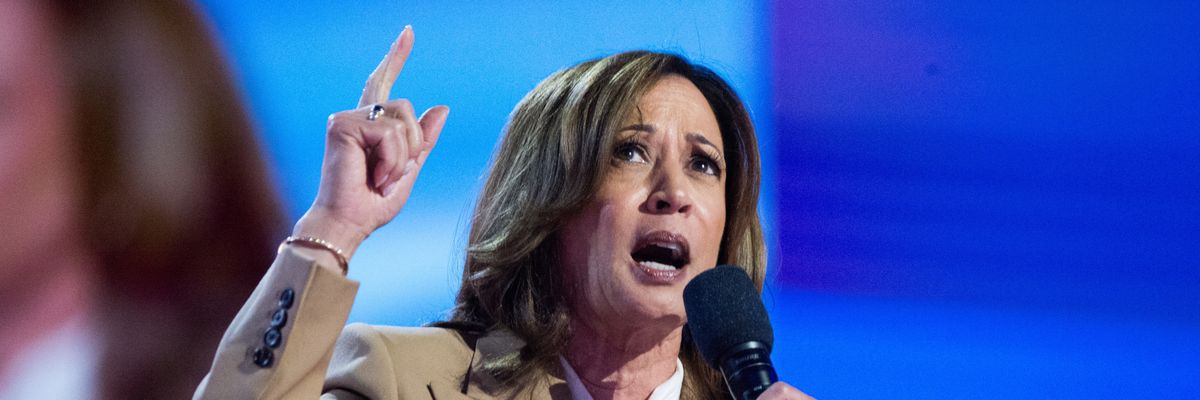
Democratic nominee Kamala Harris speaks during the 2024 Democratic National Convention in Chicago on August 19, 2024.
Gabriel Zucman, a leading authority on tax evasion by the rich, welcomed news that Kamala Harris' presidential campaign is embracing proposals to tax the ultra-wealthy and large corporations.
An economist at the forefront of the growing global push for a billionaire wealth tax is welcoming news that U.S. Democratic presidential nominee Kamala Harris is embracing calls for a minimum levy on the United States' richest individuals.
"Let's go!" Gabriel Zucman, an economics professor at the University of California, Berkeley, wrote Tuesday in response to Semafor reporting on the Harris team's endorsement of taxes on ultra-wealthy individuals and large corporations proposed in President Joe Biden's budget for Fiscal Year 2025.
Semafor highlighted a "little-noticed portion" of an analysis released late last week by the Committee for a Responsible Federal Budget, which wrote that Harris' campaign "specifically told us that they support all of the tax increases on the high earners and corporations that are in the Biden budget."
That budget blueprint includes a 25% minimum tax on billionaire wealth, much of which is unrealized capital gains that are not currently subject to taxation. A recent analysis by Americans for Tax Fairness estimated that U.S. billionaires and centi-millionaires collectively held at least $8.5 trillion in unrealized capital gains in 2022—a massive untapped source of federal revenue.
U.S. billionaires have seen their collective fortunes grow by more than $2 trillion since former President Donald Trump—the GOP's 2024 nominee—signed into law massive tax breaks for the rich and big corporations. Trump has campaigned on extending the deeply regressive and unpopular tax cuts and slashing rates for large companies even further.
Surging billionaire wealth at a time when roughly two-thirds of Americans are living paycheck-to-paycheck has amplified calls for a minimum tax on the richest Americans. Zucman noted in a May New York Times piece that in 2018, U.S. billionaires paid a lower effective tax rate than working-class Americans for the first time in the nation's history.
"The idea that billionaires should pay a minimum amount of income tax is not a radical idea," Zucman wrote in May. "What is radical is continuing to allow the wealthiest people in the world to pay a smaller percentage in income tax than nearly everybody else."
Polling has shown that a 25% tax on billionaire wealth is extremely popular with U.S. voters across the political spectrum. A survey in March of last year by Data for Progress found that 87% of Democrats, 68% of Independents and third-party voters, and 51% of Republicans back the idea.
A spokesperson for the Harris campaign confirmed to NBC News on Monday that in addition to backing the push for a minimum tax on billionaires, the vice president supports raising the corporate tax rate from 21% to 28% as a way to help finance parts of her broader economic agenda, which includes an expanded child tax credit and substantial assistance for first-time homebuyers.
The campaign spokesperson called the move—which would still leave the corporate tax rate lower than it was when Trump first took office in 2017—a "fiscally responsible way to put money back in the pockets of working people and ensure billionaires and big corporations pay their fair share."
Dear Common Dreams reader, It’s been nearly 30 years since I co-founded Common Dreams with my late wife, Lina Newhouser. We had the radical notion that journalism should serve the public good, not corporate profits. It was clear to us from the outset what it would take to build such a project. No paid advertisements. No corporate sponsors. No millionaire publisher telling us what to think or do. Many people said we wouldn't last a year, but we proved those doubters wrong. Together with a tremendous team of journalists and dedicated staff, we built an independent media outlet free from the constraints of profits and corporate control. Our mission has always been simple: To inform. To inspire. To ignite change for the common good. Building Common Dreams was not easy. Our survival was never guaranteed. When you take on the most powerful forces—Wall Street greed, fossil fuel industry destruction, Big Tech lobbyists, and uber-rich oligarchs who have spent billions upon billions rigging the economy and democracy in their favor—the only bulwark you have is supporters who believe in your work. But here’s the urgent message from me today. It's never been this bad out there. And it's never been this hard to keep us going. At the very moment Common Dreams is most needed, the threats we face are intensifying. We need your support now more than ever. We don't accept corporate advertising and never will. We don't have a paywall because we don't think people should be blocked from critical news based on their ability to pay. Everything we do is funded by the donations of readers like you. When everyone does the little they can afford, we are strong. But if that support retreats or dries up, so do we. Will you donate now to make sure Common Dreams not only survives but thrives? —Craig Brown, Co-founder |
An economist at the forefront of the growing global push for a billionaire wealth tax is welcoming news that U.S. Democratic presidential nominee Kamala Harris is embracing calls for a minimum levy on the United States' richest individuals.
"Let's go!" Gabriel Zucman, an economics professor at the University of California, Berkeley, wrote Tuesday in response to Semafor reporting on the Harris team's endorsement of taxes on ultra-wealthy individuals and large corporations proposed in President Joe Biden's budget for Fiscal Year 2025.
Semafor highlighted a "little-noticed portion" of an analysis released late last week by the Committee for a Responsible Federal Budget, which wrote that Harris' campaign "specifically told us that they support all of the tax increases on the high earners and corporations that are in the Biden budget."
That budget blueprint includes a 25% minimum tax on billionaire wealth, much of which is unrealized capital gains that are not currently subject to taxation. A recent analysis by Americans for Tax Fairness estimated that U.S. billionaires and centi-millionaires collectively held at least $8.5 trillion in unrealized capital gains in 2022—a massive untapped source of federal revenue.
U.S. billionaires have seen their collective fortunes grow by more than $2 trillion since former President Donald Trump—the GOP's 2024 nominee—signed into law massive tax breaks for the rich and big corporations. Trump has campaigned on extending the deeply regressive and unpopular tax cuts and slashing rates for large companies even further.
Surging billionaire wealth at a time when roughly two-thirds of Americans are living paycheck-to-paycheck has amplified calls for a minimum tax on the richest Americans. Zucman noted in a May New York Times piece that in 2018, U.S. billionaires paid a lower effective tax rate than working-class Americans for the first time in the nation's history.
"The idea that billionaires should pay a minimum amount of income tax is not a radical idea," Zucman wrote in May. "What is radical is continuing to allow the wealthiest people in the world to pay a smaller percentage in income tax than nearly everybody else."
Polling has shown that a 25% tax on billionaire wealth is extremely popular with U.S. voters across the political spectrum. A survey in March of last year by Data for Progress found that 87% of Democrats, 68% of Independents and third-party voters, and 51% of Republicans back the idea.
A spokesperson for the Harris campaign confirmed to NBC News on Monday that in addition to backing the push for a minimum tax on billionaires, the vice president supports raising the corporate tax rate from 21% to 28% as a way to help finance parts of her broader economic agenda, which includes an expanded child tax credit and substantial assistance for first-time homebuyers.
The campaign spokesperson called the move—which would still leave the corporate tax rate lower than it was when Trump first took office in 2017—a "fiscally responsible way to put money back in the pockets of working people and ensure billionaires and big corporations pay their fair share."
An economist at the forefront of the growing global push for a billionaire wealth tax is welcoming news that U.S. Democratic presidential nominee Kamala Harris is embracing calls for a minimum levy on the United States' richest individuals.
"Let's go!" Gabriel Zucman, an economics professor at the University of California, Berkeley, wrote Tuesday in response to Semafor reporting on the Harris team's endorsement of taxes on ultra-wealthy individuals and large corporations proposed in President Joe Biden's budget for Fiscal Year 2025.
Semafor highlighted a "little-noticed portion" of an analysis released late last week by the Committee for a Responsible Federal Budget, which wrote that Harris' campaign "specifically told us that they support all of the tax increases on the high earners and corporations that are in the Biden budget."
That budget blueprint includes a 25% minimum tax on billionaire wealth, much of which is unrealized capital gains that are not currently subject to taxation. A recent analysis by Americans for Tax Fairness estimated that U.S. billionaires and centi-millionaires collectively held at least $8.5 trillion in unrealized capital gains in 2022—a massive untapped source of federal revenue.
U.S. billionaires have seen their collective fortunes grow by more than $2 trillion since former President Donald Trump—the GOP's 2024 nominee—signed into law massive tax breaks for the rich and big corporations. Trump has campaigned on extending the deeply regressive and unpopular tax cuts and slashing rates for large companies even further.
Surging billionaire wealth at a time when roughly two-thirds of Americans are living paycheck-to-paycheck has amplified calls for a minimum tax on the richest Americans. Zucman noted in a May New York Times piece that in 2018, U.S. billionaires paid a lower effective tax rate than working-class Americans for the first time in the nation's history.
"The idea that billionaires should pay a minimum amount of income tax is not a radical idea," Zucman wrote in May. "What is radical is continuing to allow the wealthiest people in the world to pay a smaller percentage in income tax than nearly everybody else."
Polling has shown that a 25% tax on billionaire wealth is extremely popular with U.S. voters across the political spectrum. A survey in March of last year by Data for Progress found that 87% of Democrats, 68% of Independents and third-party voters, and 51% of Republicans back the idea.
A spokesperson for the Harris campaign confirmed to NBC News on Monday that in addition to backing the push for a minimum tax on billionaires, the vice president supports raising the corporate tax rate from 21% to 28% as a way to help finance parts of her broader economic agenda, which includes an expanded child tax credit and substantial assistance for first-time homebuyers.
The campaign spokesperson called the move—which would still leave the corporate tax rate lower than it was when Trump first took office in 2017—a "fiscally responsible way to put money back in the pockets of working people and ensure billionaires and big corporations pay their fair share."