SUBSCRIBE TO OUR FREE NEWSLETTER
Daily news & progressive opinion—funded by the people, not the corporations—delivered straight to your inbox.
5
#000000
#FFFFFF
To donate by check, phone, or other method, see our More Ways to Give page.
Daily news & progressive opinion—funded by the people, not the corporations—delivered straight to your inbox.
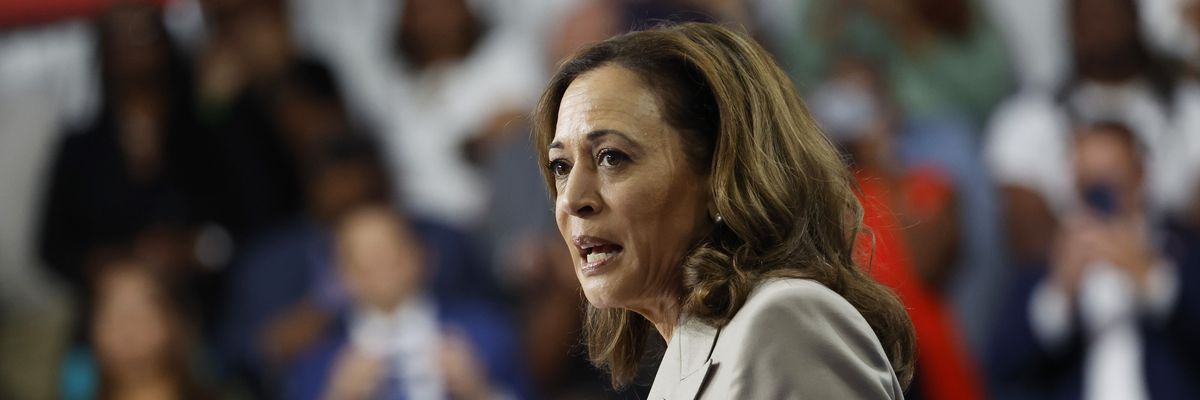
U.S. Vice President Kamala Harris gives remarks alongside U.S. President Joe Biden at Prince George’s Community College on August 15, 2024 in Largo, Maryland.
Proposals to lower housing, childcare, and healthcare costs for millions of families are "a welcome step in the right direction," said one advocate.
After announcing earlier this week that U.S. Vice President Kamala Harris plans to take on corporate price gouging with the first-ever federal ban in the food and grocery industries, the Democratic presidential nominee's campaign on Friday unveiled details about Harris' broader economic agenda, making clear to advocates that she is focused on lowering numerous costs facing working households.
Along with a four-year plan to boost housing construction, provide financial help to first-time homebuyers, and rein in predatory corporate landlords, Harris announced plans to lower medical costs and provide financial assistance to new parents and families raising young children.
The proposals, which Harris is expected to officially announce at a campaign event in Raleigh, North Carolina on Friday, send the message that "the days of 'what's good for free enterprise is good for America' are over," Felicia Wong, president of the progressive think tank Roosevelt Forward, told The Washington Post.
"Harris has made a set of policy choices over the last several weeks that make it clear that the Democratic Party is committed to a pro-working, family agenda," Wong said.
Within Harris' plan to lower healthcare costs, the vice president will include proposals to expand Medicare's cap on prescription drug costs at $2,000 annually to all Americans and to place a limit of $35 per month on insulin. Both policies are provisions of the Inflation Reduction Act (IRA) and currently apply only to Medicare recipients. As the Post reported, allowing all Americans to benefit from the price limits "could face resistance from the pharmaceutical industry and Republicans," who have fought to block Medicare drug price negotiations that were also included in the IRA.
Harris said she would work to expedite those negotiations, the first round of which yielded lower costs for 10 widely used medications that were announced by the Biden administration on Thursday.
"Policies that lift up families will always be popular with voters. Working people want to see action from our federal government to address sky-high costs."
The vice president would also work closely with states to cancel medical debt for millions of people "and to help them avoid accumulating such debt in the future, because no one should go bankrupt just because they had the misfortune of becoming sick or hurt," said the Harris campaign. "This plan builds on Vice President Harris' leadership in removing medical debt from nearly all Americans' credit reports and in helping secure American Rescue Plan funds to cancel $7 billion of medical debt for up to 3 million Americans."
The final plank of the economic plan announced on Friday was focused on "cutting taxes for the middle class," the campaign said, with the vice president pledging to restore and expand child tax credits. Republican presidential nominee Donald Trump's campaign has been focusing on the issue in recent weeks as vice presidential candidate Sen. JD Vance (R-Ohio) has come under fire for his criticism of people who don't have children and for his absence from a Senate vote on expanding the existing child tax credit, which nearly the entire GOP Senate caucus voted against.
The Harris campaign said the vice president would restore the expanded child tax credit that provided a credit of up to $3,600 per child for middle- and lower-income families; the program was passed as part of the American Rescue Plan in 2021, but expired at the end of that year due to opposition from the Republican Party and conservative Sen. Joe Manchin (I-W.Va.), then a Democrat.
Harris would also push for a further "historic expansion of the child tax credit: providing up to $6,000 in total tax relief for middle-income and low-income families for the first year of their child's life when a family's expenses are highest—with cribs, diapers, car seats, and more—and many parents are still forced to forgo income as they take time off from their job."
Diane Yentel, president and CEO of the National Low Income Housing Coalition, said the proposal would also work hand-in-hand with Harris' housing plan to "positively impact families' ability to pay rent."
Vance earlier this week called for boosting the child tax credit—currently $2,000 per year—to $5,000, but Sen. Ron Wyden (D-Ore.), who proposed a package last month that would have raised the cap on the credit for low-income families, said Vance's failure to vote on the legislation exposed him as "a phony."
"If JD Vance sincerely gave a whit about working families in America, he would have shown up in the Senate a week and a half ago and voted for my proposal to expand the child tax credit and help 16 million low income kids get ahead," said Wyden. "He didn’t even care enough to use his platform to call on his Senate Republican colleagues to support it."
Maurice Mitchell, national director of the Working Families Party, said that with plans to extend tax cuts that disproportionately benefited corporations and the wealthy, "Trump and Vance are going to look out for bosses and billionaires, while Harris and [Democratic vice presidential candidate Tim] Walz are showing working people that they have their backs."
"Policies that lift up families will always be popular with voters. Working people want to see action from our federal government to address sky-high costs," said Mitchell. "By committing to take on greedflation, lower prescription drug costs, and make housing more affordable, Kamala Harris is listening to the voters she needs to turn out in November."
A Data for Progress poll late last month showed that 75% of Americans support slashing prescription drug prices, 79% support making corporations pay their fair share in taxes, and 58% support restoring the expanded child tax credit.
Joseph Geevarghese, executive director of Our Revolution, called Harris' economic agenda "a welcome step in the right direction, particularly with its focus on tackling corporate price gouging, reining in predatory corporate landlords, reducing prescription drug prices, and providing real relief to working families burdened by medical debt."
"However, to truly address the root causes of economic inequality, we must push for comprehensive reforms that dismantle the structural issues enabling corporations to exploit consumers and workers," said Geevarghese. "The Harris-Walz plan's proposals are critical first steps, but the progressive movement will be watching closely to ensure these policies are not only enacted but rigorously enforced to deliver the meaningful change that Americans desperately need."
Dear Common Dreams reader, It’s been nearly 30 years since I co-founded Common Dreams with my late wife, Lina Newhouser. We had the radical notion that journalism should serve the public good, not corporate profits. It was clear to us from the outset what it would take to build such a project. No paid advertisements. No corporate sponsors. No millionaire publisher telling us what to think or do. Many people said we wouldn't last a year, but we proved those doubters wrong. Together with a tremendous team of journalists and dedicated staff, we built an independent media outlet free from the constraints of profits and corporate control. Our mission has always been simple: To inform. To inspire. To ignite change for the common good. Building Common Dreams was not easy. Our survival was never guaranteed. When you take on the most powerful forces—Wall Street greed, fossil fuel industry destruction, Big Tech lobbyists, and uber-rich oligarchs who have spent billions upon billions rigging the economy and democracy in their favor—the only bulwark you have is supporters who believe in your work. But here’s the urgent message from me today. It's never been this bad out there. And it's never been this hard to keep us going. At the very moment Common Dreams is most needed, the threats we face are intensifying. We need your support now more than ever. We don't accept corporate advertising and never will. We don't have a paywall because we don't think people should be blocked from critical news based on their ability to pay. Everything we do is funded by the donations of readers like you. When everyone does the little they can afford, we are strong. But if that support retreats or dries up, so do we. Will you donate now to make sure Common Dreams not only survives but thrives? —Craig Brown, Co-founder |
After announcing earlier this week that U.S. Vice President Kamala Harris plans to take on corporate price gouging with the first-ever federal ban in the food and grocery industries, the Democratic presidential nominee's campaign on Friday unveiled details about Harris' broader economic agenda, making clear to advocates that she is focused on lowering numerous costs facing working households.
Along with a four-year plan to boost housing construction, provide financial help to first-time homebuyers, and rein in predatory corporate landlords, Harris announced plans to lower medical costs and provide financial assistance to new parents and families raising young children.
The proposals, which Harris is expected to officially announce at a campaign event in Raleigh, North Carolina on Friday, send the message that "the days of 'what's good for free enterprise is good for America' are over," Felicia Wong, president of the progressive think tank Roosevelt Forward, told The Washington Post.
"Harris has made a set of policy choices over the last several weeks that make it clear that the Democratic Party is committed to a pro-working, family agenda," Wong said.
Within Harris' plan to lower healthcare costs, the vice president will include proposals to expand Medicare's cap on prescription drug costs at $2,000 annually to all Americans and to place a limit of $35 per month on insulin. Both policies are provisions of the Inflation Reduction Act (IRA) and currently apply only to Medicare recipients. As the Post reported, allowing all Americans to benefit from the price limits "could face resistance from the pharmaceutical industry and Republicans," who have fought to block Medicare drug price negotiations that were also included in the IRA.
Harris said she would work to expedite those negotiations, the first round of which yielded lower costs for 10 widely used medications that were announced by the Biden administration on Thursday.
"Policies that lift up families will always be popular with voters. Working people want to see action from our federal government to address sky-high costs."
The vice president would also work closely with states to cancel medical debt for millions of people "and to help them avoid accumulating such debt in the future, because no one should go bankrupt just because they had the misfortune of becoming sick or hurt," said the Harris campaign. "This plan builds on Vice President Harris' leadership in removing medical debt from nearly all Americans' credit reports and in helping secure American Rescue Plan funds to cancel $7 billion of medical debt for up to 3 million Americans."
The final plank of the economic plan announced on Friday was focused on "cutting taxes for the middle class," the campaign said, with the vice president pledging to restore and expand child tax credits. Republican presidential nominee Donald Trump's campaign has been focusing on the issue in recent weeks as vice presidential candidate Sen. JD Vance (R-Ohio) has come under fire for his criticism of people who don't have children and for his absence from a Senate vote on expanding the existing child tax credit, which nearly the entire GOP Senate caucus voted against.
The Harris campaign said the vice president would restore the expanded child tax credit that provided a credit of up to $3,600 per child for middle- and lower-income families; the program was passed as part of the American Rescue Plan in 2021, but expired at the end of that year due to opposition from the Republican Party and conservative Sen. Joe Manchin (I-W.Va.), then a Democrat.
Harris would also push for a further "historic expansion of the child tax credit: providing up to $6,000 in total tax relief for middle-income and low-income families for the first year of their child's life when a family's expenses are highest—with cribs, diapers, car seats, and more—and many parents are still forced to forgo income as they take time off from their job."
Diane Yentel, president and CEO of the National Low Income Housing Coalition, said the proposal would also work hand-in-hand with Harris' housing plan to "positively impact families' ability to pay rent."
Vance earlier this week called for boosting the child tax credit—currently $2,000 per year—to $5,000, but Sen. Ron Wyden (D-Ore.), who proposed a package last month that would have raised the cap on the credit for low-income families, said Vance's failure to vote on the legislation exposed him as "a phony."
"If JD Vance sincerely gave a whit about working families in America, he would have shown up in the Senate a week and a half ago and voted for my proposal to expand the child tax credit and help 16 million low income kids get ahead," said Wyden. "He didn’t even care enough to use his platform to call on his Senate Republican colleagues to support it."
Maurice Mitchell, national director of the Working Families Party, said that with plans to extend tax cuts that disproportionately benefited corporations and the wealthy, "Trump and Vance are going to look out for bosses and billionaires, while Harris and [Democratic vice presidential candidate Tim] Walz are showing working people that they have their backs."
"Policies that lift up families will always be popular with voters. Working people want to see action from our federal government to address sky-high costs," said Mitchell. "By committing to take on greedflation, lower prescription drug costs, and make housing more affordable, Kamala Harris is listening to the voters she needs to turn out in November."
A Data for Progress poll late last month showed that 75% of Americans support slashing prescription drug prices, 79% support making corporations pay their fair share in taxes, and 58% support restoring the expanded child tax credit.
Joseph Geevarghese, executive director of Our Revolution, called Harris' economic agenda "a welcome step in the right direction, particularly with its focus on tackling corporate price gouging, reining in predatory corporate landlords, reducing prescription drug prices, and providing real relief to working families burdened by medical debt."
"However, to truly address the root causes of economic inequality, we must push for comprehensive reforms that dismantle the structural issues enabling corporations to exploit consumers and workers," said Geevarghese. "The Harris-Walz plan's proposals are critical first steps, but the progressive movement will be watching closely to ensure these policies are not only enacted but rigorously enforced to deliver the meaningful change that Americans desperately need."
After announcing earlier this week that U.S. Vice President Kamala Harris plans to take on corporate price gouging with the first-ever federal ban in the food and grocery industries, the Democratic presidential nominee's campaign on Friday unveiled details about Harris' broader economic agenda, making clear to advocates that she is focused on lowering numerous costs facing working households.
Along with a four-year plan to boost housing construction, provide financial help to first-time homebuyers, and rein in predatory corporate landlords, Harris announced plans to lower medical costs and provide financial assistance to new parents and families raising young children.
The proposals, which Harris is expected to officially announce at a campaign event in Raleigh, North Carolina on Friday, send the message that "the days of 'what's good for free enterprise is good for America' are over," Felicia Wong, president of the progressive think tank Roosevelt Forward, told The Washington Post.
"Harris has made a set of policy choices over the last several weeks that make it clear that the Democratic Party is committed to a pro-working, family agenda," Wong said.
Within Harris' plan to lower healthcare costs, the vice president will include proposals to expand Medicare's cap on prescription drug costs at $2,000 annually to all Americans and to place a limit of $35 per month on insulin. Both policies are provisions of the Inflation Reduction Act (IRA) and currently apply only to Medicare recipients. As the Post reported, allowing all Americans to benefit from the price limits "could face resistance from the pharmaceutical industry and Republicans," who have fought to block Medicare drug price negotiations that were also included in the IRA.
Harris said she would work to expedite those negotiations, the first round of which yielded lower costs for 10 widely used medications that were announced by the Biden administration on Thursday.
"Policies that lift up families will always be popular with voters. Working people want to see action from our federal government to address sky-high costs."
The vice president would also work closely with states to cancel medical debt for millions of people "and to help them avoid accumulating such debt in the future, because no one should go bankrupt just because they had the misfortune of becoming sick or hurt," said the Harris campaign. "This plan builds on Vice President Harris' leadership in removing medical debt from nearly all Americans' credit reports and in helping secure American Rescue Plan funds to cancel $7 billion of medical debt for up to 3 million Americans."
The final plank of the economic plan announced on Friday was focused on "cutting taxes for the middle class," the campaign said, with the vice president pledging to restore and expand child tax credits. Republican presidential nominee Donald Trump's campaign has been focusing on the issue in recent weeks as vice presidential candidate Sen. JD Vance (R-Ohio) has come under fire for his criticism of people who don't have children and for his absence from a Senate vote on expanding the existing child tax credit, which nearly the entire GOP Senate caucus voted against.
The Harris campaign said the vice president would restore the expanded child tax credit that provided a credit of up to $3,600 per child for middle- and lower-income families; the program was passed as part of the American Rescue Plan in 2021, but expired at the end of that year due to opposition from the Republican Party and conservative Sen. Joe Manchin (I-W.Va.), then a Democrat.
Harris would also push for a further "historic expansion of the child tax credit: providing up to $6,000 in total tax relief for middle-income and low-income families for the first year of their child's life when a family's expenses are highest—with cribs, diapers, car seats, and more—and many parents are still forced to forgo income as they take time off from their job."
Diane Yentel, president and CEO of the National Low Income Housing Coalition, said the proposal would also work hand-in-hand with Harris' housing plan to "positively impact families' ability to pay rent."
Vance earlier this week called for boosting the child tax credit—currently $2,000 per year—to $5,000, but Sen. Ron Wyden (D-Ore.), who proposed a package last month that would have raised the cap on the credit for low-income families, said Vance's failure to vote on the legislation exposed him as "a phony."
"If JD Vance sincerely gave a whit about working families in America, he would have shown up in the Senate a week and a half ago and voted for my proposal to expand the child tax credit and help 16 million low income kids get ahead," said Wyden. "He didn’t even care enough to use his platform to call on his Senate Republican colleagues to support it."
Maurice Mitchell, national director of the Working Families Party, said that with plans to extend tax cuts that disproportionately benefited corporations and the wealthy, "Trump and Vance are going to look out for bosses and billionaires, while Harris and [Democratic vice presidential candidate Tim] Walz are showing working people that they have their backs."
"Policies that lift up families will always be popular with voters. Working people want to see action from our federal government to address sky-high costs," said Mitchell. "By committing to take on greedflation, lower prescription drug costs, and make housing more affordable, Kamala Harris is listening to the voters she needs to turn out in November."
A Data for Progress poll late last month showed that 75% of Americans support slashing prescription drug prices, 79% support making corporations pay their fair share in taxes, and 58% support restoring the expanded child tax credit.
Joseph Geevarghese, executive director of Our Revolution, called Harris' economic agenda "a welcome step in the right direction, particularly with its focus on tackling corporate price gouging, reining in predatory corporate landlords, reducing prescription drug prices, and providing real relief to working families burdened by medical debt."
"However, to truly address the root causes of economic inequality, we must push for comprehensive reforms that dismantle the structural issues enabling corporations to exploit consumers and workers," said Geevarghese. "The Harris-Walz plan's proposals are critical first steps, but the progressive movement will be watching closely to ensure these policies are not only enacted but rigorously enforced to deliver the meaningful change that Americans desperately need."