SUBSCRIBE TO OUR FREE NEWSLETTER
Daily news & progressive opinion—funded by the people, not the corporations—delivered straight to your inbox.
5
#000000
#FFFFFF
To donate by check, phone, or other method, see our More Ways to Give page.
Daily news & progressive opinion—funded by the people, not the corporations—delivered straight to your inbox.
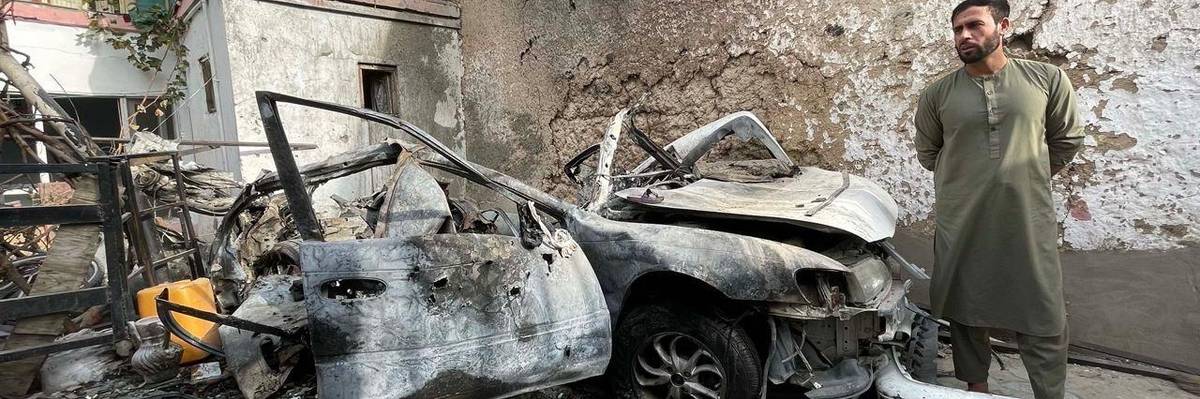
A man stands next to the wreckage of the car that was struck by a U.S. drone strike on August 29, 2021, killing 10 civilians including seven children, in Kabul, Afghanistan.
One Amnesty International campaigner called the new report "more evidence that we need a huge change in how the U.S. uses lethal force and assesses and reveals its consequences."
U.S. military officials knew that an August 2021 drone strike in Kabul likely killed Afghan civilians including children but lied about it, a report published Friday revealed.
New York Times investigative reporter Azmat Khan analyzed a 66-page redacted U.S. Central Command report on the August 29, 2021 drone strike that killed 10 members of the Ahmadi family, including seven children, outside their home in the Afghan capital. The strike took place during the chaotic final days of the U.S. ground war in Afghanistan, just three days after a bombing that killed at least 182 people, including 13 American troops, at Kabul's international airport.
"When confirmation bias was so deadly in this case, you have to ask how many other people targeted by the military over the years were also unjustly killed."
Zamarai Ahmadi, a 43-year-old aid worker for California-based nonprofit Nutrition and Education International, was carrying water containers that were mistaken for explosives when his Toyota Corolla was bombed by a Lockheed-Martin Hellfire missile fired from a General Atomics MQ-9 Reaper drone.
As reports of civilian casualties began circulating hours after the strike, U.S. military officials claimed there were "no indications" that noncombatants were harmed in the attack, while stating that they would investigate whether a secondary explosion may have killed or wounded people nearby.
However, as the Times details:
Portions of a U.S. Central Command investigation obtained by The New York Times show that military analysts reported within minutes of the strike that civilians may have been killed, and within three hours had assessed that at least three children were killed.
The documents also provide detailed examples of how assumptions and biases led to the deadly blunder.
Military analysts wrongly concluded, for example, that a package loaded into the car contained explosives because of its "careful handling and size," and that the driver's "erratic route" was evidence that he was trying to evade surveillance.
Furthermore:
The investigation refers to an additional surveillance drone not under military control that was also tracking the vehicle but does not specify what it observed. The Times confirmed that the drone was operated by the CIA and observed children, possibly in the car, moments before impact, as CNN had reported.
U.S. military officials initially claimed the "righteous strike" had prevented an imminent new attack on the airport. However they later admitted that the botched bombing was a "horrible mistake."
The military's investigation was completed less than two weeks after the strike. However, it was never released to the public. The Pentagon said it would not punish anyone for killing the Ahmadi family.
Hina Shamsi, an ACLU attorney representing families victims of the strike, told the Times that the investigation "makes clear that military personnel saw what they wanted to see and not reality, which was an Afghan aid worker going about his daily life."
"When confirmation bias was so deadly in this case, you have to ask how many other people targeted by the military over the years were also unjustly killed," Shamsi added.
Daphne Eviatar, who heads Amnesty International's Security With Human Rights program, called the new report "more evidence that we need a huge change in how the U.S. uses lethal force and assesses and reveals its consequences."
Dear Common Dreams reader, It’s been nearly 30 years since I co-founded Common Dreams with my late wife, Lina Newhouser. We had the radical notion that journalism should serve the public good, not corporate profits. It was clear to us from the outset what it would take to build such a project. No paid advertisements. No corporate sponsors. No millionaire publisher telling us what to think or do. Many people said we wouldn't last a year, but we proved those doubters wrong. Together with a tremendous team of journalists and dedicated staff, we built an independent media outlet free from the constraints of profits and corporate control. Our mission has always been simple: To inform. To inspire. To ignite change for the common good. Building Common Dreams was not easy. Our survival was never guaranteed. When you take on the most powerful forces—Wall Street greed, fossil fuel industry destruction, Big Tech lobbyists, and uber-rich oligarchs who have spent billions upon billions rigging the economy and democracy in their favor—the only bulwark you have is supporters who believe in your work. But here’s the urgent message from me today. It's never been this bad out there. And it's never been this hard to keep us going. At the very moment Common Dreams is most needed, the threats we face are intensifying. We need your support now more than ever. We don't accept corporate advertising and never will. We don't have a paywall because we don't think people should be blocked from critical news based on their ability to pay. Everything we do is funded by the donations of readers like you. When everyone does the little they can afford, we are strong. But if that support retreats or dries up, so do we. Will you donate now to make sure Common Dreams not only survives but thrives? —Craig Brown, Co-founder |
U.S. military officials knew that an August 2021 drone strike in Kabul likely killed Afghan civilians including children but lied about it, a report published Friday revealed.
New York Times investigative reporter Azmat Khan analyzed a 66-page redacted U.S. Central Command report on the August 29, 2021 drone strike that killed 10 members of the Ahmadi family, including seven children, outside their home in the Afghan capital. The strike took place during the chaotic final days of the U.S. ground war in Afghanistan, just three days after a bombing that killed at least 182 people, including 13 American troops, at Kabul's international airport.
"When confirmation bias was so deadly in this case, you have to ask how many other people targeted by the military over the years were also unjustly killed."
Zamarai Ahmadi, a 43-year-old aid worker for California-based nonprofit Nutrition and Education International, was carrying water containers that were mistaken for explosives when his Toyota Corolla was bombed by a Lockheed-Martin Hellfire missile fired from a General Atomics MQ-9 Reaper drone.
As reports of civilian casualties began circulating hours after the strike, U.S. military officials claimed there were "no indications" that noncombatants were harmed in the attack, while stating that they would investigate whether a secondary explosion may have killed or wounded people nearby.
However, as the Times details:
Portions of a U.S. Central Command investigation obtained by The New York Times show that military analysts reported within minutes of the strike that civilians may have been killed, and within three hours had assessed that at least three children were killed.
The documents also provide detailed examples of how assumptions and biases led to the deadly blunder.
Military analysts wrongly concluded, for example, that a package loaded into the car contained explosives because of its "careful handling and size," and that the driver's "erratic route" was evidence that he was trying to evade surveillance.
Furthermore:
The investigation refers to an additional surveillance drone not under military control that was also tracking the vehicle but does not specify what it observed. The Times confirmed that the drone was operated by the CIA and observed children, possibly in the car, moments before impact, as CNN had reported.
U.S. military officials initially claimed the "righteous strike" had prevented an imminent new attack on the airport. However they later admitted that the botched bombing was a "horrible mistake."
The military's investigation was completed less than two weeks after the strike. However, it was never released to the public. The Pentagon said it would not punish anyone for killing the Ahmadi family.
Hina Shamsi, an ACLU attorney representing families victims of the strike, told the Times that the investigation "makes clear that military personnel saw what they wanted to see and not reality, which was an Afghan aid worker going about his daily life."
"When confirmation bias was so deadly in this case, you have to ask how many other people targeted by the military over the years were also unjustly killed," Shamsi added.
Daphne Eviatar, who heads Amnesty International's Security With Human Rights program, called the new report "more evidence that we need a huge change in how the U.S. uses lethal force and assesses and reveals its consequences."
U.S. military officials knew that an August 2021 drone strike in Kabul likely killed Afghan civilians including children but lied about it, a report published Friday revealed.
New York Times investigative reporter Azmat Khan analyzed a 66-page redacted U.S. Central Command report on the August 29, 2021 drone strike that killed 10 members of the Ahmadi family, including seven children, outside their home in the Afghan capital. The strike took place during the chaotic final days of the U.S. ground war in Afghanistan, just three days after a bombing that killed at least 182 people, including 13 American troops, at Kabul's international airport.
"When confirmation bias was so deadly in this case, you have to ask how many other people targeted by the military over the years were also unjustly killed."
Zamarai Ahmadi, a 43-year-old aid worker for California-based nonprofit Nutrition and Education International, was carrying water containers that were mistaken for explosives when his Toyota Corolla was bombed by a Lockheed-Martin Hellfire missile fired from a General Atomics MQ-9 Reaper drone.
As reports of civilian casualties began circulating hours after the strike, U.S. military officials claimed there were "no indications" that noncombatants were harmed in the attack, while stating that they would investigate whether a secondary explosion may have killed or wounded people nearby.
However, as the Times details:
Portions of a U.S. Central Command investigation obtained by The New York Times show that military analysts reported within minutes of the strike that civilians may have been killed, and within three hours had assessed that at least three children were killed.
The documents also provide detailed examples of how assumptions and biases led to the deadly blunder.
Military analysts wrongly concluded, for example, that a package loaded into the car contained explosives because of its "careful handling and size," and that the driver's "erratic route" was evidence that he was trying to evade surveillance.
Furthermore:
The investigation refers to an additional surveillance drone not under military control that was also tracking the vehicle but does not specify what it observed. The Times confirmed that the drone was operated by the CIA and observed children, possibly in the car, moments before impact, as CNN had reported.
U.S. military officials initially claimed the "righteous strike" had prevented an imminent new attack on the airport. However they later admitted that the botched bombing was a "horrible mistake."
The military's investigation was completed less than two weeks after the strike. However, it was never released to the public. The Pentagon said it would not punish anyone for killing the Ahmadi family.
Hina Shamsi, an ACLU attorney representing families victims of the strike, told the Times that the investigation "makes clear that military personnel saw what they wanted to see and not reality, which was an Afghan aid worker going about his daily life."
"When confirmation bias was so deadly in this case, you have to ask how many other people targeted by the military over the years were also unjustly killed," Shamsi added.
Daphne Eviatar, who heads Amnesty International's Security With Human Rights program, called the new report "more evidence that we need a huge change in how the U.S. uses lethal force and assesses and reveals its consequences."