

SUBSCRIBE TO OUR FREE NEWSLETTER
Daily news & progressive opinion—funded by the people, not the corporations—delivered straight to your inbox.
5
#000000
#FFFFFF
To donate by check, phone, or other method, see our More Ways to Give page.
Daily news & progressive opinion—funded by the people, not the corporations—delivered straight to your inbox.
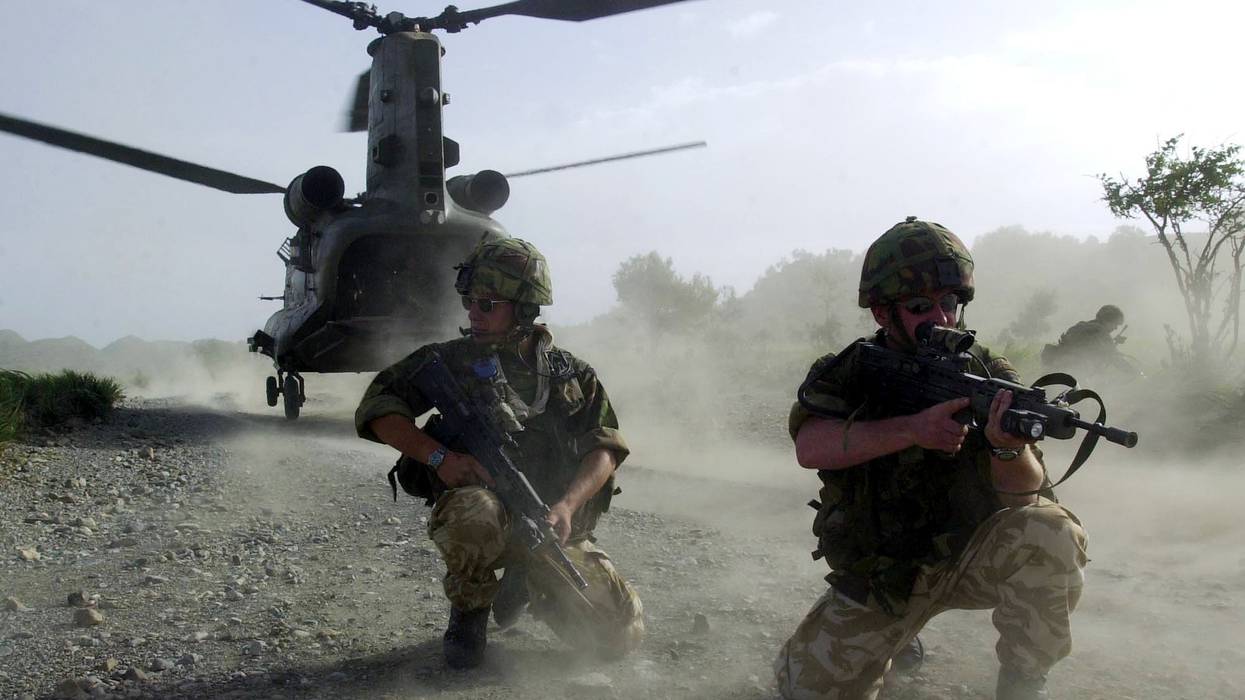
"They handcuffed a young boy and shot him," said one Special Air Service veteran.
Dozens of former United Kingdom Special Forces troops or those who served with them have broken their silence to describe alleged war crimes they witnessed—including the execution of children—during the U.S.-led wars on Afghanistan and Iraq.
BBC's "Panorama"—which has repeatedly aired episodes focused on war crimes committed by British soldiers during the so-called War on Terror—on Monday featured testimonies from 30 former U.K. Special Forces (UKSF) members, including Special Air Service (SAS), Special Boat Service (SBS), and supporting troops who served in Afghanistan and Iraq.
"They handcuffed a young boy and shot him," recalled one SAS veteran who fought in Afghanistan. "He was clearly a child, not even close to fighting age."
"It's not justified, killing people in their sleep."
Another veteran who served with the SAS said that killing was "intoxicating" for some soldiers and became "an addictive thing to do," adding that there were "lots of psychotic murderers" among the ranks.
"On some operations, the troop would go into guesthouse-type buildings and kill everyone there," he said. "They'd go in and shoot everyone sleeping there, on entry. It's not justified, killing people in their sleep."
One SBS veteran described executions of wounded people who posed no threat, including one man who was being treated by a medic when "one of our blokes came up to him."
"There was a bang. He'd been shot in the head at point-blank range," the veteran recalled, describing the killing and other like it as "completely unnecessary."
"These are not mercy killings," he said. "It's murder."
Another veteran recounted a fellow SAS commando who kept track of the dozens of Afghans he'd killed during his six-month deployment.
"It seemed like he was trying to get a kill on every operation, every night someone got killed," the former soldier said, adding that his colleague was "notorious in the squadron; he genuinely seemed like a psychopath."
The soldier allegedly slit the throat of an injured Afghan man after telling an officer not to shoot him again, "because he wanted to go and finish the wounded guy off with his knife."
Another veteran said "everyone knew" what was happening and that to avoid scrutiny for executions, British troops would plant "drop weapons" on victims' bodies to make it appear as if they were militants. U.S. troops—who widely engaged in this war crime—called it "dead-checking."
One veteran said that "there was implicit approval for what was happening" from commanders.
"We understood how to write up serious incident reviews so they wouldn't trigger a referral to the military police," he explained. "If it looked like a shooting could represent a breach of the rules of conflict, you'd get a phone call from the legal adviser or one of the staff officers in HQ. They'd pick you up on it and help you to clarify the language. 'Do you remember someone making a sudden move?' 'Oh yeah, I do now.' That sort of thing. It was built into the way we operated."
"Panorama" also confirmed for the first time that former Conservative U.K. Prime Minister David Cameron, who was in office from 2010-16, was repeatedly warned that British troops were committing war crimes.
Gen. Douglas Lute, a former U.S. ambassador to NATO, told "Panorama" that then-Afghan President Hamid Karzai—who repeatedly condemned American war crimes in his country—was "so consistent with his complaints about night raids, civilian casualties, and detentions that there was no senior Western diplomat or military leader who would have missed the fact that this was a major irritant for him."
In 2020, the International Criminal Courtdetermined that British troops committed war crimes in Iraq but declined to prosecute any alleged perpetrators.
Documented war crimes committed by U.S. troops, mercenaries, and other private contractors in nations including Afghanistan, Iraq, Pakistan, Yemen, Somalia, Libya, and Syria during the ongoing War on Terror include but are not limited to murder of civilians and detainees, extraordinary rendition, torture, rape, and jailing and sexual abuse of women and girls held as bargaining chips.
Whistleblowers who exposed these and other illegalities—including WikiLeaks founder Julian Assange, former NSA operative Edward Snowden, former Army analyst Chelsea Manning, former CIA intelligence officer John Kiriakou, and others—were almost always the only ones ever punished in connection with the crimes they exposed.
Other coalition troops—including Afghans, Iraqis, Australians, Germans, Poles, and Canadians—have allegedly committed atrocities during the War on Terror, as have Taliban, al-Qaeda, Islamic State, and other militants.
According to the Costs of War Project at Brown University's Watson Institute for International and Public Affairs, "at least 940,000 people have died due to direct war violence, including civilians, armed forces on all sides, contractors, journalists, and humanitarian workers" in U.S.-led wars since 9/11. This figure includes at least 408,000 civilians.
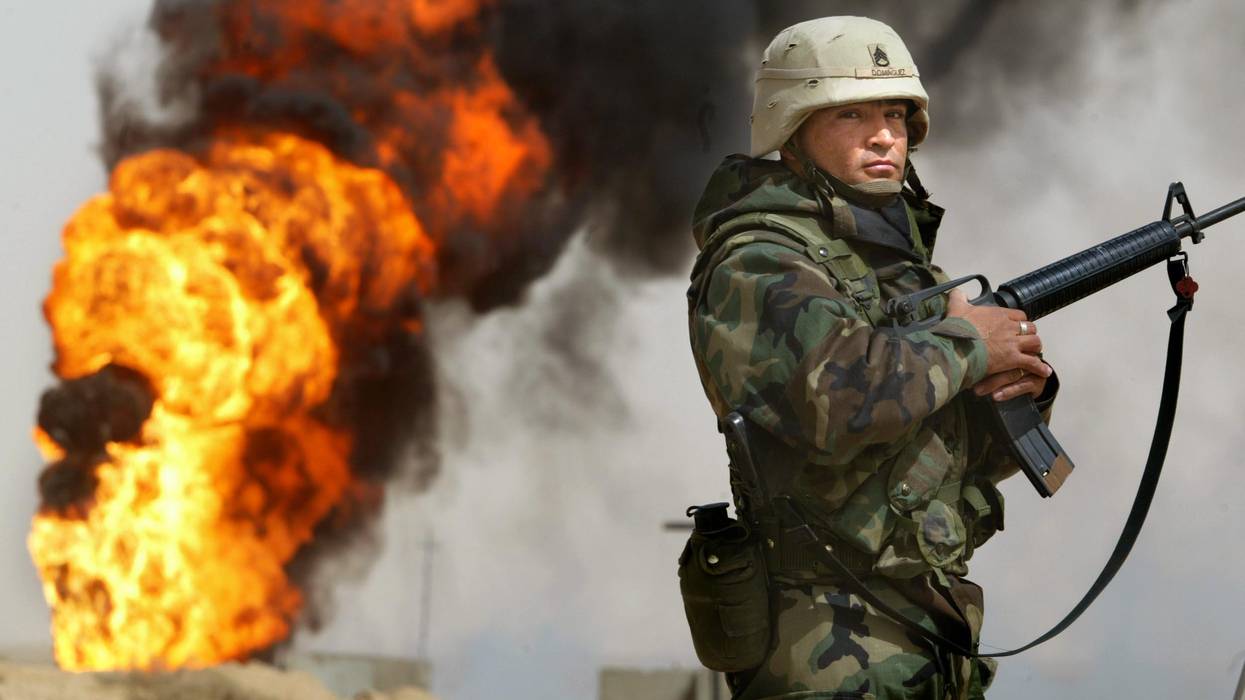
Prior to 2001, U.S. wars were financed through a mixture of higher taxes and budget cuts, and funded mostly through the regular defense budget. The post-9/11 war funding pattern was completely different.
The post-9/11 wars in Iraq and Afghanistan were enabled by a historically unprecedented combination of budgetary procedures and financing methods. Unlike all previous U.S. wars, the post-9/11 wars were funded without higher taxes or non-war budget cuts, and through a separate budget. This set of circumstances – one that I have termed the “Ghost Budget” – enabled successive administrations to prosecute the wars with limited congressional oversight and minimal transparency and public debate. I adopted the name “Ghost Budget” because the term “ghost” appeared frequently in post-9/11 government reports in reference to funds allocated to people, places, or projects that turned out to be phantoms.
The Ghost Budget was the result of an interplay between changes in the U.S. budgetary process, a more assertive military establishment, and the conditions in global capital markets. It has had far-reaching implications for the conduct and course of the post-9/11 wars and for defense policy today.
The “Ghost Budget” was the biggest budgetary anomaly in U.S. history. Prior to 9/11, U.S. wars were financed through a mixture of higher taxes and budget cuts, and funded mostly through the regular defense budget. One third of the costs of World War I and half the costs of World War II were met through higher taxes. During World War II, President Franklin D. Roosevelt described paying taxes as a “patriotic duty” as he raised taxes on business, imposed a “wealth tax,” raised inheritance taxes, and expanded the number of income taxpayers to roughly 80 percent of the workforce by 1945. Wars in Korea and Vietnam largely followed a similar pattern, with President Harry Truman pledging to make the country “pay as you go” for the Korean War. War funding was also a central issue in the Vietnam War, which ended when Congress refused to appropriate money for the South Vietnamese military.
The post-9/11 war funding pattern was completely different. For the first time since the American Revolutionary War, war costs were covered almost entirely by debt. There were no wartime tax increases or cuts in spending. Quite the reverse: far from demanding sacrifices, President George W. Bush slashed federal taxes in 2001 and again in 2003, just as the United States invaded Iraq. President Donald Trump reduced taxes further in 2017. Overall, federal taxes declined from 18.8 percent of GDP in 2001 to 16.2 percent by the start of 2020. In the same period, outstanding federal debt held by the public rose from $3.5 trillion to $20 trillion. War spending contributed at least $2.2 trillion to this increase.
Not only was the financing strategy unprecedented, but the budgetary mechanism used to approve the vast post-9/11 wartime spending also diverged radically from the past. In all previous conflicts, the United States paid for wars as part of its regular defense appropriations (the defense “base budget”), after the initial period (1-2 years) of supplemental “emergency” funding bills. By contrast, for the entire decade from FY 2001 to FY 2011, Congress paid for the conflicts in Iraq and Afghanistan as “emergencies,” devoid of serious legislative or executive oversight.
By statute, emergency spending is defined as “unanticipated…sudden…urgent…unforeseen…and temporary” and is typically reserved for one-off crises such as floods and hurricanes. Such emergency spending measures are exempt from regular procedural rules in Congress because the intent is to disburse money quickly in situations where delay would be harmful.
Congress continued to enact “emergency supplemental” funding even as the war effort expanded. The United States sent 130,000 military personnel into Iraq in 2003 (alongside troops from more than 30 countries). By 2009, there were 187,200 U.S. “boots on the ground” in Iraq and Afghanistan, supported by a similar number of military contractors, with nearly 500 U.S. military bases set up across Iraq, but the conflict was still being paid for as an “emergency.” In FY 2012, President Obama renamed the “Global War on Terror” as “Overseas Contingency Operations” (OCO) but the war continued to be funded using money that – although not designated as “emergency” – was explicitly exempted from regular spending limits on other government spending programs.
There were three primary drivers of the Ghost Budget: unusual economic conditions, congressional budget dysfunction, and military assertiveness.
Economic Conditions: Unlike earlier wars, the post 9/11 conflicts took place in an era of free-flowing international capital markets. That provided the U.S. Treasury with access to a deep and global pool of capital, making it easy to borrow large amounts without negatively affecting the cost. It was also a period of historically low interest rates. Real interest rates (nominal rate minus inflation) on 10-year Treasury bonds fell from 3.4% at the start of 2001 to negative (-0.4%) by early 2021 — a 40-year low. Consequently, the Treasury was able to borrow trillions of dollars to pay for the wars, and simultaneously finance the tax cuts of 2001 and 2003 without having any material effect on the amount of debt service being repaid through the annual budget. By FY 2017, total public debt had more than tripled, but debt service payments as a percentage of annual budget outlays had decreased to 6.6 percent, compared to 8.5 percent of federal budget outlays in FY 2002. In terms of cash outlays, this meant that the United States paid only slightly more in interest payments in FY 2017 than it had in FY 2002 ($268 billion versus $232 billion in 2018 dollars). Borrowing seemed virtually painless.
Budget Dysfunction: For several decades, the federal budget process has become increasingly dysfunctional. This breakdown may be traced to the post-Watergate budget reforms enacted in 1974, which shifted power away from the President and to the Congress. Most budget experts from both parties agree that the reforms made the budget process weaker, less predictable, less capable of reconciling competing demands, and more prone to fiscal crises. Prior to 1974, the federal government had never ceased operations for lack of funding. Since then, it has “shut down” 22 times, completely or partially. There have been only four years in which Congress passed its annual appropriations bills on time, and a series of near-defaults and other fiscal crises. In the absence of reliable budgets, Congress has enacted hundreds of short-term stopgap “continuing resolutions” to pay the bills. In this context, it was convenient for all the stakeholders to fund the wars as an“emergency” outside the regular process. The President was able to exclude war funding from his annual defense budget request to Congress, thus presenting an artificially low number for the federal budget deficit. This helped the Bush administration sustain the pretense that the wars would be short, while pursuing its political agenda of cutting taxes. Meanwhile, Congress was freed from the need to find politically painful spending cuts elsewhere to pay for the war, and the Pentagon was able to prosecute the wars without worrying about whether Congress would pass the defense appropriations bills on time.
Military Assertiveness: In 2001, the Pentagon was actively seeking to increase its budget after a decade of post-cold war budget cuts. The Afghanistan and Iraq conflict not only reversed the downward trend in military spending, but opened the floodgates to a spending bonanza due to the nature of emergency and OCO appropriations. Unlike the regular defense base budget, the wartime supplemental money was easier to secure, had few restrictions on how it could be spent, and avoided the lengthy internal Planning, Programming, Budgeting & Execution Process (PPBE) budget justification process. Consequently, the Defense Department was able to shift war funding into other categories to obtain items on its long-time “wish list” that were only tangentially (or not at all) related to the wars in Iraq or Afghanistan. Former Defense Secretary Robert Gates termed this a “culture of endless money” inside the Pentagon.
By 2009, war spending accounted for almost one quarter of the total military budget; the Pentagon budget had grown to its highest level since the Second World War, and military spending had rebounded from 2.9% of GDP in FY 2001 to above 4% of GDP, where it remained through FY 2019. The OCO budget had evolved into a second defense budget that was largely untethered from the wars, and protected the military from congressional budget volatility.
The Ghost Budget provided the ability to keep borrowing and spending in an almost unconstrained manner for more than two decades. The absence of new taxes insulated the public from the mounting cost of the wars and broke the expectation that wars would inevitably involve higher taxes. The OCO budget extended far beyond the immediate operational needs of the wars in Afghanistan and Iraq, perpetuating military actions throughout the region. As Immanuel Kant predicted in Perpetual Peace (1795), the ability to keep borrowing and spending with minimal oversight allowed the United States to keep fighting indefinitely.
The Ghost Budget also weakened the main lever through which Congress maintains control of a war, namely its control of the purse. The combination of deferred spending, weak oversight, broadening definition of war costs, and readily available supplemental funding relaxed the pressure to maintain budget discipline over military spending. Congress held fewer hearings and presidents made fewer public speeches about the war compared to previous conflicts. And the ready availability of funds for new defense programs encouraged successive administrations to see the world through a “Pentagon lens,” which views military intervention as the default foreign policy option.
The legacy of the Ghost Budget is that money is no longer a serious deterrent to war. To date, 99% of US assistance to Ukraine has been funded by supplemental emergency funds – which means that this spending is in addition to the $840 billion regular defense budget. The Biden administration has asked Congress to approve another $106 billion in emergency funding for the Middle East, Ukraine, and other regions. Regardless of the merits of any particular endeavor, the use of Ghost Budgets makes it far easier to prolong the fighting at any cost.
Just Security Editor’s Note: This article is part of our Ending Perpetual War Symposium. The article derives from a chapter in Brianna Rosen, ed., Perpetual War and International Law: Legacies of the War on Terror (Oxford University Press, forthcoming 2024).

Where is the wisdom in doing the same murderous thing again and again, each time expecting a different outcome?
When I was in my early 20s, I seriously considered murdering someone. He had given my best friend genital herpes, which many health practitioners then believed was the agent responsible for causing cervical cancer in women. (It wasn’t.)
Back in the 1970s, though, I believed that, by infecting my friend, he might have set in motion a process that would someday kill her. That he was an arrogant jerk made it that much easier for me to contemplate murdering him. But there was a larger context to my private dream of revenge. My anger was also fed by a growing awareness that so many of us were just then acquiring of the history of systematic patriarchal threats to, and constraints on, the lives of women. And in those heady days of second-wave radical feminism, I could imagine killing that man as a legitimate response, however brutal, to the male violence that seemed to surround me, and as part of a larger uprising of women.
Lest you think that my sense of systemic, state-supported male violence was nothing more than a fever dream of the times, remember that, in the 1970s, domestic violence was still often treated as a predictably normal possibility in marriage. Men’s white sleeveless T-shirts were known as “wife-beaters” and, on reruns of The Honeymooners, I could still watch comedian Jackie Gleason threaten to use his fist to send his wife Alice “to the moon.” Oh, and should you think that everything has changed since then, today, more than half a century after my murderous daydreaming, the Supreme Court is considering a case that could overturn a federal law prohibiting someone from buying a gun while still under a domestic-violence restraining order.
My murderous intentions then might serve as a miniature version of President George W. Bush’s epistemic certainty in 2003 that Iraq possessed weapons of mass destruction.
When I remember what I considered doing at the time, however, I’m now horrified. Even then, I was an antiwar activist, a proponent of nonviolent action against the still-ongoing American war in Vietnam and in the struggle for Black rights here at home. But truly grasping the level of woman-hatred then drove me a little crazy and gave me the urge to fight back in kind.
Was I overreacting to the idea of my friend getting a sexually transmitted disease? Of course I was, especially by trusting so completely my “knowledge” about the connection between herpes and cervical cancer. In fact, what I “knew” would prove dead wrong decades later. Indeed, I didn’t even know (with what a philosopher might call “epistemic certainty“) that my friend had gotten herpes from that particular guy in the first place. But someone gave it to her, and someone, I thought, should pay.
My murderous intentions then might serve as a miniature version of President George W. Bush’s epistemic certainty in 2003 that Iraq possessed weapons of mass destruction. (It didn’t.) Did Bush and his vice president, Dick Cheney, truly believe in those weapons of mass destruction? My guess is that they just wanted to invade Iraq and didn’t care one way or the other. Nonetheless, enough people in this country did believe in them—including that illustrious flagship newspaper The New York Times—for the invasion to take place with the support of a majority of Americans.
According to the Iraq Body Count project, at least 300,000 people would die in that war, a substantial majority of them civilians. Brown University’s Costs of War Project has tallied up the human costs of all of America’s post-9/11 wars of revenge and found that “at least 940,000 people have been killed by direct war violence in Iraq, Afghanistan, Syria, Yemen, and Pakistan. The number of people who have been wounded or have fallen ill as a result of the conflicts is far higher.”
Millions more, Costs of War’s research suggests, were killed indirectly through economic collapse, the disruption of public services and health systems, and environmental contamination. And 38 million people were displaced from their homes thanks to Washington’s post-9/11 “Global War on Terror.” That’s about 1,300 people made homeless for each of the almost 3,000 who died in the terrorist attacks of September 11, 2001.
Those 9/11 attacks were a hideous crime. But none of the 19 men directly responsible for them were citizens of any of the countries against which the United States launched its wars of reprisal. (Fifteen were Saudis, two were from the United Arab Emirates, one was Egyptian, and one Lebanese.) Still, it didn’t matter to the people of this country. Someone had killed almost 3,000 of us that day, so someone had to pay.
On October 7, 2023, as the world watched in horror, the military wing of Hamas launched a surprise attack from Gaza, murdering about 1,200 people, most of them Israelis, most of them civilians, significant numbers of them children. They kidnapped as many as 240 others, a few of whom have since died and a few of whom have been released. I must admit that I’m glad my father, raised as an Orthodox Jew in this country, didn’t live to see that day.
Like the U.S. in 2001, Israel has now launched its war of reprisal. The announced goal is the complete destruction of Hamas, which, whether achievable or not, now seems to entail the destruction of much of Gaza itself.
More than 12,000 people, nearly half of them children, have already been killed as of this writing. Half the population—over a million people—have been forcibly displaced from the northern to the southern part of Gaza, supposedly to avoid a crushing aerial war. Meanwhile, an estimated 45% of all housing units in the north have been damaged or destroyed. On November 16, however, Israel began warning people in Khan Younis, a town in southern Gaza, that they would have to move again, as its ground war continued to expand.
Modern wars almost always kill more civilians than combatants, especially when collateral effects like the destruction of infrastructure are taken into account, and they rarely achieve their stated objectives.
To understand what this means, it’s helpful to look at a map of the area. It’s called the Gaza “Strip” because it’s a roughly rectangular little strip of land, less than 25 miles long and 10 miles wide at its widest point. Yet it houses 2.2 million people (half of whom are 18 or younger). It’s surrounded by the Mediterranean Sea on the west, Egypt to the south, and Israel on the east and north. Because most Gazans can never leave and communication with the rest of the world has largely been controlled by Israel, it has been described as the world’s largest open-air prison.
Despite the fact that international humanitarian law, including the Geneva Conventions, absolutely forbids attacks on medical facilities in wartime, the Israel Defense Forces (IDF) launched repeated raids on a number of hospitals and health centers, including the Al-Shifa Hospital, a sprawling medical center in northern Gaza. Here we encounter another instance of how epistemic certainty is used to justify wars and their inevitable collateral damage. In this case, the Israeli government maintained that Al-Shifa sat atop a major Hamas command-and-control center, part of a network of underground tunnels. Just as certainty about Saddam’s weapons of mass destruction justified American crimes in those post-9/11 wars, certainty about a command center that may well turn out not to exist justified attacks on one of northern Gaza’s last functioning hospitals.
There’s no need to further catalog the horrors of this war here. The world’s media has done little else for the last month and a half. Meanwhile, wars continue elsewhere: an ongoing conflict in Sudan has killed thousands and displaced millions to almost no notice in the U.S. media; Europe is living through a World War I-style conflict in Ukraine, where Russian and Ukrainian armies continue to chew through the lives of thousands of soldiers to advance a few yards in one direction or the other.
“War! What is it good for?”
That’s the question the Motown group the Temptations asked back in 1968. Their answer, as people my age will remember, was: “Absolutely nothing!” Modern wars almost always kill more civilians than combatants, especially when collateral effects like the destruction of infrastructure are taken into account, and they rarely achieve their stated objectives.
And yet, today’s wars are regularly fought because people believe war is the best, often the only method of protecting innocent people from violent death. Collective human experience would seem to suggest the opposite. As a means of preventing death, war really does leave something to be desired. Even if you’re willing to treat the deaths of enemy civilians as a “necessary” price to pay for your own people’s survival, history suggests that, in the long run, those deaths won’t protect you. Unless the IDF is prepared to kill everyone in Gaza, it’s unlikely that those who live through the present nightmare will come out of it with less desire to kill Israelis than they had before it started.
It turns out, however, that wars—big and small—are good for something: enriching the corporations that manufacture weapons. As the Los Angeles Times reported in September, the war in Ukraine has been a boon to weapons manufacturers, especially in the United States:
Weapons companies are seeing their shares rise on the stock market to their best level in years, with indexes for the defense sector outperforming those tracking the broader market by a wide margin… The combat in Ukraine, now in its second year, has jacked [up] the global arms trade, fueling a new appetite for matériel not just in Moscow and Kyiv but also around the world as nations gird themselves for possible confrontations. The war has rocked long-standing relationships within the weapons industry, rejiggered the calculations of who sells what to whom and changed customers’ tastes in what they want in their arsenal.
One example of this realignment: Israel and the United Arab Emirates have started a joint weapons development project. European governments, too, from the United Kingdom to Germany, have raised their weapons-production game, with Germany pledging to spend $100 billion to re-equip its armed forces in the next few years.
Now, Ukraine seeks to kill two birds (and a lot of people) with one stone, by partnering with U.S. companies to turn the country into what The Associated Press calls a “weapons hub for the west.” As the Ukrainian Minister for Strategic Industries Oleksandr Kamyshin told the AP, “We’re really focusing on making Ukraine the arsenal of the free world.”
War may not be healthy for children and other living things, but it’s great for the arms industry.
Why, when war so rarely seems to achieve its stated aims, are the people who seek alternatives to it invariably considered naïve or stupid? Where is the wisdom in doing the same murderous thing again and again, each time expecting a different outcome?
War, we are told, is necessary because there is no legitimate alternative. Refusal to use violence when you’ve been attacked or when you live under a regime of grinding oppression is at best stupidity and at worst cowardice. Yet for decades, as journalist Peter Beinart wrote eloquently in The New York Times after the October 7 attacks, Palestinians, who are neither stupid nor cowards, have done precisely that—employing time-honored strategies like the 2018 March of Return, a series of massive peaceful demonstrations at the Israeli wall surrounding Gaza. In the nonviolent Boycott, Divestment, and Sanctions movement, or BDS, Palestinians have adopted a method once employed by the African National Congress to bring pressure on South Africa’s apartheid regime. As a senator, Joe Biden voted for sanctions on South Africa, but as president, he’s condemned the BDS movement as “too often veer[ing] into antisemitism.”
In Israel/Palestine, it turns out there is an alternative to war, indeed more than one. It’s not easy or safe, however. The Israeli organization Standing Together, for example, unites Palestinians and Jews in concrete work, like running a bilingual hotline for people affected by violence or racism, in an effort to bypass what they see as the stagnation miring both major NGOs and the leftist parties in Israel. In the wake of the October 7 attack, they wrote to their supporters:
After over a month in this horrific reality, the feelings of despair are starting to creep up on everyone. It’s in moments like these that solidarity and hope are more important than ever. If we let despair win, we lose our ability to act, and if we don’t act, we won’t have an impact on our reality. We know that, in these incredibly difficult times, we must continue to act—by strengthening the partnership between Jews and Palestinians—and working together to start to think about what happens the day after this deadly war ends, and what kind of society we want to build.
Standing Together is not alone in seeking another way. One of those killed by Hamas was peace activist Vivian Silver, who spent her life building connections between Palestinians and Jewish Israelis. She served on the board of B’tselem, an Israeli human rights organization, and routinely drove Gazans in her car to healthcare appointments in Israel. In her newsletter, her friend Dana Mills, a former director of the Israeli group Peace Now, wrote that “the only way to avenge this horrific loss of Vivian’s life” is to continue to support her demand for justice and peace for everyone “between the river and the sea.”
That response to Silver’s death continues the tradition of nonviolent action as the only possible means of interrupting a deadly cycle of revenge and counter-revenge.
In her essay “On Revolution and Equilibrium,” written at the height of the Black Power movement, the nonviolent activist Barbara Deming addressed a number of critiques of nonviolent action by her comrades. Far from being a coward’s way out, Deming argued, nonviolence in response to aggression is so difficult precisely because it’s so dangerous. On the other hand, nonviolence doesn’t condemn your own side to mass suicide. Take the long view, the one that might extend beyond our own personal deaths, and you’ll see that eventually those who oppose violent oppression with nonviolent obstruction will take fewer casualties than those who choose armed struggle. Eventually (though never soon enough), we’ll wear out the opposition. Yes, some of us will certainly die in the process, because we face real violence. But we’re already dying. The only question is how to prevent more death.
As Deming wrote,
In nonviolent struggle, the violence used against one may mount for a while (indeed, if one is bold in one’s rebellion, it is bound to do so), but the escalation is no longer automatic; with the refusal of one side to retaliate, the mainspring of the automation has been snapped and one can count on reaching a point where de-escalation begins. One can count, that is, in the long run, on receiving far fewer casualties.
I am glad that I encountered this tradition of vigorous nonviolent struggle back when I was in the grip of that murderous rage. It convinced me that I could take more effective action against the systems that demeaned and constrained me than any of my nightmare dreams of violent revenge could offer. The longer I live, the surer I become that, in a world filled with deadly armed struggles, nonviolent rebellion is the only way off the hamster wheel of war.

"Even after the fighting stops, conflicts often leave behind a terrifying legacy: landmines and explosive ordnance that litter communities," said U.N. chief António Guterres. "Peace brings no assurance of safety when roads and fields are mined."
United Nations Secretary-General António Guterres on Tuesday called for far-reaching global action to rid the world of landmines and other lethal remnants of war that endanger civilians for generations on end and impede socioeconomic development.
"For the millions living amidst the chaos of armed conflicts—especially women and children—every step can put them in danger's path," Guterres said in an address marking this year's International Day for Mine Awareness and Assistance in Mine Action.
"Even after the fighting stops, conflicts often leave behind a terrifying legacy: landmines and explosive ordnance that litter communities," he continued. "Peace brings no assurance of safety when roads and fields are mined, when unexploded ordnance threatens the return of displaced populations, and when children find and play with shiny objects that explode."
"Let's take action to end the threat of these devices of death, support communities as they heal, and help people return and rebuild their lives in safety and security."
Since it was established in 1997, the United Nations Mine Action Service (UNMAS) has collaborated with partners "to remove these deadly weapons, support national authorities, and ensure safe access to homes, schools, hospitals, and farmers' fields," said Guterres. "Yet, broader global efforts are essential to safeguard people from mines."
The U.N. chief urged member states "to ratify and fully implement the Anti-Personnel Mine Ban Convention, the Convention on Cluster Munitions, and the Convention on Certain Conventional Weapons."
"Let's take action to end the threat of these devices of death, support communities as they heal, and help people return and rebuild their lives in safety and security," Guterres concluded.
Since 2006, April 4 has been observed as the International Day for Mine Awareness and Assistance in Mine Action. This year, UNMAS is acknowledging the day with a campaign titled "Mine Action Cannot Wait."
On Tuesday afternoon and evening, UNMAS is holding a symposium and launching a multimedia exhibition at the U.N. headquarters in New York City to draw attention to decades of landmine terror and cleanup work in Cambodia, Laos, Vietnam, and Iraq, and to shed light on the devastating effects of more recent explosive ordnance contamination in Colombia, Myanmar, Ukraine, and Yemen.
UNMAS and its partners have also organized events in more than a dozen countries and territories around the globe, including the Central African Republic, Somalia, and Syria. Those began last month and continue through the end of this week.
A previous campaign and digital exhibit launched by Guterres in 2019—"Safe Ground. Safe Steps. Safe Home"—focused on "turning minefields into playing fields," highlighting how human flourishing depends in part on removing what U.N. News describes as "one of the most insidious and indiscriminate weapons of war" from the Earth's surface.
"The threats posed by explosive hazards perpetuate humanitarian crisis and hinder responses and effective peace operations."
As a result of the genocidal wars that French and U.S. imperialists waged on Indochina in the 20th century, more than 64,000 civilians have been killed or injured by landmines and similar devices in Cambodia since 1979, and over 40% of the land in Vietnam's Binh Dinh province was still contaminated by unexploded ordnance as of 2019, according to U.N. News.
More people have been killed or injured by landmines in Afghanistan—an impoverished nation shattered by Soviet and U.S. military invasions and occupations—than anywhere else. Since 1989, 18 million unexploded ordinances have been cleared from Afghan land.
Worldwide, more than 55 million landmines have been destroyed since the late 1990s. During that time, "over 30 countries have become mine-free, casualties have been dramatically reduced, and mechanisms, including the U.N. Voluntary Trust Fund for Assistance in Mine Action, have been established to support victims and communities in need," U.N. News points out.
Nevertheless, the lives of roughly 60 million people in nearly 70 countries and territories are still put in jeopardy on a daily basis by at least 110 million landmines, which "kill and maim between 1,000 and 2,000 people every month," U.N. News notes. "It'll take 1,100 years to clear all the world's active landmines if no new mines are laid."
U.N. Under-Secretary-General for Peace Operations Jean-Pierre Lacroix said Tuesday that "mine action is needed more than ever in the face of global challenges."
"The threats posed by explosive hazards," he added, "perpetuate humanitarian crisis and hinder responses and effective peace operations."

Why we owe future generations our renunciation of all war and our continued vigilance to save this planet from further grief and destruction.
The extraordinary March 10, 2023 announcement that China’s top diplomat, Mr. Wang Yi, helped broker a rapprochement between Saudi Arabia and Iran suggests that major powers can benefit from believing that, as Albert Camus once put it, “words are more powerful than munitions.”
This concept was also acknowledged by General Mark Milley, Chairman of the U.S. Joint Chiefs of Staff who said on January 20th, 2023, that he believes Russia's war in Ukraine will conclude with negotiations rather than on the battlefield. In November of 2022, asked about prospects for diplomacy in Ukraine, Milley noted that the early refusal to negotiate in World War One compounded human suffering and led to millions more casualties.
"So when there's an opportunity to negotiate, when peace can be achieved ... seize the moment," Milley told the Economic Club of New York.
Twenty years ago, in Baghdad, I shared quarters with Iraqis and internationals in a small hotel, the Al-Fanar, which had been home base for numerous Voices in the Wilderness delegations acting in open defiance of the economic sanctions against Iraq. U.S. government officials charged us as criminals for delivering medicines to Iraqi hospitals. In response, we told them we understood the penalties they threatened us with (twelve years in prison and a $1 million fine), but we couldn’t be governed by unjust laws primarily punishing children. And we invited government officials to join us. Instead, we were steadily joined by other peace groups longing to prevent a looming war.
In late January 2003, I still hoped war could be averted. The International Atomic Energy Agency’s report was imminent. If it declared that Iraq didn’t have weapons of mass destruction (WMD), U.S. allies might drop out of the attack plans, in spite of the massive military buildup we were witnessing on nightly television. Then came Secretary of State Colin Powell’s February 5, 2003, United Nations briefing, when he insisted that Iraq did indeed possess WMD. His presentation was eventually proven to be fraudulent on every count, but it tragically gave the United States enough credibility to proceed at full throttle with its “Shock and Awe” bombing campaign.
Beginning in mid-March 2003, the ghastly aerial attacks pounded Iraq day and night. In our hotel, parents and grandparents prayed to survive ear-splitting blasts and sickening thuds. A lively, engaging nine-year-old girl completely lost control over her bladder. Toddlers devised games to mimic the sounds of bombs and pretended to use small flashlights as guns.
Our team visited hospital wards where maimed children moaned as they recovered from surgeries. I remember sitting on a bench outside of an emergency room. Next to me, a woman convulsed in sobs asking, “How will I tell him? What will I say?” She needed to tell her nephew, who was undergoing emergency surgery, that he had not only lost both his arms but also that she was now his only surviving relative. A U.S. bomb had hit Ali Abbas’s family as they shared a lunch outside their home. A surgeon later reported that he had already told Ali that they had amputated both of his arms. “But,” Ali had asked him, “will I always be this way?”
I returned to the Al-Fanar Hotel that evening feeling overwhelmed by anger and shame. Alone in my room, I pounded my pillow, tearfully murmuring, “Will we always be this way?”
Throughout the Forever Wars of the past two decades, U.S. elites in the military-industrial-Congressional-media complex have manifested an insatiable appetite for war. They seldom heed the wreckage they have left behind after “ending” a war of choice.
Following the 2003 “Shock and Awe” war in Iraq, Iraqi novelist Sinan Antoon created a main character, Jawad, in The Corpse Washer, who felt overwhelmed by the rising numbers of corpses for whom he must care.
“I felt as if we had been struck by an earthquake which had changed everything,” Jawad reflects. “For decades to come, we would be groping our way around in the rubble it left behind. In the past there were streams between Sunnis and Shi͑ites, or this group and that, which could be easily crossed or were invisible at times. Now, after the earthquake, the earth had all these fissures and the streams had become rivers. The rivers became torrents filled with blood, and whoever tried to cross drowned. The images of those on the other side of the river had been inflated and disfigured . . . concrete walls rose to seal the tragedy.”
“War is worse than an earthquake,” a surgeon, Saeed Abuhassan, told me during Israel’s 2008-2009 bombing of Gaza, called Operation Cast Lead. He pointed out that rescuers come from all over the world following an earthquake, but when wars are waged, governments send only more munitions, prolonging the agony.
He explained the effects of weapons that had maimed patients undergoing surgery in Gaza’s Al-Shifa Hospital as the bombs continued to fall. Dense inert metal explosives lop off people’s limbs in ways that surgeons can’t repair. White phosphorus bomb fragments, embedded subcutaneously in human flesh, continue to burn when exposed to oxygen, asphyxiating the surgeons trying to remove the sinister material.
“You know, the most important thing you can tell people in your country is that U.S. people paid for many of the weapons used to kill people in Gaza,” Abuhassan said. “And this also is why it's worse than an earthquake.”
As the world enters the second year of war between Ukraine and Russia, some say it’s unconscionable for peace activists to clamor for a cease-fire and immediate negotiations. Is it more honorable to watch the pile-up of body bags, the funerals, the grave digging, the towns becoming uninhabitable, and the escalation that could lead to a world war or even a nuclear war?
U.S. mainstream media rarely engages with professor Noam Chomsky, whose wise and pragmatic analysis rests on indisputable facts. In June 2022, four months into the Russia-Ukraine war, Chomsky spoke of two options, one being a negotiated diplomatic settlement. “The other,” he said, “is just to drag it out and see how much everybody will suffer, how many Ukrainians will die, how much Russia will suffer, how many millions of people will starve to death in Asia and Africa, how much we’ll proceed toward heating the environment to the point where there will be no possibility for a livable human existence.”
UNICEF reports how months of escalating devastation and displacement affect Ukrainian children: “Children continue to be killed, wounded, and deeply traumatized by violence that has sparked displacement on a scale and speed not seen since World War II. Schools, hospitals, and other civilian infrastructure on which they depend continue to be damaged or destroyed. Families have been separated and lives torn apart.”
Estimates of Russian and Ukrainian military casualties vary, but some have suggested that more than 200,000 soldiers on both sides have been killed or wounded.
Gearing up for a major offensive before the spring thaw, Russia’s government announced it would pay a bonus to troops that destroy weapons used by Ukrainian soldiers which were sent from abroad. The blood money bonus is chilling, but on an exponentially greater level, major weapons manufacturers have accrued a steady bonanza of “bonuses” since the war began.
In the last year alone, the United States sent $27.5 billion in military assistance to Ukraine, providing “armored vehicles, including Stryker armored personnel carriers, Bradley infantry fighting vehicles, Mine-Resistant Ambush Protected vehicles, and High Mobility Multipurpose Wheeled vehicles.” The package also included air defense support for Ukraine, night vision devices, and small arms ammunition.
Shortly after Western countries agreed to send sophisticated Abrams and Leopard tanks to Ukraine, an adviser to Ukraine’s Defense Ministry, Yuriy Sak, spoke confidently about getting F-16 fighter jets next. "They didn't want to give us heavy artillery, then they did. They didn't want to give us Himars systems, then they did. They didn't want to give us tanks, now they're giving us tanks. Apart from nuclear weapons, there is nothing left that we will not get," he told Reuters.
Ukraine isn’t likely to get nuclear weapons, but the danger of nuclear war was clarified in a Bulletin of the Atomic Scientists statement on January 24, which set the Doomsday Clock for 2023 to ninety seconds before the metaphorical “midnight.” The scientists warned that effects of the Russia-Ukraine war are not limited to an alarming increase in nuclear danger; they also undermine global efforts to combat climate change. “Countries dependent on Russian oil and gas have sought to diversify their supplies and suppliers,” the report notes, “leading to expanded investment in natural gas exactly when such investment should have been shrinking.”
Mary Robinson, the former U.N. High Commissioner for Human Rights, says the Doomsday Clock sounds an alarm for all humanity. “We are on the brink of a precipice,” she said. “But our leaders are not acting at sufficient speed or scale to secure a peaceful and livable planet. From cutting carbon emissions to strengthening arms control treaties and investing in pandemic preparedness, we know what needs to be done. The science is clear, but the political will is lacking. This must change in 2023 if we are to avert catastrophe. We are facing multiple existential crises. Leaders need a crisis mindset.”
As do we all. The Doomsday Clock indicates we’re living on borrowed time. We needn’t “always be this way.”
Over the past decade, I was fortunate to be hosted in dozens of trips to Kabul, Afghanistan, by young Afghans who fervently believed that words could be stronger than weapons. They espoused a simple, pragmatic proverb: “Blood does not wash away blood.”
We owe to future generations every possible effort to renounce all war and protect the planet.

"Ukraine needs to learn from the horrible experience of Afghanistan to avoid becoming a long-term disaster."
The greatest enemy of economic development is war. If the world slips further into global conflict, our economic hopes and our very survival could go up in flames. The Bulletin of the Atomic Scientists has moved the hands of the Doomsday Clock to a mere 90 seconds to midnight.
The world’s biggest economic loser in 2022 was Ukraine, where the economy collapsed by 35% according to the International Monetary Fund. The war in Ukraine could end soon, and economic recovery could begin, but this depends on Ukraine understanding its predicament as victim of a U.S.-Russia proxy war that broke out in 2014.
The U.S. has been heavily arming and funding Ukraine since 2014 with the goal of expanding NATO and weakening Russia. America’s proxy wars typically rage for years and even decades, leaving battleground countries like Ukraine in rubble.
Unless the proxy war ends soon, Ukraine faces a dire future. Ukraine needs to learn from the horrible experience of Afghanistan to avoid becoming a long-term disaster. It could also look to the U.S. proxy wars in Vietnam, Cambodia, Lao PDR, Iraq, Syria, and Libya.
Afghanistan lies in ruins. While the U.S. wasted more than $2-trillion of U.S. military outlays, Afghanistan is impoverished, with a 2021 GDP below $400 per person!
Starting in 1979, the U.S. armed the mujahideen (Islamist fighters) to harass the Soviet-backed government in Afghanistan. As president Jimmy Carter’s national security advisor Zbigniew Brzezinski later explained, the U.S. objective was to provoke the Soviet Union to intervene, in order to trap the Soviet Union in a costly war. The fact that Afghanistan would be collateral damage was of no concern to U.S. leaders.
The Soviet military entered Afghanistan in 1979 as the U.S. hoped, and fought through the 1980s. Meanwhile, the US-backed fighters established al-Qaeda in the 1980s, and the Taliban in the early 1990s. The U.S. “trick” on the Soviet Union had boomeranged.
In 2001, the U.S. invaded Afghanistan to fight al-Qaeda and the Taliban. The U.S. war continued for another 20 years until the U.S. finally left in 2021. Sporadic U.S. military operations in Afghanistan continue.
Afghanistan lies in ruins. While the U.S. wasted more than $2-trillion of U.S. military outlays, Afghanistan is impoverished, with a 2021 GDP below $400 per person! As a parting “gift” to Afghanistan in 2021, the U.S. government seized Afghanistan’s tiny foreign exchange holdings, paralyzing the banking system.
The proxy war in Ukraine began nine years ago when the U.S. government backed the overthrow of Ukraine’s president Viktor Yanukovych. Yanukovych’s sin from the US viewpoint was his attempt to maintain Ukraine’s neutrality despite the U.S. desire to expand NATO to include Ukraine (and Georgia). America’s objective was for NATO countries to encircle Russia in the Black Sea region. To achieve this goal, the U.S. has been massively arming and funding Ukraine since 2014.
The American protagonists then and now are the same. The U.S. government’s point person on Ukraine in 2014 was Assistant Secretary of State Victoria Nuland, who today is Undersecretary of State. Back in 2014, Nuland worked closely with Jake Sullivan, president Joe Biden’s national security adviser, who played the same role for Vice President Biden in 2014.
The U.S. overlooked two harsh political realities in Ukraine. The first is that Ukraine is deeply divided ethnically and politically between Russia-hating nationalists in western Ukraine and ethnic Russians in eastern Ukraine and Crimea.
The second is that NATO enlargement to Ukraine crosses a Russian redline. Russia will fight to the end, and escalate as necessary, to prevent the U.S. from incorporating Ukraine into NATO.
The U.S. repeatedly asserts that NATO is a defensive alliance. Yet NATO bombed Russia’s ally Serbia for 78 days in 1999 in order to break Kosovo away from Serbia, after which the U.S. established a giant military base in Kosovo. NATO forces similarly toppled Russian ally Moammar Qaddafi in 2011, setting off a decade of chaos in Libya. Russia certainly will never accept NATO in Ukraine.
At the end of 2021, Russian president Vladimir Putin put forward three demands to the U.S.: Ukraine should remain neutral and out of NATO; Crimea should remain part of Russia; and the Donbas should become autonomous in accord with the Minsk II Agreement.
The Biden-Sullivan-Nuland team rejected negotiations over NATO enlargement, eight years after the same group backed Yanukovych’s overthrow. With Putin’s negotiating demands flatly rejected by the U.S., Russia invaded Ukraine in February 2022.
In March 2022, Ukraine’s president Volodymyr Zelensky seemed to understand Ukraine’s dire predicament as victim of a U.S.-Russia proxy war. He declared publicly that Ukraine would become a neutral country, and asked for security guarantees. He also publicly recognised that Crimea and Donbas would need some kind of special treatment.
Israel’s prime minister at that time, Naftali Bennett, became involved as a mediator, along with Turkey. Russia and Ukraine came close to reaching an agreement. Yet, as Bennett has recently explained, the U.S. “blocked” the peace process.
Since then, the war has escalated. According to U.S. investigative reporter Seymour Hersh, U.S. agents blew up the Nord Stream pipelines in September, a claim denied by the White House. More recently, the U.S. and its allies have committed to sending tanks, longer-range missiles, and possibly fighter jets to Ukraine.
The basis for peace is clear. Ukraine would be a neutral non-NATO country. Crimea would remain home to Russia’s Black Sea naval fleet, as it has been since 1783. A practical solution would be found for the Donbas, such as a territorial division, autonomy, or an armistice line.
Most importantly, the fighting would stop, Russian troops would leave Ukraine, and Ukraine’s sovereignty would be guaranteed by the U.N. Security Council and other nations. Such an agreement could have been reached in December 2021 or in March 2022.
Above all, the government and people of Ukraine would tell Russia and the U.S. that Ukraine refuses any longer to be the battleground of a proxy war. In the face of deep internal divisions, Ukrainians on both sides of the ethnic divide would strive for peace, rather than believing that an outside power will spare them the need to compromise.

One Amnesty International campaigner called the new report "more evidence that we need a huge change in how the U.S. uses lethal force and assesses and reveals its consequences."
U.S. military officials knew that an August 2021 drone strike in Kabul likely killed Afghan civilians including children but lied about it, a report published Friday revealed.
New York Times investigative reporter Azmat Khan analyzed a 66-page redacted U.S. Central Command report on the August 29, 2021 drone strike that killed 10 members of the Ahmadi family, including seven children, outside their home in the Afghan capital. The strike took place during the chaotic final days of the U.S. ground war in Afghanistan, just three days after a bombing that killed at least 182 people, including 13 American troops, at Kabul's international airport.
"When confirmation bias was so deadly in this case, you have to ask how many other people targeted by the military over the years were also unjustly killed."
Zamarai Ahmadi, a 43-year-old aid worker for California-based nonprofit Nutrition and Education International, was carrying water containers that were mistaken for explosives when his Toyota Corolla was bombed by a Lockheed-Martin Hellfire missile fired from a General Atomics MQ-9 Reaper drone.
As reports of civilian casualties began circulating hours after the strike, U.S. military officials claimed there were "no indications" that noncombatants were harmed in the attack, while stating that they would investigate whether a secondary explosion may have killed or wounded people nearby.
However, as the Times details:
Portions of a U.S. Central Command investigation obtained by The New York Times show that military analysts reported within minutes of the strike that civilians may have been killed, and within three hours had assessed that at least three children were killed.
The documents also provide detailed examples of how assumptions and biases led to the deadly blunder.
Military analysts wrongly concluded, for example, that a package loaded into the car contained explosives because of its "careful handling and size," and that the driver's "erratic route" was evidence that he was trying to evade surveillance.
Furthermore:
The investigation refers to an additional surveillance drone not under military control that was also tracking the vehicle but does not specify what it observed. The Times confirmed that the drone was operated by the CIA and observed children, possibly in the car, moments before impact, as CNN had reported.
U.S. military officials initially claimed the "righteous strike" had prevented an imminent new attack on the airport. However they later admitted that the botched bombing was a "horrible mistake."
The military's investigation was completed less than two weeks after the strike. However, it was never released to the public. The Pentagon said it would not punish anyone for killing the Ahmadi family.
Hina Shamsi, an ACLU attorney representing families victims of the strike, told the Times that the investigation "makes clear that military personnel saw what they wanted to see and not reality, which was an Afghan aid worker going about his daily life."
"When confirmation bias was so deadly in this case, you have to ask how many other people targeted by the military over the years were also unjustly killed," Shamsi added.
Daphne Eviatar, who heads Amnesty International's Security With Human Rights program, called the new report "more evidence that we need a huge change in how the U.S. uses lethal force and assesses and reveals its consequences."
It's frustrating that whereas all human beings wish to live meaningful lives, we seem helpless in the face of a few individuals waging wars and exploiting our world.
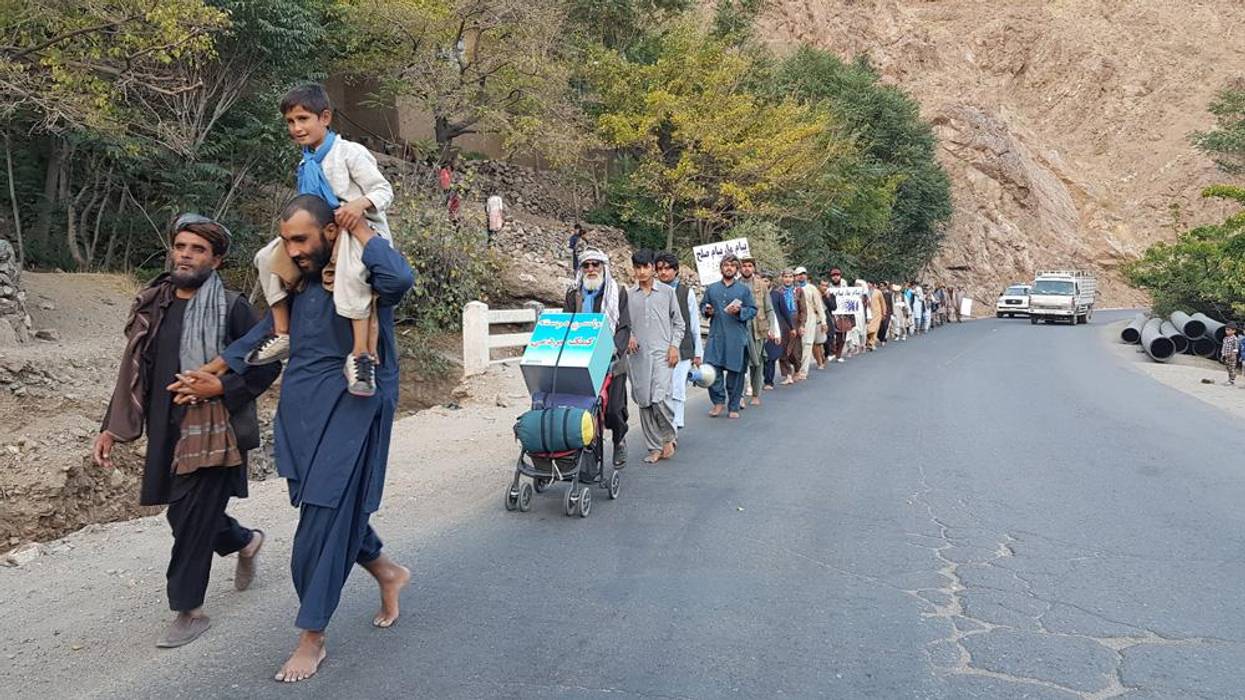
But we can each do something about this insensible status quo, as ordinary folk of the People's Peace Movement ( PPM ) show us by taking one barefoot-step at a time, traveling to the Northern areas of Afghanistan to persuade fellow Afghans, whether they're with 'insurgent groups' or with the U.S./NATO/Afghan forces, to stop fighting.
Their action of walking without shoes suggest to us that, for us to survive today's militarized and profit-driven norms, we have to live each day differently, and with clarity and compassion.
We've been thinking that we need armies to stop 'terrorists', but armies don't stop 'terrorists'. Instead, they give 'terrorists' reason to keep fighting.
We need to think anew.
Moreover, the roots of 'terrorism' lie within ourselves. We are our own source of wars.
Iqbal Khyber, a representative of PPM, told the Afghan Peace Volunteers ( APVs ) about how violence has taken root in all of us. "A blind member of our group, Zindani ( a name he gave himself after he was blinded by a Taliban-planted roadside bomb, meaning 'imprisoned' ) had so much pain in him that, one evening, when we were camped outside the U.S. Embassy in Kabul, he pleaded with me, 'Can I throw a pebble at the fence?' "
"I advised Zindani, 'No, we need to end the anger inside us.'" Iqbal continued.
Zindani is rightfully angry because he has been hurt by all sides of the Afghan conflict, like all civilians in all wars. His father literally disappeared from his life when he was just seven, as a bomb from a U.S. airstrike in Helmand left 'a crater so large that no trace of his father and uncle could be found'. Years later, another bomb, this time a Taliban device, killed his sister and blinded him. He not only lost his sight, he also lost the chance to marry the teenage love of his life.
At a large gathering in Kabul, Zindani sat in front of a crowd of Afghans who were shouting, "We want peace! Enough war! " He had a brown turban wrapped over his head and eyes, and a Borderfree blue scarf of the Afghan Peace Volunteers draped around his neck.
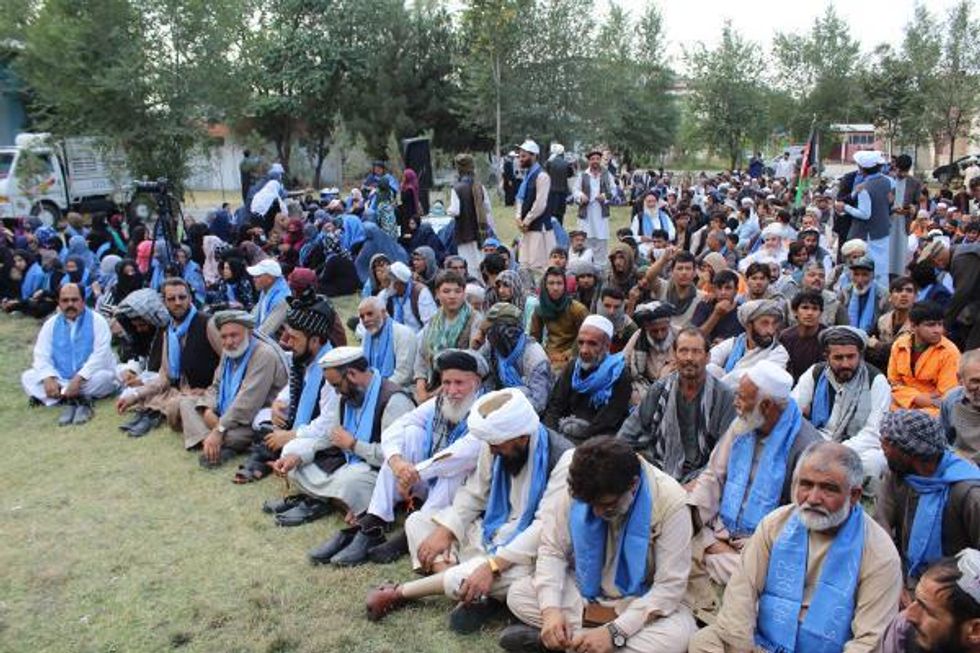 The crowd at the PPM's meeting in Kabul on the 9th of August 2018.Photo by Dr Hakim
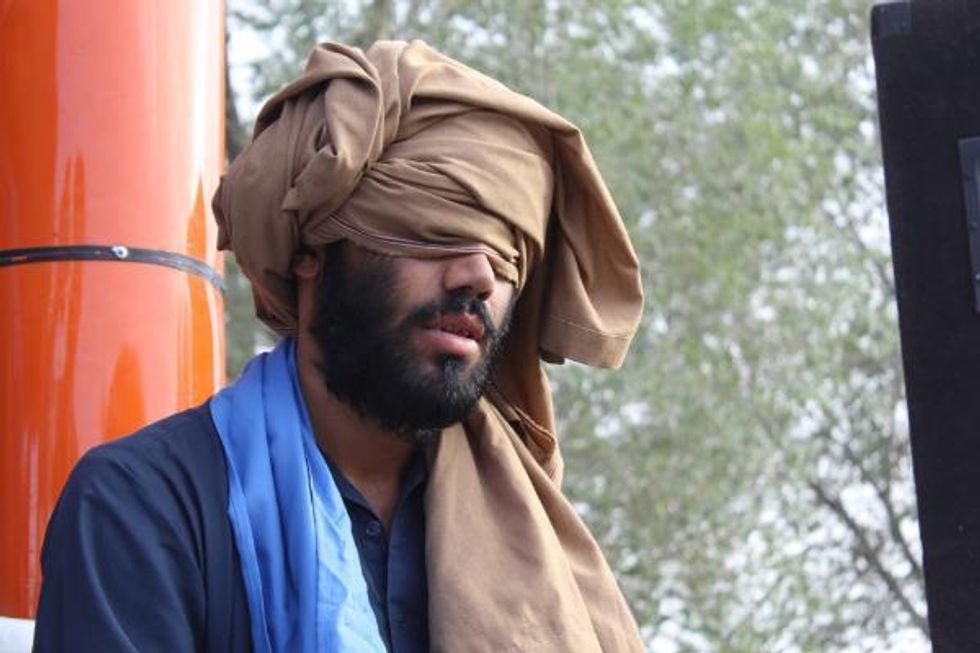 Zindani is determined to end war. Photo by Dr Hakim
He was quiet.
But his stand was clear. He had already walked more than 700 km from Helmand to Kabul, and he was ready to persist.
He couldn't see the crowd before him, but he could hear them, and understand their intense desire to end the war.
What makes us think that ordinary people like Zindani, or we ourselves, cannot end 'terrorism' and wars through nonviolent methods? Misinformation has infected us with doubts.
One way to work through those doubts is to emulate Zindani, members of the PPM and the APVs: relate person-to-person, ask, "How can we live better?", listen, love.
And to take courage in not doubting love when we encounter it.
"I was suspicious of their intentions. Politicians and leaders have misused the people so much we can no longer trust one another. But, when I met and conversed with these people from Helmand, I knew we could work together," Masuma testified to the other Volunteers who had gathered on another occasion to hear from four members of the Movement.
How about fear? How do we deal with legitimate fears?
The Volunteers were grappling with multiple concerns before they went to the big meeting organized by the PPM, held just next to Ghazi Stadium, where the Taliban used to execute people publicly.
Surely, Zindani, with his past trauma of losing eight family members to war, has been afraid all through his dark journey. Fear is an emotion we can work with, like our experience of fear even in love, like Zindani did in creating two poetic lines for his teenage girl-friend:
I am too scared to even drink water
It may fade my beloved's name on my heart.
Love triumphs over fear.
"We'll go together, come what may," Khalid, an Afghan Peace Volunteer who is a university undergraduate, had said. At the large gathering, Khalid was so 'fired up' that he overcame his usual shyness for 30 seconds on stage, delivering two lines of a Pashto poem which meant:
"Whatever you destroy,
don't destroy my thoughts and my mind."
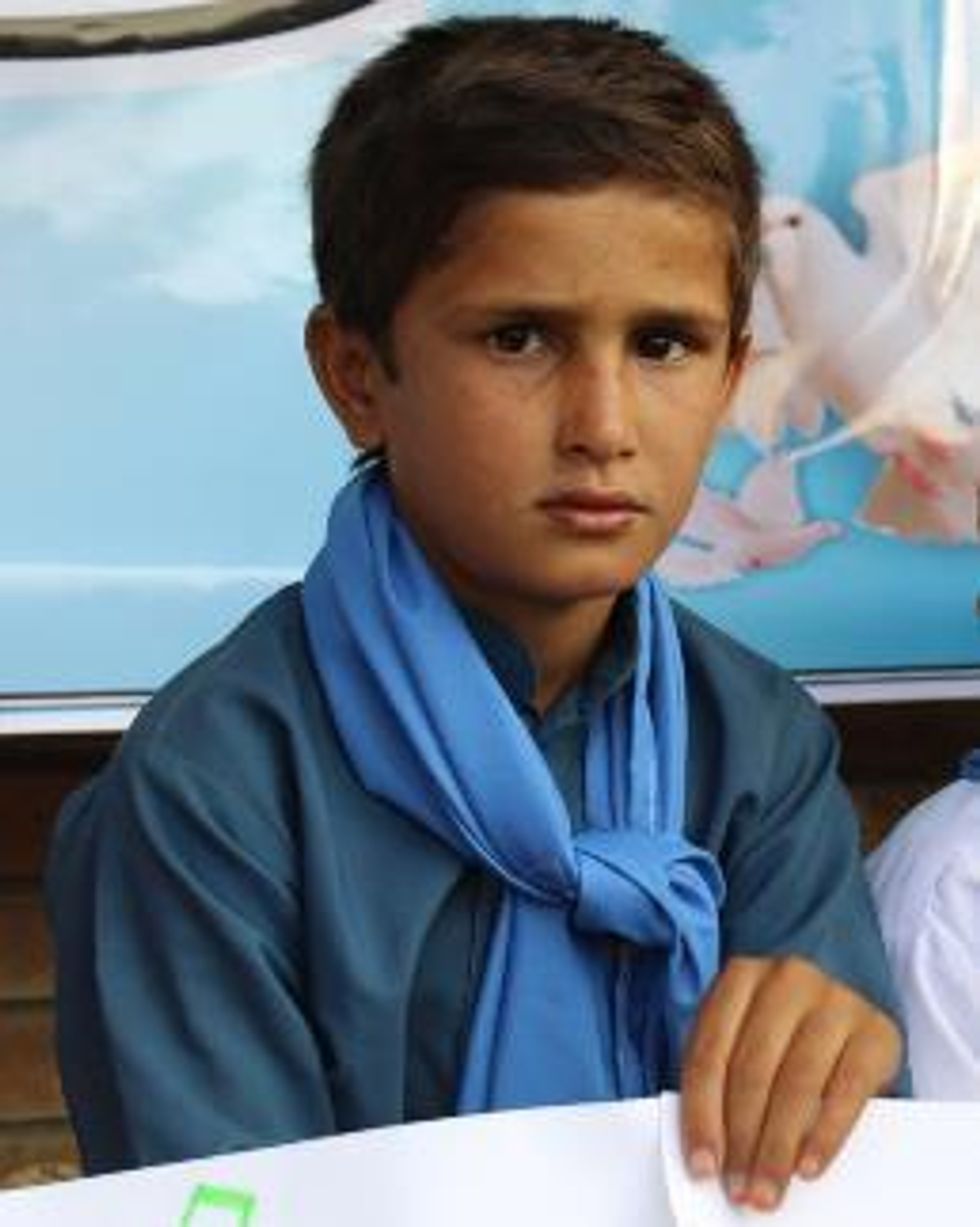 The young want an end to war.Photo by Dr Hakim
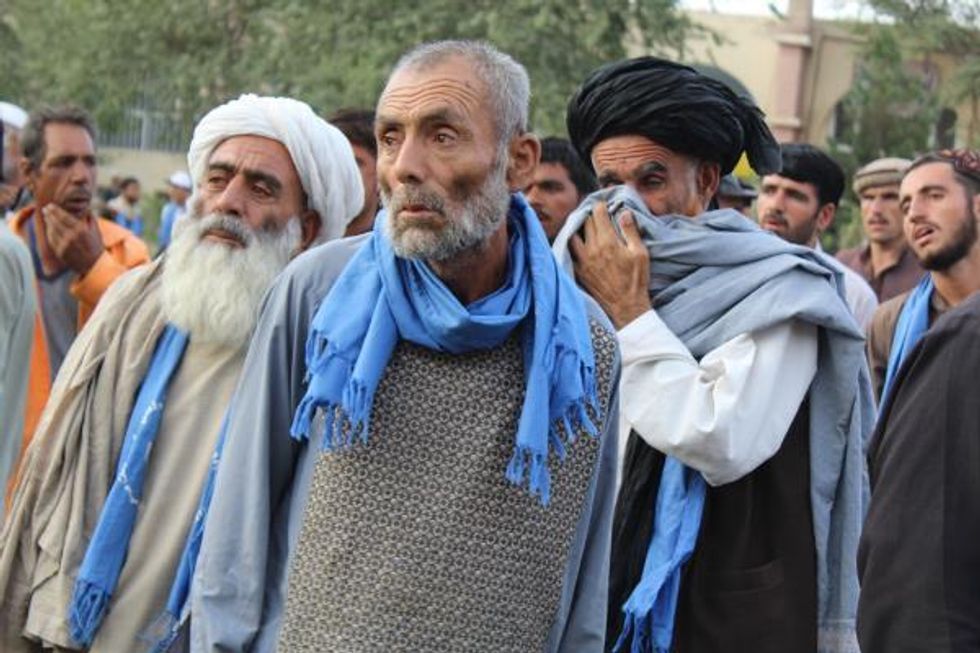 The old want an end to war.Photo by Dr Hakim
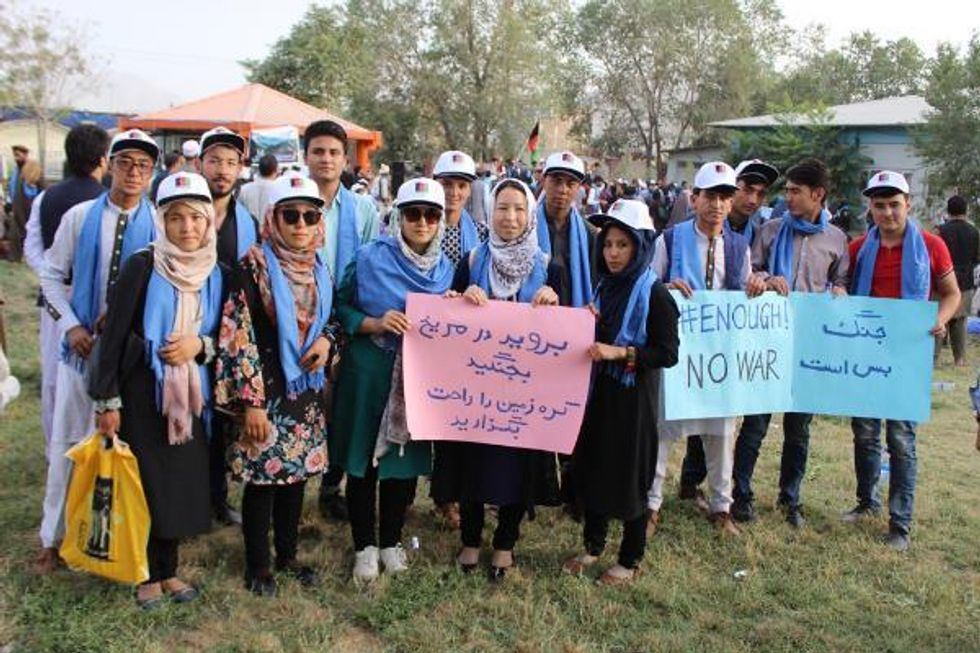 The APVs, the PPM and the people want an end to war.Photo by Dr Hakim
That's how we can overcome fear, and end the obsolete human institution of war.
We can love.
We can think anew.
We can turn up together.
If the highest-ranking U.S. and NATO military commander in Afghanistan gets his way, America's longest official war could become even more protracted.
Army General John Campbell said in a USA Today article published on Tuesday that he wants to keep the 9,800 American troops currently in Afghanistan there for as long as possible--and is considering asking for even more boots on the ground.
"My intent would be to keep as much as I could for as long as I could," Campbell told the paper from Kabul.
"Every time I've gone to the president and said, 'I need X,' I've been very, very fortunate that he's provided that."
--Army General John Campbell
The general's comments follow President Obama's October announcement that he plans to reverse his pledge to remove all but 1,000 U.S. troops from the country by the conclusion of 2016. Instead, Obama proclaimed that the 9,800 troops would be maintained through most of 2016 and cut to 5,500 by the beginning of 2017.
Even then, Obama's statement came despite the official declaration a year ago that the war was "over."
But now Campbell plans to ask the president to put off troop withdrawals even further by delaying the reduction to 5,500 troops.
"If I don't believe that we can accomplish the train, advise and assist... the (counter-terrorism) missions, then I owe it to the senior leadership to come back and say, 'Here's what I need,'" Campbell said. "If that's more people, it's more people."
The general expressed confidence that he would get his way. "My job as commander on the ground is to make assessments continually," Campbell said. "Every time I've gone to the president and said, 'I need X,' I've been very fortunate that he's provided that. So he's been very flexible."
Campbell's comments come as the U.S.-led war in Afghanistan stretches well into its 15th year--and appears certain to extend into the next presidency. While many argue that the Afghanistan intervention is not, in reality, the longest war in U.S. history, it is widely recognized as the most protracted, according to the official record.
What's more, the Bilateral Security Agreement signed in 2014 by the U.S. and Afghanistan locks in another decade of heavy American involvement in the country, including the training, funding, and arming of the Afghan military. The pact also secures immunity for U.S. service members under Afghan law--a highly controversial measure in a country that has suffered civilian massacres by U.S. troops.
The U.S. is planning a military role long into Afghanistan's future despite indications that its long-term intervention and occupation so far has worsened conflict and violence, with the Taliban now showing signs of increased strength.
Meanwhile, Afghan civilians continue to pay the greatest price. In the first half of 2015 alone, United Nations agencies documented 4,921 civilian casualties (1,592 deaths and 3,329 injured).
While the CIA claims it subjected just three prisoners to waterboarding, new lawsuits and documents, as well as further analysis of last year's Senate Torture Report, show that a separate water-torture technique known as "water dousing" was used on at least 13 men, the Guardian reported Friday.
According to journalist Spencer Ackerman, that tactic "created a drowning sensation or chilled a person's body temperature—sometimes through 'immersion' in water, and often without use of a board."
Moreover, Ackerman adds that water dousing often "added an element of hypothermia. Some detainees reported their CIA captors dousing them with 'cold or refrigerated' water, then wrapping them in similarly frigid sheets of plastic, keeping their temperatures low."
"Those familiar with their cases and an interrogator cited in the Senate report consider water dousing's departure from waterboarding to be 'a distinction without a difference'," the Guardian states.
The reporting continues:
The CIA did not ask the Justice Department for approval to use water dousing until summer 2004, two years after the torture program began. The description of the technique provided to department attorneys "made no mention of cold water immersion, which was used on CIA detainees and taught in CIA interrogator training", according to the Senate report.
McClatchy reported on water dousing last year, citing the Senate investigation.
"Interrogators used the water dousing technique in various ways," the Senate report reads. "At detention site Cobalt (in Afghanistan), detainees were often held down, naked, on a tarp on the floor, with the tarp pulled up around them to form a makeshift tub, while cold or refrigerated water was poured on them. Others were hosed down repeatedly while they were shackled naked, in the standing sleep deprivation position."
A lawsuit filed this week by torture survivors Suleiman Abdullah Salim and Mohamed Ahmed Ben Soud, as well as the family of Gul Rahman, who died of hypothermia in his cell as a result of the torture he endured, describes water dousing as "a form of waterboarding."
The Guardian writes:
Rahman, an Afghan, is the only detainee known to have died in CIA custody, of hypothermia. A footnote in the Senate report cites a CIA linguist, quoted in an agency inspector general study, describing Rahman's dousing, referred to as a "shower".
"Rahman was placed back under the cold water by the guards at [redacted CIA officer]'s direction. Rahman was so cold that he could barely utter his alias. According to [the on-site linguist], the entire process lasted no more than 20 minutes. It was intended to lower Rahman's resistance and was not for hygienic reasons."
Laura Pitter of Human Rights Watch, who has investigated the U.S. government's torture program established by President George W. Bush, told the Guardian the CIA was being "entirely disingenuous" in claiming it only waterboarded three people.
"First, more than three people were waterboarded," she said. "But second, the CIA used water to torture detainees in a variety of ways that cannot escape classification as torture. Whether on a board or the floor, they induced near suffocation using water. And whether you call it 'waterboarding' or 'water dousing', that's torture--plain and simple."
According to Ackerman, "CIA officials did not address questions from the Guardian as to why the agency considers the difference between waterboarding and water dousing to be substantive"--nor did they challenge the Guardian's tally of detainees subjected to water dousing.
As Common Dreams noted this week, despite the brutality detailed in the Senate Torture Report, the government has prosecuted only a handful of low-level soldiers and one CIA contractor for prisoner abuse. Meanwhile, the architects of the CIA's torture program have escaped any form of accountability.