SUBSCRIBE TO OUR FREE NEWSLETTER
Daily news & progressive opinion—funded by the people, not the corporations—delivered straight to your inbox.
5
#000000
#FFFFFF
To donate by check, phone, or other method, see our More Ways to Give page.
Daily news & progressive opinion—funded by the people, not the corporations—delivered straight to your inbox.
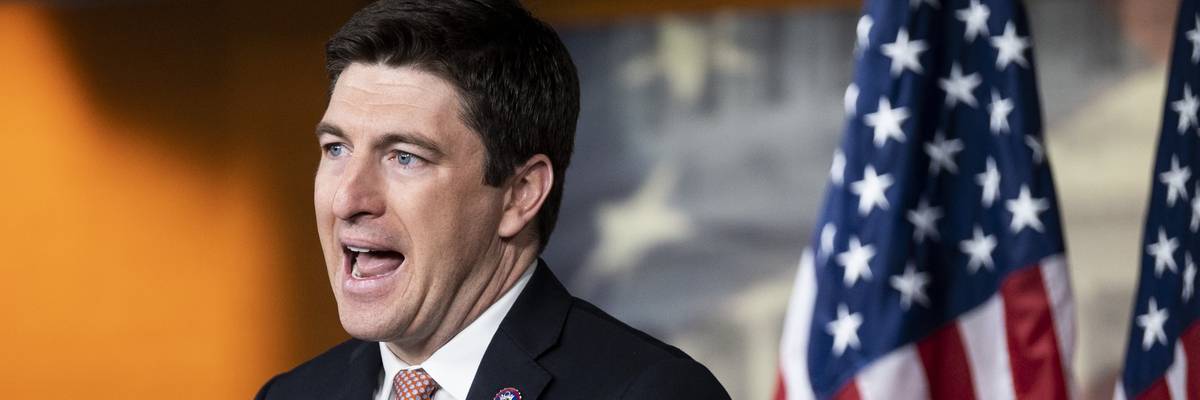
U.S. Rep. Bryan Steil (R-Wis.) speaks during a House GOP news conference on January 11, 2022.
One critic warned the legislation would "increase the influence of billionaires, corporations, and secret money in our elections while putting up barriers for eligible voters to vote."
Voting rights advocates across the United States on Monday responded with alarm to Republicans introducing what its backers called "the most conservative election integrity bill to be seriously considered" in the U.S. House of Representatives in decades.
Dubbed the "Big Lie Bill" by critics, the American Confidence in Elections (ACE) Act is spearheaded by Committee on House Administration Chair Bryan Steil (R-Wis.) and includes nearly 50 standalone bills from the chamber's GOP members.
The Declaration for American Democracy (DFAD), a coalition of over 260 groups, said in a statement it was "deeply concerned" about the bill, warning that "the benign-sounding name of this legislation cloaks an extremist, anti-voter effort to increase the role of megadonors in our elections and encourage deliberate barriers to make it harder for eligible voters to cast their ballot."
"This bill would amplify the influence of corporations and billionaires by raising contribution limits and reducing reporting and transparency requirements, opening the floodgates to even more secret money in our elections," DFAD said. "Increasing the role of big money donors in our politics prevents Congress from taking action on the issues that matter most to Americans, such as healthcare, reproductive rights, gun safety, and the environment."
"The ACE Act would disenfranchise millions of voters by encouraging restrictive anti-voter policies that have a disproportionate impact on Black, Indigenous, young, and new American voters," the coalition continued, stressing that widespread U.S. voter fraud doesn't exist. "The bill would be a huge federal government overstep into the governance of Washington D.C., overturning laws that have been enacted to expand and strengthen democracy in the district."
The leftist think tank Dēmos tweeted that "the anti-voter ACE Act is an extremist power grab that would overturn laws that strengthen democracy in D.C. and open the floodgates to secret money. District residents deserve self-determination. The only people cheering this bill are billionaires and corporations."
Fellow coalition members—including Indivisible, NextGen America, and Public Citizen—and other critics also took aim at the GOP bill.
Steil introduced the bill during a field hearing for the committee he leads in Atlanta. During that event and in an opinion piece for the Washington Examiner, the panel chair heralded the Georgia GOP's Senate Bill 202—a sweeping measure passed in 2021 that led to a "staggering" increase in voter suppression, according to a Mother Jones analysis.
"Many of the bill's requirements would replicate Georgia's laws, which already ban outside election funding, require voter ID, and prohibit noncitizen voting," The Atlanta Journal-Constitution reported Monday, noting that the state's Republicans enacted S.B. 202 in response to right-wing complaints about former President Donald Trump's loss in 2020.
The federal proposal comes as the twice-impeached, twice-indicted former president leads the crowded field of candidates for the GOP's 2024 presidential nomination—despite arguments that Trump's "Bie Lie" that the 2020 election was stolen from him incited the January 6, 2021 insurrection, so under the 14th Amendment, he is barred from holding public office again.
The Republican nominee is widely expected to face President Joe Biden, who is seeking reelection. The AJC pointed out that "the bill's rollout in Georgia, a swing state that... Biden won by fewer than 12,000 votes in 2020, creates a contrast between the two political parties ahead of another presidential election year."
When Democrats narrowly controlled both chambers of Congress early last year, right-wing Democratic Sen. Joe Manchin (W.Va.) joined with then-Democratic Sen. Kyrsten Sinema (Ariz.)—who has since become an Independent—to help the GOP block the Freedom to Vote: John R. Lewis Act, a package designed to boost federal protections, limit dark money in politics, and restore the Voting Rights Act of 1965.
Now, the Republicans have a divided majority in the House, while Democrats still have a slim advantage in the Senate, making it highly unlikely that any election-related legislation will make it to Biden's desk for the rest of this congressional session. Still, opponents of the ACE Act urged federal lawmakers to come out against it.
"Congress must reject these efforts to disenfranchise voters and worsen the problem of big money in politics," DFAD said. "To truly increase confidence in our elections, Congress should pass popular, common-sense reforms like those in the Freedom to Vote Act in order to reduce the influence of big money out of politics, ensure our freedom to vote, and guarantee that congressional districts are drawn to give fair representation for all."
"No matter our color, party, or ZIP code," the coalition added, "we all deserve to live in a democracy that represents, reflects, and responds to all of us."
Some Democrats in Congress are speaking out, including U.S. Rep. Nikema Williams, who represents Georgia's 5th District, which includes much of Atlanta.
"Extreme MAGA Republicans are at it again: this time attempting to obstruct voting rights to appease extremist election deniers," she tweeted. "S.B. 202 led to the biggest racial turnout gap in decades and they want to Copy+Paste at the federal level."
Democratic members of the Committee on House Administration declared Monday that "today's hearing is an attempt to appease election deniers."
"President Biden won the 2020 election. The election was secure. The results were accurate. It is undisputable," the panel's Democrats added. "No anti-voting, pro-corruption, #BigLieBill can change that."
Dear Common Dreams reader, It’s been nearly 30 years since I co-founded Common Dreams with my late wife, Lina Newhouser. We had the radical notion that journalism should serve the public good, not corporate profits. It was clear to us from the outset what it would take to build such a project. No paid advertisements. No corporate sponsors. No millionaire publisher telling us what to think or do. Many people said we wouldn't last a year, but we proved those doubters wrong. Together with a tremendous team of journalists and dedicated staff, we built an independent media outlet free from the constraints of profits and corporate control. Our mission has always been simple: To inform. To inspire. To ignite change for the common good. Building Common Dreams was not easy. Our survival was never guaranteed. When you take on the most powerful forces—Wall Street greed, fossil fuel industry destruction, Big Tech lobbyists, and uber-rich oligarchs who have spent billions upon billions rigging the economy and democracy in their favor—the only bulwark you have is supporters who believe in your work. But here’s the urgent message from me today. It's never been this bad out there. And it's never been this hard to keep us going. At the very moment Common Dreams is most needed, the threats we face are intensifying. We need your support now more than ever. We don't accept corporate advertising and never will. We don't have a paywall because we don't think people should be blocked from critical news based on their ability to pay. Everything we do is funded by the donations of readers like you. When everyone does the little they can afford, we are strong. But if that support retreats or dries up, so do we. Will you donate now to make sure Common Dreams not only survives but thrives? —Craig Brown, Co-founder |
Voting rights advocates across the United States on Monday responded with alarm to Republicans introducing what its backers called "the most conservative election integrity bill to be seriously considered" in the U.S. House of Representatives in decades.
Dubbed the "Big Lie Bill" by critics, the American Confidence in Elections (ACE) Act is spearheaded by Committee on House Administration Chair Bryan Steil (R-Wis.) and includes nearly 50 standalone bills from the chamber's GOP members.
The Declaration for American Democracy (DFAD), a coalition of over 260 groups, said in a statement it was "deeply concerned" about the bill, warning that "the benign-sounding name of this legislation cloaks an extremist, anti-voter effort to increase the role of megadonors in our elections and encourage deliberate barriers to make it harder for eligible voters to cast their ballot."
"This bill would amplify the influence of corporations and billionaires by raising contribution limits and reducing reporting and transparency requirements, opening the floodgates to even more secret money in our elections," DFAD said. "Increasing the role of big money donors in our politics prevents Congress from taking action on the issues that matter most to Americans, such as healthcare, reproductive rights, gun safety, and the environment."
"The ACE Act would disenfranchise millions of voters by encouraging restrictive anti-voter policies that have a disproportionate impact on Black, Indigenous, young, and new American voters," the coalition continued, stressing that widespread U.S. voter fraud doesn't exist. "The bill would be a huge federal government overstep into the governance of Washington D.C., overturning laws that have been enacted to expand and strengthen democracy in the district."
The leftist think tank Dēmos tweeted that "the anti-voter ACE Act is an extremist power grab that would overturn laws that strengthen democracy in D.C. and open the floodgates to secret money. District residents deserve self-determination. The only people cheering this bill are billionaires and corporations."
Fellow coalition members—including Indivisible, NextGen America, and Public Citizen—and other critics also took aim at the GOP bill.
Steil introduced the bill during a field hearing for the committee he leads in Atlanta. During that event and in an opinion piece for the Washington Examiner, the panel chair heralded the Georgia GOP's Senate Bill 202—a sweeping measure passed in 2021 that led to a "staggering" increase in voter suppression, according to a Mother Jones analysis.
"Many of the bill's requirements would replicate Georgia's laws, which already ban outside election funding, require voter ID, and prohibit noncitizen voting," The Atlanta Journal-Constitution reported Monday, noting that the state's Republicans enacted S.B. 202 in response to right-wing complaints about former President Donald Trump's loss in 2020.
The federal proposal comes as the twice-impeached, twice-indicted former president leads the crowded field of candidates for the GOP's 2024 presidential nomination—despite arguments that Trump's "Bie Lie" that the 2020 election was stolen from him incited the January 6, 2021 insurrection, so under the 14th Amendment, he is barred from holding public office again.
The Republican nominee is widely expected to face President Joe Biden, who is seeking reelection. The AJC pointed out that "the bill's rollout in Georgia, a swing state that... Biden won by fewer than 12,000 votes in 2020, creates a contrast between the two political parties ahead of another presidential election year."
When Democrats narrowly controlled both chambers of Congress early last year, right-wing Democratic Sen. Joe Manchin (W.Va.) joined with then-Democratic Sen. Kyrsten Sinema (Ariz.)—who has since become an Independent—to help the GOP block the Freedom to Vote: John R. Lewis Act, a package designed to boost federal protections, limit dark money in politics, and restore the Voting Rights Act of 1965.
Now, the Republicans have a divided majority in the House, while Democrats still have a slim advantage in the Senate, making it highly unlikely that any election-related legislation will make it to Biden's desk for the rest of this congressional session. Still, opponents of the ACE Act urged federal lawmakers to come out against it.
"Congress must reject these efforts to disenfranchise voters and worsen the problem of big money in politics," DFAD said. "To truly increase confidence in our elections, Congress should pass popular, common-sense reforms like those in the Freedom to Vote Act in order to reduce the influence of big money out of politics, ensure our freedom to vote, and guarantee that congressional districts are drawn to give fair representation for all."
"No matter our color, party, or ZIP code," the coalition added, "we all deserve to live in a democracy that represents, reflects, and responds to all of us."
Some Democrats in Congress are speaking out, including U.S. Rep. Nikema Williams, who represents Georgia's 5th District, which includes much of Atlanta.
"Extreme MAGA Republicans are at it again: this time attempting to obstruct voting rights to appease extremist election deniers," she tweeted. "S.B. 202 led to the biggest racial turnout gap in decades and they want to Copy+Paste at the federal level."
Democratic members of the Committee on House Administration declared Monday that "today's hearing is an attempt to appease election deniers."
"President Biden won the 2020 election. The election was secure. The results were accurate. It is undisputable," the panel's Democrats added. "No anti-voting, pro-corruption, #BigLieBill can change that."
Voting rights advocates across the United States on Monday responded with alarm to Republicans introducing what its backers called "the most conservative election integrity bill to be seriously considered" in the U.S. House of Representatives in decades.
Dubbed the "Big Lie Bill" by critics, the American Confidence in Elections (ACE) Act is spearheaded by Committee on House Administration Chair Bryan Steil (R-Wis.) and includes nearly 50 standalone bills from the chamber's GOP members.
The Declaration for American Democracy (DFAD), a coalition of over 260 groups, said in a statement it was "deeply concerned" about the bill, warning that "the benign-sounding name of this legislation cloaks an extremist, anti-voter effort to increase the role of megadonors in our elections and encourage deliberate barriers to make it harder for eligible voters to cast their ballot."
"This bill would amplify the influence of corporations and billionaires by raising contribution limits and reducing reporting and transparency requirements, opening the floodgates to even more secret money in our elections," DFAD said. "Increasing the role of big money donors in our politics prevents Congress from taking action on the issues that matter most to Americans, such as healthcare, reproductive rights, gun safety, and the environment."
"The ACE Act would disenfranchise millions of voters by encouraging restrictive anti-voter policies that have a disproportionate impact on Black, Indigenous, young, and new American voters," the coalition continued, stressing that widespread U.S. voter fraud doesn't exist. "The bill would be a huge federal government overstep into the governance of Washington D.C., overturning laws that have been enacted to expand and strengthen democracy in the district."
The leftist think tank Dēmos tweeted that "the anti-voter ACE Act is an extremist power grab that would overturn laws that strengthen democracy in D.C. and open the floodgates to secret money. District residents deserve self-determination. The only people cheering this bill are billionaires and corporations."
Fellow coalition members—including Indivisible, NextGen America, and Public Citizen—and other critics also took aim at the GOP bill.
Steil introduced the bill during a field hearing for the committee he leads in Atlanta. During that event and in an opinion piece for the Washington Examiner, the panel chair heralded the Georgia GOP's Senate Bill 202—a sweeping measure passed in 2021 that led to a "staggering" increase in voter suppression, according to a Mother Jones analysis.
"Many of the bill's requirements would replicate Georgia's laws, which already ban outside election funding, require voter ID, and prohibit noncitizen voting," The Atlanta Journal-Constitution reported Monday, noting that the state's Republicans enacted S.B. 202 in response to right-wing complaints about former President Donald Trump's loss in 2020.
The federal proposal comes as the twice-impeached, twice-indicted former president leads the crowded field of candidates for the GOP's 2024 presidential nomination—despite arguments that Trump's "Bie Lie" that the 2020 election was stolen from him incited the January 6, 2021 insurrection, so under the 14th Amendment, he is barred from holding public office again.
The Republican nominee is widely expected to face President Joe Biden, who is seeking reelection. The AJC pointed out that "the bill's rollout in Georgia, a swing state that... Biden won by fewer than 12,000 votes in 2020, creates a contrast between the two political parties ahead of another presidential election year."
When Democrats narrowly controlled both chambers of Congress early last year, right-wing Democratic Sen. Joe Manchin (W.Va.) joined with then-Democratic Sen. Kyrsten Sinema (Ariz.)—who has since become an Independent—to help the GOP block the Freedom to Vote: John R. Lewis Act, a package designed to boost federal protections, limit dark money in politics, and restore the Voting Rights Act of 1965.
Now, the Republicans have a divided majority in the House, while Democrats still have a slim advantage in the Senate, making it highly unlikely that any election-related legislation will make it to Biden's desk for the rest of this congressional session. Still, opponents of the ACE Act urged federal lawmakers to come out against it.
"Congress must reject these efforts to disenfranchise voters and worsen the problem of big money in politics," DFAD said. "To truly increase confidence in our elections, Congress should pass popular, common-sense reforms like those in the Freedom to Vote Act in order to reduce the influence of big money out of politics, ensure our freedom to vote, and guarantee that congressional districts are drawn to give fair representation for all."
"No matter our color, party, or ZIP code," the coalition added, "we all deserve to live in a democracy that represents, reflects, and responds to all of us."
Some Democrats in Congress are speaking out, including U.S. Rep. Nikema Williams, who represents Georgia's 5th District, which includes much of Atlanta.
"Extreme MAGA Republicans are at it again: this time attempting to obstruct voting rights to appease extremist election deniers," she tweeted. "S.B. 202 led to the biggest racial turnout gap in decades and they want to Copy+Paste at the federal level."
Democratic members of the Committee on House Administration declared Monday that "today's hearing is an attempt to appease election deniers."
"President Biden won the 2020 election. The election was secure. The results were accurate. It is undisputable," the panel's Democrats added. "No anti-voting, pro-corruption, #BigLieBill can change that."