SUBSCRIBE TO OUR FREE NEWSLETTER
Daily news & progressive opinion—funded by the people, not the corporations—delivered straight to your inbox.
5
#000000
#FFFFFF
To donate by check, phone, or other method, see our More Ways to Give page.
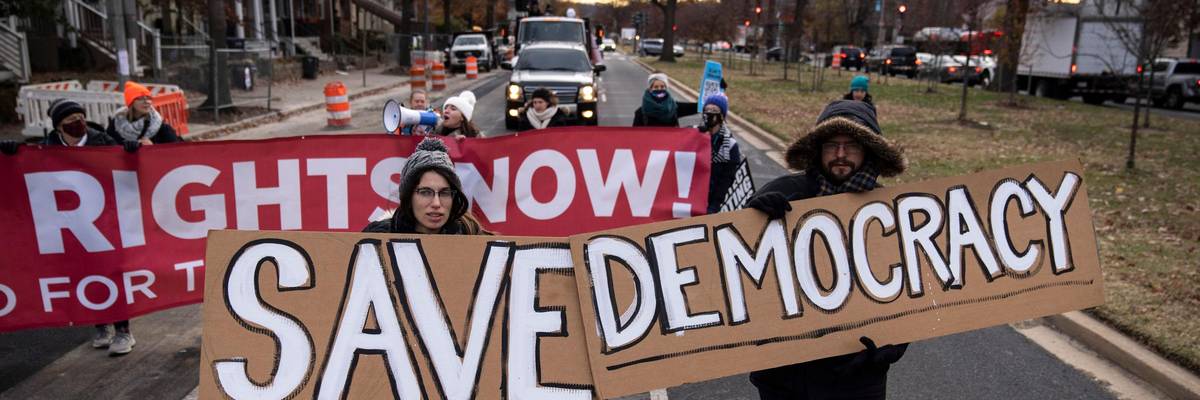
Progressives within and beyond Congress on Tuesday pointed to the Senate's vote to raise the country's debt ceiling as proof of what's not only possible but necessary to advance voting rights legislation and other Democratic priorities: working around--or killing--the filibuster.
"Our economy was at stake with the debt ceiling, and our democracy is at stake with voting rights."
The Senate's 50-49 vote along party lines--one Republican did not vote--was expected; it came after Democratic and GOP leaders struck a deal last week. The Democrat-controlled House is expected to soon send the legislation to President Joe Biden's desk.
Since the agreement was reached for Democrats to raise the debt ceiling without any GOP support, progressives have reiterated demands for reforming or abolishing the filibuster, which effectively blocks any bill that doesn't have 60 supportive votes in the evenly divided Senate. Fresh calls for Democrats to take on the filibuster stacked up Tuesday.
"If Democrats can carve out the filibuster to raise the debt ceiling to avoid economic collapse for millions of American families, then we can do the same thing for voting rights," said Sen. Ed Markey (D-Mass.) in a statement.
"Our economy was at stake with the debt ceiling, and our democracy is at stake with voting rights," he added. "We should abolish the filibuster to provide electoral integrity at the ballot box and take action now to enshrine the will and voices of the American people."
Progressive advocacy groups delivered similar messages, urging the swift passage of the Freedom to Vote Act--a compromise bill that came out of efforts to pass the For the People Act--and the House-approved John R. Lewis Voting Rights Advancement Act.
So far both bills have been blocked by Senate Republicans, as GOP state policymakers have ramped up attacks on voting rights and tried to force through new gerrymandered maps.
"With a simple majority vote, the Senate averted economic catastrophe and demonstrated that the only way to break through Republican obstruction and deliver for the American people is to bypass the filibuster," said Sean Eldridge, president and founder of the group Stand Up America.
"Now, it's time for the Senate to apply the same standard to pass the Freedom to Vote Act and the John Lewis Voting Rights Act, which are equally critical to our nation's future," Eldridge said. "If 50 votes are enough to protect our economy, then 50 votes should be enough to protect our democracy and our freedom to vote."
Indivisible's Meagan Hatcher-Mays similarly said: "Well, the U.S. Senate just passed a bill with a simple majority of votes. The sky didn't fall, and the building didn't crumble."
"Now, to protect voting rights and prevent undemocratic chaos from reigning in 2022, all the Senate needs to do is pass the Freedom to Vote Act and John Lewis Voting Rights Act the same way before the holidays--by a simple majority," she declared.
Related Content

While Senate Democrats could kill the filibuster without GOP agreement, doing so requires support from the full caucus--and there have been a few key holdouts, including Sens. Joe Manchin (D-W.Va.) and Kyrsten Sinema (D-Ariz.). There has also been speculation about the stances of other senators.
Mark Warner (D-Va.) made his position clear Tuesday afternoon, tweeting that "the Senate has shown it cannot do its basic duty and find 60 senators to support basic voting rights, so I support changing the rules around the filibuster for voting rights legislation."
Welcoming his remarks, Indivisible co-executive director Ezra Levin noted that "quietly a lot of folks pushing for reform have been worrying that Warner was bad on [the] filibuster. To have him come out and publicly like this is big."
Echoing his response to a similar move by Tom Carper (D-Del.) last month, Levin said that "this doesn't mean we've won, but this is what a realist should be looking for as evidence of forward momentum."
Progressives within and beyond Congress on Tuesday pointed to the Senate's vote to raise the country's debt ceiling as proof of what's not only possible but necessary to advance voting rights legislation and other Democratic priorities: working around--or killing--the filibuster.
"Our economy was at stake with the debt ceiling, and our democracy is at stake with voting rights."
The Senate's 50-49 vote along party lines--one Republican did not vote--was expected; it came after Democratic and GOP leaders struck a deal last week. The Democrat-controlled House is expected to soon send the legislation to President Joe Biden's desk.
Since the agreement was reached for Democrats to raise the debt ceiling without any GOP support, progressives have reiterated demands for reforming or abolishing the filibuster, which effectively blocks any bill that doesn't have 60 supportive votes in the evenly divided Senate. Fresh calls for Democrats to take on the filibuster stacked up Tuesday.
"If Democrats can carve out the filibuster to raise the debt ceiling to avoid economic collapse for millions of American families, then we can do the same thing for voting rights," said Sen. Ed Markey (D-Mass.) in a statement.
"Our economy was at stake with the debt ceiling, and our democracy is at stake with voting rights," he added. "We should abolish the filibuster to provide electoral integrity at the ballot box and take action now to enshrine the will and voices of the American people."
Progressive advocacy groups delivered similar messages, urging the swift passage of the Freedom to Vote Act--a compromise bill that came out of efforts to pass the For the People Act--and the House-approved John R. Lewis Voting Rights Advancement Act.
So far both bills have been blocked by Senate Republicans, as GOP state policymakers have ramped up attacks on voting rights and tried to force through new gerrymandered maps.
"With a simple majority vote, the Senate averted economic catastrophe and demonstrated that the only way to break through Republican obstruction and deliver for the American people is to bypass the filibuster," said Sean Eldridge, president and founder of the group Stand Up America.
"Now, it's time for the Senate to apply the same standard to pass the Freedom to Vote Act and the John Lewis Voting Rights Act, which are equally critical to our nation's future," Eldridge said. "If 50 votes are enough to protect our economy, then 50 votes should be enough to protect our democracy and our freedom to vote."
Indivisible's Meagan Hatcher-Mays similarly said: "Well, the U.S. Senate just passed a bill with a simple majority of votes. The sky didn't fall, and the building didn't crumble."
"Now, to protect voting rights and prevent undemocratic chaos from reigning in 2022, all the Senate needs to do is pass the Freedom to Vote Act and John Lewis Voting Rights Act the same way before the holidays--by a simple majority," she declared.
Related Content
While Senate Democrats could kill the filibuster without GOP agreement, doing so requires support from the full caucus--and there have been a few key holdouts, including Sens. Joe Manchin (D-W.Va.) and Kyrsten Sinema (D-Ariz.). There has also been speculation about the stances of other senators.
Mark Warner (D-Va.) made his position clear Tuesday afternoon, tweeting that "the Senate has shown it cannot do its basic duty and find 60 senators to support basic voting rights, so I support changing the rules around the filibuster for voting rights legislation."
Welcoming his remarks, Indivisible co-executive director Ezra Levin noted that "quietly a lot of folks pushing for reform have been worrying that Warner was bad on [the] filibuster. To have him come out and publicly like this is big."
Echoing his response to a similar move by Tom Carper (D-Del.) last month, Levin said that "this doesn't mean we've won, but this is what a realist should be looking for as evidence of forward momentum."
Progressives within and beyond Congress on Tuesday pointed to the Senate's vote to raise the country's debt ceiling as proof of what's not only possible but necessary to advance voting rights legislation and other Democratic priorities: working around--or killing--the filibuster.
"Our economy was at stake with the debt ceiling, and our democracy is at stake with voting rights."
The Senate's 50-49 vote along party lines--one Republican did not vote--was expected; it came after Democratic and GOP leaders struck a deal last week. The Democrat-controlled House is expected to soon send the legislation to President Joe Biden's desk.
Since the agreement was reached for Democrats to raise the debt ceiling without any GOP support, progressives have reiterated demands for reforming or abolishing the filibuster, which effectively blocks any bill that doesn't have 60 supportive votes in the evenly divided Senate. Fresh calls for Democrats to take on the filibuster stacked up Tuesday.
"If Democrats can carve out the filibuster to raise the debt ceiling to avoid economic collapse for millions of American families, then we can do the same thing for voting rights," said Sen. Ed Markey (D-Mass.) in a statement.
"Our economy was at stake with the debt ceiling, and our democracy is at stake with voting rights," he added. "We should abolish the filibuster to provide electoral integrity at the ballot box and take action now to enshrine the will and voices of the American people."
Progressive advocacy groups delivered similar messages, urging the swift passage of the Freedom to Vote Act--a compromise bill that came out of efforts to pass the For the People Act--and the House-approved John R. Lewis Voting Rights Advancement Act.
So far both bills have been blocked by Senate Republicans, as GOP state policymakers have ramped up attacks on voting rights and tried to force through new gerrymandered maps.
"With a simple majority vote, the Senate averted economic catastrophe and demonstrated that the only way to break through Republican obstruction and deliver for the American people is to bypass the filibuster," said Sean Eldridge, president and founder of the group Stand Up America.
"Now, it's time for the Senate to apply the same standard to pass the Freedom to Vote Act and the John Lewis Voting Rights Act, which are equally critical to our nation's future," Eldridge said. "If 50 votes are enough to protect our economy, then 50 votes should be enough to protect our democracy and our freedom to vote."
Indivisible's Meagan Hatcher-Mays similarly said: "Well, the U.S. Senate just passed a bill with a simple majority of votes. The sky didn't fall, and the building didn't crumble."
"Now, to protect voting rights and prevent undemocratic chaos from reigning in 2022, all the Senate needs to do is pass the Freedom to Vote Act and John Lewis Voting Rights Act the same way before the holidays--by a simple majority," she declared.
Related Content
While Senate Democrats could kill the filibuster without GOP agreement, doing so requires support from the full caucus--and there have been a few key holdouts, including Sens. Joe Manchin (D-W.Va.) and Kyrsten Sinema (D-Ariz.). There has also been speculation about the stances of other senators.
Mark Warner (D-Va.) made his position clear Tuesday afternoon, tweeting that "the Senate has shown it cannot do its basic duty and find 60 senators to support basic voting rights, so I support changing the rules around the filibuster for voting rights legislation."
Welcoming his remarks, Indivisible co-executive director Ezra Levin noted that "quietly a lot of folks pushing for reform have been worrying that Warner was bad on [the] filibuster. To have him come out and publicly like this is big."
Echoing his response to a similar move by Tom Carper (D-Del.) last month, Levin said that "this doesn't mean we've won, but this is what a realist should be looking for as evidence of forward momentum."