SUBSCRIBE TO OUR FREE NEWSLETTER
Daily news & progressive opinion—funded by the people, not the corporations—delivered straight to your inbox.
5
#000000
#FFFFFF
To donate by check, phone, or other method, see our More Ways to Give page.
Daily news & progressive opinion—funded by the people, not the corporations—delivered straight to your inbox.
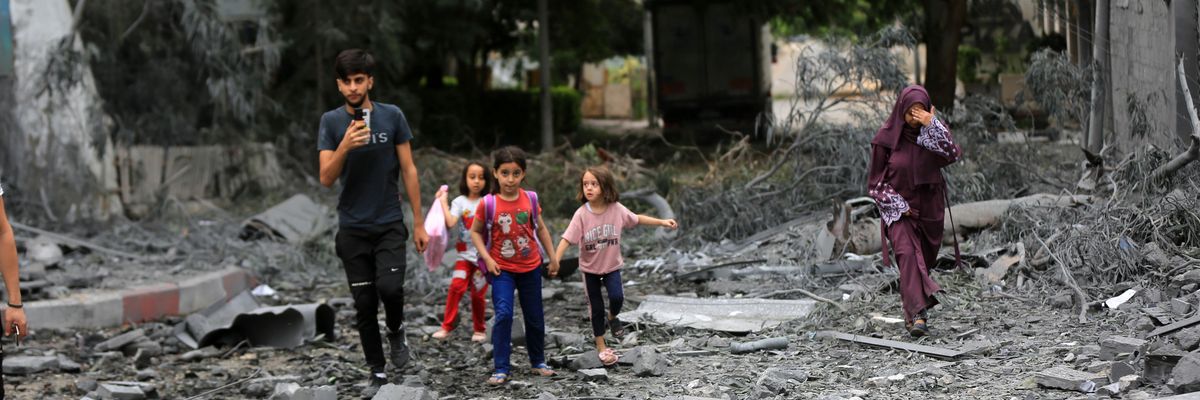
Residents seek safety amid destroyed buildings and debris around the Palestinian Telecommunications Company in the Gaza Strip on October 10, 2023.
"Gazans have been saying Israel is indiscriminately bombing them, with no goal other than to level Gaza to the ground. Now Israel admits the same."
An Israeli military spokesman admitted Tuesday what was plainly obvious to witnesses of the mass destruction underway in the besieged Gaza Strip: that the goal of Israel's ongoing bombing campaign is to inflict severe damage on the occupied territory, not to strictly target Hamas military installations.
"The emphasis is on damage and not on accuracy," Israel Defense Forces official Daniel Hagari said, according to Haaretz.
Hagari's remarks came after Israeli airstrikes leveled residential buildings, ripped through a crowded marketplace in Gaza's largest refugee camp, damaged hospitals and mosques, and wiped out families in the wake of a Hamas attack on Israel that killed hundreds of people.
The New York Times reported that Israeli strikes "also hit four mosques in the Shati refugee camp on Monday, according to Gaza authorities, toppling their domes and killing worshipers inside. Neighbors picked through the rubble of the Sousi mosque, where witnesses said boys had been playing soccer just outside when it was destroyed."
Hagari said in a briefing late Monday that Israel's aerial assault on Gaza had used "thousands of armaments" over the previous 24 hours.
"To put that in perspective, the pace of the strikes is five times that of the strikes on Hezbollah in the Second Lebanon War," said Hagari. "I repeat, five times what it was against Hezbollah in the Second Lebanon War."
The IDF official's comments amplified warnings that Israel is collectively punishing Gaza's population of around 2 million people, roughly half of whom are children. Earlier Monday, Israel's defense minister announced a "total" blockade of the enclave, cutting off its electricity supply and vowing to prevent all food and fuel from entering.
Collective punishment is a
war crime.
"Gazans have been saying Israel is indiscriminately bombing them, with no goal other than to level Gaza to the ground. Now Israel admits the same," Yumna Patel, Palestine news director at Mondoweiss, wrote in response to Hagari's remarks. "No more lies about 'precision targets against Hamas.' Just pure destruction."
Hajer Naili, director of communications at the nonprofit Center for Civilians in Conflict, added that "such a statement indicates that Israel is neither using precaution, proportionality, [nor] distinguishing between civilians and combatants when launching attacks in Gaza."
"This is a violation of international humanitarian law," Naili wrote. "The [international] community must stop condoning such violations."
Middle East Eye reported that before Israel bombed the Jabalia refugee camp on Monday, killing dozens, Gazans living nearby woke up "to clear instructions from the Israeli army: leave your homes and head to the city center."
"Many in Beit Hanoun, a densely packed area in northeast Gaza, heeded the call," the outlet noted. "They went westwards, some two kilometers away, to the Jabalia refugee camp, in the hope of finding relative safety. But instead, they were greeted with death. Israeli fighter jets bombed two buildings in the main market of the camp, killing at least 50 people, Gaza's Ministry of Health has said."
Muhammed Lubbad, a Gaza resident, told Middle East Eye that "taxi drivers, pedestrians, and sellers" were among the victims of the deadly strike.
"Almost everyone who was inside the Rabaa Mall was killed. No one there was left alive," he said. "It's a massacre that no one imagined could happen."
During a press conference on Monday, United Nations Secretary-General António Guterres condemned "acts of terror" committed by Hamas and said he is "deeply alarmed" by Israel's response.
"We already have reports of Israeli missiles striking health facilities inside Gaza as well as multi-storied residential towers and a mosque," said Guterres, who added that two United Nations Relief and Works Agency (UNRWA) schools sheltering displaced families were also hit by Israeli bombs.
"Some 137,000 people are currently sheltering in UNRWA facilities—with the number increasing as heavy shelling and airstrikes continue," Guterres added. "I am deeply distressed by today's announcement that Israel will initiate a complete siege of the Gaza Strip, nothing allowed in—no electricity, food, or fuel. The humanitarian situation in Gaza was extremely dire before these hostilities; now it will only deteriorate exponentially."
Dear Common Dreams reader, It’s been nearly 30 years since I co-founded Common Dreams with my late wife, Lina Newhouser. We had the radical notion that journalism should serve the public good, not corporate profits. It was clear to us from the outset what it would take to build such a project. No paid advertisements. No corporate sponsors. No millionaire publisher telling us what to think or do. Many people said we wouldn't last a year, but we proved those doubters wrong. Together with a tremendous team of journalists and dedicated staff, we built an independent media outlet free from the constraints of profits and corporate control. Our mission has always been simple: To inform. To inspire. To ignite change for the common good. Building Common Dreams was not easy. Our survival was never guaranteed. When you take on the most powerful forces—Wall Street greed, fossil fuel industry destruction, Big Tech lobbyists, and uber-rich oligarchs who have spent billions upon billions rigging the economy and democracy in their favor—the only bulwark you have is supporters who believe in your work. But here’s the urgent message from me today. It's never been this bad out there. And it's never been this hard to keep us going. At the very moment Common Dreams is most needed, the threats we face are intensifying. We need your support now more than ever. We don't accept corporate advertising and never will. We don't have a paywall because we don't think people should be blocked from critical news based on their ability to pay. Everything we do is funded by the donations of readers like you. When everyone does the little they can afford, we are strong. But if that support retreats or dries up, so do we. Will you donate now to make sure Common Dreams not only survives but thrives? —Craig Brown, Co-founder |
An Israeli military spokesman admitted Tuesday what was plainly obvious to witnesses of the mass destruction underway in the besieged Gaza Strip: that the goal of Israel's ongoing bombing campaign is to inflict severe damage on the occupied territory, not to strictly target Hamas military installations.
"The emphasis is on damage and not on accuracy," Israel Defense Forces official Daniel Hagari said, according to Haaretz.
Hagari's remarks came after Israeli airstrikes leveled residential buildings, ripped through a crowded marketplace in Gaza's largest refugee camp, damaged hospitals and mosques, and wiped out families in the wake of a Hamas attack on Israel that killed hundreds of people.
The New York Times reported that Israeli strikes "also hit four mosques in the Shati refugee camp on Monday, according to Gaza authorities, toppling their domes and killing worshipers inside. Neighbors picked through the rubble of the Sousi mosque, where witnesses said boys had been playing soccer just outside when it was destroyed."
Hagari said in a briefing late Monday that Israel's aerial assault on Gaza had used "thousands of armaments" over the previous 24 hours.
"To put that in perspective, the pace of the strikes is five times that of the strikes on Hezbollah in the Second Lebanon War," said Hagari. "I repeat, five times what it was against Hezbollah in the Second Lebanon War."
The IDF official's comments amplified warnings that Israel is collectively punishing Gaza's population of around 2 million people, roughly half of whom are children. Earlier Monday, Israel's defense minister announced a "total" blockade of the enclave, cutting off its electricity supply and vowing to prevent all food and fuel from entering.
Collective punishment is a
war crime.
"Gazans have been saying Israel is indiscriminately bombing them, with no goal other than to level Gaza to the ground. Now Israel admits the same," Yumna Patel, Palestine news director at Mondoweiss, wrote in response to Hagari's remarks. "No more lies about 'precision targets against Hamas.' Just pure destruction."
Hajer Naili, director of communications at the nonprofit Center for Civilians in Conflict, added that "such a statement indicates that Israel is neither using precaution, proportionality, [nor] distinguishing between civilians and combatants when launching attacks in Gaza."
"This is a violation of international humanitarian law," Naili wrote. "The [international] community must stop condoning such violations."
Middle East Eye reported that before Israel bombed the Jabalia refugee camp on Monday, killing dozens, Gazans living nearby woke up "to clear instructions from the Israeli army: leave your homes and head to the city center."
"Many in Beit Hanoun, a densely packed area in northeast Gaza, heeded the call," the outlet noted. "They went westwards, some two kilometers away, to the Jabalia refugee camp, in the hope of finding relative safety. But instead, they were greeted with death. Israeli fighter jets bombed two buildings in the main market of the camp, killing at least 50 people, Gaza's Ministry of Health has said."
Muhammed Lubbad, a Gaza resident, told Middle East Eye that "taxi drivers, pedestrians, and sellers" were among the victims of the deadly strike.
"Almost everyone who was inside the Rabaa Mall was killed. No one there was left alive," he said. "It's a massacre that no one imagined could happen."
During a press conference on Monday, United Nations Secretary-General António Guterres condemned "acts of terror" committed by Hamas and said he is "deeply alarmed" by Israel's response.
"We already have reports of Israeli missiles striking health facilities inside Gaza as well as multi-storied residential towers and a mosque," said Guterres, who added that two United Nations Relief and Works Agency (UNRWA) schools sheltering displaced families were also hit by Israeli bombs.
"Some 137,000 people are currently sheltering in UNRWA facilities—with the number increasing as heavy shelling and airstrikes continue," Guterres added. "I am deeply distressed by today's announcement that Israel will initiate a complete siege of the Gaza Strip, nothing allowed in—no electricity, food, or fuel. The humanitarian situation in Gaza was extremely dire before these hostilities; now it will only deteriorate exponentially."
An Israeli military spokesman admitted Tuesday what was plainly obvious to witnesses of the mass destruction underway in the besieged Gaza Strip: that the goal of Israel's ongoing bombing campaign is to inflict severe damage on the occupied territory, not to strictly target Hamas military installations.
"The emphasis is on damage and not on accuracy," Israel Defense Forces official Daniel Hagari said, according to Haaretz.
Hagari's remarks came after Israeli airstrikes leveled residential buildings, ripped through a crowded marketplace in Gaza's largest refugee camp, damaged hospitals and mosques, and wiped out families in the wake of a Hamas attack on Israel that killed hundreds of people.
The New York Times reported that Israeli strikes "also hit four mosques in the Shati refugee camp on Monday, according to Gaza authorities, toppling their domes and killing worshipers inside. Neighbors picked through the rubble of the Sousi mosque, where witnesses said boys had been playing soccer just outside when it was destroyed."
Hagari said in a briefing late Monday that Israel's aerial assault on Gaza had used "thousands of armaments" over the previous 24 hours.
"To put that in perspective, the pace of the strikes is five times that of the strikes on Hezbollah in the Second Lebanon War," said Hagari. "I repeat, five times what it was against Hezbollah in the Second Lebanon War."
The IDF official's comments amplified warnings that Israel is collectively punishing Gaza's population of around 2 million people, roughly half of whom are children. Earlier Monday, Israel's defense minister announced a "total" blockade of the enclave, cutting off its electricity supply and vowing to prevent all food and fuel from entering.
Collective punishment is a
war crime.
"Gazans have been saying Israel is indiscriminately bombing them, with no goal other than to level Gaza to the ground. Now Israel admits the same," Yumna Patel, Palestine news director at Mondoweiss, wrote in response to Hagari's remarks. "No more lies about 'precision targets against Hamas.' Just pure destruction."
Hajer Naili, director of communications at the nonprofit Center for Civilians in Conflict, added that "such a statement indicates that Israel is neither using precaution, proportionality, [nor] distinguishing between civilians and combatants when launching attacks in Gaza."
"This is a violation of international humanitarian law," Naili wrote. "The [international] community must stop condoning such violations."
Middle East Eye reported that before Israel bombed the Jabalia refugee camp on Monday, killing dozens, Gazans living nearby woke up "to clear instructions from the Israeli army: leave your homes and head to the city center."
"Many in Beit Hanoun, a densely packed area in northeast Gaza, heeded the call," the outlet noted. "They went westwards, some two kilometers away, to the Jabalia refugee camp, in the hope of finding relative safety. But instead, they were greeted with death. Israeli fighter jets bombed two buildings in the main market of the camp, killing at least 50 people, Gaza's Ministry of Health has said."
Muhammed Lubbad, a Gaza resident, told Middle East Eye that "taxi drivers, pedestrians, and sellers" were among the victims of the deadly strike.
"Almost everyone who was inside the Rabaa Mall was killed. No one there was left alive," he said. "It's a massacre that no one imagined could happen."
During a press conference on Monday, United Nations Secretary-General António Guterres condemned "acts of terror" committed by Hamas and said he is "deeply alarmed" by Israel's response.
"We already have reports of Israeli missiles striking health facilities inside Gaza as well as multi-storied residential towers and a mosque," said Guterres, who added that two United Nations Relief and Works Agency (UNRWA) schools sheltering displaced families were also hit by Israeli bombs.
"Some 137,000 people are currently sheltering in UNRWA facilities—with the number increasing as heavy shelling and airstrikes continue," Guterres added. "I am deeply distressed by today's announcement that Israel will initiate a complete siege of the Gaza Strip, nothing allowed in—no electricity, food, or fuel. The humanitarian situation in Gaza was extremely dire before these hostilities; now it will only deteriorate exponentially."