SUBSCRIBE TO OUR FREE NEWSLETTER
Daily news & progressive opinion—funded by the people, not the corporations—delivered straight to your inbox.
5
#000000
#FFFFFF
To donate by check, phone, or other method, see our More Ways to Give page.
Daily news & progressive opinion—funded by the people, not the corporations—delivered straight to your inbox.
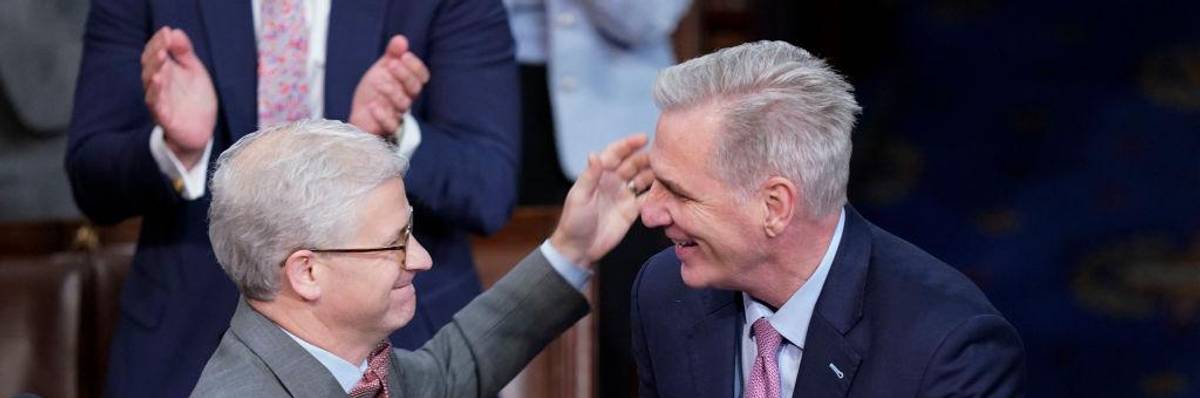
Rep. Kevin McCarthy (R-Calif.) shakes hands with Rep. Patrick McHenry (R-N.C.) after McHenry nominated him in the 14th round of voting for House Speaker on January 6, 2023.
"The MAGA majority in charge of overseeing the financial industry are completely awash in Wall Street money," said one analyst. "Consumers beware as financial scammers rejoice."
A new Accountable.US analysis published Wednesday revealed that the 11 new Republicans tapped to serve on the House Financial Services Committee collectively accepted more than $6 million from Wall Street during the 2022 election cycle, leaving them ready to do the "industry's bidding."
The HFSC "has jurisdiction over issues pertaining to the economy, the banking system, housing, insurance, and securities and exchanges," the panel's website reads. "Additionally, the committee also has jurisdiction over monetary policy, international finance, international monetary organizations, and efforts to combat terrorist financing."
Newly elected GOP lawmakers nominated to serve on the HFSC have taken nearly $6.2 million in campaign cash from the finance, insurance, and real estate (FIRE) industries that the panel is tasked with refereeing, Accountable.US researchers found.
The watchdog group broke down how much money each new Republican nominee for the HFSC received during the 2022 election cycle from the FIRE industries they are set to oversee:
"History has shown when conservative politicians in the pocket of Wall Street banks and predatory lenders seize power, everyday consumers are left more vulnerable to greedy financial industry behavior," Liz Zelnick, director of the Economic Security and Corporate Power program at Accountable.US, said in a statement. "History is about to repeat itself as the MAGA majority in charge of overseeing the financial industry are completely awash in Wall Street money."
Notably, Donalds and Ogles were part of the far-right contingent that extracted anti-worker concessions from House Speaker Kevin McCarthy (R-Calif.) during his drawn-out battle for the speaker's gavel.
"History has shown when conservative politicians in the pocket of Wall Street banks and predatory lenders seize power, everyday consumers are left more vulnerable to greedy financial industry behavior. History is about to repeat itself."
When announcing all 30 new and returning GOP lawmakers recommended to serve on the financial oversight panel, HFSC Chair Patrick McHenry (R-N.C.) claimed that "the talent and real-world expertise of this group is an embarrassment of riches." He added, "I look forward to working with them to deliver on House Republicans' commitment to America."
The House Republican Steering Committee's recommendations for membership on the HFSC will soon be considered by the full party caucus and then the entire House of Representatives, where the GOP's majority makes approval likely.
Over the course of his career, McHenry has raked in more than $9.2 million in political donations from the FIRE industries while advancing "priorities written by and for Wall Street, big banks, and predatory lenders at the expense of everyday American families," Accountable.US noted.
For example, McHenry cheered in October when a panel from the U.S. Court of Appeals for the 5th Circuit—which former President Donald Trump pushed in an even more conservative direction by appointing numerous far-right judges, including the trio of panel members—ruled that the Consumer Financial Protection Bureau's funding structure is unconstitutional.
In response to a lawsuit brought by the payday lending industry, the 5th Circuit judges—led by Cory Wilson, who received at least $10,500 in campaign cash from Wall Street when he was a Republican candidate for and member of the Mississippi House of Representatives between 2014 and 2018—argued that the CFPB's structure is unlawful because its funding comes from the Federal Reserve System rather than Congress, a feature that seeks to ensure the agency's independence.
McHenry said that he was "glad to see" the ruling and expressed his desire to bring the CFPB "under the appropriations process," where it would be vulnerable to cuts from a hostile GOP.
"Chairman McHenry, who's made no secret of his intent to ignore bad industry actors and obstruct federal efforts to protect consumers from things like junk fees, now has all the backing he needs to get payback against the pro-consumer Biden administration on behalf of his biggest donors," Zelnick said Wednesday. "Consumers beware as financial scammers rejoice."
Dear Common Dreams reader, It’s been nearly 30 years since I co-founded Common Dreams with my late wife, Lina Newhouser. We had the radical notion that journalism should serve the public good, not corporate profits. It was clear to us from the outset what it would take to build such a project. No paid advertisements. No corporate sponsors. No millionaire publisher telling us what to think or do. Many people said we wouldn't last a year, but we proved those doubters wrong. Together with a tremendous team of journalists and dedicated staff, we built an independent media outlet free from the constraints of profits and corporate control. Our mission has always been simple: To inform. To inspire. To ignite change for the common good. Building Common Dreams was not easy. Our survival was never guaranteed. When you take on the most powerful forces—Wall Street greed, fossil fuel industry destruction, Big Tech lobbyists, and uber-rich oligarchs who have spent billions upon billions rigging the economy and democracy in their favor—the only bulwark you have is supporters who believe in your work. But here’s the urgent message from me today. It's never been this bad out there. And it's never been this hard to keep us going. At the very moment Common Dreams is most needed, the threats we face are intensifying. We need your support now more than ever. We don't accept corporate advertising and never will. We don't have a paywall because we don't think people should be blocked from critical news based on their ability to pay. Everything we do is funded by the donations of readers like you. When everyone does the little they can afford, we are strong. But if that support retreats or dries up, so do we. Will you donate now to make sure Common Dreams not only survives but thrives? —Craig Brown, Co-founder |
A new Accountable.US analysis published Wednesday revealed that the 11 new Republicans tapped to serve on the House Financial Services Committee collectively accepted more than $6 million from Wall Street during the 2022 election cycle, leaving them ready to do the "industry's bidding."
The HFSC "has jurisdiction over issues pertaining to the economy, the banking system, housing, insurance, and securities and exchanges," the panel's website reads. "Additionally, the committee also has jurisdiction over monetary policy, international finance, international monetary organizations, and efforts to combat terrorist financing."
Newly elected GOP lawmakers nominated to serve on the HFSC have taken nearly $6.2 million in campaign cash from the finance, insurance, and real estate (FIRE) industries that the panel is tasked with refereeing, Accountable.US researchers found.
The watchdog group broke down how much money each new Republican nominee for the HFSC received during the 2022 election cycle from the FIRE industries they are set to oversee:
"History has shown when conservative politicians in the pocket of Wall Street banks and predatory lenders seize power, everyday consumers are left more vulnerable to greedy financial industry behavior," Liz Zelnick, director of the Economic Security and Corporate Power program at Accountable.US, said in a statement. "History is about to repeat itself as the MAGA majority in charge of overseeing the financial industry are completely awash in Wall Street money."
Notably, Donalds and Ogles were part of the far-right contingent that extracted anti-worker concessions from House Speaker Kevin McCarthy (R-Calif.) during his drawn-out battle for the speaker's gavel.
"History has shown when conservative politicians in the pocket of Wall Street banks and predatory lenders seize power, everyday consumers are left more vulnerable to greedy financial industry behavior. History is about to repeat itself."
When announcing all 30 new and returning GOP lawmakers recommended to serve on the financial oversight panel, HFSC Chair Patrick McHenry (R-N.C.) claimed that "the talent and real-world expertise of this group is an embarrassment of riches." He added, "I look forward to working with them to deliver on House Republicans' commitment to America."
The House Republican Steering Committee's recommendations for membership on the HFSC will soon be considered by the full party caucus and then the entire House of Representatives, where the GOP's majority makes approval likely.
Over the course of his career, McHenry has raked in more than $9.2 million in political donations from the FIRE industries while advancing "priorities written by and for Wall Street, big banks, and predatory lenders at the expense of everyday American families," Accountable.US noted.
For example, McHenry cheered in October when a panel from the U.S. Court of Appeals for the 5th Circuit—which former President Donald Trump pushed in an even more conservative direction by appointing numerous far-right judges, including the trio of panel members—ruled that the Consumer Financial Protection Bureau's funding structure is unconstitutional.
In response to a lawsuit brought by the payday lending industry, the 5th Circuit judges—led by Cory Wilson, who received at least $10,500 in campaign cash from Wall Street when he was a Republican candidate for and member of the Mississippi House of Representatives between 2014 and 2018—argued that the CFPB's structure is unlawful because its funding comes from the Federal Reserve System rather than Congress, a feature that seeks to ensure the agency's independence.
McHenry said that he was "glad to see" the ruling and expressed his desire to bring the CFPB "under the appropriations process," where it would be vulnerable to cuts from a hostile GOP.
"Chairman McHenry, who's made no secret of his intent to ignore bad industry actors and obstruct federal efforts to protect consumers from things like junk fees, now has all the backing he needs to get payback against the pro-consumer Biden administration on behalf of his biggest donors," Zelnick said Wednesday. "Consumers beware as financial scammers rejoice."
A new Accountable.US analysis published Wednesday revealed that the 11 new Republicans tapped to serve on the House Financial Services Committee collectively accepted more than $6 million from Wall Street during the 2022 election cycle, leaving them ready to do the "industry's bidding."
The HFSC "has jurisdiction over issues pertaining to the economy, the banking system, housing, insurance, and securities and exchanges," the panel's website reads. "Additionally, the committee also has jurisdiction over monetary policy, international finance, international monetary organizations, and efforts to combat terrorist financing."
Newly elected GOP lawmakers nominated to serve on the HFSC have taken nearly $6.2 million in campaign cash from the finance, insurance, and real estate (FIRE) industries that the panel is tasked with refereeing, Accountable.US researchers found.
The watchdog group broke down how much money each new Republican nominee for the HFSC received during the 2022 election cycle from the FIRE industries they are set to oversee:
"History has shown when conservative politicians in the pocket of Wall Street banks and predatory lenders seize power, everyday consumers are left more vulnerable to greedy financial industry behavior," Liz Zelnick, director of the Economic Security and Corporate Power program at Accountable.US, said in a statement. "History is about to repeat itself as the MAGA majority in charge of overseeing the financial industry are completely awash in Wall Street money."
Notably, Donalds and Ogles were part of the far-right contingent that extracted anti-worker concessions from House Speaker Kevin McCarthy (R-Calif.) during his drawn-out battle for the speaker's gavel.
"History has shown when conservative politicians in the pocket of Wall Street banks and predatory lenders seize power, everyday consumers are left more vulnerable to greedy financial industry behavior. History is about to repeat itself."
When announcing all 30 new and returning GOP lawmakers recommended to serve on the financial oversight panel, HFSC Chair Patrick McHenry (R-N.C.) claimed that "the talent and real-world expertise of this group is an embarrassment of riches." He added, "I look forward to working with them to deliver on House Republicans' commitment to America."
The House Republican Steering Committee's recommendations for membership on the HFSC will soon be considered by the full party caucus and then the entire House of Representatives, where the GOP's majority makes approval likely.
Over the course of his career, McHenry has raked in more than $9.2 million in political donations from the FIRE industries while advancing "priorities written by and for Wall Street, big banks, and predatory lenders at the expense of everyday American families," Accountable.US noted.
For example, McHenry cheered in October when a panel from the U.S. Court of Appeals for the 5th Circuit—which former President Donald Trump pushed in an even more conservative direction by appointing numerous far-right judges, including the trio of panel members—ruled that the Consumer Financial Protection Bureau's funding structure is unconstitutional.
In response to a lawsuit brought by the payday lending industry, the 5th Circuit judges—led by Cory Wilson, who received at least $10,500 in campaign cash from Wall Street when he was a Republican candidate for and member of the Mississippi House of Representatives between 2014 and 2018—argued that the CFPB's structure is unlawful because its funding comes from the Federal Reserve System rather than Congress, a feature that seeks to ensure the agency's independence.
McHenry said that he was "glad to see" the ruling and expressed his desire to bring the CFPB "under the appropriations process," where it would be vulnerable to cuts from a hostile GOP.
"Chairman McHenry, who's made no secret of his intent to ignore bad industry actors and obstruct federal efforts to protect consumers from things like junk fees, now has all the backing he needs to get payback against the pro-consumer Biden administration on behalf of his biggest donors," Zelnick said Wednesday. "Consumers beware as financial scammers rejoice."