
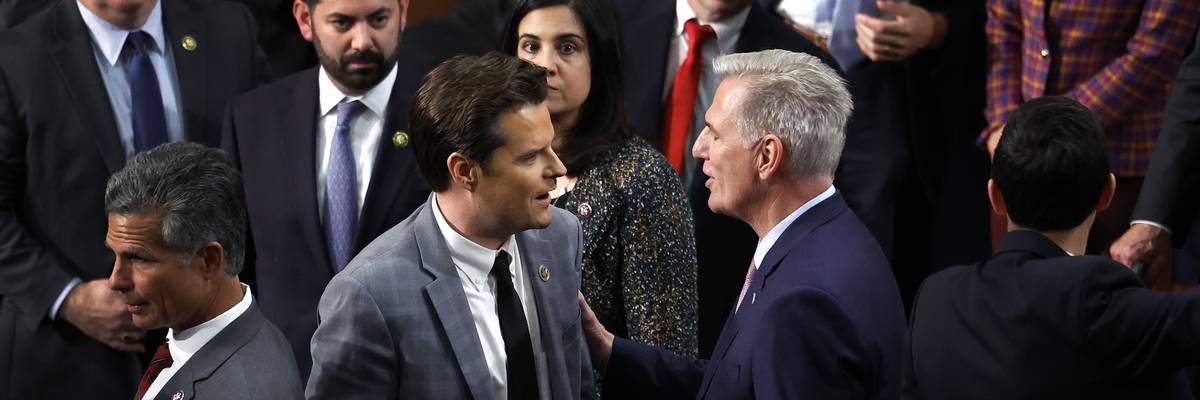
House Speaker Kevin McCarthy (R-Calif.) spoke to Rep. Matt Gaetz (R-Fla.) in the House chamber on January 6, 2023 in Washington, D.C.
Giving Away the Game, Gaetz Says McCarthy 'Picked Up' Far-Right's Debt Ceiling Plan
One progressive critic said the GOP bill is "a reflection of just how totally controlled by the fringes of his caucus McCarthy is."
Far-right House Republicans are reportedly "thrilled" with the debt ceiling legislation that Speaker Kevin McCarthy unveiled earlier this week.
That's likely because, according to Rep. Matt Gaetz (R-Fla.), McCarthy (R-Calif.) simply "picked up the House Freedom Caucus plan and helped us convert it into legislative text."
"And it shows," replied the progressive watchdog group Accountable.US.
Gaetz, one of a number of far-right Republicans who led a revolt against McCarthy's speakership bid earlier this year, told reporters Thursday that "if you held this plan and the plan that the House Freedom Caucus laid out some weeks ago and held them up to a lamp, you would see a lot of alignment."
Titled the Limit, Save, Grow Act of 2023, the legislation would revert federal spending back to fiscal year 2022 levels and cap annual spending growth at 1% over the next decade—central demands of the hardline House Freedom Caucus members who threatened to deny McCarthy the speaker's gavel in January.
Last month, the House Freedom Caucus outlined a more detailed proposal that would claw back unspent coronavirus pandemic funds, repeal clean energy tax credits and other elements of the Inflation Reduction Act, block President Joe Biden's stalled effort to cancel up to $20,000 in student loan debt per borrower, and impose new work requirements on recipients of Medicaid and federal food assistance that could kick millions off the lifesaving programs.
The Limit, Save, Grow Act would do all of the above and more, a fact that helps explain the bill's largely positive reception among far-right Republicans—though some, such as former House Freedom Caucus chair Rep. Andy Biggs (R-Ariz.), want the bill to attack aid programs more aggressively.
As Semafor reported, Biggs "expressed openness to voting for the bill" but said he "wanted to see even stricter rules around food stamps."
"That's who is really in charge of the MAGA majority," the progressive advocacy group Indivisible said of the House Freedom Caucus.
Citing Gaetz's comment to reporters, Accountable.US argued the GOP's debt ceiling bill is "a MAGA wishlist, not a serious proposal."
If passed—an unlikely scenario given opposition from congressional Democrats and the Biden White House—the Republican bill would increase the debt limit by $1.5 trillion or suspend the ceiling until next March, setting up another high-stakes standoff in early 2024, a presidential election year.
Congressional Democrats rejected the legislation as a nonstarter, pointing to the massive impact it would have on federal programs related to housing, education, healthcare, climate, and other critical areas.
Last month, the U.S. Department of Housing and Urban Development warned that roughly 640,000 families would lose rental assistance if its budget was reverted to fiscal year 2022 levels. The U.S. Department of Agriculture, meanwhile, estimated that 1.2 million people would lose access to the Special Supplemental Nutrition Program for Women, Infants, and Children (WIC) under the Republican proposal.
"These caps are cuts," Rep. Rosa DeLauro (D-Conn.), the top Democrat on the House Appropriations Committee, said in a statement on Wednesday. "They would ensure that resources for critical programs 10 years from now remain below the levels in effect today. That's 10 years of cuts for less than one year of preventing a default."
Analysts stressed that the cuts to social programs would be even steeper under the GOP plan if it exempts the bloated Pentagon from its austerity spree.
Republicans have two options to make their math work, according to Bobby Kogan, senior director of federal budget policy at the Center for American Progress.
Option one, Kogan noted, is "the entire discretionary budget is cut 28% by 2033 due to McCarthy's caps—including a 28% cut to defense and [Veterans Affairs] Medical Care." The second option is shielding the military budget and inflicting "a 58% cut to all else," leaving "most essential services destroyed."
"This is a ludicrous demand," Kogan argued. "McCarthy's position is that, unless both the president and Congress accede to his very specific and extreme demands, he will force the government to illegally default on its statutory obligations—such as payments to disabled veterans and [Social Security] recipients."
Ezra Levin, co-executive director of Indivisible, said the House GOP leadership's proposal is "a reflection of just how totally controlled by the fringes of his caucus McCarthy is."
"It's just as bad as we expected," said Levin. "Literally take food off the table of millions of families just trying to get by? Help the ultra-wealthy and big corporations get away with cheating on their taxes? Strip away healthcare from children, veterans, and seniors? Saddle millions with crushing student debt? Pull the plug on new clean energy jobs? That's your big pitch to the American people?"
"It'd be funny if it wasn't so serious," Levin added.
We are at a crossroads
This country and this world are at a monumental crossroads. In a few short weeks, US voters will have an opportunity to beat back the forces of fascism and confront the billionaires who are rigging the economy, our media system, and our democracy, making it increasingly impossible for ordinary people to get by. We’re not just talking about the election. We’re talking about what must be done once these fascist elements are vanquished from power. We need a bolder set of solutions than what either major party has so far been willing to offer and a working-class movement ready to fight like hell for it. Trump didn't emerge from nowhere. The conditions that fueled MAGA authoritarianism were created by decades of radical neoliberal economic policies and a corrupt political system dominated by corporate interests. They slashed taxes on the super-rich, promising that the benefits would trickle down. They said giveaways to the corporate titans would make life more affordable for the rest of us. It was all bullshit. And when a bitter, betrayed populace searches for someone to blame, right-wing demagogues have little trouble finding scapegoats. People know when they're being lied to, but you won't hear any of this from the corporate media. Only independent journalism—powered and funded by people who believe in building a better world—can deliver truly trustworthy daily news. Our Fall Campaign is underway, and we need your help. To power our newsroom through the rest of the year, we need to raise $125,000 by midnight on October 31. So if you share our vision, please contribute whatever you can to sustain our work. |
Far-right House Republicans are reportedly "thrilled" with the debt ceiling legislation that Speaker Kevin McCarthy unveiled earlier this week.
That's likely because, according to Rep. Matt Gaetz (R-Fla.), McCarthy (R-Calif.) simply "picked up the House Freedom Caucus plan and helped us convert it into legislative text."
"And it shows," replied the progressive watchdog group Accountable.US.
Gaetz, one of a number of far-right Republicans who led a revolt against McCarthy's speakership bid earlier this year, told reporters Thursday that "if you held this plan and the plan that the House Freedom Caucus laid out some weeks ago and held them up to a lamp, you would see a lot of alignment."
Titled the Limit, Save, Grow Act of 2023, the legislation would revert federal spending back to fiscal year 2022 levels and cap annual spending growth at 1% over the next decade—central demands of the hardline House Freedom Caucus members who threatened to deny McCarthy the speaker's gavel in January.
Last month, the House Freedom Caucus outlined a more detailed proposal that would claw back unspent coronavirus pandemic funds, repeal clean energy tax credits and other elements of the Inflation Reduction Act, block President Joe Biden's stalled effort to cancel up to $20,000 in student loan debt per borrower, and impose new work requirements on recipients of Medicaid and federal food assistance that could kick millions off the lifesaving programs.
The Limit, Save, Grow Act would do all of the above and more, a fact that helps explain the bill's largely positive reception among far-right Republicans—though some, such as former House Freedom Caucus chair Rep. Andy Biggs (R-Ariz.), want the bill to attack aid programs more aggressively.
As Semafor reported, Biggs "expressed openness to voting for the bill" but said he "wanted to see even stricter rules around food stamps."
"That's who is really in charge of the MAGA majority," the progressive advocacy group Indivisible said of the House Freedom Caucus.
Citing Gaetz's comment to reporters, Accountable.US argued the GOP's debt ceiling bill is "a MAGA wishlist, not a serious proposal."
If passed—an unlikely scenario given opposition from congressional Democrats and the Biden White House—the Republican bill would increase the debt limit by $1.5 trillion or suspend the ceiling until next March, setting up another high-stakes standoff in early 2024, a presidential election year.
Congressional Democrats rejected the legislation as a nonstarter, pointing to the massive impact it would have on federal programs related to housing, education, healthcare, climate, and other critical areas.
Last month, the U.S. Department of Housing and Urban Development warned that roughly 640,000 families would lose rental assistance if its budget was reverted to fiscal year 2022 levels. The U.S. Department of Agriculture, meanwhile, estimated that 1.2 million people would lose access to the Special Supplemental Nutrition Program for Women, Infants, and Children (WIC) under the Republican proposal.
"These caps are cuts," Rep. Rosa DeLauro (D-Conn.), the top Democrat on the House Appropriations Committee, said in a statement on Wednesday. "They would ensure that resources for critical programs 10 years from now remain below the levels in effect today. That's 10 years of cuts for less than one year of preventing a default."
Analysts stressed that the cuts to social programs would be even steeper under the GOP plan if it exempts the bloated Pentagon from its austerity spree.
Republicans have two options to make their math work, according to Bobby Kogan, senior director of federal budget policy at the Center for American Progress.
Option one, Kogan noted, is "the entire discretionary budget is cut 28% by 2033 due to McCarthy's caps—including a 28% cut to defense and [Veterans Affairs] Medical Care." The second option is shielding the military budget and inflicting "a 58% cut to all else," leaving "most essential services destroyed."
"This is a ludicrous demand," Kogan argued. "McCarthy's position is that, unless both the president and Congress accede to his very specific and extreme demands, he will force the government to illegally default on its statutory obligations—such as payments to disabled veterans and [Social Security] recipients."
Ezra Levin, co-executive director of Indivisible, said the House GOP leadership's proposal is "a reflection of just how totally controlled by the fringes of his caucus McCarthy is."
"It's just as bad as we expected," said Levin. "Literally take food off the table of millions of families just trying to get by? Help the ultra-wealthy and big corporations get away with cheating on their taxes? Strip away healthcare from children, veterans, and seniors? Saddle millions with crushing student debt? Pull the plug on new clean energy jobs? That's your big pitch to the American people?"
"It'd be funny if it wasn't so serious," Levin added.
- Opinion | McCarthy's GOP Cruelly Targets Most-Vulnerable With Sabotage of US Economy as Ransom | Common Dreams ›
- 'MAGA Economic Sabotage': 217 House Republicans Pass Debt Ceiling Bill With Harmful Cuts ›
- Opinion | The Republican Revolution Devours Its Children | Common Dreams ›
Far-right House Republicans are reportedly "thrilled" with the debt ceiling legislation that Speaker Kevin McCarthy unveiled earlier this week.
That's likely because, according to Rep. Matt Gaetz (R-Fla.), McCarthy (R-Calif.) simply "picked up the House Freedom Caucus plan and helped us convert it into legislative text."
"And it shows," replied the progressive watchdog group Accountable.US.
Gaetz, one of a number of far-right Republicans who led a revolt against McCarthy's speakership bid earlier this year, told reporters Thursday that "if you held this plan and the plan that the House Freedom Caucus laid out some weeks ago and held them up to a lamp, you would see a lot of alignment."
Titled the Limit, Save, Grow Act of 2023, the legislation would revert federal spending back to fiscal year 2022 levels and cap annual spending growth at 1% over the next decade—central demands of the hardline House Freedom Caucus members who threatened to deny McCarthy the speaker's gavel in January.
Last month, the House Freedom Caucus outlined a more detailed proposal that would claw back unspent coronavirus pandemic funds, repeal clean energy tax credits and other elements of the Inflation Reduction Act, block President Joe Biden's stalled effort to cancel up to $20,000 in student loan debt per borrower, and impose new work requirements on recipients of Medicaid and federal food assistance that could kick millions off the lifesaving programs.
The Limit, Save, Grow Act would do all of the above and more, a fact that helps explain the bill's largely positive reception among far-right Republicans—though some, such as former House Freedom Caucus chair Rep. Andy Biggs (R-Ariz.), want the bill to attack aid programs more aggressively.
As Semafor reported, Biggs "expressed openness to voting for the bill" but said he "wanted to see even stricter rules around food stamps."
"That's who is really in charge of the MAGA majority," the progressive advocacy group Indivisible said of the House Freedom Caucus.
Citing Gaetz's comment to reporters, Accountable.US argued the GOP's debt ceiling bill is "a MAGA wishlist, not a serious proposal."
If passed—an unlikely scenario given opposition from congressional Democrats and the Biden White House—the Republican bill would increase the debt limit by $1.5 trillion or suspend the ceiling until next March, setting up another high-stakes standoff in early 2024, a presidential election year.
Congressional Democrats rejected the legislation as a nonstarter, pointing to the massive impact it would have on federal programs related to housing, education, healthcare, climate, and other critical areas.
Last month, the U.S. Department of Housing and Urban Development warned that roughly 640,000 families would lose rental assistance if its budget was reverted to fiscal year 2022 levels. The U.S. Department of Agriculture, meanwhile, estimated that 1.2 million people would lose access to the Special Supplemental Nutrition Program for Women, Infants, and Children (WIC) under the Republican proposal.
"These caps are cuts," Rep. Rosa DeLauro (D-Conn.), the top Democrat on the House Appropriations Committee, said in a statement on Wednesday. "They would ensure that resources for critical programs 10 years from now remain below the levels in effect today. That's 10 years of cuts for less than one year of preventing a default."
Analysts stressed that the cuts to social programs would be even steeper under the GOP plan if it exempts the bloated Pentagon from its austerity spree.
Republicans have two options to make their math work, according to Bobby Kogan, senior director of federal budget policy at the Center for American Progress.
Option one, Kogan noted, is "the entire discretionary budget is cut 28% by 2033 due to McCarthy's caps—including a 28% cut to defense and [Veterans Affairs] Medical Care." The second option is shielding the military budget and inflicting "a 58% cut to all else," leaving "most essential services destroyed."
"This is a ludicrous demand," Kogan argued. "McCarthy's position is that, unless both the president and Congress accede to his very specific and extreme demands, he will force the government to illegally default on its statutory obligations—such as payments to disabled veterans and [Social Security] recipients."
Ezra Levin, co-executive director of Indivisible, said the House GOP leadership's proposal is "a reflection of just how totally controlled by the fringes of his caucus McCarthy is."
"It's just as bad as we expected," said Levin. "Literally take food off the table of millions of families just trying to get by? Help the ultra-wealthy and big corporations get away with cheating on their taxes? Strip away healthcare from children, veterans, and seniors? Saddle millions with crushing student debt? Pull the plug on new clean energy jobs? That's your big pitch to the American people?"
"It'd be funny if it wasn't so serious," Levin added.
- Opinion | McCarthy's GOP Cruelly Targets Most-Vulnerable With Sabotage of US Economy as Ransom | Common Dreams ›
- 'MAGA Economic Sabotage': 217 House Republicans Pass Debt Ceiling Bill With Harmful Cuts ›
- Opinion | The Republican Revolution Devours Its Children | Common Dreams ›