SUBSCRIBE TO OUR FREE NEWSLETTER
Daily news & progressive opinion—funded by the people, not the corporations—delivered straight to your inbox.
5
#000000
#FFFFFF
To donate by check, phone, or other method, see our More Ways to Give page.
Daily news & progressive opinion—funded by the people, not the corporations—delivered straight to your inbox.
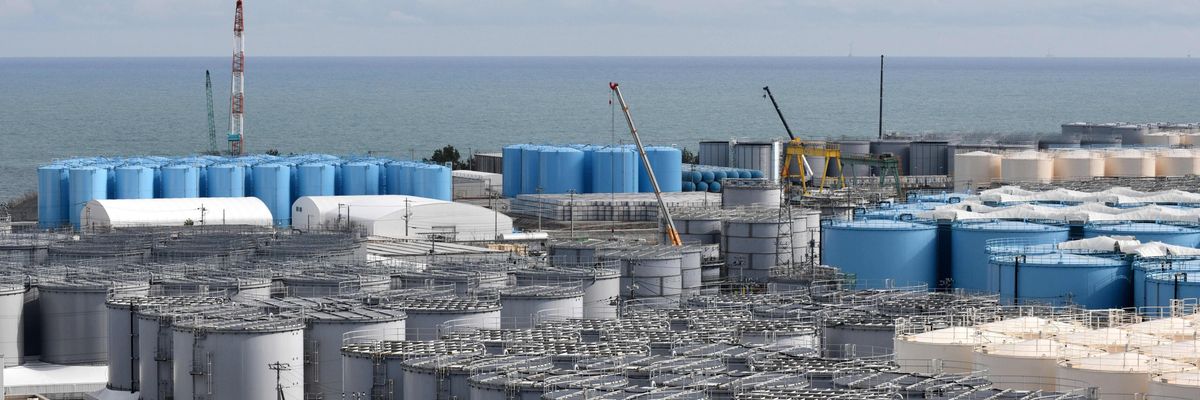
This photo taken on February 3, 2020 shows storage tanks for contaminated water at the Tokyo Electric Power Company's Fukushima Daiichi nuclear power plant in Okuma, Fukushima prefecture in Japan.
A Chinese official implored Japan to "face up to the concerns of its neighboring countries and the international community."
Thousands of liters of radioactive wastewater from the destroyed Fukushima Daiichi Nuclear Power Station in Japan leaked from the outdoor vent of a filtering device, the company that operates the facility said Wednesday.
Tokyo Electric Power Company (TEPCO) said about 5,500 liters of both contaminated and filtered water leaked when a valve was left open during cleaning. The company, which said it discovered the leak on Wednesday morning, warned that some of the water—which is believed to contain 220 times the level of radioactivity required for government reporting—may have seeped into the ground.
"TEPCO has confirmed that there was no significant fluctuation in radiation measurements recorded at the site," the International Atomic Energy Agency (IAEA) said in a statement. "The event does not pose any risk to the public and there is no environmental impact off-site."
The Fukushima plant, located about 150 miles northeast of Tokyo, was catastrophically damaged during the massive March 2011 earthquake and tsunami that caused meltdowns in three of the facility's reactors.
Last July, the IAEA approved a Japanese plan to gradually release more than 1 million metric tons of filtered Fukushima wastewater into the Pacific, despite years of warnings from environmentalists and widespread opposition by people in the region.
News of the leak prompted an angry response from the Chinese government.
"Japan's repeated accidents in the process of treating Fukushima nuclear-contaminated water have fully exposed the chaos and disorder of TEPCO's internal management," a spokesperson for the Chinese Embassy in Tokyo said on Thursday, according to the South China Morning Post.
"The Japanese government's supervision measures are lacking and ineffective, which once again proves that the nuclear-contaminated water treatment equipment lacks long-term reliability," the official added.
Asserting that "the discharge of the Fukushima nuclear-contaminated water into the sea is related to the health of all mankind, the global marine environment, and international public interests," the spokesperson reiterated calls for Japan to "face up to the concerns of its neighboring countries and the international community."
The new leak follows the October 2023 accident at a separate Fukushima wastewater treatment facility in which four workers were sprayed with radioactive liquid waste while cleaning pipes. Two of the workers were briefly hospitalized for skin contamination, although none showed symptoms of radiation poisoning.
There have been regular demonstrations against the Fukushima wastewater dump in South Korea and China—two countries that, like many others with nuclear power plants, have discharged far greater quantities of treated radioactive wastewater into oceans and other bodies of water than Japan says it will release.
Dear Common Dreams reader, It’s been nearly 30 years since I co-founded Common Dreams with my late wife, Lina Newhouser. We had the radical notion that journalism should serve the public good, not corporate profits. It was clear to us from the outset what it would take to build such a project. No paid advertisements. No corporate sponsors. No millionaire publisher telling us what to think or do. Many people said we wouldn't last a year, but we proved those doubters wrong. Together with a tremendous team of journalists and dedicated staff, we built an independent media outlet free from the constraints of profits and corporate control. Our mission has always been simple: To inform. To inspire. To ignite change for the common good. Building Common Dreams was not easy. Our survival was never guaranteed. When you take on the most powerful forces—Wall Street greed, fossil fuel industry destruction, Big Tech lobbyists, and uber-rich oligarchs who have spent billions upon billions rigging the economy and democracy in their favor—the only bulwark you have is supporters who believe in your work. But here’s the urgent message from me today. It's never been this bad out there. And it's never been this hard to keep us going. At the very moment Common Dreams is most needed, the threats we face are intensifying. We need your support now more than ever. We don't accept corporate advertising and never will. We don't have a paywall because we don't think people should be blocked from critical news based on their ability to pay. Everything we do is funded by the donations of readers like you. When everyone does the little they can afford, we are strong. But if that support retreats or dries up, so do we. Will you donate now to make sure Common Dreams not only survives but thrives? —Craig Brown, Co-founder |
Thousands of liters of radioactive wastewater from the destroyed Fukushima Daiichi Nuclear Power Station in Japan leaked from the outdoor vent of a filtering device, the company that operates the facility said Wednesday.
Tokyo Electric Power Company (TEPCO) said about 5,500 liters of both contaminated and filtered water leaked when a valve was left open during cleaning. The company, which said it discovered the leak on Wednesday morning, warned that some of the water—which is believed to contain 220 times the level of radioactivity required for government reporting—may have seeped into the ground.
"TEPCO has confirmed that there was no significant fluctuation in radiation measurements recorded at the site," the International Atomic Energy Agency (IAEA) said in a statement. "The event does not pose any risk to the public and there is no environmental impact off-site."
The Fukushima plant, located about 150 miles northeast of Tokyo, was catastrophically damaged during the massive March 2011 earthquake and tsunami that caused meltdowns in three of the facility's reactors.
Last July, the IAEA approved a Japanese plan to gradually release more than 1 million metric tons of filtered Fukushima wastewater into the Pacific, despite years of warnings from environmentalists and widespread opposition by people in the region.
News of the leak prompted an angry response from the Chinese government.
"Japan's repeated accidents in the process of treating Fukushima nuclear-contaminated water have fully exposed the chaos and disorder of TEPCO's internal management," a spokesperson for the Chinese Embassy in Tokyo said on Thursday, according to the South China Morning Post.
"The Japanese government's supervision measures are lacking and ineffective, which once again proves that the nuclear-contaminated water treatment equipment lacks long-term reliability," the official added.
Asserting that "the discharge of the Fukushima nuclear-contaminated water into the sea is related to the health of all mankind, the global marine environment, and international public interests," the spokesperson reiterated calls for Japan to "face up to the concerns of its neighboring countries and the international community."
The new leak follows the October 2023 accident at a separate Fukushima wastewater treatment facility in which four workers were sprayed with radioactive liquid waste while cleaning pipes. Two of the workers were briefly hospitalized for skin contamination, although none showed symptoms of radiation poisoning.
There have been regular demonstrations against the Fukushima wastewater dump in South Korea and China—two countries that, like many others with nuclear power plants, have discharged far greater quantities of treated radioactive wastewater into oceans and other bodies of water than Japan says it will release.
Thousands of liters of radioactive wastewater from the destroyed Fukushima Daiichi Nuclear Power Station in Japan leaked from the outdoor vent of a filtering device, the company that operates the facility said Wednesday.
Tokyo Electric Power Company (TEPCO) said about 5,500 liters of both contaminated and filtered water leaked when a valve was left open during cleaning. The company, which said it discovered the leak on Wednesday morning, warned that some of the water—which is believed to contain 220 times the level of radioactivity required for government reporting—may have seeped into the ground.
"TEPCO has confirmed that there was no significant fluctuation in radiation measurements recorded at the site," the International Atomic Energy Agency (IAEA) said in a statement. "The event does not pose any risk to the public and there is no environmental impact off-site."
The Fukushima plant, located about 150 miles northeast of Tokyo, was catastrophically damaged during the massive March 2011 earthquake and tsunami that caused meltdowns in three of the facility's reactors.
Last July, the IAEA approved a Japanese plan to gradually release more than 1 million metric tons of filtered Fukushima wastewater into the Pacific, despite years of warnings from environmentalists and widespread opposition by people in the region.
News of the leak prompted an angry response from the Chinese government.
"Japan's repeated accidents in the process of treating Fukushima nuclear-contaminated water have fully exposed the chaos and disorder of TEPCO's internal management," a spokesperson for the Chinese Embassy in Tokyo said on Thursday, according to the South China Morning Post.
"The Japanese government's supervision measures are lacking and ineffective, which once again proves that the nuclear-contaminated water treatment equipment lacks long-term reliability," the official added.
Asserting that "the discharge of the Fukushima nuclear-contaminated water into the sea is related to the health of all mankind, the global marine environment, and international public interests," the spokesperson reiterated calls for Japan to "face up to the concerns of its neighboring countries and the international community."
The new leak follows the October 2023 accident at a separate Fukushima wastewater treatment facility in which four workers were sprayed with radioactive liquid waste while cleaning pipes. Two of the workers were briefly hospitalized for skin contamination, although none showed symptoms of radiation poisoning.
There have been regular demonstrations against the Fukushima wastewater dump in South Korea and China—two countries that, like many others with nuclear power plants, have discharged far greater quantities of treated radioactive wastewater into oceans and other bodies of water than Japan says it will release.