

SUBSCRIBE TO OUR FREE NEWSLETTER
Daily news & progressive opinion—funded by the people, not the corporations—delivered straight to your inbox.
5
#000000
#FFFFFF
To donate by check, phone, or other method, see our More Ways to Give page.
Daily news & progressive opinion—funded by the people, not the corporations—delivered straight to your inbox.
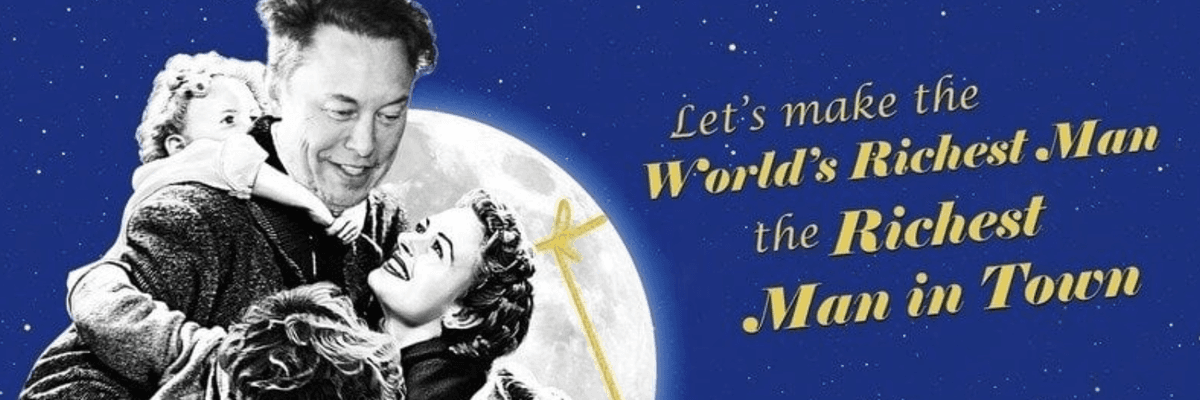
A graphic shows billionaire Elon Musk superimposed into an image from the film "It's a Wonderful Life."
... by giving nearly half of his $500 billion fortune to the children of the world.
"Let's make the world's richest man the richest man in town!" urges a new campaign launched Friday by the economic advocacy group Tax Justice Network, borrowing a memorable line from the classic film "It's a Wonderful Life."
The group's global petition emphasizes that SpaceX owner Elon Musk is already the richest person in the world, with a net worth of $508.4 billion—more than double the assets of the planet's next-richest person, Google co-founder Larry Page.
Tax Justice Network's (TJN) petition invites Musk to give 44% of his wealth—$223.6 billion—to the children of the world. That amount of money would allow the purchase of a $90 gift card for all 2.4 billion of the planet's children under the age of 18, and could stop more than 100 million children from going hungry this holiday season.
And Musk would still be the richest person alive, emphasized the group.
Let’s make the world’s richest man feel like the richest man in town this Christmas! Sign our Christmas card inviting Elon Musk to gift 44% of his wealth to the children of the world to create 2 billion smiles and still be the world’s richest man alive! #WealthTax #TaxTheSuperRichc.org/jnnZhmp6J4
[image or embed]
— Tax Justice Network (@taxjustice.net) December 12, 2025 at 10:40 AM
The campaign quotes Harry Bailey's famous line declaring his brother George Bailey, played by Jimmy Stewart, "the richest man in town" in "It's a Wonderful Life," after George's neighbors donate money to save him from financial ruin.
“We’re obviously poking a little fun here but the point is to show how extreme the concentration of wealth has become," said Alex Cobham, chief executive at TJN. "Depending on where you are in the world, if you earn the average wage, you’d need to work anywhere from 20 times to a thousand times longer than humans have existed to earn as much wealth as Elon Musk has collected."
The petition notes that TJN and the world's children "would also settle for a 2% wealth tax on the superrich," which would allow countries around the world to raise $2 trillion per year if it was applied to the richest 0.5% of people on the planet.
"That’s enough public money to meet most countries’ climate finance needs, and leave billions to spare for local public services," the group said.
The group pointed to a recent G20 report declaring a global "inequality emergency" and last week's World Inequality Report, which found that fewer than 60,000 multimillionaires—just 0.001% of the world's population—own three times more wealth than the entire bottom 50% of humanity.
"Within almost every region, the top 1% alone hold more wealth than the bottom 90% combined," noted TJN.
The petition emphasizes the difference between collected wealth—the kind enjoyed by Musk and other superrich people—and earned wealth. The vast majority of people earn money for what they do, notes TJN. Musk and other billionaires "get paid for what [they] own, so dividends for owning stocks and rent money for owning real estate."
Billionaires including Musk, Meta CEO Mark Zuckerberg, and Oracle executive Larry Ellison famously take salaries of just $1, but the money that's made them part of the world's superrich is their collected wealth, emphasized TJN.
"Earned wealth cannot create billionaires," said TJN. "Only collected wealth grows fast enough to do so. It’s impossible to earn a billion dollars."
A ProPublica report in 2021 detailed how billionaires like Musk and Amazon founder Jeff Bezos paid a collective "true tax rate" of just 3.4% while the median American household made $70,000 and paid a tax rate of 14%.
"This special tax treatment has helped the superrich quadruple their wealth since the 1980s to extreme levels," said TJN. "Studies directly link this rise in extreme wealth to lower economic productivity, to more households going into debt and to people living shorter lives."
Musk in the past has pledged to use his extreme wealth to help people around the world—only to renege on his promises. In 2022, he challenged then-World Food Program chief David Beasley to prove, as Beasley had stated, that a small fraction of Musk's wealth could help address world hunger. He pledged to donate $6 billion by selling his Tesla stock if the WFP could prove the contribution would "solve world hunger."
The WFP responded with a report detailing how $6 billion could feed 42 million at-risk people and prevent them from going hungry for a year. But Musk didn't follow through with his pledge, instead donating $5.7 billion of his Tesla shares to his own foundation.
This year, Musk spearheaded a push to slash government spending on foreign aid, with the US Agency for International Development a key target. The cuts have already proven deadly for children in impoverished nations.
Cobham on Monday pointed to research showing that the skyrocketing wealth of the richest 1% of Americans over the past 40 years has not led "to more investments, and instead resulted in dissaving among non-rich households."
“We now have plenty of evidence showing that extreme wealth shrinks economies, makes people poorer, and threatens democracy," said Cobham. "The best way to protect people, economies, and planet from the harms of extreme wealth is to end the special tax treatment that collected wealth gets over earned wealth. We must tax extreme wealth more effectively to protect the earner way of life we all rely on. Whether you’re a wealth collector or a wealth earner, we all have an equal responsibility to pitch in our fair share.”
Dear Common Dreams reader, It’s been nearly 30 years since I co-founded Common Dreams with my late wife, Lina Newhouser. We had the radical notion that journalism should serve the public good, not corporate profits. It was clear to us from the outset what it would take to build such a project. No paid advertisements. No corporate sponsors. No millionaire publisher telling us what to think or do. Many people said we wouldn't last a year, but we proved those doubters wrong. Together with a tremendous team of journalists and dedicated staff, we built an independent media outlet free from the constraints of profits and corporate control. Our mission has always been simple: To inform. To inspire. To ignite change for the common good. Building Common Dreams was not easy. Our survival was never guaranteed. When you take on the most powerful forces—Wall Street greed, fossil fuel industry destruction, Big Tech lobbyists, and uber-rich oligarchs who have spent billions upon billions rigging the economy and democracy in their favor—the only bulwark you have is supporters who believe in your work. But here’s the urgent message from me today. It's never been this bad out there. And it's never been this hard to keep us going. At the very moment Common Dreams is most needed, the threats we face are intensifying. We need your support now more than ever. We don't accept corporate advertising and never will. We don't have a paywall because we don't think people should be blocked from critical news based on their ability to pay. Everything we do is funded by the donations of readers like you. When everyone does the little they can afford, we are strong. But if that support retreats or dries up, so do we. Will you donate now to make sure Common Dreams not only survives but thrives? —Craig Brown, Co-founder |
"Let's make the world's richest man the richest man in town!" urges a new campaign launched Friday by the economic advocacy group Tax Justice Network, borrowing a memorable line from the classic film "It's a Wonderful Life."
The group's global petition emphasizes that SpaceX owner Elon Musk is already the richest person in the world, with a net worth of $508.4 billion—more than double the assets of the planet's next-richest person, Google co-founder Larry Page.
Tax Justice Network's (TJN) petition invites Musk to give 44% of his wealth—$223.6 billion—to the children of the world. That amount of money would allow the purchase of a $90 gift card for all 2.4 billion of the planet's children under the age of 18, and could stop more than 100 million children from going hungry this holiday season.
And Musk would still be the richest person alive, emphasized the group.
Let’s make the world’s richest man feel like the richest man in town this Christmas! Sign our Christmas card inviting Elon Musk to gift 44% of his wealth to the children of the world to create 2 billion smiles and still be the world’s richest man alive! #WealthTax #TaxTheSuperRichc.org/jnnZhmp6J4
[image or embed]
— Tax Justice Network (@taxjustice.net) December 12, 2025 at 10:40 AM
The campaign quotes Harry Bailey's famous line declaring his brother George Bailey, played by Jimmy Stewart, "the richest man in town" in "It's a Wonderful Life," after George's neighbors donate money to save him from financial ruin.
“We’re obviously poking a little fun here but the point is to show how extreme the concentration of wealth has become," said Alex Cobham, chief executive at TJN. "Depending on where you are in the world, if you earn the average wage, you’d need to work anywhere from 20 times to a thousand times longer than humans have existed to earn as much wealth as Elon Musk has collected."
The petition notes that TJN and the world's children "would also settle for a 2% wealth tax on the superrich," which would allow countries around the world to raise $2 trillion per year if it was applied to the richest 0.5% of people on the planet.
"That’s enough public money to meet most countries’ climate finance needs, and leave billions to spare for local public services," the group said.
The group pointed to a recent G20 report declaring a global "inequality emergency" and last week's World Inequality Report, which found that fewer than 60,000 multimillionaires—just 0.001% of the world's population—own three times more wealth than the entire bottom 50% of humanity.
"Within almost every region, the top 1% alone hold more wealth than the bottom 90% combined," noted TJN.
The petition emphasizes the difference between collected wealth—the kind enjoyed by Musk and other superrich people—and earned wealth. The vast majority of people earn money for what they do, notes TJN. Musk and other billionaires "get paid for what [they] own, so dividends for owning stocks and rent money for owning real estate."
Billionaires including Musk, Meta CEO Mark Zuckerberg, and Oracle executive Larry Ellison famously take salaries of just $1, but the money that's made them part of the world's superrich is their collected wealth, emphasized TJN.
"Earned wealth cannot create billionaires," said TJN. "Only collected wealth grows fast enough to do so. It’s impossible to earn a billion dollars."
A ProPublica report in 2021 detailed how billionaires like Musk and Amazon founder Jeff Bezos paid a collective "true tax rate" of just 3.4% while the median American household made $70,000 and paid a tax rate of 14%.
"This special tax treatment has helped the superrich quadruple their wealth since the 1980s to extreme levels," said TJN. "Studies directly link this rise in extreme wealth to lower economic productivity, to more households going into debt and to people living shorter lives."
Musk in the past has pledged to use his extreme wealth to help people around the world—only to renege on his promises. In 2022, he challenged then-World Food Program chief David Beasley to prove, as Beasley had stated, that a small fraction of Musk's wealth could help address world hunger. He pledged to donate $6 billion by selling his Tesla stock if the WFP could prove the contribution would "solve world hunger."
The WFP responded with a report detailing how $6 billion could feed 42 million at-risk people and prevent them from going hungry for a year. But Musk didn't follow through with his pledge, instead donating $5.7 billion of his Tesla shares to his own foundation.
This year, Musk spearheaded a push to slash government spending on foreign aid, with the US Agency for International Development a key target. The cuts have already proven deadly for children in impoverished nations.
Cobham on Monday pointed to research showing that the skyrocketing wealth of the richest 1% of Americans over the past 40 years has not led "to more investments, and instead resulted in dissaving among non-rich households."
“We now have plenty of evidence showing that extreme wealth shrinks economies, makes people poorer, and threatens democracy," said Cobham. "The best way to protect people, economies, and planet from the harms of extreme wealth is to end the special tax treatment that collected wealth gets over earned wealth. We must tax extreme wealth more effectively to protect the earner way of life we all rely on. Whether you’re a wealth collector or a wealth earner, we all have an equal responsibility to pitch in our fair share.”
"Let's make the world's richest man the richest man in town!" urges a new campaign launched Friday by the economic advocacy group Tax Justice Network, borrowing a memorable line from the classic film "It's a Wonderful Life."
The group's global petition emphasizes that SpaceX owner Elon Musk is already the richest person in the world, with a net worth of $508.4 billion—more than double the assets of the planet's next-richest person, Google co-founder Larry Page.
Tax Justice Network's (TJN) petition invites Musk to give 44% of his wealth—$223.6 billion—to the children of the world. That amount of money would allow the purchase of a $90 gift card for all 2.4 billion of the planet's children under the age of 18, and could stop more than 100 million children from going hungry this holiday season.
And Musk would still be the richest person alive, emphasized the group.
Let’s make the world’s richest man feel like the richest man in town this Christmas! Sign our Christmas card inviting Elon Musk to gift 44% of his wealth to the children of the world to create 2 billion smiles and still be the world’s richest man alive! #WealthTax #TaxTheSuperRichc.org/jnnZhmp6J4
[image or embed]
— Tax Justice Network (@taxjustice.net) December 12, 2025 at 10:40 AM
The campaign quotes Harry Bailey's famous line declaring his brother George Bailey, played by Jimmy Stewart, "the richest man in town" in "It's a Wonderful Life," after George's neighbors donate money to save him from financial ruin.
“We’re obviously poking a little fun here but the point is to show how extreme the concentration of wealth has become," said Alex Cobham, chief executive at TJN. "Depending on where you are in the world, if you earn the average wage, you’d need to work anywhere from 20 times to a thousand times longer than humans have existed to earn as much wealth as Elon Musk has collected."
The petition notes that TJN and the world's children "would also settle for a 2% wealth tax on the superrich," which would allow countries around the world to raise $2 trillion per year if it was applied to the richest 0.5% of people on the planet.
"That’s enough public money to meet most countries’ climate finance needs, and leave billions to spare for local public services," the group said.
The group pointed to a recent G20 report declaring a global "inequality emergency" and last week's World Inequality Report, which found that fewer than 60,000 multimillionaires—just 0.001% of the world's population—own three times more wealth than the entire bottom 50% of humanity.
"Within almost every region, the top 1% alone hold more wealth than the bottom 90% combined," noted TJN.
The petition emphasizes the difference between collected wealth—the kind enjoyed by Musk and other superrich people—and earned wealth. The vast majority of people earn money for what they do, notes TJN. Musk and other billionaires "get paid for what [they] own, so dividends for owning stocks and rent money for owning real estate."
Billionaires including Musk, Meta CEO Mark Zuckerberg, and Oracle executive Larry Ellison famously take salaries of just $1, but the money that's made them part of the world's superrich is their collected wealth, emphasized TJN.
"Earned wealth cannot create billionaires," said TJN. "Only collected wealth grows fast enough to do so. It’s impossible to earn a billion dollars."
A ProPublica report in 2021 detailed how billionaires like Musk and Amazon founder Jeff Bezos paid a collective "true tax rate" of just 3.4% while the median American household made $70,000 and paid a tax rate of 14%.
"This special tax treatment has helped the superrich quadruple their wealth since the 1980s to extreme levels," said TJN. "Studies directly link this rise in extreme wealth to lower economic productivity, to more households going into debt and to people living shorter lives."
Musk in the past has pledged to use his extreme wealth to help people around the world—only to renege on his promises. In 2022, he challenged then-World Food Program chief David Beasley to prove, as Beasley had stated, that a small fraction of Musk's wealth could help address world hunger. He pledged to donate $6 billion by selling his Tesla stock if the WFP could prove the contribution would "solve world hunger."
The WFP responded with a report detailing how $6 billion could feed 42 million at-risk people and prevent them from going hungry for a year. But Musk didn't follow through with his pledge, instead donating $5.7 billion of his Tesla shares to his own foundation.
This year, Musk spearheaded a push to slash government spending on foreign aid, with the US Agency for International Development a key target. The cuts have already proven deadly for children in impoverished nations.
Cobham on Monday pointed to research showing that the skyrocketing wealth of the richest 1% of Americans over the past 40 years has not led "to more investments, and instead resulted in dissaving among non-rich households."
“We now have plenty of evidence showing that extreme wealth shrinks economies, makes people poorer, and threatens democracy," said Cobham. "The best way to protect people, economies, and planet from the harms of extreme wealth is to end the special tax treatment that collected wealth gets over earned wealth. We must tax extreme wealth more effectively to protect the earner way of life we all rely on. Whether you’re a wealth collector or a wealth earner, we all have an equal responsibility to pitch in our fair share.”

