SUBSCRIBE TO OUR FREE NEWSLETTER
Daily news & progressive opinion—funded by the people, not the corporations—delivered straight to your inbox.
5
#000000
#FFFFFF
To donate by check, phone, or other method, see our More Ways to Give page.
Daily news & progressive opinion—funded by the people, not the corporations—delivered straight to your inbox.
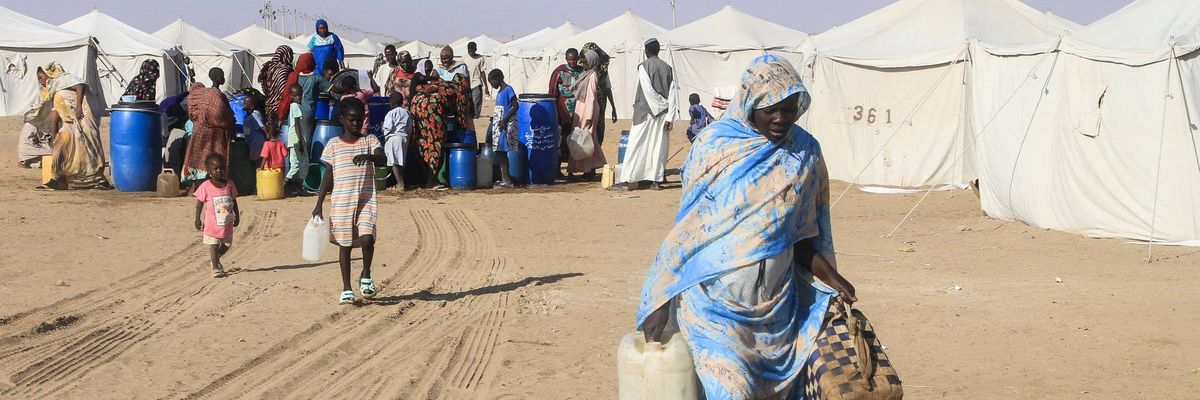
A Sudanese woman who fled el-Fasher in Darfur carries jerrycans of water at the al-Afad camp for displaced people in the town of Al-Dabba, northern Sudan, on November 21, 2025.
UN officials said they were "still very concerned about those who are injured, who we didn’t see, those who may be detained."
After weeks of pushing for access to el-Fasher, the city in Sudan's Darfur region that was taken over by the paramilitary Rapid Support Forces in October, United Nations officials reported on Tuesday that their recent visit to the city showed evidence of a "crime scene," with the few people remaining there showing signs of trauma from the mass atrocities they suffered and witnessed.
UN humanitarian workers gained access to the city last Friday, two months after the government-aligned Sudanese Armed Forces (SAF) lost control of el-Fasher to the United Arab Emirates-backed RSF.
The city was the SAF's last major stronghold in Darfur, and fighting has now escalated in the Kordofan region.
Reuters reported that the RSF has attempted to portray el-Fasher as "back to normal" since its takeover, even as the Yale Humanitan Research Lab published a report earlier this month on the mass killings that the paramilitary group have sought hide evidence of "through burial, burning, and removal of human remains on a mass scale."
Denise Brown, the UN resident and humanitarian coordinator for Sudan, told Reuters that the few people remaining in el-Fasher are living in empty buildings or tents made of plastic sheets. A small market was operating, but was selling only locally grown vegetables.
"The town was not teeming with people," Brown said. "There were very few people that [we] were able to see... We have photos of people, and you can see clearly on their faces the accumulation of fatigue, of stress, of anxiety, of loss."
Healthcare staff were seen at Saudi Hospital in el-Fasher, where 460 people were killed in an RSF attack, but they were working without medical supplies, Brown said.
Yale's report earlier this month relied partially in satellite imagery taken between October 26-November 28, which showed clusters of what researchers said were consistent with human remains in and around el-Fasher. More than 70% of the clusters had become smaller in satellite images by late November, and 38% were no longer visible.
The researchers said the RSF has used particular patterns of killing, including murdering people as they flee attacks, door-to-door and execution-style killings, and mass killings at detention centers and military installations.
Nathaniel Raymond, executive director of the Humanitarian Research Lab, said the UN's discovery of few signs of life in el-Fasher corroborated the lab's findings.
Brown said the UN team is "still very concerned about those who are injured, who we didn’t see, those who may be detained," and told Reuters the officials plan to return to assess water and sanitation access.
About 100,000 people fled el-Fasher in October, and about three-quarters of those forced to leave the city were already internally displaced people who had fled violence as many as three or more times. In total 1.17 million el-Fasher residents have been displaced.
Earlier this month, Doctors Without Borders, also known as Médecins Sans Frontières (MSF), released a short documentary detailing the experiences of people who left the city and are sheltering in Chad.
"They call it Paris, and now it is destroyed," a man named Noor told MSF of el-Fasher. "In the past it was a good city with all its lights on."
An estimated 30.4 Sudanese people are now in need of humanitarian assistance, and on Monday the UN Children's Fund (UNICEF) reported unprecedented levels of child malnutrition in the Um Baru locality in northern Darfur.
More than half of children there are suffering from acute malnutrition, and 1 in 6 are severely, acutely malnourished—a condition that could kill them within weeks if left untreated.
“When severe acute malnutrition reaches this level, time becomes the most critical factor,” said UNICEF Executive Director Catherine Russell. “Children in Um Baru are fighting for their lives and need immediate help. Every day without safe and unhindered access increases the risk of children growing weaker and more death and suffering from causes that are entirely preventable.”
Many of the families observed by UNICEF fled el-Fasher in recent weeks.
Dear Common Dreams reader, It’s been nearly 30 years since I co-founded Common Dreams with my late wife, Lina Newhouser. We had the radical notion that journalism should serve the public good, not corporate profits. It was clear to us from the outset what it would take to build such a project. No paid advertisements. No corporate sponsors. No millionaire publisher telling us what to think or do. Many people said we wouldn't last a year, but we proved those doubters wrong. Together with a tremendous team of journalists and dedicated staff, we built an independent media outlet free from the constraints of profits and corporate control. Our mission has always been simple: To inform. To inspire. To ignite change for the common good. Building Common Dreams was not easy. Our survival was never guaranteed. When you take on the most powerful forces—Wall Street greed, fossil fuel industry destruction, Big Tech lobbyists, and uber-rich oligarchs who have spent billions upon billions rigging the economy and democracy in their favor—the only bulwark you have is supporters who believe in your work. But here’s the urgent message from me today. It's never been this bad out there. And it's never been this hard to keep us going. At the very moment Common Dreams is most needed, the threats we face are intensifying. We need your support now more than ever. We don't accept corporate advertising and never will. We don't have a paywall because we don't think people should be blocked from critical news based on their ability to pay. Everything we do is funded by the donations of readers like you. When everyone does the little they can afford, we are strong. But if that support retreats or dries up, so do we. Will you donate now to make sure Common Dreams not only survives but thrives? —Craig Brown, Co-founder |
After weeks of pushing for access to el-Fasher, the city in Sudan's Darfur region that was taken over by the paramilitary Rapid Support Forces in October, United Nations officials reported on Tuesday that their recent visit to the city showed evidence of a "crime scene," with the few people remaining there showing signs of trauma from the mass atrocities they suffered and witnessed.
UN humanitarian workers gained access to the city last Friday, two months after the government-aligned Sudanese Armed Forces (SAF) lost control of el-Fasher to the United Arab Emirates-backed RSF.
The city was the SAF's last major stronghold in Darfur, and fighting has now escalated in the Kordofan region.
Reuters reported that the RSF has attempted to portray el-Fasher as "back to normal" since its takeover, even as the Yale Humanitan Research Lab published a report earlier this month on the mass killings that the paramilitary group have sought hide evidence of "through burial, burning, and removal of human remains on a mass scale."
Denise Brown, the UN resident and humanitarian coordinator for Sudan, told Reuters that the few people remaining in el-Fasher are living in empty buildings or tents made of plastic sheets. A small market was operating, but was selling only locally grown vegetables.
"The town was not teeming with people," Brown said. "There were very few people that [we] were able to see... We have photos of people, and you can see clearly on their faces the accumulation of fatigue, of stress, of anxiety, of loss."
Healthcare staff were seen at Saudi Hospital in el-Fasher, where 460 people were killed in an RSF attack, but they were working without medical supplies, Brown said.
Yale's report earlier this month relied partially in satellite imagery taken between October 26-November 28, which showed clusters of what researchers said were consistent with human remains in and around el-Fasher. More than 70% of the clusters had become smaller in satellite images by late November, and 38% were no longer visible.
The researchers said the RSF has used particular patterns of killing, including murdering people as they flee attacks, door-to-door and execution-style killings, and mass killings at detention centers and military installations.
Nathaniel Raymond, executive director of the Humanitarian Research Lab, said the UN's discovery of few signs of life in el-Fasher corroborated the lab's findings.
Brown said the UN team is "still very concerned about those who are injured, who we didn’t see, those who may be detained," and told Reuters the officials plan to return to assess water and sanitation access.
About 100,000 people fled el-Fasher in October, and about three-quarters of those forced to leave the city were already internally displaced people who had fled violence as many as three or more times. In total 1.17 million el-Fasher residents have been displaced.
Earlier this month, Doctors Without Borders, also known as Médecins Sans Frontières (MSF), released a short documentary detailing the experiences of people who left the city and are sheltering in Chad.
"They call it Paris, and now it is destroyed," a man named Noor told MSF of el-Fasher. "In the past it was a good city with all its lights on."
An estimated 30.4 Sudanese people are now in need of humanitarian assistance, and on Monday the UN Children's Fund (UNICEF) reported unprecedented levels of child malnutrition in the Um Baru locality in northern Darfur.
More than half of children there are suffering from acute malnutrition, and 1 in 6 are severely, acutely malnourished—a condition that could kill them within weeks if left untreated.
“When severe acute malnutrition reaches this level, time becomes the most critical factor,” said UNICEF Executive Director Catherine Russell. “Children in Um Baru are fighting for their lives and need immediate help. Every day without safe and unhindered access increases the risk of children growing weaker and more death and suffering from causes that are entirely preventable.”
Many of the families observed by UNICEF fled el-Fasher in recent weeks.
After weeks of pushing for access to el-Fasher, the city in Sudan's Darfur region that was taken over by the paramilitary Rapid Support Forces in October, United Nations officials reported on Tuesday that their recent visit to the city showed evidence of a "crime scene," with the few people remaining there showing signs of trauma from the mass atrocities they suffered and witnessed.
UN humanitarian workers gained access to the city last Friday, two months after the government-aligned Sudanese Armed Forces (SAF) lost control of el-Fasher to the United Arab Emirates-backed RSF.
The city was the SAF's last major stronghold in Darfur, and fighting has now escalated in the Kordofan region.
Reuters reported that the RSF has attempted to portray el-Fasher as "back to normal" since its takeover, even as the Yale Humanitan Research Lab published a report earlier this month on the mass killings that the paramilitary group have sought hide evidence of "through burial, burning, and removal of human remains on a mass scale."
Denise Brown, the UN resident and humanitarian coordinator for Sudan, told Reuters that the few people remaining in el-Fasher are living in empty buildings or tents made of plastic sheets. A small market was operating, but was selling only locally grown vegetables.
"The town was not teeming with people," Brown said. "There were very few people that [we] were able to see... We have photos of people, and you can see clearly on their faces the accumulation of fatigue, of stress, of anxiety, of loss."
Healthcare staff were seen at Saudi Hospital in el-Fasher, where 460 people were killed in an RSF attack, but they were working without medical supplies, Brown said.
Yale's report earlier this month relied partially in satellite imagery taken between October 26-November 28, which showed clusters of what researchers said were consistent with human remains in and around el-Fasher. More than 70% of the clusters had become smaller in satellite images by late November, and 38% were no longer visible.
The researchers said the RSF has used particular patterns of killing, including murdering people as they flee attacks, door-to-door and execution-style killings, and mass killings at detention centers and military installations.
Nathaniel Raymond, executive director of the Humanitarian Research Lab, said the UN's discovery of few signs of life in el-Fasher corroborated the lab's findings.
Brown said the UN team is "still very concerned about those who are injured, who we didn’t see, those who may be detained," and told Reuters the officials plan to return to assess water and sanitation access.
About 100,000 people fled el-Fasher in October, and about three-quarters of those forced to leave the city were already internally displaced people who had fled violence as many as three or more times. In total 1.17 million el-Fasher residents have been displaced.
Earlier this month, Doctors Without Borders, also known as Médecins Sans Frontières (MSF), released a short documentary detailing the experiences of people who left the city and are sheltering in Chad.
"They call it Paris, and now it is destroyed," a man named Noor told MSF of el-Fasher. "In the past it was a good city with all its lights on."
An estimated 30.4 Sudanese people are now in need of humanitarian assistance, and on Monday the UN Children's Fund (UNICEF) reported unprecedented levels of child malnutrition in the Um Baru locality in northern Darfur.
More than half of children there are suffering from acute malnutrition, and 1 in 6 are severely, acutely malnourished—a condition that could kill them within weeks if left untreated.
“When severe acute malnutrition reaches this level, time becomes the most critical factor,” said UNICEF Executive Director Catherine Russell. “Children in Um Baru are fighting for their lives and need immediate help. Every day without safe and unhindered access increases the risk of children growing weaker and more death and suffering from causes that are entirely preventable.”
Many of the families observed by UNICEF fled el-Fasher in recent weeks.