SUBSCRIBE TO OUR FREE NEWSLETTER
Daily news & progressive opinion—funded by the people, not the corporations—delivered straight to your inbox.
5
#000000
#FFFFFF
To donate by check, phone, or other method, see our More Ways to Give page.
Daily news & progressive opinion—funded by the people, not the corporations—delivered straight to your inbox.
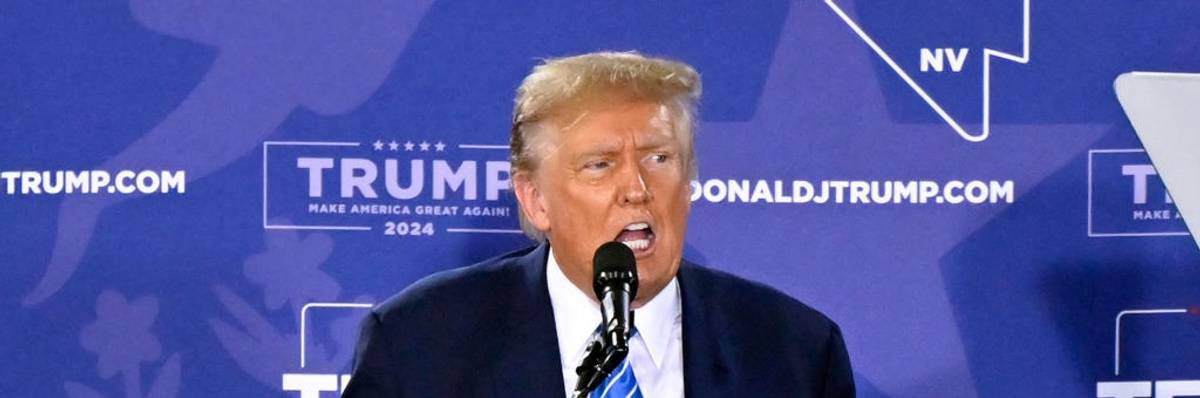
Former U.S. President Donald Trump, the leading Republican presidential candidate, speaks during a campaign event at Big League Dreams Las Vegas on January 27, 2024.
The delay sparked criticism of the D.C. Circuit that, as one legal journalist put it, "had a responsibility to Trump, the District Court, the Supreme Court, and the nation to rule expeditiously" on the immunity claims.
In a widely anticipated move, the judge overseeing former U.S. President Donald Trump's federal election interference case on Friday indefinitely postponed his March trial due to a pending decision from a higher court about the Republican front-runner's immunity claims.
Since Judge Tanya Chutkan of the U.S. District Court for the District of Columbia announced last August that the trial would begin March 4, Trump has argued that he is immune from criminal charges related to trying to overturn his 2020 loss to Democratic President Joe Biden, which culminated in the January 6, 2021 insurrection, because he was still in office at the time.
Chutkan, an appointee of former Democratic President Barack Obama, rejected the immunity argument in December. The U.S. Supreme Court—whose right-wing supermajority includes three Trump appointees and Justice Clarence Thomas, who wife was involved with the GOP effort to overturn the 2020 election—declined a request from Special Counsel Jack Smith to skip over the appeals court.
A panel from the Court of Appeals for the D.C. Circuit heard arguments for the case last month. While the trio—one judge appointed by former Republican President George H.W. Bush and two Biden appointees—appeared skeptical of Trump's argument, they have yet to issue a decision, which is widely expected to be appealed.
After Chutkan's move Friday, Law Dork's Chris Geidner pointed to his commentary from last week: "Sure, there are reasons why rulings—especially a ruling like this—takes time, but it's also a bit of bullshit. The D.C. Circuit had a responsibility to Trump, the District Court, the Supreme Court, and the nation to rule expeditiously. It has failed to do so."
Politico's Kyle Cheney reported that "in a lightly attended proceeding Friday... Chutkan didn't explicitly mention Trump's case. But she made clear that she's keeping her calendar flexible in the event she is able to reschedule" the election interference trial.
Trump faces 91 felony charges from four ongoing cases: one in New York, another in Georgia, and two at the federal level, both overseen by Smith due to the presidential election. He is also involved in various legal battles over whether he is allowed to be on state ballots after engaging in insurrection—an issue the Supreme Court is set to take up next week.
As The Washington Post highlighted Friday:
The delay in the D.C. case makes it increasingly likely that the first of Trump's four criminal trials could be held this spring in Manhattan on New York state charges of business fraud in connection with hush money payments during the 2016 election. That trial has nominally been set for March 25, but the court in that case has signaled deference to Trump's federal election subversion case. New York Supreme Court Justice Juan Merchan has scheduled a pretrial hearing in two weeks—Februray 15—and is expected to decide after that if the trial will go forward as planned.
The trial for the other federal case, which focuses on classified documents and is overseen by a Trump appointee in Florida, is scheduled for May but could be pushed back. A date has not been set for the Georgia case, which is also about 2020 election interference.
Despite his legal trouble, Trump is leading the dwindling GOP field of presidential candidates, with recent wins in the Iowa caucuses and New Hampshire primary.
Dear Common Dreams reader, It’s been nearly 30 years since I co-founded Common Dreams with my late wife, Lina Newhouser. We had the radical notion that journalism should serve the public good, not corporate profits. It was clear to us from the outset what it would take to build such a project. No paid advertisements. No corporate sponsors. No millionaire publisher telling us what to think or do. Many people said we wouldn't last a year, but we proved those doubters wrong. Together with a tremendous team of journalists and dedicated staff, we built an independent media outlet free from the constraints of profits and corporate control. Our mission has always been simple: To inform. To inspire. To ignite change for the common good. Building Common Dreams was not easy. Our survival was never guaranteed. When you take on the most powerful forces—Wall Street greed, fossil fuel industry destruction, Big Tech lobbyists, and uber-rich oligarchs who have spent billions upon billions rigging the economy and democracy in their favor—the only bulwark you have is supporters who believe in your work. But here’s the urgent message from me today. It's never been this bad out there. And it's never been this hard to keep us going. At the very moment Common Dreams is most needed, the threats we face are intensifying. We need your support now more than ever. We don't accept corporate advertising and never will. We don't have a paywall because we don't think people should be blocked from critical news based on their ability to pay. Everything we do is funded by the donations of readers like you. When everyone does the little they can afford, we are strong. But if that support retreats or dries up, so do we. Will you donate now to make sure Common Dreams not only survives but thrives? —Craig Brown, Co-founder |
In a widely anticipated move, the judge overseeing former U.S. President Donald Trump's federal election interference case on Friday indefinitely postponed his March trial due to a pending decision from a higher court about the Republican front-runner's immunity claims.
Since Judge Tanya Chutkan of the U.S. District Court for the District of Columbia announced last August that the trial would begin March 4, Trump has argued that he is immune from criminal charges related to trying to overturn his 2020 loss to Democratic President Joe Biden, which culminated in the January 6, 2021 insurrection, because he was still in office at the time.
Chutkan, an appointee of former Democratic President Barack Obama, rejected the immunity argument in December. The U.S. Supreme Court—whose right-wing supermajority includes three Trump appointees and Justice Clarence Thomas, who wife was involved with the GOP effort to overturn the 2020 election—declined a request from Special Counsel Jack Smith to skip over the appeals court.
A panel from the Court of Appeals for the D.C. Circuit heard arguments for the case last month. While the trio—one judge appointed by former Republican President George H.W. Bush and two Biden appointees—appeared skeptical of Trump's argument, they have yet to issue a decision, which is widely expected to be appealed.
After Chutkan's move Friday, Law Dork's Chris Geidner pointed to his commentary from last week: "Sure, there are reasons why rulings—especially a ruling like this—takes time, but it's also a bit of bullshit. The D.C. Circuit had a responsibility to Trump, the District Court, the Supreme Court, and the nation to rule expeditiously. It has failed to do so."
Politico's Kyle Cheney reported that "in a lightly attended proceeding Friday... Chutkan didn't explicitly mention Trump's case. But she made clear that she's keeping her calendar flexible in the event she is able to reschedule" the election interference trial.
Trump faces 91 felony charges from four ongoing cases: one in New York, another in Georgia, and two at the federal level, both overseen by Smith due to the presidential election. He is also involved in various legal battles over whether he is allowed to be on state ballots after engaging in insurrection—an issue the Supreme Court is set to take up next week.
As The Washington Post highlighted Friday:
The delay in the D.C. case makes it increasingly likely that the first of Trump's four criminal trials could be held this spring in Manhattan on New York state charges of business fraud in connection with hush money payments during the 2016 election. That trial has nominally been set for March 25, but the court in that case has signaled deference to Trump's federal election subversion case. New York Supreme Court Justice Juan Merchan has scheduled a pretrial hearing in two weeks—Februray 15—and is expected to decide after that if the trial will go forward as planned.
The trial for the other federal case, which focuses on classified documents and is overseen by a Trump appointee in Florida, is scheduled for May but could be pushed back. A date has not been set for the Georgia case, which is also about 2020 election interference.
Despite his legal trouble, Trump is leading the dwindling GOP field of presidential candidates, with recent wins in the Iowa caucuses and New Hampshire primary.
In a widely anticipated move, the judge overseeing former U.S. President Donald Trump's federal election interference case on Friday indefinitely postponed his March trial due to a pending decision from a higher court about the Republican front-runner's immunity claims.
Since Judge Tanya Chutkan of the U.S. District Court for the District of Columbia announced last August that the trial would begin March 4, Trump has argued that he is immune from criminal charges related to trying to overturn his 2020 loss to Democratic President Joe Biden, which culminated in the January 6, 2021 insurrection, because he was still in office at the time.
Chutkan, an appointee of former Democratic President Barack Obama, rejected the immunity argument in December. The U.S. Supreme Court—whose right-wing supermajority includes three Trump appointees and Justice Clarence Thomas, who wife was involved with the GOP effort to overturn the 2020 election—declined a request from Special Counsel Jack Smith to skip over the appeals court.
A panel from the Court of Appeals for the D.C. Circuit heard arguments for the case last month. While the trio—one judge appointed by former Republican President George H.W. Bush and two Biden appointees—appeared skeptical of Trump's argument, they have yet to issue a decision, which is widely expected to be appealed.
After Chutkan's move Friday, Law Dork's Chris Geidner pointed to his commentary from last week: "Sure, there are reasons why rulings—especially a ruling like this—takes time, but it's also a bit of bullshit. The D.C. Circuit had a responsibility to Trump, the District Court, the Supreme Court, and the nation to rule expeditiously. It has failed to do so."
Politico's Kyle Cheney reported that "in a lightly attended proceeding Friday... Chutkan didn't explicitly mention Trump's case. But she made clear that she's keeping her calendar flexible in the event she is able to reschedule" the election interference trial.
Trump faces 91 felony charges from four ongoing cases: one in New York, another in Georgia, and two at the federal level, both overseen by Smith due to the presidential election. He is also involved in various legal battles over whether he is allowed to be on state ballots after engaging in insurrection—an issue the Supreme Court is set to take up next week.
As The Washington Post highlighted Friday:
The delay in the D.C. case makes it increasingly likely that the first of Trump's four criminal trials could be held this spring in Manhattan on New York state charges of business fraud in connection with hush money payments during the 2016 election. That trial has nominally been set for March 25, but the court in that case has signaled deference to Trump's federal election subversion case. New York Supreme Court Justice Juan Merchan has scheduled a pretrial hearing in two weeks—Februray 15—and is expected to decide after that if the trial will go forward as planned.
The trial for the other federal case, which focuses on classified documents and is overseen by a Trump appointee in Florida, is scheduled for May but could be pushed back. A date has not been set for the Georgia case, which is also about 2020 election interference.
Despite his legal trouble, Trump is leading the dwindling GOP field of presidential candidates, with recent wins in the Iowa caucuses and New Hampshire primary.