SUBSCRIBE TO OUR FREE NEWSLETTER
Daily news & progressive opinion—funded by the people, not the corporations—delivered straight to your inbox.
5
#000000
#FFFFFF
To donate by check, phone, or other method, see our More Ways to Give page.
Daily news & progressive opinion—funded by the people, not the corporations—delivered straight to your inbox.
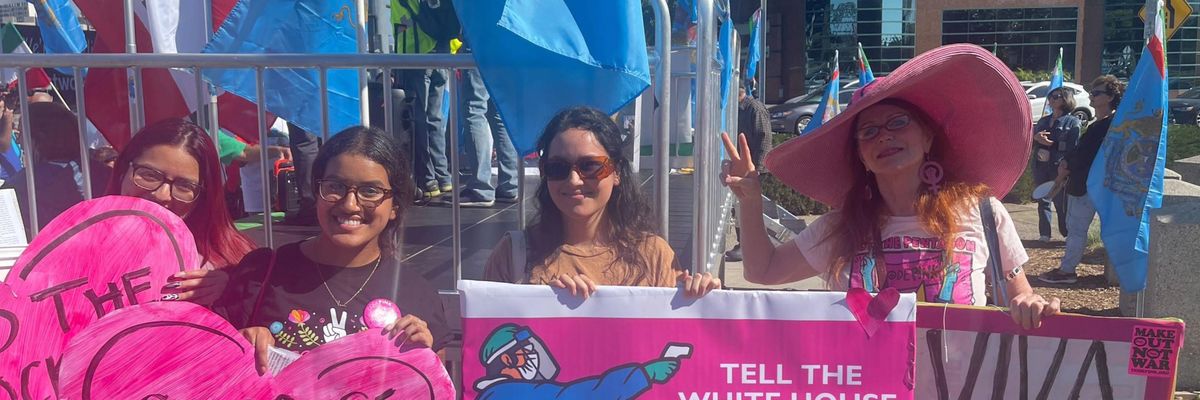
Members of the women-led peace group CodePink protest the United States embargo of Cuba and Cuba's inclusion on the U.S. state sponsors of terrorism list in Los Angeles on October 29, 2022. (Photo: CodePink/Twitter)
As United Nations member states prepare to condemn the U.S. economic embargo of Cuba for the 30th straight year, peace groups on Saturday launched a series of rallies that will take place across the nation in the coming days to demand an end to the crippling 60-year blockade.
"From L.A. to NYC we're demanding that the U.S. #UnblockCuba!"
Members of groups including CodePink, Black Alliance for Peace, Party for Socialism and Liberation, Democratic Socialists of America, and others rallied in New York City, Los Angeles, and Portland on Saturday, with further demonstrations planned on November 2 in Washington, D.C. and Chicago, and on November 3 in San Francisco. Activists from Australia to Argentina also held demonstrations of solidarity with Cuba.
The protesters have three demands: End the U.S. blockade, remove Cuba from the U.S. list of state sponsors of terrorism, and lift all travel and economic restrictions on Cuba.
Cuba will present a draft resolution to end the U.S. embargo at the United Nations General Assembly on November 2-3. The United States--usually along with Israel and a tiny handful of small, dependent nations--perennially votes against such resolutions, which pass overwhelmingly each year. Last year's vote was 184-2, with the U.S. and Israel dissenting and Brazil, Colombia, and Ukraine abstaining.
In Los Angeles, Carlos Sirah of Black Alliance for Peace noted what activists call the absurdity of the U.S. including Cuba on its list of terror sponsors.
"Imagine the United States putting someone on the terrorist list--the biggest terrorist in the Western Hemisphere, the biggest terrorist in the world--has put Cuba on the [terror list], which has effectively and materially put a burden on Cuba in terms of limiting the amount of resources it can bring in," Sirah told Kawsachun News.
This "has the effect of not only impoverishing the island, but also the added effect of keeping people from their families," Sirah added. "Who has Cuba bombed? Who has Cuba invaded, versus who has the U.S. bombed? How many bases does the United States have in the world?"
Medea Benjamin, co-founder of CodePink, was among the activists who delivered a petition with the groups' demands signed by more than 10,000 people and over 100 organizations to the U.S. State Department. CodePink is asking the Biden administration to take a big step toward normalizing relations with Cuba--which, after progress during the Obama era, were rolled back under former President Donald Trump--by abstaining from the resolution vote.
Having lost effective economic control of the island in 1959 following the successful revolution led by Fidel Castro against a brutal U.S.-backed dictatorship, successive U.S. administrations waged a decadeslong campaign of state-sanctioned exile terror, attempted subversion, failed assassination attempts, economic warfare, and covert operations large and small in a fruitless policy of regime change. There have been 13 U.S. administrations since the triumph of the Cuban revolution.
The United Nations estimated in 2018 that the U.S. embargo has cost Cuba's economy at least $130 billion.
"The Black Alliance for Peace along with this coalition calls for the immediate end of the blockade, but further than that, calls for the demilitarization of the whole hemisphere," said Sirah. "We call for the end to [United States Southern Command]. We call for the end of militarization. We call for the end of the constant meddling in the affairs of Latin America, the Caribbean--and Haiti."
Dear Common Dreams reader, It’s been nearly 30 years since I co-founded Common Dreams with my late wife, Lina Newhouser. We had the radical notion that journalism should serve the public good, not corporate profits. It was clear to us from the outset what it would take to build such a project. No paid advertisements. No corporate sponsors. No millionaire publisher telling us what to think or do. Many people said we wouldn't last a year, but we proved those doubters wrong. Together with a tremendous team of journalists and dedicated staff, we built an independent media outlet free from the constraints of profits and corporate control. Our mission has always been simple: To inform. To inspire. To ignite change for the common good. Building Common Dreams was not easy. Our survival was never guaranteed. When you take on the most powerful forces—Wall Street greed, fossil fuel industry destruction, Big Tech lobbyists, and uber-rich oligarchs who have spent billions upon billions rigging the economy and democracy in their favor—the only bulwark you have is supporters who believe in your work. But here’s the urgent message from me today. It's never been this bad out there. And it's never been this hard to keep us going. At the very moment Common Dreams is most needed, the threats we face are intensifying. We need your support now more than ever. We don't accept corporate advertising and never will. We don't have a paywall because we don't think people should be blocked from critical news based on their ability to pay. Everything we do is funded by the donations of readers like you. When everyone does the little they can afford, we are strong. But if that support retreats or dries up, so do we. Will you donate now to make sure Common Dreams not only survives but thrives? —Craig Brown, Co-founder |
As United Nations member states prepare to condemn the U.S. economic embargo of Cuba for the 30th straight year, peace groups on Saturday launched a series of rallies that will take place across the nation in the coming days to demand an end to the crippling 60-year blockade.
"From L.A. to NYC we're demanding that the U.S. #UnblockCuba!"
Members of groups including CodePink, Black Alliance for Peace, Party for Socialism and Liberation, Democratic Socialists of America, and others rallied in New York City, Los Angeles, and Portland on Saturday, with further demonstrations planned on November 2 in Washington, D.C. and Chicago, and on November 3 in San Francisco. Activists from Australia to Argentina also held demonstrations of solidarity with Cuba.
The protesters have three demands: End the U.S. blockade, remove Cuba from the U.S. list of state sponsors of terrorism, and lift all travel and economic restrictions on Cuba.
Cuba will present a draft resolution to end the U.S. embargo at the United Nations General Assembly on November 2-3. The United States--usually along with Israel and a tiny handful of small, dependent nations--perennially votes against such resolutions, which pass overwhelmingly each year. Last year's vote was 184-2, with the U.S. and Israel dissenting and Brazil, Colombia, and Ukraine abstaining.
In Los Angeles, Carlos Sirah of Black Alliance for Peace noted what activists call the absurdity of the U.S. including Cuba on its list of terror sponsors.
"Imagine the United States putting someone on the terrorist list--the biggest terrorist in the Western Hemisphere, the biggest terrorist in the world--has put Cuba on the [terror list], which has effectively and materially put a burden on Cuba in terms of limiting the amount of resources it can bring in," Sirah told Kawsachun News.
This "has the effect of not only impoverishing the island, but also the added effect of keeping people from their families," Sirah added. "Who has Cuba bombed? Who has Cuba invaded, versus who has the U.S. bombed? How many bases does the United States have in the world?"
Medea Benjamin, co-founder of CodePink, was among the activists who delivered a petition with the groups' demands signed by more than 10,000 people and over 100 organizations to the U.S. State Department. CodePink is asking the Biden administration to take a big step toward normalizing relations with Cuba--which, after progress during the Obama era, were rolled back under former President Donald Trump--by abstaining from the resolution vote.
Having lost effective economic control of the island in 1959 following the successful revolution led by Fidel Castro against a brutal U.S.-backed dictatorship, successive U.S. administrations waged a decadeslong campaign of state-sanctioned exile terror, attempted subversion, failed assassination attempts, economic warfare, and covert operations large and small in a fruitless policy of regime change. There have been 13 U.S. administrations since the triumph of the Cuban revolution.
The United Nations estimated in 2018 that the U.S. embargo has cost Cuba's economy at least $130 billion.
"The Black Alliance for Peace along with this coalition calls for the immediate end of the blockade, but further than that, calls for the demilitarization of the whole hemisphere," said Sirah. "We call for the end to [United States Southern Command]. We call for the end of militarization. We call for the end of the constant meddling in the affairs of Latin America, the Caribbean--and Haiti."
As United Nations member states prepare to condemn the U.S. economic embargo of Cuba for the 30th straight year, peace groups on Saturday launched a series of rallies that will take place across the nation in the coming days to demand an end to the crippling 60-year blockade.
"From L.A. to NYC we're demanding that the U.S. #UnblockCuba!"
Members of groups including CodePink, Black Alliance for Peace, Party for Socialism and Liberation, Democratic Socialists of America, and others rallied in New York City, Los Angeles, and Portland on Saturday, with further demonstrations planned on November 2 in Washington, D.C. and Chicago, and on November 3 in San Francisco. Activists from Australia to Argentina also held demonstrations of solidarity with Cuba.
The protesters have three demands: End the U.S. blockade, remove Cuba from the U.S. list of state sponsors of terrorism, and lift all travel and economic restrictions on Cuba.
Cuba will present a draft resolution to end the U.S. embargo at the United Nations General Assembly on November 2-3. The United States--usually along with Israel and a tiny handful of small, dependent nations--perennially votes against such resolutions, which pass overwhelmingly each year. Last year's vote was 184-2, with the U.S. and Israel dissenting and Brazil, Colombia, and Ukraine abstaining.
In Los Angeles, Carlos Sirah of Black Alliance for Peace noted what activists call the absurdity of the U.S. including Cuba on its list of terror sponsors.
"Imagine the United States putting someone on the terrorist list--the biggest terrorist in the Western Hemisphere, the biggest terrorist in the world--has put Cuba on the [terror list], which has effectively and materially put a burden on Cuba in terms of limiting the amount of resources it can bring in," Sirah told Kawsachun News.
This "has the effect of not only impoverishing the island, but also the added effect of keeping people from their families," Sirah added. "Who has Cuba bombed? Who has Cuba invaded, versus who has the U.S. bombed? How many bases does the United States have in the world?"
Medea Benjamin, co-founder of CodePink, was among the activists who delivered a petition with the groups' demands signed by more than 10,000 people and over 100 organizations to the U.S. State Department. CodePink is asking the Biden administration to take a big step toward normalizing relations with Cuba--which, after progress during the Obama era, were rolled back under former President Donald Trump--by abstaining from the resolution vote.
Having lost effective economic control of the island in 1959 following the successful revolution led by Fidel Castro against a brutal U.S.-backed dictatorship, successive U.S. administrations waged a decadeslong campaign of state-sanctioned exile terror, attempted subversion, failed assassination attempts, economic warfare, and covert operations large and small in a fruitless policy of regime change. There have been 13 U.S. administrations since the triumph of the Cuban revolution.
The United Nations estimated in 2018 that the U.S. embargo has cost Cuba's economy at least $130 billion.
"The Black Alliance for Peace along with this coalition calls for the immediate end of the blockade, but further than that, calls for the demilitarization of the whole hemisphere," said Sirah. "We call for the end to [United States Southern Command]. We call for the end of militarization. We call for the end of the constant meddling in the affairs of Latin America, the Caribbean--and Haiti."