
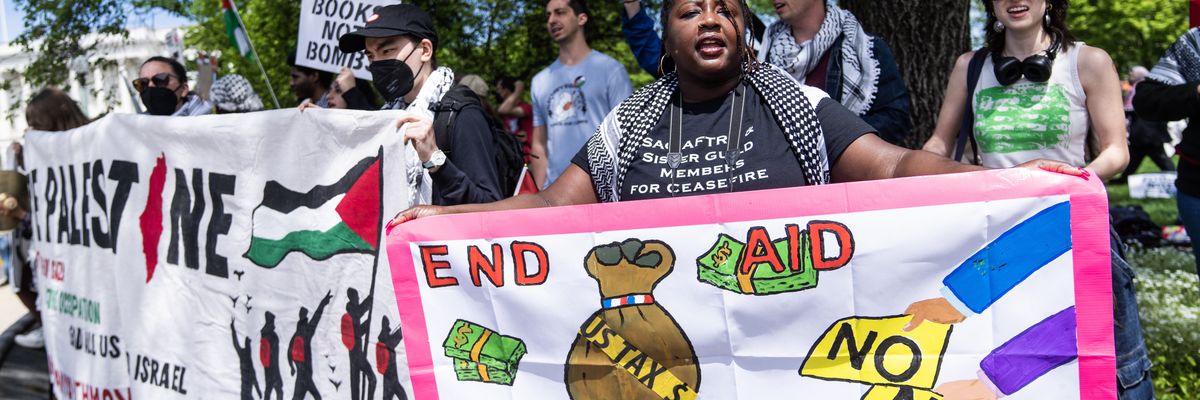
Demonstrators calling for no funding for Israel in the conflict in Gaza are seen outside the U.S. Capitol before the House passed the foreign aid package on Saturday, April 20, 2024.
Israel's War on Gaza and Beyond Has Cost US Taxpayers At Least $22.76 Billion: Report
"It has been difficult for the U.S. public, journalists, and members of Congress to get an accurate understanding of the amount of military equipment and financial assistance that the U.S. government has provided."
U.S. armed aid to Israel and related spending on American militarism in the Middle East cost taxpayers at least $22.76 billion over the past year, according to new research published Monday.
The Costs of War Project at Brown University's Watson Institute for International & Public Affairs—which has long been the premier source for statistics on the human and economic costs of ongoing U.S.-led post-9/11 wars and militarism in the Middle East and beyond—called the $22.76 billion estimate "conservative."
"This figure includes the $17.9 billion the U.S. government has approved in security assistance for Israeli military operations in Gaza and elsewhere since October 7—substantially more than in any other year since the U.S. began granting military aid to Israel in 1959," report authors Linda Bilmes, William Hartung, and Stephen Semler wrote. "Yet the report describes how this is only a partial amount of the U.S. financial support provided during this war."
In addition to the repeated multibillion-dollar rounds of military aid to Israel, related U.S. operations in the region, particularly bombing and shipping defense in and near Yemen—where Houthi rebels have attacked maritime commerce and launched missiles at Israel—have cost over $2 billion since last October.
"It has been difficult for the U.S. public, journalists, and members of Congress to get an accurate understanding of the amount of military equipment and financial assistance that the U.S. government has provided to Israel's military during the past year of war," the report states. "There is likewise little U.S. public awareness of the costs of the United States military's own related operations in the region, particularly in and around Yemen."
The analysis adds that regional hostilities "have escalated to become the most sustained military campaign by U.S. forces since the 2016-19 air war" against the so-called Islamic State in Iraq and Syria.
"The Costs of War project has an obligation to look at the consequences of the U.S. backing of Israel's military operations after October 7, especially as it reverberates throughout the region," Costs of War director Stephanie Savell said in a statement. "Our project examines the human and budgetary costs of U.S. militarism at home and abroad, and for the last year, people in Gaza have suffered the highest consequences imaginable."
According to the Gaza Health Ministry and international agencies, Israel's yearlong assault on Gaza has left at least 149,000 Palestinians dead, maimed, or missing, and millions more forcibly displaced, starved, or sickened. U.S. military aid to Israel has continued in successive waves, even as the country stands trial for genocide at the International Court of Justice.
The Hamas-led October 7 attack on resulted in more than 1,100 Israeli and other deaths—at least some of which were caused by so-called "friendly fire" and intentional targeting under the Hannibal Directive—with more than 240 people kidnapped.
Although the Costs of War Project report mainly covers U.S. aid to Israel since last October, it also notes that since 1948—the year the modern state of Israel was founded, largely through the ethnic cleansing of Palestine's Arabs—American taxpayers have contributed over a quarter trillion inflation-adjusted dollars to the key Mideast ally.
A second report published Monday by the Costs of War Project found that around 90% of Gaza's population has been forcibly displaced by the Israeli onslaught and 96% of Gazans face "acute levels of food insecurity." The publication cites a letter sent last week by a group of U.S. physicians to President Joe Biden—who has repeatedly declared his "unwavering" support for Israel—stating that "it is likely that the death toll from this conflict is already greater than 118,908, an astonishing 5.4% of Gaza's population." That figure includes 62,000 deaths due to starvation.
"In addition to killing people directly through traumatic injuries, wars cause 'indirect deaths' by destroying, damaging, or causing deterioration of economic, social, psychological and health conditions," report author Sophia Stamatopoulou-Robbins wrote. "These deaths result from diseases and other population-level health effects that stem from war's destruction of public infrastructure and livelihood sources, reduced access to water and sanitation, environmental damage, and other such factors."
The new report comes less than two weeks after Israel secured yet another U.S. armed aid package, this one worth $8.7 billion. Meanwhile, the Federal Emergency Management Agency said it faced a nearly $9 billion shortfall for Hurricane Helene relief efforts.
An Urgent Message From Our Co-Founder
Dear Common Dreams reader, It’s been nearly 30 years since I co-founded Common Dreams with my late wife, Lina Newhouser. We had the radical notion that journalism should serve the public good, not corporate profits. It was clear to us from the outset what it would take to build such a project. No paid advertisements. No corporate sponsors. No millionaire publisher telling us what to think or do. Many people said we wouldn't last a year, but we proved those doubters wrong. Together with a tremendous team of journalists and dedicated staff, we built an independent media outlet free from the constraints of profits and corporate control. Our mission has always been simple: To inform. To inspire. To ignite change for the common good. Building Common Dreams was not easy. Our survival was never guaranteed. When you take on the most powerful forces—Wall Street greed, fossil fuel industry destruction, Big Tech lobbyists, and uber-rich oligarchs who have spent billions upon billions rigging the economy and democracy in their favor—the only bulwark you have is supporters who believe in your work. But here’s the urgent message from me today. It's never been this bad out there. And it's never been this hard to keep us going. At the very moment Common Dreams is most needed, the threats we face are intensifying. We need your support now more than ever. We don't accept corporate advertising and never will. We don't have a paywall because we don't think people should be blocked from critical news based on their ability to pay. Everything we do is funded by the donations of readers like you. When everyone does the little they can afford, we are strong. But if that support retreats or dries up, so do we. Will you donate now to make sure Common Dreams not only survives but thrives? —Craig Brown, Co-founder |
U.S. armed aid to Israel and related spending on American militarism in the Middle East cost taxpayers at least $22.76 billion over the past year, according to new research published Monday.
The Costs of War Project at Brown University's Watson Institute for International & Public Affairs—which has long been the premier source for statistics on the human and economic costs of ongoing U.S.-led post-9/11 wars and militarism in the Middle East and beyond—called the $22.76 billion estimate "conservative."
"This figure includes the $17.9 billion the U.S. government has approved in security assistance for Israeli military operations in Gaza and elsewhere since October 7—substantially more than in any other year since the U.S. began granting military aid to Israel in 1959," report authors Linda Bilmes, William Hartung, and Stephen Semler wrote. "Yet the report describes how this is only a partial amount of the U.S. financial support provided during this war."
In addition to the repeated multibillion-dollar rounds of military aid to Israel, related U.S. operations in the region, particularly bombing and shipping defense in and near Yemen—where Houthi rebels have attacked maritime commerce and launched missiles at Israel—have cost over $2 billion since last October.
"It has been difficult for the U.S. public, journalists, and members of Congress to get an accurate understanding of the amount of military equipment and financial assistance that the U.S. government has provided to Israel's military during the past year of war," the report states. "There is likewise little U.S. public awareness of the costs of the United States military's own related operations in the region, particularly in and around Yemen."
The analysis adds that regional hostilities "have escalated to become the most sustained military campaign by U.S. forces since the 2016-19 air war" against the so-called Islamic State in Iraq and Syria.
"The Costs of War project has an obligation to look at the consequences of the U.S. backing of Israel's military operations after October 7, especially as it reverberates throughout the region," Costs of War director Stephanie Savell said in a statement. "Our project examines the human and budgetary costs of U.S. militarism at home and abroad, and for the last year, people in Gaza have suffered the highest consequences imaginable."
According to the Gaza Health Ministry and international agencies, Israel's yearlong assault on Gaza has left at least 149,000 Palestinians dead, maimed, or missing, and millions more forcibly displaced, starved, or sickened. U.S. military aid to Israel has continued in successive waves, even as the country stands trial for genocide at the International Court of Justice.
The Hamas-led October 7 attack on resulted in more than 1,100 Israeli and other deaths—at least some of which were caused by so-called "friendly fire" and intentional targeting under the Hannibal Directive—with more than 240 people kidnapped.
Although the Costs of War Project report mainly covers U.S. aid to Israel since last October, it also notes that since 1948—the year the modern state of Israel was founded, largely through the ethnic cleansing of Palestine's Arabs—American taxpayers have contributed over a quarter trillion inflation-adjusted dollars to the key Mideast ally.
A second report published Monday by the Costs of War Project found that around 90% of Gaza's population has been forcibly displaced by the Israeli onslaught and 96% of Gazans face "acute levels of food insecurity." The publication cites a letter sent last week by a group of U.S. physicians to President Joe Biden—who has repeatedly declared his "unwavering" support for Israel—stating that "it is likely that the death toll from this conflict is already greater than 118,908, an astonishing 5.4% of Gaza's population." That figure includes 62,000 deaths due to starvation.
"In addition to killing people directly through traumatic injuries, wars cause 'indirect deaths' by destroying, damaging, or causing deterioration of economic, social, psychological and health conditions," report author Sophia Stamatopoulou-Robbins wrote. "These deaths result from diseases and other population-level health effects that stem from war's destruction of public infrastructure and livelihood sources, reduced access to water and sanitation, environmental damage, and other such factors."
The new report comes less than two weeks after Israel secured yet another U.S. armed aid package, this one worth $8.7 billion. Meanwhile, the Federal Emergency Management Agency said it faced a nearly $9 billion shortfall for Hurricane Helene relief efforts.
- To Prevent War in Lebanon, the US Must Stop Giving Israel the Support to Wage It ›
- Opinion | Dispatch From Gaza: the War That Never Ends | Common Dreams ›
- Opinion | US Taxpayers Are Funding the Gift Card Israel Uses to Buy US Weapons | Common Dreams ›
U.S. armed aid to Israel and related spending on American militarism in the Middle East cost taxpayers at least $22.76 billion over the past year, according to new research published Monday.
The Costs of War Project at Brown University's Watson Institute for International & Public Affairs—which has long been the premier source for statistics on the human and economic costs of ongoing U.S.-led post-9/11 wars and militarism in the Middle East and beyond—called the $22.76 billion estimate "conservative."
"This figure includes the $17.9 billion the U.S. government has approved in security assistance for Israeli military operations in Gaza and elsewhere since October 7—substantially more than in any other year since the U.S. began granting military aid to Israel in 1959," report authors Linda Bilmes, William Hartung, and Stephen Semler wrote. "Yet the report describes how this is only a partial amount of the U.S. financial support provided during this war."
In addition to the repeated multibillion-dollar rounds of military aid to Israel, related U.S. operations in the region, particularly bombing and shipping defense in and near Yemen—where Houthi rebels have attacked maritime commerce and launched missiles at Israel—have cost over $2 billion since last October.
"It has been difficult for the U.S. public, journalists, and members of Congress to get an accurate understanding of the amount of military equipment and financial assistance that the U.S. government has provided to Israel's military during the past year of war," the report states. "There is likewise little U.S. public awareness of the costs of the United States military's own related operations in the region, particularly in and around Yemen."
The analysis adds that regional hostilities "have escalated to become the most sustained military campaign by U.S. forces since the 2016-19 air war" against the so-called Islamic State in Iraq and Syria.
"The Costs of War project has an obligation to look at the consequences of the U.S. backing of Israel's military operations after October 7, especially as it reverberates throughout the region," Costs of War director Stephanie Savell said in a statement. "Our project examines the human and budgetary costs of U.S. militarism at home and abroad, and for the last year, people in Gaza have suffered the highest consequences imaginable."
According to the Gaza Health Ministry and international agencies, Israel's yearlong assault on Gaza has left at least 149,000 Palestinians dead, maimed, or missing, and millions more forcibly displaced, starved, or sickened. U.S. military aid to Israel has continued in successive waves, even as the country stands trial for genocide at the International Court of Justice.
The Hamas-led October 7 attack on resulted in more than 1,100 Israeli and other deaths—at least some of which were caused by so-called "friendly fire" and intentional targeting under the Hannibal Directive—with more than 240 people kidnapped.
Although the Costs of War Project report mainly covers U.S. aid to Israel since last October, it also notes that since 1948—the year the modern state of Israel was founded, largely through the ethnic cleansing of Palestine's Arabs—American taxpayers have contributed over a quarter trillion inflation-adjusted dollars to the key Mideast ally.
A second report published Monday by the Costs of War Project found that around 90% of Gaza's population has been forcibly displaced by the Israeli onslaught and 96% of Gazans face "acute levels of food insecurity." The publication cites a letter sent last week by a group of U.S. physicians to President Joe Biden—who has repeatedly declared his "unwavering" support for Israel—stating that "it is likely that the death toll from this conflict is already greater than 118,908, an astonishing 5.4% of Gaza's population." That figure includes 62,000 deaths due to starvation.
"In addition to killing people directly through traumatic injuries, wars cause 'indirect deaths' by destroying, damaging, or causing deterioration of economic, social, psychological and health conditions," report author Sophia Stamatopoulou-Robbins wrote. "These deaths result from diseases and other population-level health effects that stem from war's destruction of public infrastructure and livelihood sources, reduced access to water and sanitation, environmental damage, and other such factors."
The new report comes less than two weeks after Israel secured yet another U.S. armed aid package, this one worth $8.7 billion. Meanwhile, the Federal Emergency Management Agency said it faced a nearly $9 billion shortfall for Hurricane Helene relief efforts.
- To Prevent War in Lebanon, the US Must Stop Giving Israel the Support to Wage It ›
- Opinion | Dispatch From Gaza: the War That Never Ends | Common Dreams ›
- Opinion | US Taxpayers Are Funding the Gift Card Israel Uses to Buy US Weapons | Common Dreams ›