SUBSCRIBE TO OUR FREE NEWSLETTER
Daily news & progressive opinion—funded by the people, not the corporations—delivered straight to your inbox.
5
#000000
#FFFFFF
To donate by check, phone, or other method, see our More Ways to Give page.
Daily news & progressive opinion—funded by the people, not the corporations—delivered straight to your inbox.
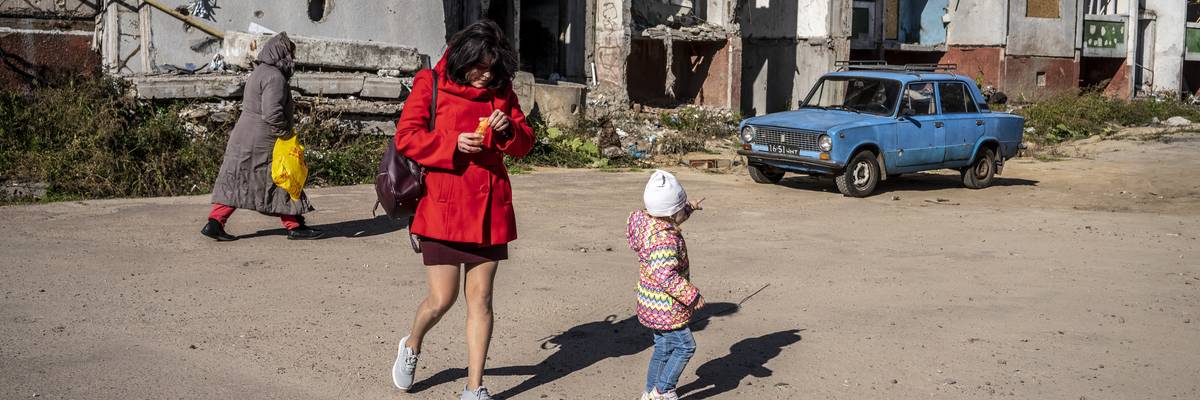
A child walking with a woman points at an old blue car seen amid severely damaged buildings in Chernihiv Oblast, Ukraine on October 14, 2022.
"It's unconscionable that civilians are still dying from cluster munition attacks 15 years after these weapons were outlawed," said one advocate.
The refusal of countries including Russia, Ukraine, and the United States to end the use and transfer of cluster munitions caused nearly 1,000 civilian deaths and injuries in 2022, according to the latest international report on the use of the widely banned weapons.
In the Cluster Munition Monitor 2023 report on Tuesday, a coalition including Human Rights Watch (HRW), Humanity & Inclusion, and the Colombian Campaign to Ban Landmines reported that cluster munitions killed or wounded at least 1,172 people last year.
Nearly 1,000 people were killed or injured by cluster bomb attacks—including 890 in Ukraine, which has been under invasion by Russia since February 2022—while at least 185 people were killed or wounded by the remnants of cluster munitions.
Cluster munitions explode in the air after being fired by rockets or aircraft and can disperse numerous submunitions across a wide area, creating de facto landmines in residential neighborhoods and other places frequented by civilians and making the bombs deadly for years after they initially explode.
The "immediate and long-term civilian harm and suffering" caused by cluster munitions are the reason they have been banned by 112 countries that have ratified the 2008 Convention on Cluster Munitions, said Mary Wareham, arms advocacy director at HRW.
"It's unconscionable that civilians are still dying from cluster munition attacks 15 years after these weapons were outlawed," she said in a statement.
Twelve additional countries have signed the convention, signaling a willingness to abide by its ban on the use, production, stockpiling, or transfer of cluster munitions.
More than 70 countries, however, have yet to sign onto the agreement, leaving civilians in countries including Ukraine, Myanmar, and Syria in danger of the bombs.
In 2022, the remnants of cluster munitions killed or maimed civilians in Azerbaijan, Iraq, Laos, Lebanon, Syria, Ukraine, and Yemen, with 71% of the casualties recorded among children, who sometimes mistake unexploded ordnance for harmless metal balls and pick them up to play with them.
There were no new cluster bomb attacks in Iraq in 2022, but 15 people were killed by their remnants and 25 were wounded, according to HRW. Ninety people were wounded by remnants in Yemen, where there were also no new attacks, and five were killed.
"This weapon must be stopped," said Beatrice Fihn, former executive director of the International Campaign to Abolish Nuclear Weapons, after HRW's study was released.
According to HRW's report, Russia used old stockpiles of cluster munitions as well as new weapons in 2022 and the first half of this year. This past July, the U.S. began transferring to Ukraine cluster munitions that have a 6%-14% rate of delivering unexploded ordnance.
HRW says that the progress made by countries that have ratified the Convention on Cluster Munitions suggests that casualties caused by the bombs would be drastically reduced if the U.S. and other countries signed the treaty.
"The greatest obstacle to countries working to eradicate cluster munitions are governments that are unwilling to join the convention and that undermine its principles by using or transferring the weapon," Wareham said. "Overall, countries that have banned cluster munitions are making steady progress to destroy their stockpiles and clear contaminated areas, despite wide-ranging challenges."
There have been no confirmed reports of new use, production, or transfers of cluster munitions by any of the countries that have ratified the agreement.
State parties that have signed onto the treaty have collectively destroyed 99% of their cluster bomb stockpiles, amounting to 1.47 million munitions and 178.5 million submunitions.
Bulgaria destroyed the last of its stockpile in June, and Belgium destroyed 95% of its munitions in 2022. Eleven countries have retained live cluster munitions "for permitted research and training purposes," according to HRW.
"Cluster munitions are widely stigmatized weapons for ethical, legal, and humanitarian reasons," Wareham said. "Governments that buck the stigma against cluster munitions should reconsider their position in light of the terrible harm these weapons cause and join the international ban."
Dear Common Dreams reader, It’s been nearly 30 years since I co-founded Common Dreams with my late wife, Lina Newhouser. We had the radical notion that journalism should serve the public good, not corporate profits. It was clear to us from the outset what it would take to build such a project. No paid advertisements. No corporate sponsors. No millionaire publisher telling us what to think or do. Many people said we wouldn't last a year, but we proved those doubters wrong. Together with a tremendous team of journalists and dedicated staff, we built an independent media outlet free from the constraints of profits and corporate control. Our mission has always been simple: To inform. To inspire. To ignite change for the common good. Building Common Dreams was not easy. Our survival was never guaranteed. When you take on the most powerful forces—Wall Street greed, fossil fuel industry destruction, Big Tech lobbyists, and uber-rich oligarchs who have spent billions upon billions rigging the economy and democracy in their favor—the only bulwark you have is supporters who believe in your work. But here’s the urgent message from me today. It's never been this bad out there. And it's never been this hard to keep us going. At the very moment Common Dreams is most needed, the threats we face are intensifying. We need your support now more than ever. We don't accept corporate advertising and never will. We don't have a paywall because we don't think people should be blocked from critical news based on their ability to pay. Everything we do is funded by the donations of readers like you. When everyone does the little they can afford, we are strong. But if that support retreats or dries up, so do we. Will you donate now to make sure Common Dreams not only survives but thrives? —Craig Brown, Co-founder |
The refusal of countries including Russia, Ukraine, and the United States to end the use and transfer of cluster munitions caused nearly 1,000 civilian deaths and injuries in 2022, according to the latest international report on the use of the widely banned weapons.
In the Cluster Munition Monitor 2023 report on Tuesday, a coalition including Human Rights Watch (HRW), Humanity & Inclusion, and the Colombian Campaign to Ban Landmines reported that cluster munitions killed or wounded at least 1,172 people last year.
Nearly 1,000 people were killed or injured by cluster bomb attacks—including 890 in Ukraine, which has been under invasion by Russia since February 2022—while at least 185 people were killed or wounded by the remnants of cluster munitions.
Cluster munitions explode in the air after being fired by rockets or aircraft and can disperse numerous submunitions across a wide area, creating de facto landmines in residential neighborhoods and other places frequented by civilians and making the bombs deadly for years after they initially explode.
The "immediate and long-term civilian harm and suffering" caused by cluster munitions are the reason they have been banned by 112 countries that have ratified the 2008 Convention on Cluster Munitions, said Mary Wareham, arms advocacy director at HRW.
"It's unconscionable that civilians are still dying from cluster munition attacks 15 years after these weapons were outlawed," she said in a statement.
Twelve additional countries have signed the convention, signaling a willingness to abide by its ban on the use, production, stockpiling, or transfer of cluster munitions.
More than 70 countries, however, have yet to sign onto the agreement, leaving civilians in countries including Ukraine, Myanmar, and Syria in danger of the bombs.
In 2022, the remnants of cluster munitions killed or maimed civilians in Azerbaijan, Iraq, Laos, Lebanon, Syria, Ukraine, and Yemen, with 71% of the casualties recorded among children, who sometimes mistake unexploded ordnance for harmless metal balls and pick them up to play with them.
There were no new cluster bomb attacks in Iraq in 2022, but 15 people were killed by their remnants and 25 were wounded, according to HRW. Ninety people were wounded by remnants in Yemen, where there were also no new attacks, and five were killed.
"This weapon must be stopped," said Beatrice Fihn, former executive director of the International Campaign to Abolish Nuclear Weapons, after HRW's study was released.
According to HRW's report, Russia used old stockpiles of cluster munitions as well as new weapons in 2022 and the first half of this year. This past July, the U.S. began transferring to Ukraine cluster munitions that have a 6%-14% rate of delivering unexploded ordnance.
HRW says that the progress made by countries that have ratified the Convention on Cluster Munitions suggests that casualties caused by the bombs would be drastically reduced if the U.S. and other countries signed the treaty.
"The greatest obstacle to countries working to eradicate cluster munitions are governments that are unwilling to join the convention and that undermine its principles by using or transferring the weapon," Wareham said. "Overall, countries that have banned cluster munitions are making steady progress to destroy their stockpiles and clear contaminated areas, despite wide-ranging challenges."
There have been no confirmed reports of new use, production, or transfers of cluster munitions by any of the countries that have ratified the agreement.
State parties that have signed onto the treaty have collectively destroyed 99% of their cluster bomb stockpiles, amounting to 1.47 million munitions and 178.5 million submunitions.
Bulgaria destroyed the last of its stockpile in June, and Belgium destroyed 95% of its munitions in 2022. Eleven countries have retained live cluster munitions "for permitted research and training purposes," according to HRW.
"Cluster munitions are widely stigmatized weapons for ethical, legal, and humanitarian reasons," Wareham said. "Governments that buck the stigma against cluster munitions should reconsider their position in light of the terrible harm these weapons cause and join the international ban."
The refusal of countries including Russia, Ukraine, and the United States to end the use and transfer of cluster munitions caused nearly 1,000 civilian deaths and injuries in 2022, according to the latest international report on the use of the widely banned weapons.
In the Cluster Munition Monitor 2023 report on Tuesday, a coalition including Human Rights Watch (HRW), Humanity & Inclusion, and the Colombian Campaign to Ban Landmines reported that cluster munitions killed or wounded at least 1,172 people last year.
Nearly 1,000 people were killed or injured by cluster bomb attacks—including 890 in Ukraine, which has been under invasion by Russia since February 2022—while at least 185 people were killed or wounded by the remnants of cluster munitions.
Cluster munitions explode in the air after being fired by rockets or aircraft and can disperse numerous submunitions across a wide area, creating de facto landmines in residential neighborhoods and other places frequented by civilians and making the bombs deadly for years after they initially explode.
The "immediate and long-term civilian harm and suffering" caused by cluster munitions are the reason they have been banned by 112 countries that have ratified the 2008 Convention on Cluster Munitions, said Mary Wareham, arms advocacy director at HRW.
"It's unconscionable that civilians are still dying from cluster munition attacks 15 years after these weapons were outlawed," she said in a statement.
Twelve additional countries have signed the convention, signaling a willingness to abide by its ban on the use, production, stockpiling, or transfer of cluster munitions.
More than 70 countries, however, have yet to sign onto the agreement, leaving civilians in countries including Ukraine, Myanmar, and Syria in danger of the bombs.
In 2022, the remnants of cluster munitions killed or maimed civilians in Azerbaijan, Iraq, Laos, Lebanon, Syria, Ukraine, and Yemen, with 71% of the casualties recorded among children, who sometimes mistake unexploded ordnance for harmless metal balls and pick them up to play with them.
There were no new cluster bomb attacks in Iraq in 2022, but 15 people were killed by their remnants and 25 were wounded, according to HRW. Ninety people were wounded by remnants in Yemen, where there were also no new attacks, and five were killed.
"This weapon must be stopped," said Beatrice Fihn, former executive director of the International Campaign to Abolish Nuclear Weapons, after HRW's study was released.
According to HRW's report, Russia used old stockpiles of cluster munitions as well as new weapons in 2022 and the first half of this year. This past July, the U.S. began transferring to Ukraine cluster munitions that have a 6%-14% rate of delivering unexploded ordnance.
HRW says that the progress made by countries that have ratified the Convention on Cluster Munitions suggests that casualties caused by the bombs would be drastically reduced if the U.S. and other countries signed the treaty.
"The greatest obstacle to countries working to eradicate cluster munitions are governments that are unwilling to join the convention and that undermine its principles by using or transferring the weapon," Wareham said. "Overall, countries that have banned cluster munitions are making steady progress to destroy their stockpiles and clear contaminated areas, despite wide-ranging challenges."
There have been no confirmed reports of new use, production, or transfers of cluster munitions by any of the countries that have ratified the agreement.
State parties that have signed onto the treaty have collectively destroyed 99% of their cluster bomb stockpiles, amounting to 1.47 million munitions and 178.5 million submunitions.
Bulgaria destroyed the last of its stockpile in June, and Belgium destroyed 95% of its munitions in 2022. Eleven countries have retained live cluster munitions "for permitted research and training purposes," according to HRW.
"Cluster munitions are widely stigmatized weapons for ethical, legal, and humanitarian reasons," Wareham said. "Governments that buck the stigma against cluster munitions should reconsider their position in light of the terrible harm these weapons cause and join the international ban."