SUBSCRIBE TO OUR FREE NEWSLETTER
Daily news & progressive opinion—funded by the people, not the corporations—delivered straight to your inbox.
5
#000000
#FFFFFF
To donate by check, phone, or other method, see our More Ways to Give page.
Daily news & progressive opinion—funded by the people, not the corporations—delivered straight to your inbox.
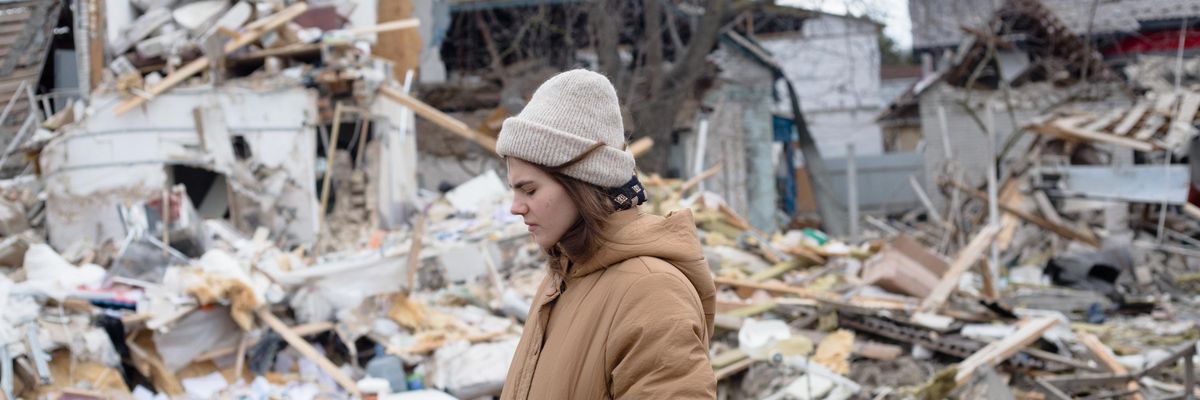
Local resident stands in front of the rubble as a result of Russian shelling on March 5, 2022 in Markhalivka, Ukraine. (Photo: Anastasia Vlasova/Getty Images)
A coalition of humanitarian groups on Wednesday urged President Joe Biden to immediately take steps to make the U.S. a party to the international treaty banning cluster munitions as Russian forces face condemnation for using the devastating and indiscriminate explosives in their assault on Ukraine.
"The U.S., like both Russia and Ukraine, refuses to sign the Convention on Cluster Munitions."
While the Biden administration has criticized Russia's use of cluster bombs in Ukraine, the U.S. has joined Russia and a handful of other powerful countries in refusing to sign the 2008 Convention on Cluster Munitions, which prohibits the use or stockpiling of the weapons. Long deplored by human rights advocates, cluster bombs can release hundreds of submunitions that maim and kill civilians.
In a new statement, the U.S. Campaign to Ban Landmines and the U.S. Cluster Munition Coalition forcefully denounced Russia for dropping the deadly weapons on Ukraine--as documented last week by Human Rights Watch--but argued that "the failure of the United States to join the international agreement banning cluster munitions weakens the impact of United States' criticism about Russia's use of these weapons."
"Therefore," the groups said, "[we] call upon the Biden administration to rapidly submit the Convention on Cluster Munitions to the United States Senate for advice and consent to accede to the treaty. The time for the United States government to act is now."
The Intercept's Jeremy Scahill argued in a column earlier this week that while the U.S. claim that Russia's use of cluster munitions constitutes a violation of international law is "indisputably true," a fact that "goes virtually unmentioned in much of the reporting on this topic is that the U.S., like both Russia and Ukraine, refuses to sign the Convention on Cluster Munitions."
Scahill continued:
The U.S. has repeatedly used cluster bombs, going back to the war in Vietnam and the "secret" bombings of Cambodia. In the modern era, both Presidents Bill Clinton and George W. Bush used them. President Barack Obama used cluster bombs in a 2009 attack in Yemen that killed some 55 people, the majority of them women and children. Despite the ban, which was finalized in 2008 and went into effect in 2010, the U.S. continued to sell cluster bombs to nations like Saudi Arabia, which regularly used them in its attacks in Yemen.
In 2017, President Donald Trump reversed an internal U.S. policy aimed at limiting the use of certain types of cluster munitions, a move which a Human Rights Watch expert warned "could embolden others to use cluster munitions that have caused so much human suffering."
"None of this exonerates Russia for its unconscionable use of cluster bombs against civilians," Scahill stressed, "but these facts are clearly relevant when assessing the credibility of the U.S."
Dear Common Dreams reader, It’s been nearly 30 years since I co-founded Common Dreams with my late wife, Lina Newhouser. We had the radical notion that journalism should serve the public good, not corporate profits. It was clear to us from the outset what it would take to build such a project. No paid advertisements. No corporate sponsors. No millionaire publisher telling us what to think or do. Many people said we wouldn't last a year, but we proved those doubters wrong. Together with a tremendous team of journalists and dedicated staff, we built an independent media outlet free from the constraints of profits and corporate control. Our mission has always been simple: To inform. To inspire. To ignite change for the common good. Building Common Dreams was not easy. Our survival was never guaranteed. When you take on the most powerful forces—Wall Street greed, fossil fuel industry destruction, Big Tech lobbyists, and uber-rich oligarchs who have spent billions upon billions rigging the economy and democracy in their favor—the only bulwark you have is supporters who believe in your work. But here’s the urgent message from me today. It's never been this bad out there. And it's never been this hard to keep us going. At the very moment Common Dreams is most needed, the threats we face are intensifying. We need your support now more than ever. We don't accept corporate advertising and never will. We don't have a paywall because we don't think people should be blocked from critical news based on their ability to pay. Everything we do is funded by the donations of readers like you. When everyone does the little they can afford, we are strong. But if that support retreats or dries up, so do we. Will you donate now to make sure Common Dreams not only survives but thrives? —Craig Brown, Co-founder |
A coalition of humanitarian groups on Wednesday urged President Joe Biden to immediately take steps to make the U.S. a party to the international treaty banning cluster munitions as Russian forces face condemnation for using the devastating and indiscriminate explosives in their assault on Ukraine.
"The U.S., like both Russia and Ukraine, refuses to sign the Convention on Cluster Munitions."
While the Biden administration has criticized Russia's use of cluster bombs in Ukraine, the U.S. has joined Russia and a handful of other powerful countries in refusing to sign the 2008 Convention on Cluster Munitions, which prohibits the use or stockpiling of the weapons. Long deplored by human rights advocates, cluster bombs can release hundreds of submunitions that maim and kill civilians.
In a new statement, the U.S. Campaign to Ban Landmines and the U.S. Cluster Munition Coalition forcefully denounced Russia for dropping the deadly weapons on Ukraine--as documented last week by Human Rights Watch--but argued that "the failure of the United States to join the international agreement banning cluster munitions weakens the impact of United States' criticism about Russia's use of these weapons."
"Therefore," the groups said, "[we] call upon the Biden administration to rapidly submit the Convention on Cluster Munitions to the United States Senate for advice and consent to accede to the treaty. The time for the United States government to act is now."
The Intercept's Jeremy Scahill argued in a column earlier this week that while the U.S. claim that Russia's use of cluster munitions constitutes a violation of international law is "indisputably true," a fact that "goes virtually unmentioned in much of the reporting on this topic is that the U.S., like both Russia and Ukraine, refuses to sign the Convention on Cluster Munitions."
Scahill continued:
The U.S. has repeatedly used cluster bombs, going back to the war in Vietnam and the "secret" bombings of Cambodia. In the modern era, both Presidents Bill Clinton and George W. Bush used them. President Barack Obama used cluster bombs in a 2009 attack in Yemen that killed some 55 people, the majority of them women and children. Despite the ban, which was finalized in 2008 and went into effect in 2010, the U.S. continued to sell cluster bombs to nations like Saudi Arabia, which regularly used them in its attacks in Yemen.
In 2017, President Donald Trump reversed an internal U.S. policy aimed at limiting the use of certain types of cluster munitions, a move which a Human Rights Watch expert warned "could embolden others to use cluster munitions that have caused so much human suffering."
"None of this exonerates Russia for its unconscionable use of cluster bombs against civilians," Scahill stressed, "but these facts are clearly relevant when assessing the credibility of the U.S."
A coalition of humanitarian groups on Wednesday urged President Joe Biden to immediately take steps to make the U.S. a party to the international treaty banning cluster munitions as Russian forces face condemnation for using the devastating and indiscriminate explosives in their assault on Ukraine.
"The U.S., like both Russia and Ukraine, refuses to sign the Convention on Cluster Munitions."
While the Biden administration has criticized Russia's use of cluster bombs in Ukraine, the U.S. has joined Russia and a handful of other powerful countries in refusing to sign the 2008 Convention on Cluster Munitions, which prohibits the use or stockpiling of the weapons. Long deplored by human rights advocates, cluster bombs can release hundreds of submunitions that maim and kill civilians.
In a new statement, the U.S. Campaign to Ban Landmines and the U.S. Cluster Munition Coalition forcefully denounced Russia for dropping the deadly weapons on Ukraine--as documented last week by Human Rights Watch--but argued that "the failure of the United States to join the international agreement banning cluster munitions weakens the impact of United States' criticism about Russia's use of these weapons."
"Therefore," the groups said, "[we] call upon the Biden administration to rapidly submit the Convention on Cluster Munitions to the United States Senate for advice and consent to accede to the treaty. The time for the United States government to act is now."
The Intercept's Jeremy Scahill argued in a column earlier this week that while the U.S. claim that Russia's use of cluster munitions constitutes a violation of international law is "indisputably true," a fact that "goes virtually unmentioned in much of the reporting on this topic is that the U.S., like both Russia and Ukraine, refuses to sign the Convention on Cluster Munitions."
Scahill continued:
The U.S. has repeatedly used cluster bombs, going back to the war in Vietnam and the "secret" bombings of Cambodia. In the modern era, both Presidents Bill Clinton and George W. Bush used them. President Barack Obama used cluster bombs in a 2009 attack in Yemen that killed some 55 people, the majority of them women and children. Despite the ban, which was finalized in 2008 and went into effect in 2010, the U.S. continued to sell cluster bombs to nations like Saudi Arabia, which regularly used them in its attacks in Yemen.
In 2017, President Donald Trump reversed an internal U.S. policy aimed at limiting the use of certain types of cluster munitions, a move which a Human Rights Watch expert warned "could embolden others to use cluster munitions that have caused so much human suffering."
"None of this exonerates Russia for its unconscionable use of cluster bombs against civilians," Scahill stressed, "but these facts are clearly relevant when assessing the credibility of the U.S."