

SUBSCRIBE TO OUR FREE NEWSLETTER
Daily news & progressive opinion—funded by the people, not the corporations—delivered straight to your inbox.
5
#000000
#FFFFFF
To donate by check, phone, or other method, see our More Ways to Give page.
Daily news & progressive opinion—funded by the people, not the corporations—delivered straight to your inbox.
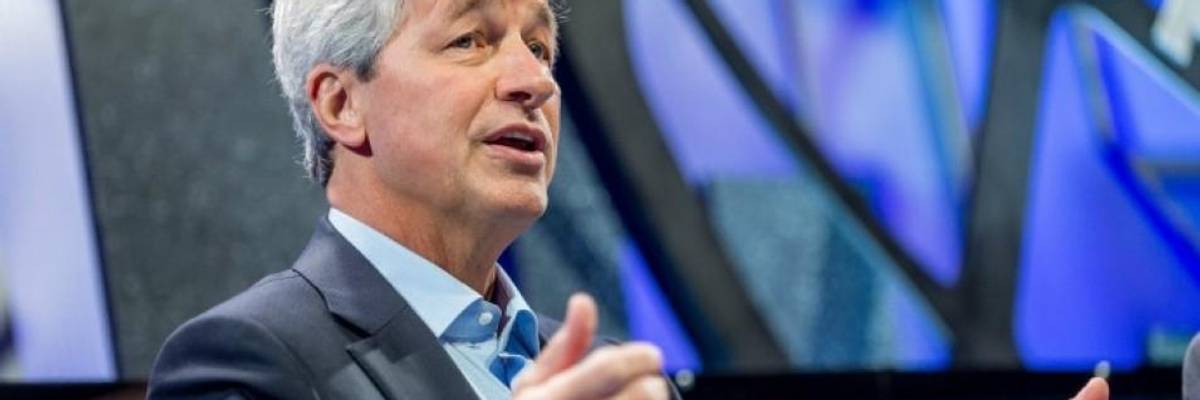
JPMorgan Chase CEO Jamie Dimon delivers a speech at the Fortune Global Forum in San Francisco.
"The CFPB must stop this ploy by the biggest banks to keep us trapped under their thumbs."
Consumer advocates applauded last month as the Consumer Financial Protection Bureau finalized a rule aimed at making it easier for people to switch financial institutions if they're unhappy with a bank's service, without the bank retaining their personal data—but on Thursday, more than a dozen groups warned the CFPB that major Wall Street firms are trying to stop Americans from benefiting from the rule.
Several advocacy groups, led by the Demand Progress Education Fund, wrote to CFPB director Rohit Chopra warning that major banks—including JP Morgan Chase, Bank of America, Citi, TD Bank, and Wells Fargo—sit on the board of the Financial Data Exchange (FDX), which has applied to the bureau for standard-setting body (SSB) status, which would give it authority over what is commonly known as the "open banking rule."
Standard-setting authority for the banks would present a major conflict of interest, said the groups.
The banks are also on the board of the Bank Policy Institute, which promptly filed what the consumer advocates called a "frivolous lawsuit" to block the open banking rule when it was introduced last month, claiming it will keep banks from protecting customer data.
At a panel discussion this week, Bank of America CEO Brian Moynihan also said the open banking rule, by requiring financial firms to unlock a consumer's financial data and transfer it to another provider for free, would cause "chaos" and amplify concerns over fraud.
"The American people are fed up with Wall Street controlling every aspect of their lives and the open banking rule is an opportunity to give all of us some financial freedom."
The groups wrote on Thursday that big banks want to continue to "maintain their dominance by making it unduly difficult for consumers to switch institutions."
"The presence of these organizations on both the FDX and BPI boards undermines the credibility of FDX and presents various concerns relating to conflict of interest, interlocking directorate, and antitrust law," they wrote.
Upon introducing the finalized rule last month, Chopra said the action would "give people more power to get better rates and service on bank accounts, credit cards, and more" and help those who are "stuck in financial products with lousy rates and service."
The coalition of consumer advocacy groups—including Public Citizen, the American Economic Liberties Project, and Americans for Financial Reform—urged Chopra to reject FDX's application for standard-setting authority so long as the banks remain on its board.
“It would be a flagrant conflict of interest for the same banks who are suing to block the open banking rule because it threatens their market dominance to also be in charge of implementing it," said Demand Progress Education Fund corporate power director Emily Peterson-Cassin. "The American people are fed up with Wall Street controlling every aspect of their lives and the open banking rule is an opportunity to give all of us some financial freedom. The CFPB must stop this ploy by the biggest banks to keep us trapped under their thumbs."
The groups called the open banking rule "a historic step forward for the cause of giving consumers true freedom intheir financial lives."
"For this reason, it is imperative that SSB status not be granted to an organization whose board members are, either directly or through a trade association they are participating in, suing the CFPB to stop the rules from taking effect, particularly when such members may be ethically conflicted from such dual participation," said the groups. "By rejecting SSB status for FDX or any other organization with similar conflicts of interest pertaining to Section 1033, the CFPB will help prevent big banks from sabotaging open banking rules."
Dear Common Dreams reader, It’s been nearly 30 years since I co-founded Common Dreams with my late wife, Lina Newhouser. We had the radical notion that journalism should serve the public good, not corporate profits. It was clear to us from the outset what it would take to build such a project. No paid advertisements. No corporate sponsors. No millionaire publisher telling us what to think or do. Many people said we wouldn't last a year, but we proved those doubters wrong. Together with a tremendous team of journalists and dedicated staff, we built an independent media outlet free from the constraints of profits and corporate control. Our mission has always been simple: To inform. To inspire. To ignite change for the common good. Building Common Dreams was not easy. Our survival was never guaranteed. When you take on the most powerful forces—Wall Street greed, fossil fuel industry destruction, Big Tech lobbyists, and uber-rich oligarchs who have spent billions upon billions rigging the economy and democracy in their favor—the only bulwark you have is supporters who believe in your work. But here’s the urgent message from me today. It's never been this bad out there. And it's never been this hard to keep us going. At the very moment Common Dreams is most needed, the threats we face are intensifying. We need your support now more than ever. We don't accept corporate advertising and never will. We don't have a paywall because we don't think people should be blocked from critical news based on their ability to pay. Everything we do is funded by the donations of readers like you. When everyone does the little they can afford, we are strong. But if that support retreats or dries up, so do we. Will you donate now to make sure Common Dreams not only survives but thrives? —Craig Brown, Co-founder |
Consumer advocates applauded last month as the Consumer Financial Protection Bureau finalized a rule aimed at making it easier for people to switch financial institutions if they're unhappy with a bank's service, without the bank retaining their personal data—but on Thursday, more than a dozen groups warned the CFPB that major Wall Street firms are trying to stop Americans from benefiting from the rule.
Several advocacy groups, led by the Demand Progress Education Fund, wrote to CFPB director Rohit Chopra warning that major banks—including JP Morgan Chase, Bank of America, Citi, TD Bank, and Wells Fargo—sit on the board of the Financial Data Exchange (FDX), which has applied to the bureau for standard-setting body (SSB) status, which would give it authority over what is commonly known as the "open banking rule."
Standard-setting authority for the banks would present a major conflict of interest, said the groups.
The banks are also on the board of the Bank Policy Institute, which promptly filed what the consumer advocates called a "frivolous lawsuit" to block the open banking rule when it was introduced last month, claiming it will keep banks from protecting customer data.
At a panel discussion this week, Bank of America CEO Brian Moynihan also said the open banking rule, by requiring financial firms to unlock a consumer's financial data and transfer it to another provider for free, would cause "chaos" and amplify concerns over fraud.
"The American people are fed up with Wall Street controlling every aspect of their lives and the open banking rule is an opportunity to give all of us some financial freedom."
The groups wrote on Thursday that big banks want to continue to "maintain their dominance by making it unduly difficult for consumers to switch institutions."
"The presence of these organizations on both the FDX and BPI boards undermines the credibility of FDX and presents various concerns relating to conflict of interest, interlocking directorate, and antitrust law," they wrote.
Upon introducing the finalized rule last month, Chopra said the action would "give people more power to get better rates and service on bank accounts, credit cards, and more" and help those who are "stuck in financial products with lousy rates and service."
The coalition of consumer advocacy groups—including Public Citizen, the American Economic Liberties Project, and Americans for Financial Reform—urged Chopra to reject FDX's application for standard-setting authority so long as the banks remain on its board.
“It would be a flagrant conflict of interest for the same banks who are suing to block the open banking rule because it threatens their market dominance to also be in charge of implementing it," said Demand Progress Education Fund corporate power director Emily Peterson-Cassin. "The American people are fed up with Wall Street controlling every aspect of their lives and the open banking rule is an opportunity to give all of us some financial freedom. The CFPB must stop this ploy by the biggest banks to keep us trapped under their thumbs."
The groups called the open banking rule "a historic step forward for the cause of giving consumers true freedom intheir financial lives."
"For this reason, it is imperative that SSB status not be granted to an organization whose board members are, either directly or through a trade association they are participating in, suing the CFPB to stop the rules from taking effect, particularly when such members may be ethically conflicted from such dual participation," said the groups. "By rejecting SSB status for FDX or any other organization with similar conflicts of interest pertaining to Section 1033, the CFPB will help prevent big banks from sabotaging open banking rules."
Consumer advocates applauded last month as the Consumer Financial Protection Bureau finalized a rule aimed at making it easier for people to switch financial institutions if they're unhappy with a bank's service, without the bank retaining their personal data—but on Thursday, more than a dozen groups warned the CFPB that major Wall Street firms are trying to stop Americans from benefiting from the rule.
Several advocacy groups, led by the Demand Progress Education Fund, wrote to CFPB director Rohit Chopra warning that major banks—including JP Morgan Chase, Bank of America, Citi, TD Bank, and Wells Fargo—sit on the board of the Financial Data Exchange (FDX), which has applied to the bureau for standard-setting body (SSB) status, which would give it authority over what is commonly known as the "open banking rule."
Standard-setting authority for the banks would present a major conflict of interest, said the groups.
The banks are also on the board of the Bank Policy Institute, which promptly filed what the consumer advocates called a "frivolous lawsuit" to block the open banking rule when it was introduced last month, claiming it will keep banks from protecting customer data.
At a panel discussion this week, Bank of America CEO Brian Moynihan also said the open banking rule, by requiring financial firms to unlock a consumer's financial data and transfer it to another provider for free, would cause "chaos" and amplify concerns over fraud.
"The American people are fed up with Wall Street controlling every aspect of their lives and the open banking rule is an opportunity to give all of us some financial freedom."
The groups wrote on Thursday that big banks want to continue to "maintain their dominance by making it unduly difficult for consumers to switch institutions."
"The presence of these organizations on both the FDX and BPI boards undermines the credibility of FDX and presents various concerns relating to conflict of interest, interlocking directorate, and antitrust law," they wrote.
Upon introducing the finalized rule last month, Chopra said the action would "give people more power to get better rates and service on bank accounts, credit cards, and more" and help those who are "stuck in financial products with lousy rates and service."
The coalition of consumer advocacy groups—including Public Citizen, the American Economic Liberties Project, and Americans for Financial Reform—urged Chopra to reject FDX's application for standard-setting authority so long as the banks remain on its board.
“It would be a flagrant conflict of interest for the same banks who are suing to block the open banking rule because it threatens their market dominance to also be in charge of implementing it," said Demand Progress Education Fund corporate power director Emily Peterson-Cassin. "The American people are fed up with Wall Street controlling every aspect of their lives and the open banking rule is an opportunity to give all of us some financial freedom. The CFPB must stop this ploy by the biggest banks to keep us trapped under their thumbs."
The groups called the open banking rule "a historic step forward for the cause of giving consumers true freedom intheir financial lives."
"For this reason, it is imperative that SSB status not be granted to an organization whose board members are, either directly or through a trade association they are participating in, suing the CFPB to stop the rules from taking effect, particularly when such members may be ethically conflicted from such dual participation," said the groups. "By rejecting SSB status for FDX or any other organization with similar conflicts of interest pertaining to Section 1033, the CFPB will help prevent big banks from sabotaging open banking rules."

