SUBSCRIBE TO OUR FREE NEWSLETTER
Daily news & progressive opinion—funded by the people, not the corporations—delivered straight to your inbox.
5
#000000
#FFFFFF
To donate by check, phone, or other method, see our More Ways to Give page.
Daily news & progressive opinion—funded by the people, not the corporations—delivered straight to your inbox.
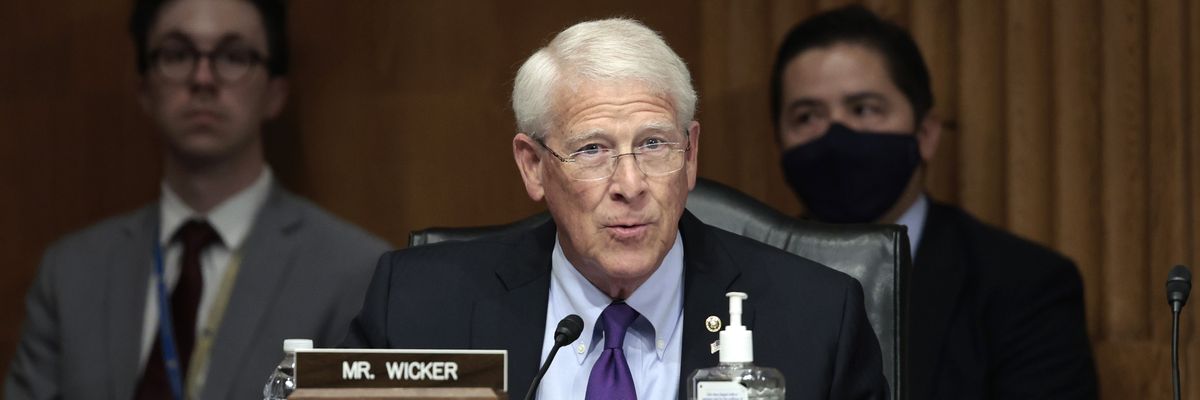
Sen. Roger Wicker (R-Miss.) speaks during a Senate hearing on March 23, 2022 in Washington, D.C.
"If the Supreme Court doesn't do the industry's bidding by weakening the CFPB, predatory lenders are counting on their MAGA Majority friends to finish the job," said the watchdog group behind a new analysis.
The payday lending industry has donated tens of thousands of dollars to congressional Republicans who backed a lawsuit asking the U.S. Supreme Court to invalidate the Consumer Financial Protection Bureau's funding structure, a step that would give corporate-friendly GOP lawmakers an opening to gut the agency they've been targeting since its creation.
A new report by the watchdog group Accountable.US—shared exclusively with Common Dreams—shows that the predatory payday loan industry gave at least $82,500 to the campaigns of Republican lawmakers who signed an amicus brief supporting the challenge to the CFPB, whose funding comes from the Federal Reserve system rather than annual congressional appropriations.
At least five Republicans—including Sen. Tim Scott (R-S.C.), the top Republican on the Senate Banking Committee—received a total of $23,400 in campaign contributions from board members of the Community Financial Services Association of America (CFSA) after they signed onto the amicus brief.
The CFSA is an industry trade group that brought the suit against the CFPB, challenging an agency rule targeting the abusive practices of payday lenders. The case has been described as an existential threat to the consumer agency and a potential disaster for the U.S. economy.
A previous analysis by Accountable.US found that CFSA member companies "have histories of criminal behavior or involvement in corruption and ethics scandals, including racketeering convictions, Ponzi scheme payouts, and payments to disgraced politicians."
Rep. Bill Posey (R-Fla.) received $7,500 in campaign donations from the owners of the payday lending company Amscot Financial, a CFSA member, less than two weeks after he backed the amicus brief, which echoes the industry's widely disputed claim that the CFPB's funding structure is unconstitutional. Amscot was charged in the late 1990s with fraud and racketeering, and the company's CEO, Ian MacKechnie, is banned for life from selling insurance in Florida.
"Predatory lenders, including convicted criminals, are greasing the palms of Republicans in Congress who endorsed their legal scheme for gutting the nation's top consumer advocate," said Liz Zelnick, director of the Economic Security and Corporate Power Program at Accountable.US. "It's all part of the plan for payday lenders notorious for trapping families in debt with triple-digit interest rates."
Accountable.US identified 27 Republican supporters of the CFPB challenge who received donations from the payday lending industry following their support for the amicus brief. Eleven of the GOP lawmakers, including Reps. Blaine Luetkemeyer (Mo.) and Bill Huizenga (Mich.), are members of the House Financial Services Committee.
Sen. Roger Wicker (R-Miss.), one of six GOP senators named in the Accountable.US report, got $6,600 in donations from Michael Lynn Hodges, the chairman of Advance Financial, after backing the amicus brief.
In 2019, consumer watchdogs obtained audio of Hodges bragging about how campaign donations bought the payday lending industry access to the Trump White House.
"Since the CFPB's inception, the financial industry and their lackeys in Congress have tried to shut it down all because it's an agency that puts consumers before corporations."
The conservative-dominated U.S. Supreme Court heard oral arguments in CFPB v. CFSA last month, and the justices "appeared highly skeptical that Congress improperly funded the Consumer Financial Protection Bureau by tethering its budget to the Federal Reserve," the American Banker reported at the time.
But the legal uncertainty generated by the case has benefited payday lenders, which profit by offering sky-high-interest loans to struggling Americans.
As The Washington Post reported late last month, payday lenders "have blocked at least five federal investigations into their business practices since the start of last year, part of a broad and aggressive campaign by payday lenders to neuter or eliminate their chief watchdog agency in Washington."
"Some companies have successfully cited the pending Supreme Court decision to slow ongoing CFPB investigations or fight off the agency's recent punishments," the Post found after reviewing court filings. "Top lending executives, meanwhile, have donated generously this year to Republican lawmakers and presidential candidates who previously signaled they could restrain, if not eliminate, the bureau."
Even if the Supreme Court rejects the CFSA's challenge and upholds the CFPB's funding structure—which insulates it from annual political fights over government spending—Republicans who have been hostile to the agency since its establishment in the wake of the 2008 financial crisis are unlikely to stop trying to gut its ability to pursue relief for consumers and impose penalties on lawbreaking corporations.
Rep. Andy Barr (R-Ky.)—who helped lead the anti-CFPB amicus brief—introduced legislation in March that would make the agency's funding subject to the yearly congressional appropriations process, setting the stage for budget cuts. The legislation is just one of the slew of bills Republicans have introduced in their campaign against the CFPB, which has delivered $19 billion in relief to consumers since its creation in 2011.
"If the Supreme Court doesn't do the industry's bidding by weakening the CFPB, predatory lenders are counting on their MAGA Majority friends to finish the job of rolling back consumer protections for millions of Americans," said Zelnick. "Since the CFPB's inception, the financial industry and their lackeys in Congress have tried to shut it down all because it's an agency that puts consumers before corporations."
Dear Common Dreams reader, It’s been nearly 30 years since I co-founded Common Dreams with my late wife, Lina Newhouser. We had the radical notion that journalism should serve the public good, not corporate profits. It was clear to us from the outset what it would take to build such a project. No paid advertisements. No corporate sponsors. No millionaire publisher telling us what to think or do. Many people said we wouldn't last a year, but we proved those doubters wrong. Together with a tremendous team of journalists and dedicated staff, we built an independent media outlet free from the constraints of profits and corporate control. Our mission has always been simple: To inform. To inspire. To ignite change for the common good. Building Common Dreams was not easy. Our survival was never guaranteed. When you take on the most powerful forces—Wall Street greed, fossil fuel industry destruction, Big Tech lobbyists, and uber-rich oligarchs who have spent billions upon billions rigging the economy and democracy in their favor—the only bulwark you have is supporters who believe in your work. But here’s the urgent message from me today. It's never been this bad out there. And it's never been this hard to keep us going. At the very moment Common Dreams is most needed, the threats we face are intensifying. We need your support now more than ever. We don't accept corporate advertising and never will. We don't have a paywall because we don't think people should be blocked from critical news based on their ability to pay. Everything we do is funded by the donations of readers like you. When everyone does the little they can afford, we are strong. But if that support retreats or dries up, so do we. Will you donate now to make sure Common Dreams not only survives but thrives? —Craig Brown, Co-founder |
The payday lending industry has donated tens of thousands of dollars to congressional Republicans who backed a lawsuit asking the U.S. Supreme Court to invalidate the Consumer Financial Protection Bureau's funding structure, a step that would give corporate-friendly GOP lawmakers an opening to gut the agency they've been targeting since its creation.
A new report by the watchdog group Accountable.US—shared exclusively with Common Dreams—shows that the predatory payday loan industry gave at least $82,500 to the campaigns of Republican lawmakers who signed an amicus brief supporting the challenge to the CFPB, whose funding comes from the Federal Reserve system rather than annual congressional appropriations.
At least five Republicans—including Sen. Tim Scott (R-S.C.), the top Republican on the Senate Banking Committee—received a total of $23,400 in campaign contributions from board members of the Community Financial Services Association of America (CFSA) after they signed onto the amicus brief.
The CFSA is an industry trade group that brought the suit against the CFPB, challenging an agency rule targeting the abusive practices of payday lenders. The case has been described as an existential threat to the consumer agency and a potential disaster for the U.S. economy.
A previous analysis by Accountable.US found that CFSA member companies "have histories of criminal behavior or involvement in corruption and ethics scandals, including racketeering convictions, Ponzi scheme payouts, and payments to disgraced politicians."
Rep. Bill Posey (R-Fla.) received $7,500 in campaign donations from the owners of the payday lending company Amscot Financial, a CFSA member, less than two weeks after he backed the amicus brief, which echoes the industry's widely disputed claim that the CFPB's funding structure is unconstitutional. Amscot was charged in the late 1990s with fraud and racketeering, and the company's CEO, Ian MacKechnie, is banned for life from selling insurance in Florida.
"Predatory lenders, including convicted criminals, are greasing the palms of Republicans in Congress who endorsed their legal scheme for gutting the nation's top consumer advocate," said Liz Zelnick, director of the Economic Security and Corporate Power Program at Accountable.US. "It's all part of the plan for payday lenders notorious for trapping families in debt with triple-digit interest rates."
Accountable.US identified 27 Republican supporters of the CFPB challenge who received donations from the payday lending industry following their support for the amicus brief. Eleven of the GOP lawmakers, including Reps. Blaine Luetkemeyer (Mo.) and Bill Huizenga (Mich.), are members of the House Financial Services Committee.
Sen. Roger Wicker (R-Miss.), one of six GOP senators named in the Accountable.US report, got $6,600 in donations from Michael Lynn Hodges, the chairman of Advance Financial, after backing the amicus brief.
In 2019, consumer watchdogs obtained audio of Hodges bragging about how campaign donations bought the payday lending industry access to the Trump White House.
"Since the CFPB's inception, the financial industry and their lackeys in Congress have tried to shut it down all because it's an agency that puts consumers before corporations."
The conservative-dominated U.S. Supreme Court heard oral arguments in CFPB v. CFSA last month, and the justices "appeared highly skeptical that Congress improperly funded the Consumer Financial Protection Bureau by tethering its budget to the Federal Reserve," the American Banker reported at the time.
But the legal uncertainty generated by the case has benefited payday lenders, which profit by offering sky-high-interest loans to struggling Americans.
As The Washington Post reported late last month, payday lenders "have blocked at least five federal investigations into their business practices since the start of last year, part of a broad and aggressive campaign by payday lenders to neuter or eliminate their chief watchdog agency in Washington."
"Some companies have successfully cited the pending Supreme Court decision to slow ongoing CFPB investigations or fight off the agency's recent punishments," the Post found after reviewing court filings. "Top lending executives, meanwhile, have donated generously this year to Republican lawmakers and presidential candidates who previously signaled they could restrain, if not eliminate, the bureau."
Even if the Supreme Court rejects the CFSA's challenge and upholds the CFPB's funding structure—which insulates it from annual political fights over government spending—Republicans who have been hostile to the agency since its establishment in the wake of the 2008 financial crisis are unlikely to stop trying to gut its ability to pursue relief for consumers and impose penalties on lawbreaking corporations.
Rep. Andy Barr (R-Ky.)—who helped lead the anti-CFPB amicus brief—introduced legislation in March that would make the agency's funding subject to the yearly congressional appropriations process, setting the stage for budget cuts. The legislation is just one of the slew of bills Republicans have introduced in their campaign against the CFPB, which has delivered $19 billion in relief to consumers since its creation in 2011.
"If the Supreme Court doesn't do the industry's bidding by weakening the CFPB, predatory lenders are counting on their MAGA Majority friends to finish the job of rolling back consumer protections for millions of Americans," said Zelnick. "Since the CFPB's inception, the financial industry and their lackeys in Congress have tried to shut it down all because it's an agency that puts consumers before corporations."
The payday lending industry has donated tens of thousands of dollars to congressional Republicans who backed a lawsuit asking the U.S. Supreme Court to invalidate the Consumer Financial Protection Bureau's funding structure, a step that would give corporate-friendly GOP lawmakers an opening to gut the agency they've been targeting since its creation.
A new report by the watchdog group Accountable.US—shared exclusively with Common Dreams—shows that the predatory payday loan industry gave at least $82,500 to the campaigns of Republican lawmakers who signed an amicus brief supporting the challenge to the CFPB, whose funding comes from the Federal Reserve system rather than annual congressional appropriations.
At least five Republicans—including Sen. Tim Scott (R-S.C.), the top Republican on the Senate Banking Committee—received a total of $23,400 in campaign contributions from board members of the Community Financial Services Association of America (CFSA) after they signed onto the amicus brief.
The CFSA is an industry trade group that brought the suit against the CFPB, challenging an agency rule targeting the abusive practices of payday lenders. The case has been described as an existential threat to the consumer agency and a potential disaster for the U.S. economy.
A previous analysis by Accountable.US found that CFSA member companies "have histories of criminal behavior or involvement in corruption and ethics scandals, including racketeering convictions, Ponzi scheme payouts, and payments to disgraced politicians."
Rep. Bill Posey (R-Fla.) received $7,500 in campaign donations from the owners of the payday lending company Amscot Financial, a CFSA member, less than two weeks after he backed the amicus brief, which echoes the industry's widely disputed claim that the CFPB's funding structure is unconstitutional. Amscot was charged in the late 1990s with fraud and racketeering, and the company's CEO, Ian MacKechnie, is banned for life from selling insurance in Florida.
"Predatory lenders, including convicted criminals, are greasing the palms of Republicans in Congress who endorsed their legal scheme for gutting the nation's top consumer advocate," said Liz Zelnick, director of the Economic Security and Corporate Power Program at Accountable.US. "It's all part of the plan for payday lenders notorious for trapping families in debt with triple-digit interest rates."
Accountable.US identified 27 Republican supporters of the CFPB challenge who received donations from the payday lending industry following their support for the amicus brief. Eleven of the GOP lawmakers, including Reps. Blaine Luetkemeyer (Mo.) and Bill Huizenga (Mich.), are members of the House Financial Services Committee.
Sen. Roger Wicker (R-Miss.), one of six GOP senators named in the Accountable.US report, got $6,600 in donations from Michael Lynn Hodges, the chairman of Advance Financial, after backing the amicus brief.
In 2019, consumer watchdogs obtained audio of Hodges bragging about how campaign donations bought the payday lending industry access to the Trump White House.
"Since the CFPB's inception, the financial industry and their lackeys in Congress have tried to shut it down all because it's an agency that puts consumers before corporations."
The conservative-dominated U.S. Supreme Court heard oral arguments in CFPB v. CFSA last month, and the justices "appeared highly skeptical that Congress improperly funded the Consumer Financial Protection Bureau by tethering its budget to the Federal Reserve," the American Banker reported at the time.
But the legal uncertainty generated by the case has benefited payday lenders, which profit by offering sky-high-interest loans to struggling Americans.
As The Washington Post reported late last month, payday lenders "have blocked at least five federal investigations into their business practices since the start of last year, part of a broad and aggressive campaign by payday lenders to neuter or eliminate their chief watchdog agency in Washington."
"Some companies have successfully cited the pending Supreme Court decision to slow ongoing CFPB investigations or fight off the agency's recent punishments," the Post found after reviewing court filings. "Top lending executives, meanwhile, have donated generously this year to Republican lawmakers and presidential candidates who previously signaled they could restrain, if not eliminate, the bureau."
Even if the Supreme Court rejects the CFSA's challenge and upholds the CFPB's funding structure—which insulates it from annual political fights over government spending—Republicans who have been hostile to the agency since its establishment in the wake of the 2008 financial crisis are unlikely to stop trying to gut its ability to pursue relief for consumers and impose penalties on lawbreaking corporations.
Rep. Andy Barr (R-Ky.)—who helped lead the anti-CFPB amicus brief—introduced legislation in March that would make the agency's funding subject to the yearly congressional appropriations process, setting the stage for budget cuts. The legislation is just one of the slew of bills Republicans have introduced in their campaign against the CFPB, which has delivered $19 billion in relief to consumers since its creation in 2011.
"If the Supreme Court doesn't do the industry's bidding by weakening the CFPB, predatory lenders are counting on their MAGA Majority friends to finish the job of rolling back consumer protections for millions of Americans," said Zelnick. "Since the CFPB's inception, the financial industry and their lackeys in Congress have tried to shut it down all because it's an agency that puts consumers before corporations."