SUBSCRIBE TO OUR FREE NEWSLETTER
Daily news & progressive opinion—funded by the people, not the corporations—delivered straight to your inbox.
5
#000000
#FFFFFF
To donate by check, phone, or other method, see our More Ways to Give page.
Daily news & progressive opinion—funded by the people, not the corporations—delivered straight to your inbox.
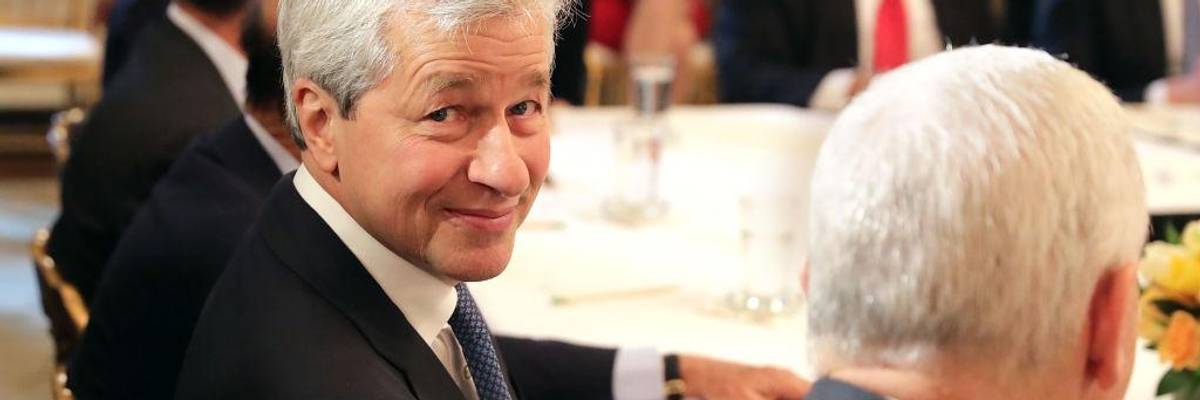
JPMorgan Chase CEO Jamie Dimon attends a policy forum with then-U.S. President Donald Trump in the State Dining Room at the White House on February 3, 2017 in Washington, D.C.
"Corporate greed is out of control," said consumer watchdog Public Citizen.
As workers in a range of industries across the United States demanded fair pay and benefits last year—and in several cases, were forced to strike as companies refused to meet those demands—median compensation for the top chief executives rose to a record-breaking $22.3 million.
The executive compensation research firm Equilar released its annual findings on CEO pay in 2022 Wednesday, showing the 100 highest-paid CEOs of companies with a revenue of $1 billion or more made 7.7% more than in 2021, driven largely by huge stock awards.
Corporations have blamed inflation for higher prices on goods and services, but the supposed financial burden caused by the rising consumer price index has not forced executives to take pay cuts, the study shows—bolstering earlier analysis that has shown companies have used inflation as an excuse to unnecessarily raise prices and have pocketed the increased profits.
With the average U.S. private sector employee earning $1,132 per week last year—up only 3.6% from 2021—the median CEO-to-worker pay ratio rose to 288-to-1. The ratio was 254-to-1 the previous year, an astronomical rise from its level in 1965, when CEOs earned 20 times more than their employees on average.
The Federal Reserve, which on Wednesday raised interest rates for the 10th time to fight the current trend of rising inflation—a tactic that can lead to job losses—has in recent months pushed companies to "get wages down" for workers, even as average pay for workers has remained relatively stagnant and CEO compensation has skyrocketed.
"Just to catch up with what their CEO made in 2018 alone, it would take the typical worker 158 years," said economist and former Labor Secretary Robert Reich in a video he released about CEO pay on Monday.
Median stock awards for executives went up 20% to $13.8 million last year, allowing CEOs who make headlines by taking low salaries to rake in record-breaking compensation nonetheless.
Hamid Moghadam, chief executive of logistics real estate company Prologis, is among the U.S. CEOs who officially take home a salary of just $1 per year, but his stock awards drove his total compensation up to $48.2 million last year—an increase of 94% over 2021.
Richard Handler, CEO of the investment back Jefferies Group, nearly doubled his 2021 compensation thanks to a one-time "leadership continuity grant" of stock awards that was approved by only 59% of his company's shareholders. The grant amounted to $25 million and his total compensation was $56.9 million.
On Tuesday, as television writers represented by the Writers Guild of America went on strike due to their inflation-adjusted pay declining by 23% over the past decade, consumer rights watchdog Public Citizen noted that studio executives made hundreds of millions annually in recent years.
" Corporate greed is out of control," said the group.
Dear Common Dreams reader, It’s been nearly 30 years since I co-founded Common Dreams with my late wife, Lina Newhouser. We had the radical notion that journalism should serve the public good, not corporate profits. It was clear to us from the outset what it would take to build such a project. No paid advertisements. No corporate sponsors. No millionaire publisher telling us what to think or do. Many people said we wouldn't last a year, but we proved those doubters wrong. Together with a tremendous team of journalists and dedicated staff, we built an independent media outlet free from the constraints of profits and corporate control. Our mission has always been simple: To inform. To inspire. To ignite change for the common good. Building Common Dreams was not easy. Our survival was never guaranteed. When you take on the most powerful forces—Wall Street greed, fossil fuel industry destruction, Big Tech lobbyists, and uber-rich oligarchs who have spent billions upon billions rigging the economy and democracy in their favor—the only bulwark you have is supporters who believe in your work. But here’s the urgent message from me today. It's never been this bad out there. And it's never been this hard to keep us going. At the very moment Common Dreams is most needed, the threats we face are intensifying. We need your support now more than ever. We don't accept corporate advertising and never will. We don't have a paywall because we don't think people should be blocked from critical news based on their ability to pay. Everything we do is funded by the donations of readers like you. When everyone does the little they can afford, we are strong. But if that support retreats or dries up, so do we. Will you donate now to make sure Common Dreams not only survives but thrives? —Craig Brown, Co-founder |
As workers in a range of industries across the United States demanded fair pay and benefits last year—and in several cases, were forced to strike as companies refused to meet those demands—median compensation for the top chief executives rose to a record-breaking $22.3 million.
The executive compensation research firm Equilar released its annual findings on CEO pay in 2022 Wednesday, showing the 100 highest-paid CEOs of companies with a revenue of $1 billion or more made 7.7% more than in 2021, driven largely by huge stock awards.
Corporations have blamed inflation for higher prices on goods and services, but the supposed financial burden caused by the rising consumer price index has not forced executives to take pay cuts, the study shows—bolstering earlier analysis that has shown companies have used inflation as an excuse to unnecessarily raise prices and have pocketed the increased profits.
With the average U.S. private sector employee earning $1,132 per week last year—up only 3.6% from 2021—the median CEO-to-worker pay ratio rose to 288-to-1. The ratio was 254-to-1 the previous year, an astronomical rise from its level in 1965, when CEOs earned 20 times more than their employees on average.
The Federal Reserve, which on Wednesday raised interest rates for the 10th time to fight the current trend of rising inflation—a tactic that can lead to job losses—has in recent months pushed companies to "get wages down" for workers, even as average pay for workers has remained relatively stagnant and CEO compensation has skyrocketed.
"Just to catch up with what their CEO made in 2018 alone, it would take the typical worker 158 years," said economist and former Labor Secretary Robert Reich in a video he released about CEO pay on Monday.
Median stock awards for executives went up 20% to $13.8 million last year, allowing CEOs who make headlines by taking low salaries to rake in record-breaking compensation nonetheless.
Hamid Moghadam, chief executive of logistics real estate company Prologis, is among the U.S. CEOs who officially take home a salary of just $1 per year, but his stock awards drove his total compensation up to $48.2 million last year—an increase of 94% over 2021.
Richard Handler, CEO of the investment back Jefferies Group, nearly doubled his 2021 compensation thanks to a one-time "leadership continuity grant" of stock awards that was approved by only 59% of his company's shareholders. The grant amounted to $25 million and his total compensation was $56.9 million.
On Tuesday, as television writers represented by the Writers Guild of America went on strike due to their inflation-adjusted pay declining by 23% over the past decade, consumer rights watchdog Public Citizen noted that studio executives made hundreds of millions annually in recent years.
" Corporate greed is out of control," said the group.
As workers in a range of industries across the United States demanded fair pay and benefits last year—and in several cases, were forced to strike as companies refused to meet those demands—median compensation for the top chief executives rose to a record-breaking $22.3 million.
The executive compensation research firm Equilar released its annual findings on CEO pay in 2022 Wednesday, showing the 100 highest-paid CEOs of companies with a revenue of $1 billion or more made 7.7% more than in 2021, driven largely by huge stock awards.
Corporations have blamed inflation for higher prices on goods and services, but the supposed financial burden caused by the rising consumer price index has not forced executives to take pay cuts, the study shows—bolstering earlier analysis that has shown companies have used inflation as an excuse to unnecessarily raise prices and have pocketed the increased profits.
With the average U.S. private sector employee earning $1,132 per week last year—up only 3.6% from 2021—the median CEO-to-worker pay ratio rose to 288-to-1. The ratio was 254-to-1 the previous year, an astronomical rise from its level in 1965, when CEOs earned 20 times more than their employees on average.
The Federal Reserve, which on Wednesday raised interest rates for the 10th time to fight the current trend of rising inflation—a tactic that can lead to job losses—has in recent months pushed companies to "get wages down" for workers, even as average pay for workers has remained relatively stagnant and CEO compensation has skyrocketed.
"Just to catch up with what their CEO made in 2018 alone, it would take the typical worker 158 years," said economist and former Labor Secretary Robert Reich in a video he released about CEO pay on Monday.
Median stock awards for executives went up 20% to $13.8 million last year, allowing CEOs who make headlines by taking low salaries to rake in record-breaking compensation nonetheless.
Hamid Moghadam, chief executive of logistics real estate company Prologis, is among the U.S. CEOs who officially take home a salary of just $1 per year, but his stock awards drove his total compensation up to $48.2 million last year—an increase of 94% over 2021.
Richard Handler, CEO of the investment back Jefferies Group, nearly doubled his 2021 compensation thanks to a one-time "leadership continuity grant" of stock awards that was approved by only 59% of his company's shareholders. The grant amounted to $25 million and his total compensation was $56.9 million.
On Tuesday, as television writers represented by the Writers Guild of America went on strike due to their inflation-adjusted pay declining by 23% over the past decade, consumer rights watchdog Public Citizen noted that studio executives made hundreds of millions annually in recent years.
" Corporate greed is out of control," said the group.