SUBSCRIBE TO OUR FREE NEWSLETTER
Daily news & progressive opinion—funded by the people, not the corporations—delivered straight to your inbox.
5
#000000
#FFFFFF
To donate by check, phone, or other method, see our More Ways to Give page.
Daily news & progressive opinion—funded by the people, not the corporations—delivered straight to your inbox.
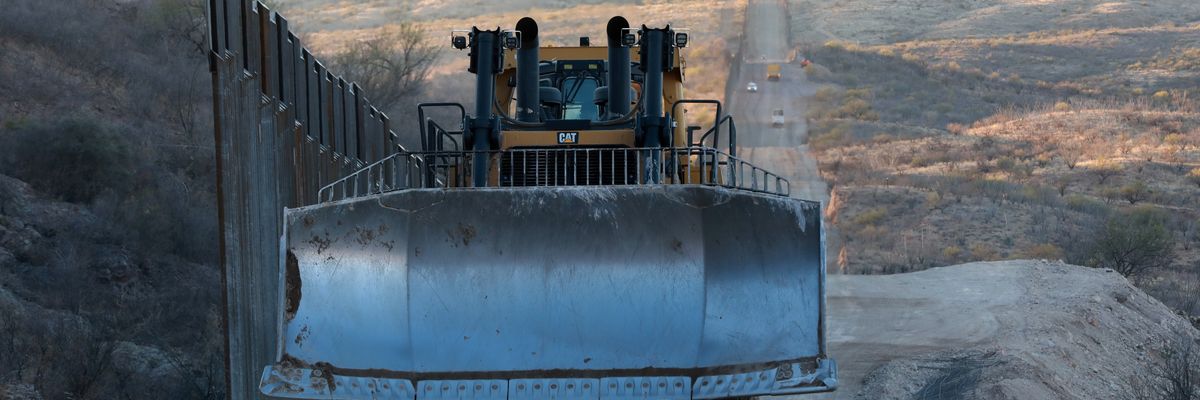
A construction vehicle drives along the border wall with Mexico on January 12, 2021 in Sasabe, Arizona.
"Every acre of habitat left in the Rio Grande Valley is irreplaceable," said one advocate. "We can't afford to lose more of it to a useless, medieval wall."
Environmental protection advocates and immigrant rights campaigners expressed horror Wednesday over a Department of Homeland Security plan entered into the Federal Register that will waive more than two dozen laws in order to expedite the construction of the U.S.-Mexico border wall.
The "notice of determination" was entered under Section 102 of the Illegal Immigration Reform and Immigration Responsibility Act, which was signed by former President Bill Clinton in 1996, and said Secretary of Homeland Security Alejandro Mayorkas "has determined, pursuant to law, that it is necessary to waive certain laws, regulations, and other legal requirements."
The 26 laws—which include the National Environmental Policy Act, the Endangered Species Act, the Migratory Bird Conservation Act, and the Native American Graves Protection and Repatriation Act—are being set aside "to ensure the expeditious construction of barriers and roads in the vicinity of the international land border in Starr County, Texas," the Federal Register said.
The waiver will allow construction through the Lower Rio Grande Valley National Wildlife Refuge and could threaten endangered species including ocelots, as well as the plant species Zapata bladderpod and prostrate milkweed, said the Center for Biological Diversity (CBD).
Voces Unidas Rio Grande Valley said it was "disappointed, but not surprised" by DHS's plan and noted that it will further limit the access to green spaces that area residents have.
Mayorkas' determination marks the first time the Biden administration has used its waiver authority under the REAL ID Act of 2005 to override federal laws.
The Trump and George W. Bush administrations
used the authority in all four states that border Mexico to build walls and roads that they claimed were "an impediment" to the construction. Environmental groups have long condemned the REAL ID Act and its waiver authority.
Laiken Jordahl, Southwest conservation advocate for CBD, said it was "disheartening to see President Biden stoop to this level" in order to "build ineffective wildlife-killing border walls" that international advocates say also violates human rights.
"Starr County is home to some of the most spectacular and biologically important habitat left in Texas and now bulldozers are preparing to rip right through it," said Jordahl. "This is a horrific step backwards for the borderlands."
The proposal is the Biden administration's latest escalation of its anti-immigration policies and follows an expansion of the Trump-era Title 42 policy and a rule barring entry into the U.S. for asylum seekers who can't prove they applied for asylum in another country.
"Every acre of habitat left in the Rio Grande Valley is irreplaceable," said Jordahl. "We can't afford to lose more of it to a useless, medieval wall that won't do a thing to stop immigration or smuggling. President Biden's cynical decision to destroy a wildlife refuge and seal the beautiful Rio Grande behind a grotesque border wall must be stopped."
The proposal was announced a month after the federal government's own watchdog, the Government Accountability Office, released a report saying that border wall construction under Trump damaged native plants, helped spread invasive species, disrupted migration patterns for endangered species, and destroyed Indigenous burial grounds and sacred sites.
"There's no end to this insanity,"
said historian Greg Grandin of Biden's plan to fast-track the wall's construction.
Dear Common Dreams reader, It’s been nearly 30 years since I co-founded Common Dreams with my late wife, Lina Newhouser. We had the radical notion that journalism should serve the public good, not corporate profits. It was clear to us from the outset what it would take to build such a project. No paid advertisements. No corporate sponsors. No millionaire publisher telling us what to think or do. Many people said we wouldn't last a year, but we proved those doubters wrong. Together with a tremendous team of journalists and dedicated staff, we built an independent media outlet free from the constraints of profits and corporate control. Our mission has always been simple: To inform. To inspire. To ignite change for the common good. Building Common Dreams was not easy. Our survival was never guaranteed. When you take on the most powerful forces—Wall Street greed, fossil fuel industry destruction, Big Tech lobbyists, and uber-rich oligarchs who have spent billions upon billions rigging the economy and democracy in their favor—the only bulwark you have is supporters who believe in your work. But here’s the urgent message from me today. It's never been this bad out there. And it's never been this hard to keep us going. At the very moment Common Dreams is most needed, the threats we face are intensifying. We need your support now more than ever. We don't accept corporate advertising and never will. We don't have a paywall because we don't think people should be blocked from critical news based on their ability to pay. Everything we do is funded by the donations of readers like you. When everyone does the little they can afford, we are strong. But if that support retreats or dries up, so do we. Will you donate now to make sure Common Dreams not only survives but thrives? —Craig Brown, Co-founder |
Environmental protection advocates and immigrant rights campaigners expressed horror Wednesday over a Department of Homeland Security plan entered into the Federal Register that will waive more than two dozen laws in order to expedite the construction of the U.S.-Mexico border wall.
The "notice of determination" was entered under Section 102 of the Illegal Immigration Reform and Immigration Responsibility Act, which was signed by former President Bill Clinton in 1996, and said Secretary of Homeland Security Alejandro Mayorkas "has determined, pursuant to law, that it is necessary to waive certain laws, regulations, and other legal requirements."
The 26 laws—which include the National Environmental Policy Act, the Endangered Species Act, the Migratory Bird Conservation Act, and the Native American Graves Protection and Repatriation Act—are being set aside "to ensure the expeditious construction of barriers and roads in the vicinity of the international land border in Starr County, Texas," the Federal Register said.
The waiver will allow construction through the Lower Rio Grande Valley National Wildlife Refuge and could threaten endangered species including ocelots, as well as the plant species Zapata bladderpod and prostrate milkweed, said the Center for Biological Diversity (CBD).
Voces Unidas Rio Grande Valley said it was "disappointed, but not surprised" by DHS's plan and noted that it will further limit the access to green spaces that area residents have.
Mayorkas' determination marks the first time the Biden administration has used its waiver authority under the REAL ID Act of 2005 to override federal laws.
The Trump and George W. Bush administrations
used the authority in all four states that border Mexico to build walls and roads that they claimed were "an impediment" to the construction. Environmental groups have long condemned the REAL ID Act and its waiver authority.
Laiken Jordahl, Southwest conservation advocate for CBD, said it was "disheartening to see President Biden stoop to this level" in order to "build ineffective wildlife-killing border walls" that international advocates say also violates human rights.
"Starr County is home to some of the most spectacular and biologically important habitat left in Texas and now bulldozers are preparing to rip right through it," said Jordahl. "This is a horrific step backwards for the borderlands."
The proposal is the Biden administration's latest escalation of its anti-immigration policies and follows an expansion of the Trump-era Title 42 policy and a rule barring entry into the U.S. for asylum seekers who can't prove they applied for asylum in another country.
"Every acre of habitat left in the Rio Grande Valley is irreplaceable," said Jordahl. "We can't afford to lose more of it to a useless, medieval wall that won't do a thing to stop immigration or smuggling. President Biden's cynical decision to destroy a wildlife refuge and seal the beautiful Rio Grande behind a grotesque border wall must be stopped."
The proposal was announced a month after the federal government's own watchdog, the Government Accountability Office, released a report saying that border wall construction under Trump damaged native plants, helped spread invasive species, disrupted migration patterns for endangered species, and destroyed Indigenous burial grounds and sacred sites.
"There's no end to this insanity,"
said historian Greg Grandin of Biden's plan to fast-track the wall's construction.
Environmental protection advocates and immigrant rights campaigners expressed horror Wednesday over a Department of Homeland Security plan entered into the Federal Register that will waive more than two dozen laws in order to expedite the construction of the U.S.-Mexico border wall.
The "notice of determination" was entered under Section 102 of the Illegal Immigration Reform and Immigration Responsibility Act, which was signed by former President Bill Clinton in 1996, and said Secretary of Homeland Security Alejandro Mayorkas "has determined, pursuant to law, that it is necessary to waive certain laws, regulations, and other legal requirements."
The 26 laws—which include the National Environmental Policy Act, the Endangered Species Act, the Migratory Bird Conservation Act, and the Native American Graves Protection and Repatriation Act—are being set aside "to ensure the expeditious construction of barriers and roads in the vicinity of the international land border in Starr County, Texas," the Federal Register said.
The waiver will allow construction through the Lower Rio Grande Valley National Wildlife Refuge and could threaten endangered species including ocelots, as well as the plant species Zapata bladderpod and prostrate milkweed, said the Center for Biological Diversity (CBD).
Voces Unidas Rio Grande Valley said it was "disappointed, but not surprised" by DHS's plan and noted that it will further limit the access to green spaces that area residents have.
Mayorkas' determination marks the first time the Biden administration has used its waiver authority under the REAL ID Act of 2005 to override federal laws.
The Trump and George W. Bush administrations
used the authority in all four states that border Mexico to build walls and roads that they claimed were "an impediment" to the construction. Environmental groups have long condemned the REAL ID Act and its waiver authority.
Laiken Jordahl, Southwest conservation advocate for CBD, said it was "disheartening to see President Biden stoop to this level" in order to "build ineffective wildlife-killing border walls" that international advocates say also violates human rights.
"Starr County is home to some of the most spectacular and biologically important habitat left in Texas and now bulldozers are preparing to rip right through it," said Jordahl. "This is a horrific step backwards for the borderlands."
The proposal is the Biden administration's latest escalation of its anti-immigration policies and follows an expansion of the Trump-era Title 42 policy and a rule barring entry into the U.S. for asylum seekers who can't prove they applied for asylum in another country.
"Every acre of habitat left in the Rio Grande Valley is irreplaceable," said Jordahl. "We can't afford to lose more of it to a useless, medieval wall that won't do a thing to stop immigration or smuggling. President Biden's cynical decision to destroy a wildlife refuge and seal the beautiful Rio Grande behind a grotesque border wall must be stopped."
The proposal was announced a month after the federal government's own watchdog, the Government Accountability Office, released a report saying that border wall construction under Trump damaged native plants, helped spread invasive species, disrupted migration patterns for endangered species, and destroyed Indigenous burial grounds and sacred sites.
"There's no end to this insanity,"
said historian Greg Grandin of Biden's plan to fast-track the wall's construction.