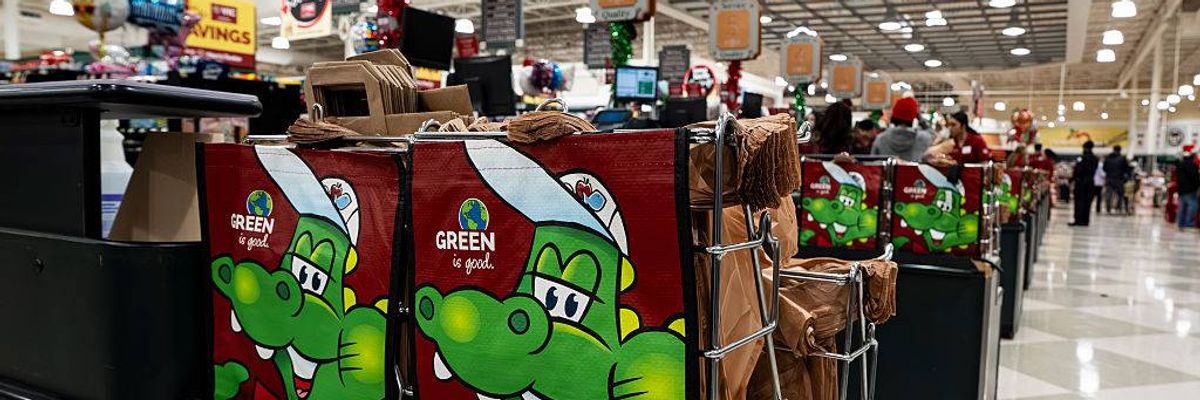
Harry the Happy Dragon, the mascot for Harris Teeter, on reusable plastic bags for sale at a grocery store on December 22, 2025 in Durham, North Carolina.
(Photo by Al Drago/Getty Images)
New State Laws Aim to Protect Environment, Consumers as Trump Wages All-Out War on Climate
"The gridlock and partisanship we see in Washington, DC can be dispiriting. But history shows that states can build momentum that eventually leads to change at the federal level."
Dec 29, 2025
Even as President Donald Trump and his administration have been ripping up environmental and consumer protection regulations, a number of state laws are set to take effect next year that could at least mitigate some of the damage.
A Monday statement from Environment America and the Public Interest Network highlighted a number of new laws aimed at curbing corporate polluters and enhancing consumer welfare.
First, the groups highlighted "Right to Repair" laws set to take effect in Washington, Nevada, Oregon, and Colorado, which give people the right to repair their own appliances and electronics without burdensome costs or barriers.
The groups lavished particular praise on Colorado's "Right to Repair" laws that they said provide "the broadest repair protections in the country," with new regulations that will give businesses in the state "access to what they and independent repair providers need to fix their electronics themselves."
Illinois, meanwhile, will fully phase out the sale of fluorescent lightbulbs, which will be replaced by energy-efficient LED bulbs. The groups estimate that eliminating the fluorescent bulbs will collectively save Illinois households more than $1.5 billion on their utility bills by 2050, while also reducing energy waste and mercury pollution.
Illinois also drew praise for enacting a ban on polystyrene foam foodware that will take effect on January 1.
The groups also highlighted the work being done in Oregon to protect consumers with legislation mandating price transparency to eliminate surprise junk fees on purchases; prohibiting ambulance companies from socking out-of-network patients with massive fees for rides to nearby hospitals; and placing new restrictions on the ability of medical debt to negatively impact a person's credit score.
California also got a mention in the groups' release for closing a loophole that allowed supermarkets to continue using plastic bags and for creating a new privacy tool for consumers allowing them to request that online data brokers delete all of the personal information they have gathered on them over the years.
Emily Rusch, vice president and senior director of state offices for the Public Interest Network, contrasted the action being taken in the states to protect consumers and the environment with a lack of action being done at the federal level.
"The gridlock and partisanship we see in Washington, DC can be dispiriting," said Rusch. "But history shows that states can build momentum that eventually leads to change at the federal level. As we build on this progress in 2026, we look forward to working with anyone—Republican, Democrat, or independent—with whom we can find common ground."
An Urgent Message From Our Co-Founder
Dear Common Dreams reader, The U.S. is on a fast track to authoritarianism like nothing I've ever seen. Meanwhile, corporate news outlets are utterly capitulating to Trump, twisting their coverage to avoid drawing his ire while lining up to stuff cash in his pockets. That's why I believe that Common Dreams is doing the best and most consequential reporting that we've ever done. Our small but mighty team is a progressive reporting powerhouse, covering the news every day that the corporate media never will. Our mission has always been simple: To inform. To inspire. And to ignite change for the common good. Now here's the key piece that I want all our readers to understand: None of this would be possible without your financial support. That's not just some fundraising cliche. It's the absolute and literal truth. We don't accept corporate advertising and never will. We don't have a paywall because we don't think people should be blocked from critical news based on their ability to pay. Everything we do is funded by the donations of readers like you. Will you donate now to help power the nonprofit, independent reporting of Common Dreams? Thank you for being a vital member of our community. Together, we can keep independent journalism alive when it’s needed most. - Craig Brown, Co-founder |
Our work is licensed under Creative Commons (CC BY-NC-ND 3.0). Feel free to republish and share widely.
Even as President Donald Trump and his administration have been ripping up environmental and consumer protection regulations, a number of state laws are set to take effect next year that could at least mitigate some of the damage.
A Monday statement from Environment America and the Public Interest Network highlighted a number of new laws aimed at curbing corporate polluters and enhancing consumer welfare.
First, the groups highlighted "Right to Repair" laws set to take effect in Washington, Nevada, Oregon, and Colorado, which give people the right to repair their own appliances and electronics without burdensome costs or barriers.
The groups lavished particular praise on Colorado's "Right to Repair" laws that they said provide "the broadest repair protections in the country," with new regulations that will give businesses in the state "access to what they and independent repair providers need to fix their electronics themselves."
Illinois, meanwhile, will fully phase out the sale of fluorescent lightbulbs, which will be replaced by energy-efficient LED bulbs. The groups estimate that eliminating the fluorescent bulbs will collectively save Illinois households more than $1.5 billion on their utility bills by 2050, while also reducing energy waste and mercury pollution.
Illinois also drew praise for enacting a ban on polystyrene foam foodware that will take effect on January 1.
The groups also highlighted the work being done in Oregon to protect consumers with legislation mandating price transparency to eliminate surprise junk fees on purchases; prohibiting ambulance companies from socking out-of-network patients with massive fees for rides to nearby hospitals; and placing new restrictions on the ability of medical debt to negatively impact a person's credit score.
California also got a mention in the groups' release for closing a loophole that allowed supermarkets to continue using plastic bags and for creating a new privacy tool for consumers allowing them to request that online data brokers delete all of the personal information they have gathered on them over the years.
Emily Rusch, vice president and senior director of state offices for the Public Interest Network, contrasted the action being taken in the states to protect consumers and the environment with a lack of action being done at the federal level.
"The gridlock and partisanship we see in Washington, DC can be dispiriting," said Rusch. "But history shows that states can build momentum that eventually leads to change at the federal level. As we build on this progress in 2026, we look forward to working with anyone—Republican, Democrat, or independent—with whom we can find common ground."
From Your Site Articles
- GOP Megalaw Will Mean Tax Hikes for Many Poor Americans as Soon as 2026: Analysis ›
- Electric Vehicles Are No Silver Bullet—Transportation Fixes Must Go Further ›
- Officials Plot to Have Trump Declare National Emergency in 2026, Raising Fears He May 'Hijack' the Next Election ›
Related Articles Around the Web
Even as President Donald Trump and his administration have been ripping up environmental and consumer protection regulations, a number of state laws are set to take effect next year that could at least mitigate some of the damage.
A Monday statement from Environment America and the Public Interest Network highlighted a number of new laws aimed at curbing corporate polluters and enhancing consumer welfare.
First, the groups highlighted "Right to Repair" laws set to take effect in Washington, Nevada, Oregon, and Colorado, which give people the right to repair their own appliances and electronics without burdensome costs or barriers.
The groups lavished particular praise on Colorado's "Right to Repair" laws that they said provide "the broadest repair protections in the country," with new regulations that will give businesses in the state "access to what they and independent repair providers need to fix their electronics themselves."
Illinois, meanwhile, will fully phase out the sale of fluorescent lightbulbs, which will be replaced by energy-efficient LED bulbs. The groups estimate that eliminating the fluorescent bulbs will collectively save Illinois households more than $1.5 billion on their utility bills by 2050, while also reducing energy waste and mercury pollution.
Illinois also drew praise for enacting a ban on polystyrene foam foodware that will take effect on January 1.
The groups also highlighted the work being done in Oregon to protect consumers with legislation mandating price transparency to eliminate surprise junk fees on purchases; prohibiting ambulance companies from socking out-of-network patients with massive fees for rides to nearby hospitals; and placing new restrictions on the ability of medical debt to negatively impact a person's credit score.
California also got a mention in the groups' release for closing a loophole that allowed supermarkets to continue using plastic bags and for creating a new privacy tool for consumers allowing them to request that online data brokers delete all of the personal information they have gathered on them over the years.
Emily Rusch, vice president and senior director of state offices for the Public Interest Network, contrasted the action being taken in the states to protect consumers and the environment with a lack of action being done at the federal level.
"The gridlock and partisanship we see in Washington, DC can be dispiriting," said Rusch. "But history shows that states can build momentum that eventually leads to change at the federal level. As we build on this progress in 2026, we look forward to working with anyone—Republican, Democrat, or independent—with whom we can find common ground."
From Your Site Articles
- GOP Megalaw Will Mean Tax Hikes for Many Poor Americans as Soon as 2026: Analysis ›
- Electric Vehicles Are No Silver Bullet—Transportation Fixes Must Go Further ›
- Officials Plot to Have Trump Declare National Emergency in 2026, Raising Fears He May 'Hijack' the Next Election ›
Related Articles Around the Web
We've had enough. The 1% own and operate the corporate media. They are doing everything they can to defend the status quo, squash dissent and protect the wealthy and the powerful. The Common Dreams media model is different. We cover the news that matters to the 99%. Our mission? To inform. To inspire. To ignite change for the common good. How? Nonprofit. Independent. Reader-supported. Free to read. Free to republish. Free to share. With no advertising. No paywalls. No selling of your data. Thousands of small donations fund our newsroom and allow us to continue publishing. Can you chip in? We can't do it without you. Thank you.