SUBSCRIBE TO OUR FREE NEWSLETTER
Daily news & progressive opinion—funded by the people, not the corporations—delivered straight to your inbox.
5
#000000
#FFFFFF
To donate by check, phone, or other method, see our More Ways to Give page.
Daily news & progressive opinion—funded by the people, not the corporations—delivered straight to your inbox.
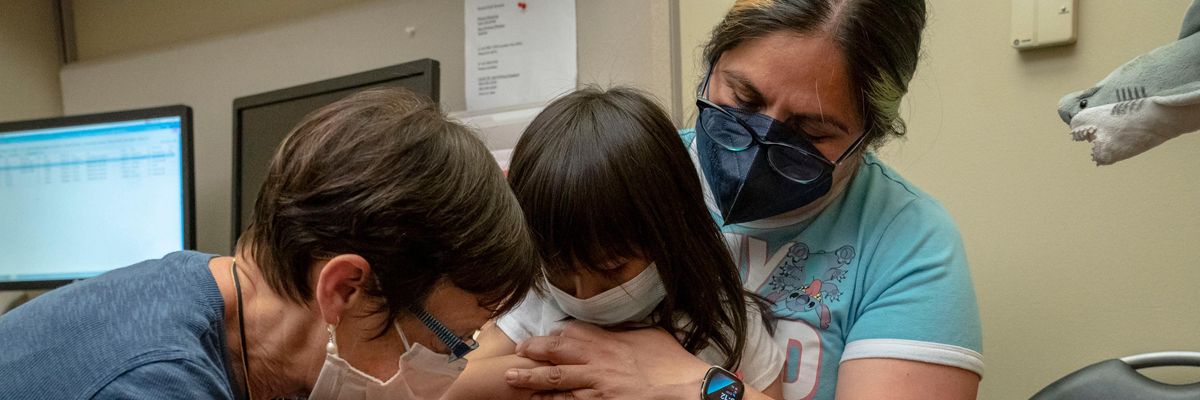
A two-year-old receives her first dose of the Pfizer Covid-19 vaccination from a nurse while being held by her mother at a medical center in Seattle, Washington on June 21, 2022. (Photo: David Ryder/Getty Images)
With congressional leadership expected to imminently release the text of omnibus government funding legislation, Politico revealed Monday that Democrats are preparing to join with Republicans who have demanded an end to Medicaid policies enacted because of the Covid-19 pandemic.
As part of pandemic relief legislation passed in 2020, Congress boosted Medicaid funding to states but imposed a "continuous coverage" requirement, barring them from cutting off most enrollees from the government healthcare program until after the public health emergency (PHE) officially ends.
Citing four unnamed sources familiar with talks, Politico reported that while the nonpartisan Congressional Budget Office expects the PHE to expire next July, "lawmakers have struck an agreement to move the end of its Medicaid rules up to April 1, which would allow states to begin removing people from the rolls who no longer qualify, usually because their income has increased."
As Common Dreams has reported amid mounting calls from Republicans for President Joe Biden to end the PHE, rolling back the pandemic-era healthcare policies could cause millions of people to lose coverage--despite fears of high cases of Covid-19 and other viruses going into the winter holidays.
"We are decoupling the Medicaid continuous eligibility policy from the public health emergency. We are not ending the PHE," a Capitol Hill source close to the negotiations told Politico. "We're providing certainty to states and giving them a gradual stream of funding and guardrail requirements that protect people. This is something both Democratic and Republican states asked for so that the 90 million people enrolled in Medicaid can be given certainty and protected during this massive undertaking."
According to the news outlet:
Under the tentative deal, much of the money saved would go to two Medicaid policies Democrats have long sought: a year of postpartum coverage for low-income moms in states that don't already offer it and a year of continuous coverage provisions for children at risk of losing health insurance.
[...]
With Republicans set to take control of [the] House in January, Democrats see the move as the best and possibly last chance to fund some of their top health priorities, including policies that address the country's worsening rates of maternal mortality that were left out of other packages passed this year.
Senate Majority Leader Chuck Schumer (D-N.Y.) did not address the potential provision while speaking about the package on the chamber's floor Monday.
"Appropriators are racing around the clock to finish the last major item on our to-do list for 2022: an omnibus package that will keep the government funded into next fall," he said in part. "We all know the omnibus will be the best way to ensure that our kids, our veterans, our small businesses, and our military continue to have full access to vital services and programs they depend on. It's not going to be everything anybody wants, that's for sure, but it's far preferable to a [continuing resolution], which will leave the country high and dry, and it's certainly preferable to a government shutdown."
The pending deal on Medicaid drew criticism from some policy experts and progressives.
"Umm. Why would we do that?" organizer Melissa Byrne tweeted in response to the reporting. "Keep the Medicaid rules until we get Medicare for All."
Dear Common Dreams reader, It’s been nearly 30 years since I co-founded Common Dreams with my late wife, Lina Newhouser. We had the radical notion that journalism should serve the public good, not corporate profits. It was clear to us from the outset what it would take to build such a project. No paid advertisements. No corporate sponsors. No millionaire publisher telling us what to think or do. Many people said we wouldn't last a year, but we proved those doubters wrong. Together with a tremendous team of journalists and dedicated staff, we built an independent media outlet free from the constraints of profits and corporate control. Our mission has always been simple: To inform. To inspire. To ignite change for the common good. Building Common Dreams was not easy. Our survival was never guaranteed. When you take on the most powerful forces—Wall Street greed, fossil fuel industry destruction, Big Tech lobbyists, and uber-rich oligarchs who have spent billions upon billions rigging the economy and democracy in their favor—the only bulwark you have is supporters who believe in your work. But here’s the urgent message from me today. It's never been this bad out there. And it's never been this hard to keep us going. At the very moment Common Dreams is most needed, the threats we face are intensifying. We need your support now more than ever. We don't accept corporate advertising and never will. We don't have a paywall because we don't think people should be blocked from critical news based on their ability to pay. Everything we do is funded by the donations of readers like you. When everyone does the little they can afford, we are strong. But if that support retreats or dries up, so do we. Will you donate now to make sure Common Dreams not only survives but thrives? —Craig Brown, Co-founder |
With congressional leadership expected to imminently release the text of omnibus government funding legislation, Politico revealed Monday that Democrats are preparing to join with Republicans who have demanded an end to Medicaid policies enacted because of the Covid-19 pandemic.
As part of pandemic relief legislation passed in 2020, Congress boosted Medicaid funding to states but imposed a "continuous coverage" requirement, barring them from cutting off most enrollees from the government healthcare program until after the public health emergency (PHE) officially ends.
Citing four unnamed sources familiar with talks, Politico reported that while the nonpartisan Congressional Budget Office expects the PHE to expire next July, "lawmakers have struck an agreement to move the end of its Medicaid rules up to April 1, which would allow states to begin removing people from the rolls who no longer qualify, usually because their income has increased."
As Common Dreams has reported amid mounting calls from Republicans for President Joe Biden to end the PHE, rolling back the pandemic-era healthcare policies could cause millions of people to lose coverage--despite fears of high cases of Covid-19 and other viruses going into the winter holidays.
"We are decoupling the Medicaid continuous eligibility policy from the public health emergency. We are not ending the PHE," a Capitol Hill source close to the negotiations told Politico. "We're providing certainty to states and giving them a gradual stream of funding and guardrail requirements that protect people. This is something both Democratic and Republican states asked for so that the 90 million people enrolled in Medicaid can be given certainty and protected during this massive undertaking."
According to the news outlet:
Under the tentative deal, much of the money saved would go to two Medicaid policies Democrats have long sought: a year of postpartum coverage for low-income moms in states that don't already offer it and a year of continuous coverage provisions for children at risk of losing health insurance.
[...]
With Republicans set to take control of [the] House in January, Democrats see the move as the best and possibly last chance to fund some of their top health priorities, including policies that address the country's worsening rates of maternal mortality that were left out of other packages passed this year.
Senate Majority Leader Chuck Schumer (D-N.Y.) did not address the potential provision while speaking about the package on the chamber's floor Monday.
"Appropriators are racing around the clock to finish the last major item on our to-do list for 2022: an omnibus package that will keep the government funded into next fall," he said in part. "We all know the omnibus will be the best way to ensure that our kids, our veterans, our small businesses, and our military continue to have full access to vital services and programs they depend on. It's not going to be everything anybody wants, that's for sure, but it's far preferable to a [continuing resolution], which will leave the country high and dry, and it's certainly preferable to a government shutdown."
The pending deal on Medicaid drew criticism from some policy experts and progressives.
"Umm. Why would we do that?" organizer Melissa Byrne tweeted in response to the reporting. "Keep the Medicaid rules until we get Medicare for All."
With congressional leadership expected to imminently release the text of omnibus government funding legislation, Politico revealed Monday that Democrats are preparing to join with Republicans who have demanded an end to Medicaid policies enacted because of the Covid-19 pandemic.
As part of pandemic relief legislation passed in 2020, Congress boosted Medicaid funding to states but imposed a "continuous coverage" requirement, barring them from cutting off most enrollees from the government healthcare program until after the public health emergency (PHE) officially ends.
Citing four unnamed sources familiar with talks, Politico reported that while the nonpartisan Congressional Budget Office expects the PHE to expire next July, "lawmakers have struck an agreement to move the end of its Medicaid rules up to April 1, which would allow states to begin removing people from the rolls who no longer qualify, usually because their income has increased."
As Common Dreams has reported amid mounting calls from Republicans for President Joe Biden to end the PHE, rolling back the pandemic-era healthcare policies could cause millions of people to lose coverage--despite fears of high cases of Covid-19 and other viruses going into the winter holidays.
"We are decoupling the Medicaid continuous eligibility policy from the public health emergency. We are not ending the PHE," a Capitol Hill source close to the negotiations told Politico. "We're providing certainty to states and giving them a gradual stream of funding and guardrail requirements that protect people. This is something both Democratic and Republican states asked for so that the 90 million people enrolled in Medicaid can be given certainty and protected during this massive undertaking."
According to the news outlet:
Under the tentative deal, much of the money saved would go to two Medicaid policies Democrats have long sought: a year of postpartum coverage for low-income moms in states that don't already offer it and a year of continuous coverage provisions for children at risk of losing health insurance.
[...]
With Republicans set to take control of [the] House in January, Democrats see the move as the best and possibly last chance to fund some of their top health priorities, including policies that address the country's worsening rates of maternal mortality that were left out of other packages passed this year.
Senate Majority Leader Chuck Schumer (D-N.Y.) did not address the potential provision while speaking about the package on the chamber's floor Monday.
"Appropriators are racing around the clock to finish the last major item on our to-do list for 2022: an omnibus package that will keep the government funded into next fall," he said in part. "We all know the omnibus will be the best way to ensure that our kids, our veterans, our small businesses, and our military continue to have full access to vital services and programs they depend on. It's not going to be everything anybody wants, that's for sure, but it's far preferable to a [continuing resolution], which will leave the country high and dry, and it's certainly preferable to a government shutdown."
The pending deal on Medicaid drew criticism from some policy experts and progressives.
"Umm. Why would we do that?" organizer Melissa Byrne tweeted in response to the reporting. "Keep the Medicaid rules until we get Medicare for All."