SUBSCRIBE TO OUR FREE NEWSLETTER
Daily news & progressive opinion—funded by the people, not the corporations—delivered straight to your inbox.
5
#000000
#FFFFFF
To donate by check, phone, or other method, see our More Ways to Give page.
Daily news & progressive opinion—funded by the people, not the corporations—delivered straight to your inbox.
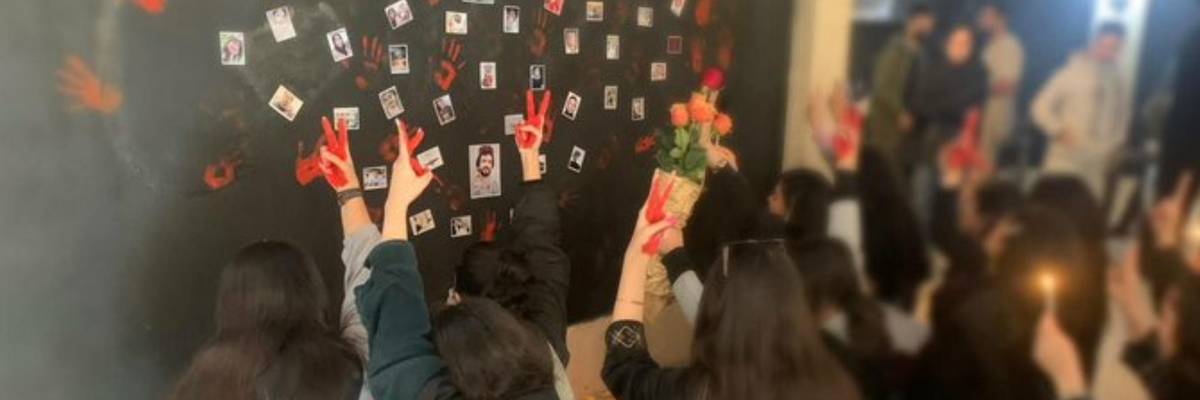
Students of the University of Science and Culture in Tehran, their faces blurred to protect their identities, hold a November 13, 2022 ceremony in memory of those killed by the regime in recent protests. (Photo: @Mojahedineng/Twitter)
Demonstrations against Iran's authoritarian regime continued for the 58th straight day Sunday despite the rising number of people killed by state forces and the Iranian parliament's recent vote to execute protesters.
"The Iranian parliament is so disconnected from its people that it would rather kill them instead of hearing their legitimate concerns."
Omid Memarian, an Iranian journalist and communications director at Democracy for the Arab World Now, reports hundreds of people gathered Sunday in small groups outside Dey Hospital in Tehran, where dissident blogger Hossein Ronaghi was transported after his health dangerously deteriorated during a 50-day hunger strike at the capital's notorious Evin Prison.
Ronaghi's relatives told London-based Iran International that Hossein's jailers tortured him--including by breaking both of his legs--and have withheld proper medical care since his arrest, despite serious medical conditions including partial kidney failure.
Video posted on social media by Memarian also showed motorists honking their horns and shouting Ronaghi's name. Other acts of defiance captured on video include a schoolgirl without the mandatory hijab headscarf knocking the turban from the head of a Shi'a cleric, a young woman defiantly waving her hijab on a freeway overpass, numerous demonstrations at universities and other schools, and several Iranian sports teams protesting during the playing of their national anthem.
On Saturday, the Norway-based Iran Human Rights NGO (IHRNGO) said security forces have killed at least 326 people, including 25 women and 43 children, during the nationwide protests sparked by the September 16 death of Mahsa Amini, a 22-year-old Kurdish-Iranian woman arrested by Iran's morality police three days earlier and reportedly beaten for violating the fundamentalist theocracy's strict dress code.
IHRNGO said that "protesters have been killed in 22 provinces, with the most reported in Sistan and Baluchistan, Tehran, Mazandaran, Kurdistan, and Gilan, respectively."
More than 15,000 protesters have also reportedly been arrested since the start of the demonstrations.
Iranians have kept up their protests despite the deadly dangers--which now include the risk of execution following a vote by 227 of Iran's 290 members of parliament in favor of imposing possible death sentences on demonstrators in order to teach them a "hard lesson."
Among those sentenced to death in recent days for waging "war against God" is 27-year-old Kurdish rapper Saman Yasin.
"The Iranian parliament is so disconnected from its people that it would rather kill them instead of hearing their legitimate concerns," Vahid Razavi, an Iran-born American technology activist, told Common Dreams Sunday.
Human rights defenders sounded the alarm Friday that Zoreh Elahian, one of the lawmakers who voted to execute protesters, was visiting New York City for a meeting of the United Nations Commission on the Status of Women.
Iran currently sits on the 45-member commission, despite severely restricting women's rights.
"With the continuous repression of protests, many more indictments on charges carrying the death penalty and death sentences might soon be issued, and we fear that women and girls, who have been at the forefront of protests, and especially women human rights defenders, who have been arrested and jailed for demanding the end of systemic and systematic discriminatory laws, policies and practices might be particularly targeted," a group of U.N. experts said Friday.
"We urge Iranian authorities to stop using the death penalty as a tool to squash protests and reiterate our call to immediately release all protesters who have been arbitrarily deprived of their liberty for the sole reason of exercising their legitimate rights to freedom of opinion and expression, association, and peaceful assembly," the experts added, "and for their actions to promote and protect human rights and fundamental freedoms through peaceful means."
Dear Common Dreams reader, It’s been nearly 30 years since I co-founded Common Dreams with my late wife, Lina Newhouser. We had the radical notion that journalism should serve the public good, not corporate profits. It was clear to us from the outset what it would take to build such a project. No paid advertisements. No corporate sponsors. No millionaire publisher telling us what to think or do. Many people said we wouldn't last a year, but we proved those doubters wrong. Together with a tremendous team of journalists and dedicated staff, we built an independent media outlet free from the constraints of profits and corporate control. Our mission has always been simple: To inform. To inspire. To ignite change for the common good. Building Common Dreams was not easy. Our survival was never guaranteed. When you take on the most powerful forces—Wall Street greed, fossil fuel industry destruction, Big Tech lobbyists, and uber-rich oligarchs who have spent billions upon billions rigging the economy and democracy in their favor—the only bulwark you have is supporters who believe in your work. But here’s the urgent message from me today. It's never been this bad out there. And it's never been this hard to keep us going. At the very moment Common Dreams is most needed, the threats we face are intensifying. We need your support now more than ever. We don't accept corporate advertising and never will. We don't have a paywall because we don't think people should be blocked from critical news based on their ability to pay. Everything we do is funded by the donations of readers like you. When everyone does the little they can afford, we are strong. But if that support retreats or dries up, so do we. Will you donate now to make sure Common Dreams not only survives but thrives? —Craig Brown, Co-founder |
Demonstrations against Iran's authoritarian regime continued for the 58th straight day Sunday despite the rising number of people killed by state forces and the Iranian parliament's recent vote to execute protesters.
"The Iranian parliament is so disconnected from its people that it would rather kill them instead of hearing their legitimate concerns."
Omid Memarian, an Iranian journalist and communications director at Democracy for the Arab World Now, reports hundreds of people gathered Sunday in small groups outside Dey Hospital in Tehran, where dissident blogger Hossein Ronaghi was transported after his health dangerously deteriorated during a 50-day hunger strike at the capital's notorious Evin Prison.
Ronaghi's relatives told London-based Iran International that Hossein's jailers tortured him--including by breaking both of his legs--and have withheld proper medical care since his arrest, despite serious medical conditions including partial kidney failure.
Video posted on social media by Memarian also showed motorists honking their horns and shouting Ronaghi's name. Other acts of defiance captured on video include a schoolgirl without the mandatory hijab headscarf knocking the turban from the head of a Shi'a cleric, a young woman defiantly waving her hijab on a freeway overpass, numerous demonstrations at universities and other schools, and several Iranian sports teams protesting during the playing of their national anthem.
On Saturday, the Norway-based Iran Human Rights NGO (IHRNGO) said security forces have killed at least 326 people, including 25 women and 43 children, during the nationwide protests sparked by the September 16 death of Mahsa Amini, a 22-year-old Kurdish-Iranian woman arrested by Iran's morality police three days earlier and reportedly beaten for violating the fundamentalist theocracy's strict dress code.
IHRNGO said that "protesters have been killed in 22 provinces, with the most reported in Sistan and Baluchistan, Tehran, Mazandaran, Kurdistan, and Gilan, respectively."
More than 15,000 protesters have also reportedly been arrested since the start of the demonstrations.
Iranians have kept up their protests despite the deadly dangers--which now include the risk of execution following a vote by 227 of Iran's 290 members of parliament in favor of imposing possible death sentences on demonstrators in order to teach them a "hard lesson."
Among those sentenced to death in recent days for waging "war against God" is 27-year-old Kurdish rapper Saman Yasin.
"The Iranian parliament is so disconnected from its people that it would rather kill them instead of hearing their legitimate concerns," Vahid Razavi, an Iran-born American technology activist, told Common Dreams Sunday.
Human rights defenders sounded the alarm Friday that Zoreh Elahian, one of the lawmakers who voted to execute protesters, was visiting New York City for a meeting of the United Nations Commission on the Status of Women.
Iran currently sits on the 45-member commission, despite severely restricting women's rights.
"With the continuous repression of protests, many more indictments on charges carrying the death penalty and death sentences might soon be issued, and we fear that women and girls, who have been at the forefront of protests, and especially women human rights defenders, who have been arrested and jailed for demanding the end of systemic and systematic discriminatory laws, policies and practices might be particularly targeted," a group of U.N. experts said Friday.
"We urge Iranian authorities to stop using the death penalty as a tool to squash protests and reiterate our call to immediately release all protesters who have been arbitrarily deprived of their liberty for the sole reason of exercising their legitimate rights to freedom of opinion and expression, association, and peaceful assembly," the experts added, "and for their actions to promote and protect human rights and fundamental freedoms through peaceful means."
Demonstrations against Iran's authoritarian regime continued for the 58th straight day Sunday despite the rising number of people killed by state forces and the Iranian parliament's recent vote to execute protesters.
"The Iranian parliament is so disconnected from its people that it would rather kill them instead of hearing their legitimate concerns."
Omid Memarian, an Iranian journalist and communications director at Democracy for the Arab World Now, reports hundreds of people gathered Sunday in small groups outside Dey Hospital in Tehran, where dissident blogger Hossein Ronaghi was transported after his health dangerously deteriorated during a 50-day hunger strike at the capital's notorious Evin Prison.
Ronaghi's relatives told London-based Iran International that Hossein's jailers tortured him--including by breaking both of his legs--and have withheld proper medical care since his arrest, despite serious medical conditions including partial kidney failure.
Video posted on social media by Memarian also showed motorists honking their horns and shouting Ronaghi's name. Other acts of defiance captured on video include a schoolgirl without the mandatory hijab headscarf knocking the turban from the head of a Shi'a cleric, a young woman defiantly waving her hijab on a freeway overpass, numerous demonstrations at universities and other schools, and several Iranian sports teams protesting during the playing of their national anthem.
On Saturday, the Norway-based Iran Human Rights NGO (IHRNGO) said security forces have killed at least 326 people, including 25 women and 43 children, during the nationwide protests sparked by the September 16 death of Mahsa Amini, a 22-year-old Kurdish-Iranian woman arrested by Iran's morality police three days earlier and reportedly beaten for violating the fundamentalist theocracy's strict dress code.
IHRNGO said that "protesters have been killed in 22 provinces, with the most reported in Sistan and Baluchistan, Tehran, Mazandaran, Kurdistan, and Gilan, respectively."
More than 15,000 protesters have also reportedly been arrested since the start of the demonstrations.
Iranians have kept up their protests despite the deadly dangers--which now include the risk of execution following a vote by 227 of Iran's 290 members of parliament in favor of imposing possible death sentences on demonstrators in order to teach them a "hard lesson."
Among those sentenced to death in recent days for waging "war against God" is 27-year-old Kurdish rapper Saman Yasin.
"The Iranian parliament is so disconnected from its people that it would rather kill them instead of hearing their legitimate concerns," Vahid Razavi, an Iran-born American technology activist, told Common Dreams Sunday.
Human rights defenders sounded the alarm Friday that Zoreh Elahian, one of the lawmakers who voted to execute protesters, was visiting New York City for a meeting of the United Nations Commission on the Status of Women.
Iran currently sits on the 45-member commission, despite severely restricting women's rights.
"With the continuous repression of protests, many more indictments on charges carrying the death penalty and death sentences might soon be issued, and we fear that women and girls, who have been at the forefront of protests, and especially women human rights defenders, who have been arrested and jailed for demanding the end of systemic and systematic discriminatory laws, policies and practices might be particularly targeted," a group of U.N. experts said Friday.
"We urge Iranian authorities to stop using the death penalty as a tool to squash protests and reiterate our call to immediately release all protesters who have been arbitrarily deprived of their liberty for the sole reason of exercising their legitimate rights to freedom of opinion and expression, association, and peaceful assembly," the experts added, "and for their actions to promote and protect human rights and fundamental freedoms through peaceful means."