SUBSCRIBE TO OUR FREE NEWSLETTER
Daily news & progressive opinion—funded by the people, not the corporations—delivered straight to your inbox.
5
#000000
#FFFFFF
To donate by check, phone, or other method, see our More Ways to Give page.
Daily news & progressive opinion—funded by the people, not the corporations—delivered straight to your inbox.
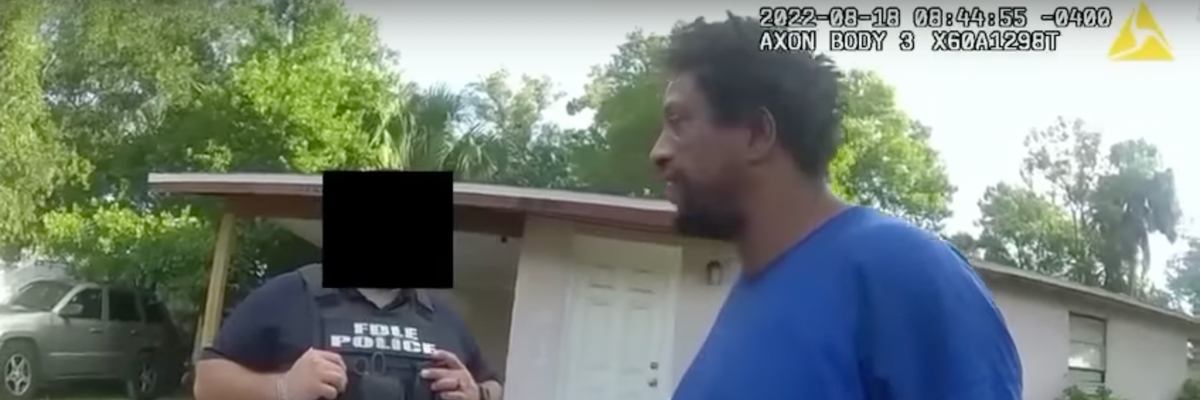
A police officer tells Tony Patterson (right) he is being arrested for alleged "voter fraud" on August 18, 2022 in Tampa, Florida. (Image: screenshot/Tampa Bay Times)
Never-before-seen police body camera footage released on Tuesday reveals that Florida Gov. Ron DeSantis' efforts to punish Florida residents for alleged "voter fraud" is targeting not "scheming fraudsters," as one journalist said, but people who were led to believe they were legally allowed to vote.
Through public records requests, the Tampa Bay Times obtained several videos of arrests of people who were accused of voting illegally by DeSantis' new Office of Election Crimes and Security, which was established earlier this year.
The videos show arrests made on August 18, shortly before DeSantis spoke publicly about the new law enforcement office, which operates under the Florida State Department and works with state and local police officers.
Police in the Tampa area arrested 19 people, including 13 Black residents and 12 registered Democrats.
The people said they had been led to believe they were legally allowed to vote when they cast ballots in recent years, following Florida residents' overwhelming approval of a voting rights referendum in 2018.
The passage of the referendum meant that voting rights were restored to 1.4 million people with past felony convictions, but the law excluded people who were convicted of sex offenses or murder.
"The prosecutions will not hold up. But that wasn't the point."
That exclusion was not explained on the voter registration forms signed by the people shown in the newly released body camera footage, including Tony Patterson, Romona Oliver, and Nathan Hart.
"Voter fraud?" asked Patterson as the officers explained they had a warrant for his arrest. "Y'all said anybody with a felony could vote, man."
According to the Times, Oliver, who served 18 years in prison for second-degree murder, filled out both a voter registration form and a change-of-address form in 2020 before voting, and the forms were reviewed by the State Department before she was given a voter ID.
State registration forms require voters to swear that they have not been convicted of a felony or that their voting rights have been restored, but they do not clarify that people convicted of certain crimes are not eligible for restored rights.
Hart told officers that he had questioned a Department of Motor Vehicles employee when they urged him to register to vote, and had told the person, "I'm a convicted felon, I'm pretty sure I can't."
"He said, 'Well, just fill out this form, and if they let you vote, then you can,'" Hart said as he was handcuffed. "'If they don't, then you can't.'"
No one stopped him from voting in 2020, yet DeSantis' Office of Election Crimes and Security investigated him and issued a warrant for his arrest nearly two years later.
The videos offer "an incredible look at the gulf between the voter fraud rhetoric of politicians and reality," tweeted Buzzfeed reporter Paul McLeod.
Mark Rankin, an attorney for Oliver, told the Times he believed DeSantis' office targeted people with past felonies so the governor could announce the arrests at a later press conference and claim his administration was cracking down on convicted criminals.
"That's a political strategy," Rankin told the Times.
The police officers in the videos appeared to be nearly as bewildered as the people they were arresting, with one telling Hart that he had a clear "defense" because he hadn't known he was not eligible to vote.
As the Times reported, prosecutors have already declined to bring charges against six people convicted of sex offenses because they could not prove that they "willfully" broke the law--a standard set by Florida's voting laws.
Although the people who were arrested on August 18 are unlikely to be found guilty of a crime, suggested civil rights attorney Sherrilyn Ifill, the damage DeSantis intended to do has likely been done.
"The prosecutions will not hold up," said Ifill. "But that wasn't the point."
Dear Common Dreams reader, It’s been nearly 30 years since I co-founded Common Dreams with my late wife, Lina Newhouser. We had the radical notion that journalism should serve the public good, not corporate profits. It was clear to us from the outset what it would take to build such a project. No paid advertisements. No corporate sponsors. No millionaire publisher telling us what to think or do. Many people said we wouldn't last a year, but we proved those doubters wrong. Together with a tremendous team of journalists and dedicated staff, we built an independent media outlet free from the constraints of profits and corporate control. Our mission has always been simple: To inform. To inspire. To ignite change for the common good. Building Common Dreams was not easy. Our survival was never guaranteed. When you take on the most powerful forces—Wall Street greed, fossil fuel industry destruction, Big Tech lobbyists, and uber-rich oligarchs who have spent billions upon billions rigging the economy and democracy in their favor—the only bulwark you have is supporters who believe in your work. But here’s the urgent message from me today. It's never been this bad out there. And it's never been this hard to keep us going. At the very moment Common Dreams is most needed, the threats we face are intensifying. We need your support now more than ever. We don't accept corporate advertising and never will. We don't have a paywall because we don't think people should be blocked from critical news based on their ability to pay. Everything we do is funded by the donations of readers like you. When everyone does the little they can afford, we are strong. But if that support retreats or dries up, so do we. Will you donate now to make sure Common Dreams not only survives but thrives? —Craig Brown, Co-founder |
Never-before-seen police body camera footage released on Tuesday reveals that Florida Gov. Ron DeSantis' efforts to punish Florida residents for alleged "voter fraud" is targeting not "scheming fraudsters," as one journalist said, but people who were led to believe they were legally allowed to vote.
Through public records requests, the Tampa Bay Times obtained several videos of arrests of people who were accused of voting illegally by DeSantis' new Office of Election Crimes and Security, which was established earlier this year.
The videos show arrests made on August 18, shortly before DeSantis spoke publicly about the new law enforcement office, which operates under the Florida State Department and works with state and local police officers.
Police in the Tampa area arrested 19 people, including 13 Black residents and 12 registered Democrats.
The people said they had been led to believe they were legally allowed to vote when they cast ballots in recent years, following Florida residents' overwhelming approval of a voting rights referendum in 2018.
The passage of the referendum meant that voting rights were restored to 1.4 million people with past felony convictions, but the law excluded people who were convicted of sex offenses or murder.
"The prosecutions will not hold up. But that wasn't the point."
That exclusion was not explained on the voter registration forms signed by the people shown in the newly released body camera footage, including Tony Patterson, Romona Oliver, and Nathan Hart.
"Voter fraud?" asked Patterson as the officers explained they had a warrant for his arrest. "Y'all said anybody with a felony could vote, man."
According to the Times, Oliver, who served 18 years in prison for second-degree murder, filled out both a voter registration form and a change-of-address form in 2020 before voting, and the forms were reviewed by the State Department before she was given a voter ID.
State registration forms require voters to swear that they have not been convicted of a felony or that their voting rights have been restored, but they do not clarify that people convicted of certain crimes are not eligible for restored rights.
Hart told officers that he had questioned a Department of Motor Vehicles employee when they urged him to register to vote, and had told the person, "I'm a convicted felon, I'm pretty sure I can't."
"He said, 'Well, just fill out this form, and if they let you vote, then you can,'" Hart said as he was handcuffed. "'If they don't, then you can't.'"
No one stopped him from voting in 2020, yet DeSantis' Office of Election Crimes and Security investigated him and issued a warrant for his arrest nearly two years later.
The videos offer "an incredible look at the gulf between the voter fraud rhetoric of politicians and reality," tweeted Buzzfeed reporter Paul McLeod.
Mark Rankin, an attorney for Oliver, told the Times he believed DeSantis' office targeted people with past felonies so the governor could announce the arrests at a later press conference and claim his administration was cracking down on convicted criminals.
"That's a political strategy," Rankin told the Times.
The police officers in the videos appeared to be nearly as bewildered as the people they were arresting, with one telling Hart that he had a clear "defense" because he hadn't known he was not eligible to vote.
As the Times reported, prosecutors have already declined to bring charges against six people convicted of sex offenses because they could not prove that they "willfully" broke the law--a standard set by Florida's voting laws.
Although the people who were arrested on August 18 are unlikely to be found guilty of a crime, suggested civil rights attorney Sherrilyn Ifill, the damage DeSantis intended to do has likely been done.
"The prosecutions will not hold up," said Ifill. "But that wasn't the point."
Never-before-seen police body camera footage released on Tuesday reveals that Florida Gov. Ron DeSantis' efforts to punish Florida residents for alleged "voter fraud" is targeting not "scheming fraudsters," as one journalist said, but people who were led to believe they were legally allowed to vote.
Through public records requests, the Tampa Bay Times obtained several videos of arrests of people who were accused of voting illegally by DeSantis' new Office of Election Crimes and Security, which was established earlier this year.
The videos show arrests made on August 18, shortly before DeSantis spoke publicly about the new law enforcement office, which operates under the Florida State Department and works with state and local police officers.
Police in the Tampa area arrested 19 people, including 13 Black residents and 12 registered Democrats.
The people said they had been led to believe they were legally allowed to vote when they cast ballots in recent years, following Florida residents' overwhelming approval of a voting rights referendum in 2018.
The passage of the referendum meant that voting rights were restored to 1.4 million people with past felony convictions, but the law excluded people who were convicted of sex offenses or murder.
"The prosecutions will not hold up. But that wasn't the point."
That exclusion was not explained on the voter registration forms signed by the people shown in the newly released body camera footage, including Tony Patterson, Romona Oliver, and Nathan Hart.
"Voter fraud?" asked Patterson as the officers explained they had a warrant for his arrest. "Y'all said anybody with a felony could vote, man."
According to the Times, Oliver, who served 18 years in prison for second-degree murder, filled out both a voter registration form and a change-of-address form in 2020 before voting, and the forms were reviewed by the State Department before she was given a voter ID.
State registration forms require voters to swear that they have not been convicted of a felony or that their voting rights have been restored, but they do not clarify that people convicted of certain crimes are not eligible for restored rights.
Hart told officers that he had questioned a Department of Motor Vehicles employee when they urged him to register to vote, and had told the person, "I'm a convicted felon, I'm pretty sure I can't."
"He said, 'Well, just fill out this form, and if they let you vote, then you can,'" Hart said as he was handcuffed. "'If they don't, then you can't.'"
No one stopped him from voting in 2020, yet DeSantis' Office of Election Crimes and Security investigated him and issued a warrant for his arrest nearly two years later.
The videos offer "an incredible look at the gulf between the voter fraud rhetoric of politicians and reality," tweeted Buzzfeed reporter Paul McLeod.
Mark Rankin, an attorney for Oliver, told the Times he believed DeSantis' office targeted people with past felonies so the governor could announce the arrests at a later press conference and claim his administration was cracking down on convicted criminals.
"That's a political strategy," Rankin told the Times.
The police officers in the videos appeared to be nearly as bewildered as the people they were arresting, with one telling Hart that he had a clear "defense" because he hadn't known he was not eligible to vote.
As the Times reported, prosecutors have already declined to bring charges against six people convicted of sex offenses because they could not prove that they "willfully" broke the law--a standard set by Florida's voting laws.
Although the people who were arrested on August 18 are unlikely to be found guilty of a crime, suggested civil rights attorney Sherrilyn Ifill, the damage DeSantis intended to do has likely been done.
"The prosecutions will not hold up," said Ifill. "But that wasn't the point."