SUBSCRIBE TO OUR FREE NEWSLETTER
Daily news & progressive opinion—funded by the people, not the corporations—delivered straight to your inbox.
5
#000000
#FFFFFF
To donate by check, phone, or other method, see our More Ways to Give page.
Daily news & progressive opinion—funded by the people, not the corporations—delivered straight to your inbox.
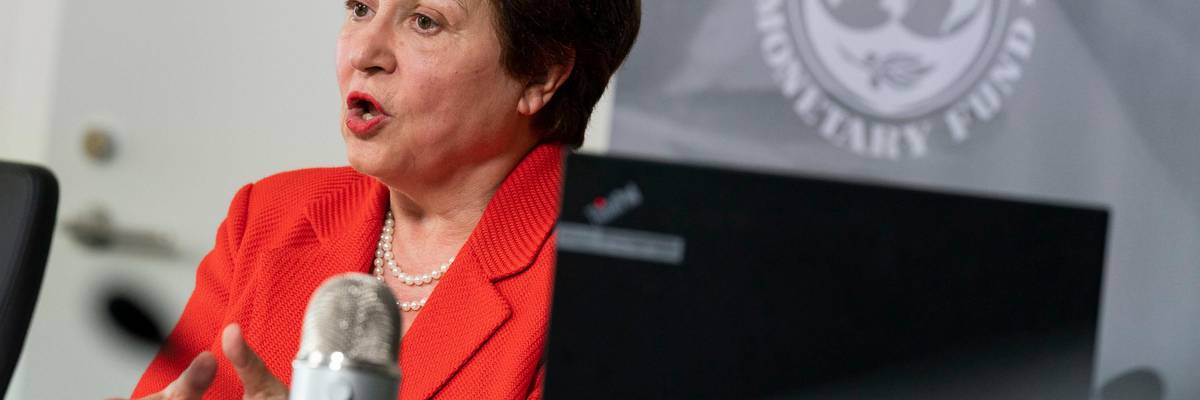
International Monetary Fund managing director Kristalina Georgieva speaks at the IMF Women's Forum on July 29, 2020 in Washington, D.C.
With the world's three largest economies slowing down, said the IMF managing director, economic conditions will "feel like recession for hundreds of millions of people" this year.
After numerous warnings in recent months from economists and economic justice advocates alike that repeated interest rate hikes could help send the world into a recession, the International Monetary Fund is warning that a third of the global economy will likely face a downturn in 2023.
With the world's three largest economies—the United States, European Union, and China—"all slowing down simultaneously," IMF Managing Director Kristalina Georgieva told CBS's "Face the Nation" Sunday, "even countries that are not in recession, it would feel like recession for hundreds of millions of people."
"It is likely that the world economy will face recession next year as a result of the rises in interest rates in response to higher inflation."
The IMF is currently projecting that the world economy will face its weakest year since 2001, excluding the beginning of the coronavirus pandemic in 2020 and the 2007-08 global financial crisis.
In October, the financial institution announced that global economic growth was projected to fall to 2.7% in 2023 as the war in Ukraine continues and central banks including the U.S. Federal Reserve repeatedly raise interest rates, as Chairman Jerome Powell has indicated the Fed will likely do once again in the coming months.
"It is likely that the world economy will face recession next year as a result of the rises in interest rates in response to higher inflation," Kay Daniel Neufeld, director and head of forecasting at the Center for Economics and Business Research (CEBR), told CNN last week.
Georgieva noted that the U.S.—as its central bank's actions increase debt burdens and cost-of-living crises in developing countries—may escape the worst of the global economic downturn, saying that "we see the labor market remaining quite strong" in the United States.
"This is... a mixed blessing because if the labor market is very strong, the Fed may have to keep interest rates tighter for longer to bring inflation down," she told CBS.
Research firm Capital Economics is forecasting a 90% chance that the U.S. will be in a recession in the next six months, saying that it is "likely to be mild," while Europe is expected to have "a larger downturn due to the huge hit to its terms of trade caused by the Ukraine war."
U.S. Sen. Elizabeth Warren (D-Mass.) is among the critics who have warned in recent months that the Federal Reserve risks throwing the U.S. into a recession if it continues hiking interest rates, which it last did in mid-December.
As a United Nations Conference on Trade and Development report released in October warned, "The current course of action is hurting the most vulnerable, especially in developing countries, and risks tipping the world into a global recession."
Dear Common Dreams reader, It’s been nearly 30 years since I co-founded Common Dreams with my late wife, Lina Newhouser. We had the radical notion that journalism should serve the public good, not corporate profits. It was clear to us from the outset what it would take to build such a project. No paid advertisements. No corporate sponsors. No millionaire publisher telling us what to think or do. Many people said we wouldn't last a year, but we proved those doubters wrong. Together with a tremendous team of journalists and dedicated staff, we built an independent media outlet free from the constraints of profits and corporate control. Our mission has always been simple: To inform. To inspire. To ignite change for the common good. Building Common Dreams was not easy. Our survival was never guaranteed. When you take on the most powerful forces—Wall Street greed, fossil fuel industry destruction, Big Tech lobbyists, and uber-rich oligarchs who have spent billions upon billions rigging the economy and democracy in their favor—the only bulwark you have is supporters who believe in your work. But here’s the urgent message from me today. It's never been this bad out there. And it's never been this hard to keep us going. At the very moment Common Dreams is most needed, the threats we face are intensifying. We need your support now more than ever. We don't accept corporate advertising and never will. We don't have a paywall because we don't think people should be blocked from critical news based on their ability to pay. Everything we do is funded by the donations of readers like you. When everyone does the little they can afford, we are strong. But if that support retreats or dries up, so do we. Will you donate now to make sure Common Dreams not only survives but thrives? —Craig Brown, Co-founder |
After numerous warnings in recent months from economists and economic justice advocates alike that repeated interest rate hikes could help send the world into a recession, the International Monetary Fund is warning that a third of the global economy will likely face a downturn in 2023.
With the world's three largest economies—the United States, European Union, and China—"all slowing down simultaneously," IMF Managing Director Kristalina Georgieva told CBS's "Face the Nation" Sunday, "even countries that are not in recession, it would feel like recession for hundreds of millions of people."
"It is likely that the world economy will face recession next year as a result of the rises in interest rates in response to higher inflation."
The IMF is currently projecting that the world economy will face its weakest year since 2001, excluding the beginning of the coronavirus pandemic in 2020 and the 2007-08 global financial crisis.
In October, the financial institution announced that global economic growth was projected to fall to 2.7% in 2023 as the war in Ukraine continues and central banks including the U.S. Federal Reserve repeatedly raise interest rates, as Chairman Jerome Powell has indicated the Fed will likely do once again in the coming months.
"It is likely that the world economy will face recession next year as a result of the rises in interest rates in response to higher inflation," Kay Daniel Neufeld, director and head of forecasting at the Center for Economics and Business Research (CEBR), told CNN last week.
Georgieva noted that the U.S.—as its central bank's actions increase debt burdens and cost-of-living crises in developing countries—may escape the worst of the global economic downturn, saying that "we see the labor market remaining quite strong" in the United States.
"This is... a mixed blessing because if the labor market is very strong, the Fed may have to keep interest rates tighter for longer to bring inflation down," she told CBS.
Research firm Capital Economics is forecasting a 90% chance that the U.S. will be in a recession in the next six months, saying that it is "likely to be mild," while Europe is expected to have "a larger downturn due to the huge hit to its terms of trade caused by the Ukraine war."
U.S. Sen. Elizabeth Warren (D-Mass.) is among the critics who have warned in recent months that the Federal Reserve risks throwing the U.S. into a recession if it continues hiking interest rates, which it last did in mid-December.
As a United Nations Conference on Trade and Development report released in October warned, "The current course of action is hurting the most vulnerable, especially in developing countries, and risks tipping the world into a global recession."
After numerous warnings in recent months from economists and economic justice advocates alike that repeated interest rate hikes could help send the world into a recession, the International Monetary Fund is warning that a third of the global economy will likely face a downturn in 2023.
With the world's three largest economies—the United States, European Union, and China—"all slowing down simultaneously," IMF Managing Director Kristalina Georgieva told CBS's "Face the Nation" Sunday, "even countries that are not in recession, it would feel like recession for hundreds of millions of people."
"It is likely that the world economy will face recession next year as a result of the rises in interest rates in response to higher inflation."
The IMF is currently projecting that the world economy will face its weakest year since 2001, excluding the beginning of the coronavirus pandemic in 2020 and the 2007-08 global financial crisis.
In October, the financial institution announced that global economic growth was projected to fall to 2.7% in 2023 as the war in Ukraine continues and central banks including the U.S. Federal Reserve repeatedly raise interest rates, as Chairman Jerome Powell has indicated the Fed will likely do once again in the coming months.
"It is likely that the world economy will face recession next year as a result of the rises in interest rates in response to higher inflation," Kay Daniel Neufeld, director and head of forecasting at the Center for Economics and Business Research (CEBR), told CNN last week.
Georgieva noted that the U.S.—as its central bank's actions increase debt burdens and cost-of-living crises in developing countries—may escape the worst of the global economic downturn, saying that "we see the labor market remaining quite strong" in the United States.
"This is... a mixed blessing because if the labor market is very strong, the Fed may have to keep interest rates tighter for longer to bring inflation down," she told CBS.
Research firm Capital Economics is forecasting a 90% chance that the U.S. will be in a recession in the next six months, saying that it is "likely to be mild," while Europe is expected to have "a larger downturn due to the huge hit to its terms of trade caused by the Ukraine war."
U.S. Sen. Elizabeth Warren (D-Mass.) is among the critics who have warned in recent months that the Federal Reserve risks throwing the U.S. into a recession if it continues hiking interest rates, which it last did in mid-December.
As a United Nations Conference on Trade and Development report released in October warned, "The current course of action is hurting the most vulnerable, especially in developing countries, and risks tipping the world into a global recession."