SUBSCRIBE TO OUR FREE NEWSLETTER
Daily news & progressive opinion—funded by the people, not the corporations—delivered straight to your inbox.
5
#000000
#FFFFFF
To donate by check, phone, or other method, see our More Ways to Give page.
Daily news & progressive opinion—funded by the people, not the corporations—delivered straight to your inbox.
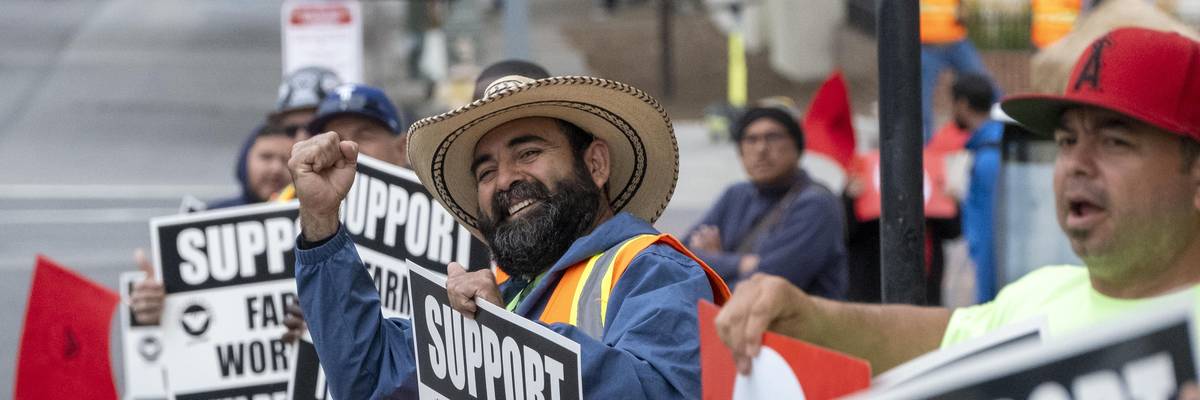
People rally for legislation that would ease farm union voting in Los Angeles on March 31, 2022. (Photo: Hans Gutknecht/MediaNews Group/Los Angeles Daily News via Getty Images)
After vetoing similar legislation last year and threatening to do so again last month, California Gov. Gavin Newsom on Wednesday signed Assembly Bill 2183 into law, making it easier for farmworkers in the state to participate in union elections.
"This victory belongs to every farmworker who marched and sacrificed."
The Democratic governor's about-face on the measure represents a major victory for labor leaders. It follows a monthslong push by United Farm Workers of America (UFW) and the California Labor Federation (CLF) and comes in the wake of pressure from President Joe Biden and two high-ranking national Democrats with California ties--Vice President Kamala Harris and House Speaker Nancy Pelosi.
"This is an incredible victory," said UFW president Teresa Romero. "Starting next year, farmworkers can participate in elections free from intimidation and deportations. !Si se puede!"
A.B. 2183, which the CLF called "the most consequential private sector organizing bill in our state's history," gives farmworkers a streamlined way to unionize without having to cast a ballot at a polling place on or near growers' property following a monthslong anti-union campaign.
Proponents say the newly enacted law, which contains several provisions aimed at preventing union-busting and was opposed by dozens of agriculture industry groups, will make it harder for bosses to subdue and retaliate against the workers who provide most of the nation's fruits and vegetables, many of whom are undocumented and fearful of being deported.
When California's Democratic-led Legislature approved the bill last month, Newsom's office expressed opposition. The governor only signed it after his administration, the CLF, and UFW "reached a 'supplemental agreement' on provisions that will be introduced in the next legislative session," the New York Times reported Wednesday.
According to the Associated Press: "The agreement includes a cap on the number of unionization petitions over the next five years and will allow state regulators to better protect worker confidentiality and safety, Newsom's office said. It would do away with an option for workers to unionize through mail-in voting that is contained in the current language, but keeps a 'card check' election process."
Under the revised law, farmworkers will still have the opportunity to "vote from home or anywhere else they feel comfortable," reducing the likelihood of employer intimidation, UFW legislative and political director Giev Kashkooli told the news outlet.
As the CLF explains:
Majority sign-up, or "card check," allows workers who want to join a union to sign a card authorizing the union to represent them in collective bargaining. If a majority of workers sign cards, the cards are submitted to the National Labor Relations Board (private sector) or the Public Employment Relations Board (public sector). If the Board finds that the majority of workers want a union, the union is entitled to recognition. In California, public sector employees already have the right to majority sign-up; all workers should be able to organize under this fair and democratic system.
In a video, Romero told those who led and supported the fight for free and fair union elections that "this is your victory."
"Every one of you who struggled and donated your time and your energy to get this done," said Romero. "Farmworkers organized and sacrificed to make their voices heard and to pass A.B. 2183."
Starting on August 3, as KCRA reported Wednesday, UFW members embarked on "a 24-day, 335-mile journey from Kern County, near Bakersfield, to the state capitol, a march that civil rights activist Cesar Chavez first led in 1966."
Although Newsom disappointed farmworkers by announcing near the end of their march that he "cannot support an untested mail-in election process," labor organizers around the state--with an assist from Biden and other top Democrats--continued to hold rallies and eventually won important reforms.
On social media, the CLF wrote: "This victory belongs to every farmworker who marched and sacrificed. It is shared with the whole California labor movement, who mobilized and stood in historic solidarity with the United Farm Workers. The fight of farmworkers is the fight for all of labor."
That message was echoed by Sara Nelson, president of the Association of Flight Attendants-CWA, who said that "this is what happens when we organize with urgency. Together, we can win."
The effort to secure free and fair union elections follows "years of dwindling union membership among California farmworkers," the Times noted. "There are more than 400,000 agricultural workers in the state," but the percentage who are unionized is "statistically zero," according to recent estimates based on data from a 2020 Bureau of Labor Statistics survey.
Organizing agricultural workers was made more difficult last year when the U.S. Supreme Court's far-right majority ruled that a California regulation granting union representatives access to farms amounted to an uncompensated government taking of farm owners' private property.
"In this historic time when workers want a union more than ever before, everything we do--including legislatively--must be focused on organizing," CLF chief officer Lorena Gonzalez Fletcher told the Times on Wednesday. "It's natural that in California, our farmworkers will be leading the way."
Also on Wednesday, Newsom signed A.B. 2530, which protects the healthcare benefits of striking workers. As Unite Here put it, the newly enacted law allows workers to "exercise their right to strike for better jobs without jeopardizing their families' access to care."
In a statement, Gonzalez Fletcher said, "Workers have the right to stand up to their boss and go on strike to improve wages, working conditions, and for a better life."
Dear Common Dreams reader, It’s been nearly 30 years since I co-founded Common Dreams with my late wife, Lina Newhouser. We had the radical notion that journalism should serve the public good, not corporate profits. It was clear to us from the outset what it would take to build such a project. No paid advertisements. No corporate sponsors. No millionaire publisher telling us what to think or do. Many people said we wouldn't last a year, but we proved those doubters wrong. Together with a tremendous team of journalists and dedicated staff, we built an independent media outlet free from the constraints of profits and corporate control. Our mission has always been simple: To inform. To inspire. To ignite change for the common good. Building Common Dreams was not easy. Our survival was never guaranteed. When you take on the most powerful forces—Wall Street greed, fossil fuel industry destruction, Big Tech lobbyists, and uber-rich oligarchs who have spent billions upon billions rigging the economy and democracy in their favor—the only bulwark you have is supporters who believe in your work. But here’s the urgent message from me today. It's never been this bad out there. And it's never been this hard to keep us going. At the very moment Common Dreams is most needed, the threats we face are intensifying. We need your support now more than ever. We don't accept corporate advertising and never will. We don't have a paywall because we don't think people should be blocked from critical news based on their ability to pay. Everything we do is funded by the donations of readers like you. When everyone does the little they can afford, we are strong. But if that support retreats or dries up, so do we. Will you donate now to make sure Common Dreams not only survives but thrives? —Craig Brown, Co-founder |
After vetoing similar legislation last year and threatening to do so again last month, California Gov. Gavin Newsom on Wednesday signed Assembly Bill 2183 into law, making it easier for farmworkers in the state to participate in union elections.
"This victory belongs to every farmworker who marched and sacrificed."
The Democratic governor's about-face on the measure represents a major victory for labor leaders. It follows a monthslong push by United Farm Workers of America (UFW) and the California Labor Federation (CLF) and comes in the wake of pressure from President Joe Biden and two high-ranking national Democrats with California ties--Vice President Kamala Harris and House Speaker Nancy Pelosi.
"This is an incredible victory," said UFW president Teresa Romero. "Starting next year, farmworkers can participate in elections free from intimidation and deportations. !Si se puede!"
A.B. 2183, which the CLF called "the most consequential private sector organizing bill in our state's history," gives farmworkers a streamlined way to unionize without having to cast a ballot at a polling place on or near growers' property following a monthslong anti-union campaign.
Proponents say the newly enacted law, which contains several provisions aimed at preventing union-busting and was opposed by dozens of agriculture industry groups, will make it harder for bosses to subdue and retaliate against the workers who provide most of the nation's fruits and vegetables, many of whom are undocumented and fearful of being deported.
When California's Democratic-led Legislature approved the bill last month, Newsom's office expressed opposition. The governor only signed it after his administration, the CLF, and UFW "reached a 'supplemental agreement' on provisions that will be introduced in the next legislative session," the New York Times reported Wednesday.
According to the Associated Press: "The agreement includes a cap on the number of unionization petitions over the next five years and will allow state regulators to better protect worker confidentiality and safety, Newsom's office said. It would do away with an option for workers to unionize through mail-in voting that is contained in the current language, but keeps a 'card check' election process."
Under the revised law, farmworkers will still have the opportunity to "vote from home or anywhere else they feel comfortable," reducing the likelihood of employer intimidation, UFW legislative and political director Giev Kashkooli told the news outlet.
As the CLF explains:
Majority sign-up, or "card check," allows workers who want to join a union to sign a card authorizing the union to represent them in collective bargaining. If a majority of workers sign cards, the cards are submitted to the National Labor Relations Board (private sector) or the Public Employment Relations Board (public sector). If the Board finds that the majority of workers want a union, the union is entitled to recognition. In California, public sector employees already have the right to majority sign-up; all workers should be able to organize under this fair and democratic system.
In a video, Romero told those who led and supported the fight for free and fair union elections that "this is your victory."
"Every one of you who struggled and donated your time and your energy to get this done," said Romero. "Farmworkers organized and sacrificed to make their voices heard and to pass A.B. 2183."
Starting on August 3, as KCRA reported Wednesday, UFW members embarked on "a 24-day, 335-mile journey from Kern County, near Bakersfield, to the state capitol, a march that civil rights activist Cesar Chavez first led in 1966."
Although Newsom disappointed farmworkers by announcing near the end of their march that he "cannot support an untested mail-in election process," labor organizers around the state--with an assist from Biden and other top Democrats--continued to hold rallies and eventually won important reforms.
On social media, the CLF wrote: "This victory belongs to every farmworker who marched and sacrificed. It is shared with the whole California labor movement, who mobilized and stood in historic solidarity with the United Farm Workers. The fight of farmworkers is the fight for all of labor."
That message was echoed by Sara Nelson, president of the Association of Flight Attendants-CWA, who said that "this is what happens when we organize with urgency. Together, we can win."
The effort to secure free and fair union elections follows "years of dwindling union membership among California farmworkers," the Times noted. "There are more than 400,000 agricultural workers in the state," but the percentage who are unionized is "statistically zero," according to recent estimates based on data from a 2020 Bureau of Labor Statistics survey.
Organizing agricultural workers was made more difficult last year when the U.S. Supreme Court's far-right majority ruled that a California regulation granting union representatives access to farms amounted to an uncompensated government taking of farm owners' private property.
"In this historic time when workers want a union more than ever before, everything we do--including legislatively--must be focused on organizing," CLF chief officer Lorena Gonzalez Fletcher told the Times on Wednesday. "It's natural that in California, our farmworkers will be leading the way."
Also on Wednesday, Newsom signed A.B. 2530, which protects the healthcare benefits of striking workers. As Unite Here put it, the newly enacted law allows workers to "exercise their right to strike for better jobs without jeopardizing their families' access to care."
In a statement, Gonzalez Fletcher said, "Workers have the right to stand up to their boss and go on strike to improve wages, working conditions, and for a better life."
After vetoing similar legislation last year and threatening to do so again last month, California Gov. Gavin Newsom on Wednesday signed Assembly Bill 2183 into law, making it easier for farmworkers in the state to participate in union elections.
"This victory belongs to every farmworker who marched and sacrificed."
The Democratic governor's about-face on the measure represents a major victory for labor leaders. It follows a monthslong push by United Farm Workers of America (UFW) and the California Labor Federation (CLF) and comes in the wake of pressure from President Joe Biden and two high-ranking national Democrats with California ties--Vice President Kamala Harris and House Speaker Nancy Pelosi.
"This is an incredible victory," said UFW president Teresa Romero. "Starting next year, farmworkers can participate in elections free from intimidation and deportations. !Si se puede!"
A.B. 2183, which the CLF called "the most consequential private sector organizing bill in our state's history," gives farmworkers a streamlined way to unionize without having to cast a ballot at a polling place on or near growers' property following a monthslong anti-union campaign.
Proponents say the newly enacted law, which contains several provisions aimed at preventing union-busting and was opposed by dozens of agriculture industry groups, will make it harder for bosses to subdue and retaliate against the workers who provide most of the nation's fruits and vegetables, many of whom are undocumented and fearful of being deported.
When California's Democratic-led Legislature approved the bill last month, Newsom's office expressed opposition. The governor only signed it after his administration, the CLF, and UFW "reached a 'supplemental agreement' on provisions that will be introduced in the next legislative session," the New York Times reported Wednesday.
According to the Associated Press: "The agreement includes a cap on the number of unionization petitions over the next five years and will allow state regulators to better protect worker confidentiality and safety, Newsom's office said. It would do away with an option for workers to unionize through mail-in voting that is contained in the current language, but keeps a 'card check' election process."
Under the revised law, farmworkers will still have the opportunity to "vote from home or anywhere else they feel comfortable," reducing the likelihood of employer intimidation, UFW legislative and political director Giev Kashkooli told the news outlet.
As the CLF explains:
Majority sign-up, or "card check," allows workers who want to join a union to sign a card authorizing the union to represent them in collective bargaining. If a majority of workers sign cards, the cards are submitted to the National Labor Relations Board (private sector) or the Public Employment Relations Board (public sector). If the Board finds that the majority of workers want a union, the union is entitled to recognition. In California, public sector employees already have the right to majority sign-up; all workers should be able to organize under this fair and democratic system.
In a video, Romero told those who led and supported the fight for free and fair union elections that "this is your victory."
"Every one of you who struggled and donated your time and your energy to get this done," said Romero. "Farmworkers organized and sacrificed to make their voices heard and to pass A.B. 2183."
Starting on August 3, as KCRA reported Wednesday, UFW members embarked on "a 24-day, 335-mile journey from Kern County, near Bakersfield, to the state capitol, a march that civil rights activist Cesar Chavez first led in 1966."
Although Newsom disappointed farmworkers by announcing near the end of their march that he "cannot support an untested mail-in election process," labor organizers around the state--with an assist from Biden and other top Democrats--continued to hold rallies and eventually won important reforms.
On social media, the CLF wrote: "This victory belongs to every farmworker who marched and sacrificed. It is shared with the whole California labor movement, who mobilized and stood in historic solidarity with the United Farm Workers. The fight of farmworkers is the fight for all of labor."
That message was echoed by Sara Nelson, president of the Association of Flight Attendants-CWA, who said that "this is what happens when we organize with urgency. Together, we can win."
The effort to secure free and fair union elections follows "years of dwindling union membership among California farmworkers," the Times noted. "There are more than 400,000 agricultural workers in the state," but the percentage who are unionized is "statistically zero," according to recent estimates based on data from a 2020 Bureau of Labor Statistics survey.
Organizing agricultural workers was made more difficult last year when the U.S. Supreme Court's far-right majority ruled that a California regulation granting union representatives access to farms amounted to an uncompensated government taking of farm owners' private property.
"In this historic time when workers want a union more than ever before, everything we do--including legislatively--must be focused on organizing," CLF chief officer Lorena Gonzalez Fletcher told the Times on Wednesday. "It's natural that in California, our farmworkers will be leading the way."
Also on Wednesday, Newsom signed A.B. 2530, which protects the healthcare benefits of striking workers. As Unite Here put it, the newly enacted law allows workers to "exercise their right to strike for better jobs without jeopardizing their families' access to care."
In a statement, Gonzalez Fletcher said, "Workers have the right to stand up to their boss and go on strike to improve wages, working conditions, and for a better life."