
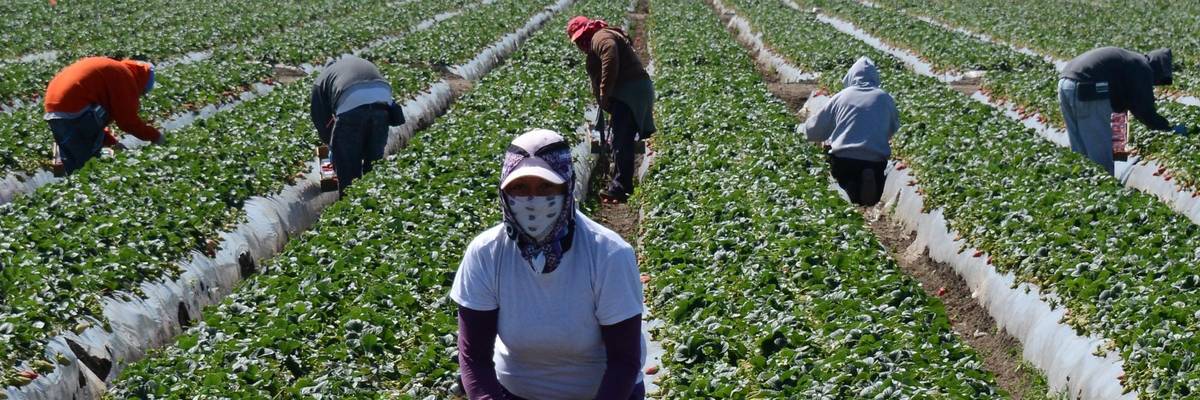
Farm workers harvest strawberries on March 13, 2013 near Oxnard, California. (Photo: Joe Klamar/AFP via Getty Images)
Right-Wing SCOTUS Majority Rules Union Organizing on Farms Violates Landowners' Rights
The Supreme Court "fails to balance a farmer's property rights with a farm worker's human rights," said United Farm Workers of America.
The U.S. Supreme Court on Wednesday dealt a significant blow to the rights of agricultural workers to organize, ruling 6-3 that a California regulation granting union representatives access to farms amounted to an uncompensated government taking of farm owners' private property.
"While Cedar Point is devastating for California agricultural workers, its impact on others workers may be minimal--but only because they already have so few rights on the job."
--Samir Sonti, CUNY
Wednesday's decision (pdf) in Cedar Point Nursery vs. Hassid "makes a racist, broken farm labor system even more unequal," said the United Farm Workers of America (UFW). "SCOTUS fails to balance a farmer's property rights with a farm worker's human rights."
"Farm workers are the hardest working people in America," UFW added. "This decision denies workers the right to use breaks to freely discuss whether they want to have a union."
Other critics of the ruling included Rep. Bill Pascrell (D-N.J.), who tweeted that the high court's right-wing majority, a product of the Republican Party's recent stacking of the bench, "has handed down another attack on organized labor in their long war against working Americans."
At issue was a California regulation that allows labor organizers to enter private farms to talk with farm workers during non-working times about joining a union.
Writing for the majority, Chief Justice John Roberts argued that "the access regulation grants labor organizations a right to invade the growers' property," which he characterized as an appropriation without just compensation.
The decision "expands the category of per se physical takings," said Jenny Breen, associate professor of law at Syracuse University, setting a judicial precedent with potentially profound consequences.
As Breen explained in an email to Common Dreams:
Government regulations that affect property rights are typically analyzed using a fact-oriented balancing test established by the court in the 1978 case Penn Central v. NYC. Instead of applying that test to the facts of this case, the court applied a separate line of cases regarding per se physical takings of private property by the government. That decision is perplexing given the obvious fact that the government did not physically take the property of the agricultural employers in the case, but merely gave agricultural employees the right to meet with union organizers at their place of work (during non-working times and in ways that did not interfere with work). The court applies the physical, per se takings line of cases because it concludes that the regulation "amounts to a simple appropriation of private property" because it limited the employers' "right to exclude."
The ruling has major implications, according to Steve Vladeck, the Charles Alan Wright Chair in Federal Courts at the University of Texas School of Law.
As a result of the decision, Vladeck said, "states cannot authorize unions (or anyone else) to enter private property, even for lawful activities (like union organizing) without compensating the property owners"--an additional cost the labor movement can ill afford.
Samir Sonti, assistant professor at the CUNY School of Labor and Urban Studies, described the decision as "an attack on California agricultural workers and their right to organize for better working conditions."
"The 1975 California Agricultural Labor Relations Act (CALRA) was a landmark victory for the UFW and others, which at least in one state confronted the historic injustice of farm worker exclusion from federal labor law," Sonti told Common Dreams. "That important law has now taken a major hit."
It is "a bit less clear" how the ruling will affect labor law more broadly, noted Sonti.
"Decades of precedents have already undermined the National Labor Relations Act (NLRA) as it pertains to union organizers' access to the workplace," he said. "Only under the most exceptional circumstances are private sector workers attempting to form a union able to speak to an organizer while on the employer's property."
"This decision does not bode well for the fate of labor regulations--or any other government regulations that could conceivably impact private property rights."
--Jenny Breen, Syracuse University
"While Cedar Point is devastating for California agricultural workers, its impact on others workers may be minimal--but only because they already have so few rights on the job," he added.
Sonti likened Wednesday's ruling to the 2018 Supreme Court decision in Janus vs. AFSCME, which held that public sector unions cannot collect so-called "fair share" fees that help unions represent all workers, including non-unionized ones. Both rulings, he told Common Dreams, constitute assaults on the labor movement and are geared toward "enshrining the race to the bottom" when it comes to worker rights.
In addition to undermining the CALRA, the Cedar Point decision has far-reaching constitutional ramifications. According to Vladeck, "It's not just a major loss for unions. It's a major win for property rights beyond labor cases."
Justice Stephen Breyer, in a dissenting opinion--which was joined by Justices Elena Kagan and Sonia Sotomayor--warned that "the majority's conclusion threatens to make many ordinary forms of regulation unusually complex or impractical."
Those concerns were shared by Breen, who criticized the high court for continuing "to assume that employers have nearly unfettered private property rights that are unaffected by the presence of workers on their property."
"One of the parties in this case, for example, employed between 1,800 to 3,000 employees," Breen told Common Dreams. "The rights of those workers to have access to union organizers--the basis of the regulation in the first place--played no role in the court's decision today."
She continued:
Employers continue to wield property rights as forms of their "sole and despotic dominion" (in the words of Blackstone, quoted approvingly by the court) over their employees, with no meaningful check by the court. It is truly incredible that the court interprets a regulation impacting a workplace employing thousands of workers in the same manner it would interpret a regulation impacting your backyard. There is no justification for such an extreme commitment to ignoring reality.
Furthermore, Breen added, the court's interpretation of constitutional language, which she said "imports absolutist views of common law rights," jeopardizes the legality of long-standing regulations protecting occupational health and safety.
"This decision does not bode well for the fate of labor regulations--or any other government regulations that could conceivably impact private property rights--in future cases to reach this court," said Breen, who warned of a return to the Lochner era, a pre-New Deal period when the Supreme Court routinely shot down regulations and defended employers' right to exploit workers without state interference.
We are at a crossroads
This country and this world are at a monumental crossroads. In a few short weeks, US voters will have an opportunity to beat back the forces of fascism and confront the billionaires who are rigging the economy, our media system, and our democracy, making it increasingly impossible for ordinary people to get by. We’re not just talking about the election. We’re talking about what must be done once these fascist elements are vanquished from power. We need a bolder set of solutions than what either major party has so far been willing to offer and a working-class movement ready to fight like hell for it. Trump didn't emerge from nowhere. The conditions that fueled MAGA authoritarianism were created by decades of radical neoliberal economic policies and a corrupt political system dominated by corporate interests. They slashed taxes on the super-rich, promising that the benefits would trickle down. They said giveaways to the corporate titans would make life more affordable for the rest of us. It was all bullshit. And when a bitter, betrayed populace searches for someone to blame, right-wing demagogues have little trouble finding scapegoats. People know when they're being lied to, but you won't hear any of this from the corporate media. Only independent journalism—powered and funded by people who believe in building a better world—can deliver truly trustworthy daily news. Our Fall Campaign is underway, and we need your help. To power our newsroom through the rest of the year, we need to raise $125,000 by midnight on October 31. So if you share our vision, please contribute whatever you can to sustain our work. |
The U.S. Supreme Court on Wednesday dealt a significant blow to the rights of agricultural workers to organize, ruling 6-3 that a California regulation granting union representatives access to farms amounted to an uncompensated government taking of farm owners' private property.
"While Cedar Point is devastating for California agricultural workers, its impact on others workers may be minimal--but only because they already have so few rights on the job."
--Samir Sonti, CUNY
Wednesday's decision (pdf) in Cedar Point Nursery vs. Hassid "makes a racist, broken farm labor system even more unequal," said the United Farm Workers of America (UFW). "SCOTUS fails to balance a farmer's property rights with a farm worker's human rights."
"Farm workers are the hardest working people in America," UFW added. "This decision denies workers the right to use breaks to freely discuss whether they want to have a union."
Other critics of the ruling included Rep. Bill Pascrell (D-N.J.), who tweeted that the high court's right-wing majority, a product of the Republican Party's recent stacking of the bench, "has handed down another attack on organized labor in their long war against working Americans."
At issue was a California regulation that allows labor organizers to enter private farms to talk with farm workers during non-working times about joining a union.
Writing for the majority, Chief Justice John Roberts argued that "the access regulation grants labor organizations a right to invade the growers' property," which he characterized as an appropriation without just compensation.
The decision "expands the category of per se physical takings," said Jenny Breen, associate professor of law at Syracuse University, setting a judicial precedent with potentially profound consequences.
As Breen explained in an email to Common Dreams:
Government regulations that affect property rights are typically analyzed using a fact-oriented balancing test established by the court in the 1978 case Penn Central v. NYC. Instead of applying that test to the facts of this case, the court applied a separate line of cases regarding per se physical takings of private property by the government. That decision is perplexing given the obvious fact that the government did not physically take the property of the agricultural employers in the case, but merely gave agricultural employees the right to meet with union organizers at their place of work (during non-working times and in ways that did not interfere with work). The court applies the physical, per se takings line of cases because it concludes that the regulation "amounts to a simple appropriation of private property" because it limited the employers' "right to exclude."
The ruling has major implications, according to Steve Vladeck, the Charles Alan Wright Chair in Federal Courts at the University of Texas School of Law.
As a result of the decision, Vladeck said, "states cannot authorize unions (or anyone else) to enter private property, even for lawful activities (like union organizing) without compensating the property owners"--an additional cost the labor movement can ill afford.
Samir Sonti, assistant professor at the CUNY School of Labor and Urban Studies, described the decision as "an attack on California agricultural workers and their right to organize for better working conditions."
"The 1975 California Agricultural Labor Relations Act (CALRA) was a landmark victory for the UFW and others, which at least in one state confronted the historic injustice of farm worker exclusion from federal labor law," Sonti told Common Dreams. "That important law has now taken a major hit."
It is "a bit less clear" how the ruling will affect labor law more broadly, noted Sonti.
"Decades of precedents have already undermined the National Labor Relations Act (NLRA) as it pertains to union organizers' access to the workplace," he said. "Only under the most exceptional circumstances are private sector workers attempting to form a union able to speak to an organizer while on the employer's property."
"This decision does not bode well for the fate of labor regulations--or any other government regulations that could conceivably impact private property rights."
--Jenny Breen, Syracuse University
"While Cedar Point is devastating for California agricultural workers, its impact on others workers may be minimal--but only because they already have so few rights on the job," he added.
Sonti likened Wednesday's ruling to the 2018 Supreme Court decision in Janus vs. AFSCME, which held that public sector unions cannot collect so-called "fair share" fees that help unions represent all workers, including non-unionized ones. Both rulings, he told Common Dreams, constitute assaults on the labor movement and are geared toward "enshrining the race to the bottom" when it comes to worker rights.
In addition to undermining the CALRA, the Cedar Point decision has far-reaching constitutional ramifications. According to Vladeck, "It's not just a major loss for unions. It's a major win for property rights beyond labor cases."
Justice Stephen Breyer, in a dissenting opinion--which was joined by Justices Elena Kagan and Sonia Sotomayor--warned that "the majority's conclusion threatens to make many ordinary forms of regulation unusually complex or impractical."
Those concerns were shared by Breen, who criticized the high court for continuing "to assume that employers have nearly unfettered private property rights that are unaffected by the presence of workers on their property."
"One of the parties in this case, for example, employed between 1,800 to 3,000 employees," Breen told Common Dreams. "The rights of those workers to have access to union organizers--the basis of the regulation in the first place--played no role in the court's decision today."
She continued:
Employers continue to wield property rights as forms of their "sole and despotic dominion" (in the words of Blackstone, quoted approvingly by the court) over their employees, with no meaningful check by the court. It is truly incredible that the court interprets a regulation impacting a workplace employing thousands of workers in the same manner it would interpret a regulation impacting your backyard. There is no justification for such an extreme commitment to ignoring reality.
Furthermore, Breen added, the court's interpretation of constitutional language, which she said "imports absolutist views of common law rights," jeopardizes the legality of long-standing regulations protecting occupational health and safety.
"This decision does not bode well for the fate of labor regulations--or any other government regulations that could conceivably impact private property rights--in future cases to reach this court," said Breen, who warned of a return to the Lochner era, a pre-New Deal period when the Supreme Court routinely shot down regulations and defended employers' right to exploit workers without state interference.
The U.S. Supreme Court on Wednesday dealt a significant blow to the rights of agricultural workers to organize, ruling 6-3 that a California regulation granting union representatives access to farms amounted to an uncompensated government taking of farm owners' private property.
"While Cedar Point is devastating for California agricultural workers, its impact on others workers may be minimal--but only because they already have so few rights on the job."
--Samir Sonti, CUNY
Wednesday's decision (pdf) in Cedar Point Nursery vs. Hassid "makes a racist, broken farm labor system even more unequal," said the United Farm Workers of America (UFW). "SCOTUS fails to balance a farmer's property rights with a farm worker's human rights."
"Farm workers are the hardest working people in America," UFW added. "This decision denies workers the right to use breaks to freely discuss whether they want to have a union."
Other critics of the ruling included Rep. Bill Pascrell (D-N.J.), who tweeted that the high court's right-wing majority, a product of the Republican Party's recent stacking of the bench, "has handed down another attack on organized labor in their long war against working Americans."
At issue was a California regulation that allows labor organizers to enter private farms to talk with farm workers during non-working times about joining a union.
Writing for the majority, Chief Justice John Roberts argued that "the access regulation grants labor organizations a right to invade the growers' property," which he characterized as an appropriation without just compensation.
The decision "expands the category of per se physical takings," said Jenny Breen, associate professor of law at Syracuse University, setting a judicial precedent with potentially profound consequences.
As Breen explained in an email to Common Dreams:
Government regulations that affect property rights are typically analyzed using a fact-oriented balancing test established by the court in the 1978 case Penn Central v. NYC. Instead of applying that test to the facts of this case, the court applied a separate line of cases regarding per se physical takings of private property by the government. That decision is perplexing given the obvious fact that the government did not physically take the property of the agricultural employers in the case, but merely gave agricultural employees the right to meet with union organizers at their place of work (during non-working times and in ways that did not interfere with work). The court applies the physical, per se takings line of cases because it concludes that the regulation "amounts to a simple appropriation of private property" because it limited the employers' "right to exclude."
The ruling has major implications, according to Steve Vladeck, the Charles Alan Wright Chair in Federal Courts at the University of Texas School of Law.
As a result of the decision, Vladeck said, "states cannot authorize unions (or anyone else) to enter private property, even for lawful activities (like union organizing) without compensating the property owners"--an additional cost the labor movement can ill afford.
Samir Sonti, assistant professor at the CUNY School of Labor and Urban Studies, described the decision as "an attack on California agricultural workers and their right to organize for better working conditions."
"The 1975 California Agricultural Labor Relations Act (CALRA) was a landmark victory for the UFW and others, which at least in one state confronted the historic injustice of farm worker exclusion from federal labor law," Sonti told Common Dreams. "That important law has now taken a major hit."
It is "a bit less clear" how the ruling will affect labor law more broadly, noted Sonti.
"Decades of precedents have already undermined the National Labor Relations Act (NLRA) as it pertains to union organizers' access to the workplace," he said. "Only under the most exceptional circumstances are private sector workers attempting to form a union able to speak to an organizer while on the employer's property."
"This decision does not bode well for the fate of labor regulations--or any other government regulations that could conceivably impact private property rights."
--Jenny Breen, Syracuse University
"While Cedar Point is devastating for California agricultural workers, its impact on others workers may be minimal--but only because they already have so few rights on the job," he added.
Sonti likened Wednesday's ruling to the 2018 Supreme Court decision in Janus vs. AFSCME, which held that public sector unions cannot collect so-called "fair share" fees that help unions represent all workers, including non-unionized ones. Both rulings, he told Common Dreams, constitute assaults on the labor movement and are geared toward "enshrining the race to the bottom" when it comes to worker rights.
In addition to undermining the CALRA, the Cedar Point decision has far-reaching constitutional ramifications. According to Vladeck, "It's not just a major loss for unions. It's a major win for property rights beyond labor cases."
Justice Stephen Breyer, in a dissenting opinion--which was joined by Justices Elena Kagan and Sonia Sotomayor--warned that "the majority's conclusion threatens to make many ordinary forms of regulation unusually complex or impractical."
Those concerns were shared by Breen, who criticized the high court for continuing "to assume that employers have nearly unfettered private property rights that are unaffected by the presence of workers on their property."
"One of the parties in this case, for example, employed between 1,800 to 3,000 employees," Breen told Common Dreams. "The rights of those workers to have access to union organizers--the basis of the regulation in the first place--played no role in the court's decision today."
She continued:
Employers continue to wield property rights as forms of their "sole and despotic dominion" (in the words of Blackstone, quoted approvingly by the court) over their employees, with no meaningful check by the court. It is truly incredible that the court interprets a regulation impacting a workplace employing thousands of workers in the same manner it would interpret a regulation impacting your backyard. There is no justification for such an extreme commitment to ignoring reality.
Furthermore, Breen added, the court's interpretation of constitutional language, which she said "imports absolutist views of common law rights," jeopardizes the legality of long-standing regulations protecting occupational health and safety.
"This decision does not bode well for the fate of labor regulations--or any other government regulations that could conceivably impact private property rights--in future cases to reach this court," said Breen, who warned of a return to the Lochner era, a pre-New Deal period when the Supreme Court routinely shot down regulations and defended employers' right to exploit workers without state interference.