
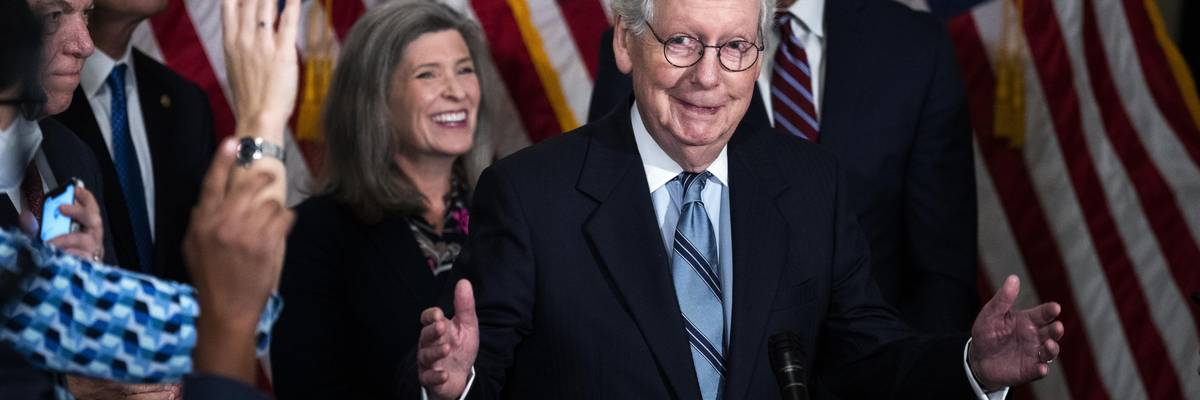
Senate Minority Leader Mitch McConnell (R-Ky.) conducts a news conference in the U.S. Capitol on Tuesday, September 20, 2022. (Photo: Tom Williams/CQ-Roll Call, Inc via Getty Images)
Zero GOP Senators Vote to Curb Dark Money's Stranglehold on Democracy
"Instead of voting for the DISCLOSE Act and cracking down on the dark money in our democracy, Republicans blocked it," said Sen. Patty Murray. "Shameful."
Proponents of democracy responded with disgust Thursday after Senate Republicans filibustered the popular DISCLOSE Act, which seeks to expose the super-wealthy donors who are spending unlimited amounts of undisclosed money to ensure that the U.S. government advances their interests at the expense of the vast majority.
As Sen. Sheldon Whitehouse (D-R.I.), author of the defeated legislation, said in a Wednesday floor speech, the bill's goal is to prevent corporations and billionaires from using dark money loopholes to "spew bile and slime" into the nation's political system.
"Republicans heeded the wishes of dark money donors today, but the fight to pass this bill isn't over."
After all 49 of his GOP colleagues in attendance voted to prevent debate on the legislation endorsed by President Joe Biden, Whitehouse released a statement slamming right-wing lawmakers for fighting to preserve "dark money's poisonous influence over American democracy."
"Today, Senate Republicans stood in lockstep with their megadonors and secretive special interests to protect the most corrupting force in American politics--dark money," said Whitehouse, a senior member of the Senate Judiciary Committee. "The American people are fed up with dark money influence campaigns that rig their government against them and stymie their priorities."
Whitehouse was far from alone in condemning the GOP.
"Once again, Senate Republicans sided with special interests and dark money--and against honest and transparent political debate," Sen. Patty Murray (D-Wash.) tweeted. "Instead of voting for the DISCLOSE Act and cracking down on the dark money in our democracy, Republicans blocked it. Shameful."
Michael Sozan, a senior fellow at the Center for American Progress, said in a statement that "at a time when the guardrails of our democracy are undergoing a severe stress test, it's lamentable that the Senate minority continues to give corporations, wealthy special interests, and foreign entities the ability to secretly spend vast amounts of money to influence election outcomes."
Trevor Potter, president of Campaign Legal Center, added that the failure "to advance, or even allow debate on, the Democracy Is Strengthened by Casting Light On Spending in Elections (DISCLOSE) Act... disappoints those of us who have been fighting against the influence of secret spending."
"More importantly," he continued, "it deprives voters of important information about who is attempting to influence their vote and allows corruption to prevail by permitting special interests to continue anonymously rigging the system in their favor."
"It is past time for Congress to enact legislation that bolsters transparency requirements and fulfills voters' right to know who is spending on election influence--a right that has repeatedly been upheld by the U.S. Supreme Court, even as the court has struck down other campaign finance and election-related laws," said Potter.
The ability of the nation's wealthiest individuals to translate their disproportionate economic power into political clout has increased exponentially since the Supreme Court's 2010 Citizens United decision eliminated effective limits on campaign contributions.
As Whitehouse's office noted, "Dark money in particular has skyrocketed despite the Supreme Court, by an 8 to 1 margin in Citizens United, upholding disclosure requirements as a means for citizens and shareholders to hold elected officials and corporate spenders accountable."
According to the Rhode Island Democrat, "Dark money political spending went from under $5 million in 2006 to more than $1 billion in 2020. Billionaire political spending increased by a factor of 70, from $17 million for the 2008 election to $1.2 billion for 2020."
Among other things, the DISCLOSE Act would require "organizations spending money in elections--including super PACs and 501(c)(4) dark money groups--to promptly disclose donors who have given $10,000 or more during an election cycle," his office explained. "In addition to election disclosure requirements, the bill requires groups that spend money on ads supporting or opposing judicial nominees to disclose their donors."
"The DISCLOSE Act would shine a light on special interest spending to neutralize its toxic effect, giving Americans' voices a chance to be heard," said Whitehouse. "Republicans heeded the wishes of dark money donors today, but the fight to pass this bill isn't over."
Given the GOP's unified opposition to the legislation, passing it requires that Senate Democrats abolish the upper chamber's 60-vote filibuster rule--a move corporate Democrats like Joe Manchin of West Virginia and Kyrsten Sinema of Arizona have refused to support.
"Holding a vote on the DISCLOSE Act without pushing to end the filibuster highlights the fundamental flaw with Democrats in Washington: Their rhetoric and warnings about dark money have always been spot-on, but they have failed to take the actions necessary to actually stop the flow of secret cash distorting and corrupting American politics," The Lever reported earlier this week. "Meanwhile, the party has become increasingly reliant on these same dark pools of cash to help elect more Democratic lawmakers."
We are at a crossroads
This country and this world are at a monumental crossroads. In a few short weeks, US voters will have an opportunity to beat back the forces of fascism and confront the billionaires who are rigging the economy, our media system, and our democracy, making it increasingly impossible for ordinary people to get by. We’re not just talking about the election. We’re talking about what must be done once these fascist elements are vanquished from power. We need a bolder set of solutions than what either major party has so far been willing to offer and a working-class movement ready to fight like hell for it. Trump didn't emerge from nowhere. The conditions that fueled MAGA authoritarianism were created by decades of radical neoliberal economic policies and a corrupt political system dominated by corporate interests. They slashed taxes on the super-rich, promising that the benefits would trickle down. They said giveaways to the corporate titans would make life more affordable for the rest of us. It was all bullshit. And when a bitter, betrayed populace searches for someone to blame, right-wing demagogues have little trouble finding scapegoats. People know when they're being lied to, but you won't hear any of this from the corporate media. Only independent journalism—powered and funded by people who believe in building a better world—can deliver truly trustworthy daily news. Our Fall Campaign is underway, and we need your help. To power our newsroom through the rest of the year, we need to raise $125,000 by midnight on October 31. So if you share our vision, please contribute whatever you can to sustain our work. |
Proponents of democracy responded with disgust Thursday after Senate Republicans filibustered the popular DISCLOSE Act, which seeks to expose the super-wealthy donors who are spending unlimited amounts of undisclosed money to ensure that the U.S. government advances their interests at the expense of the vast majority.
As Sen. Sheldon Whitehouse (D-R.I.), author of the defeated legislation, said in a Wednesday floor speech, the bill's goal is to prevent corporations and billionaires from using dark money loopholes to "spew bile and slime" into the nation's political system.
"Republicans heeded the wishes of dark money donors today, but the fight to pass this bill isn't over."
After all 49 of his GOP colleagues in attendance voted to prevent debate on the legislation endorsed by President Joe Biden, Whitehouse released a statement slamming right-wing lawmakers for fighting to preserve "dark money's poisonous influence over American democracy."
"Today, Senate Republicans stood in lockstep with their megadonors and secretive special interests to protect the most corrupting force in American politics--dark money," said Whitehouse, a senior member of the Senate Judiciary Committee. "The American people are fed up with dark money influence campaigns that rig their government against them and stymie their priorities."
Whitehouse was far from alone in condemning the GOP.
"Once again, Senate Republicans sided with special interests and dark money--and against honest and transparent political debate," Sen. Patty Murray (D-Wash.) tweeted. "Instead of voting for the DISCLOSE Act and cracking down on the dark money in our democracy, Republicans blocked it. Shameful."
Michael Sozan, a senior fellow at the Center for American Progress, said in a statement that "at a time when the guardrails of our democracy are undergoing a severe stress test, it's lamentable that the Senate minority continues to give corporations, wealthy special interests, and foreign entities the ability to secretly spend vast amounts of money to influence election outcomes."
Trevor Potter, president of Campaign Legal Center, added that the failure "to advance, or even allow debate on, the Democracy Is Strengthened by Casting Light On Spending in Elections (DISCLOSE) Act... disappoints those of us who have been fighting against the influence of secret spending."
"More importantly," he continued, "it deprives voters of important information about who is attempting to influence their vote and allows corruption to prevail by permitting special interests to continue anonymously rigging the system in their favor."
"It is past time for Congress to enact legislation that bolsters transparency requirements and fulfills voters' right to know who is spending on election influence--a right that has repeatedly been upheld by the U.S. Supreme Court, even as the court has struck down other campaign finance and election-related laws," said Potter.
The ability of the nation's wealthiest individuals to translate their disproportionate economic power into political clout has increased exponentially since the Supreme Court's 2010 Citizens United decision eliminated effective limits on campaign contributions.
As Whitehouse's office noted, "Dark money in particular has skyrocketed despite the Supreme Court, by an 8 to 1 margin in Citizens United, upholding disclosure requirements as a means for citizens and shareholders to hold elected officials and corporate spenders accountable."
According to the Rhode Island Democrat, "Dark money political spending went from under $5 million in 2006 to more than $1 billion in 2020. Billionaire political spending increased by a factor of 70, from $17 million for the 2008 election to $1.2 billion for 2020."
Among other things, the DISCLOSE Act would require "organizations spending money in elections--including super PACs and 501(c)(4) dark money groups--to promptly disclose donors who have given $10,000 or more during an election cycle," his office explained. "In addition to election disclosure requirements, the bill requires groups that spend money on ads supporting or opposing judicial nominees to disclose their donors."
"The DISCLOSE Act would shine a light on special interest spending to neutralize its toxic effect, giving Americans' voices a chance to be heard," said Whitehouse. "Republicans heeded the wishes of dark money donors today, but the fight to pass this bill isn't over."
Given the GOP's unified opposition to the legislation, passing it requires that Senate Democrats abolish the upper chamber's 60-vote filibuster rule--a move corporate Democrats like Joe Manchin of West Virginia and Kyrsten Sinema of Arizona have refused to support.
"Holding a vote on the DISCLOSE Act without pushing to end the filibuster highlights the fundamental flaw with Democrats in Washington: Their rhetoric and warnings about dark money have always been spot-on, but they have failed to take the actions necessary to actually stop the flow of secret cash distorting and corrupting American politics," The Lever reported earlier this week. "Meanwhile, the party has become increasingly reliant on these same dark pools of cash to help elect more Democratic lawmakers."
Proponents of democracy responded with disgust Thursday after Senate Republicans filibustered the popular DISCLOSE Act, which seeks to expose the super-wealthy donors who are spending unlimited amounts of undisclosed money to ensure that the U.S. government advances their interests at the expense of the vast majority.
As Sen. Sheldon Whitehouse (D-R.I.), author of the defeated legislation, said in a Wednesday floor speech, the bill's goal is to prevent corporations and billionaires from using dark money loopholes to "spew bile and slime" into the nation's political system.
"Republicans heeded the wishes of dark money donors today, but the fight to pass this bill isn't over."
After all 49 of his GOP colleagues in attendance voted to prevent debate on the legislation endorsed by President Joe Biden, Whitehouse released a statement slamming right-wing lawmakers for fighting to preserve "dark money's poisonous influence over American democracy."
"Today, Senate Republicans stood in lockstep with their megadonors and secretive special interests to protect the most corrupting force in American politics--dark money," said Whitehouse, a senior member of the Senate Judiciary Committee. "The American people are fed up with dark money influence campaigns that rig their government against them and stymie their priorities."
Whitehouse was far from alone in condemning the GOP.
"Once again, Senate Republicans sided with special interests and dark money--and against honest and transparent political debate," Sen. Patty Murray (D-Wash.) tweeted. "Instead of voting for the DISCLOSE Act and cracking down on the dark money in our democracy, Republicans blocked it. Shameful."
Michael Sozan, a senior fellow at the Center for American Progress, said in a statement that "at a time when the guardrails of our democracy are undergoing a severe stress test, it's lamentable that the Senate minority continues to give corporations, wealthy special interests, and foreign entities the ability to secretly spend vast amounts of money to influence election outcomes."
Trevor Potter, president of Campaign Legal Center, added that the failure "to advance, or even allow debate on, the Democracy Is Strengthened by Casting Light On Spending in Elections (DISCLOSE) Act... disappoints those of us who have been fighting against the influence of secret spending."
"More importantly," he continued, "it deprives voters of important information about who is attempting to influence their vote and allows corruption to prevail by permitting special interests to continue anonymously rigging the system in their favor."
"It is past time for Congress to enact legislation that bolsters transparency requirements and fulfills voters' right to know who is spending on election influence--a right that has repeatedly been upheld by the U.S. Supreme Court, even as the court has struck down other campaign finance and election-related laws," said Potter.
The ability of the nation's wealthiest individuals to translate their disproportionate economic power into political clout has increased exponentially since the Supreme Court's 2010 Citizens United decision eliminated effective limits on campaign contributions.
As Whitehouse's office noted, "Dark money in particular has skyrocketed despite the Supreme Court, by an 8 to 1 margin in Citizens United, upholding disclosure requirements as a means for citizens and shareholders to hold elected officials and corporate spenders accountable."
According to the Rhode Island Democrat, "Dark money political spending went from under $5 million in 2006 to more than $1 billion in 2020. Billionaire political spending increased by a factor of 70, from $17 million for the 2008 election to $1.2 billion for 2020."
Among other things, the DISCLOSE Act would require "organizations spending money in elections--including super PACs and 501(c)(4) dark money groups--to promptly disclose donors who have given $10,000 or more during an election cycle," his office explained. "In addition to election disclosure requirements, the bill requires groups that spend money on ads supporting or opposing judicial nominees to disclose their donors."
"The DISCLOSE Act would shine a light on special interest spending to neutralize its toxic effect, giving Americans' voices a chance to be heard," said Whitehouse. "Republicans heeded the wishes of dark money donors today, but the fight to pass this bill isn't over."
Given the GOP's unified opposition to the legislation, passing it requires that Senate Democrats abolish the upper chamber's 60-vote filibuster rule--a move corporate Democrats like Joe Manchin of West Virginia and Kyrsten Sinema of Arizona have refused to support.
"Holding a vote on the DISCLOSE Act without pushing to end the filibuster highlights the fundamental flaw with Democrats in Washington: Their rhetoric and warnings about dark money have always been spot-on, but they have failed to take the actions necessary to actually stop the flow of secret cash distorting and corrupting American politics," The Lever reported earlier this week. "Meanwhile, the party has become increasingly reliant on these same dark pools of cash to help elect more Democratic lawmakers."