SUBSCRIBE TO OUR FREE NEWSLETTER
Daily news & progressive opinion—funded by the people, not the corporations—delivered straight to your inbox.
5
#000000
#FFFFFF
To donate by check, phone, or other method, see our More Ways to Give page.
Daily news & progressive opinion—funded by the people, not the corporations—delivered straight to your inbox.
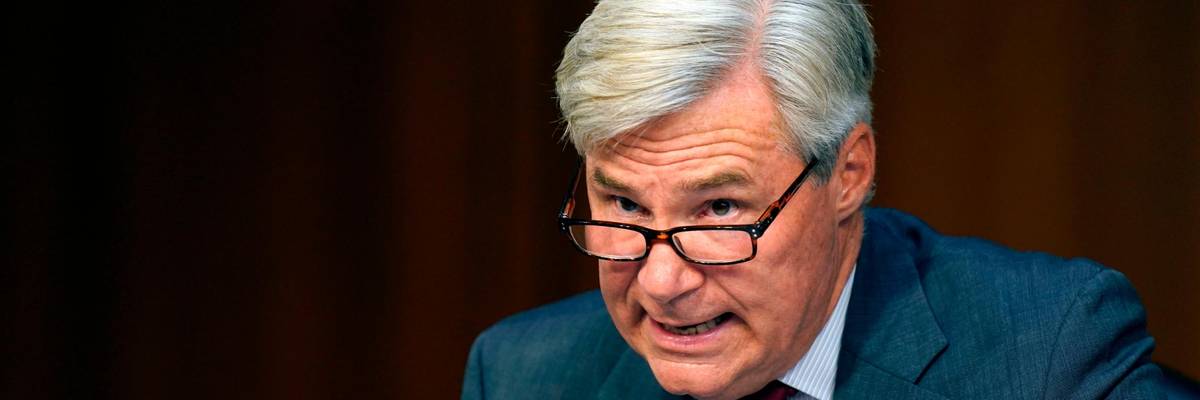
Sen. Sheldon Whitehouse (D-R.I.) speaks during an October 13, 2020 hearing on Capitol Hill in Washington, D.C.
"We are here today because fossil fuel-funded climate disinformation and obstruction is directly causing systemic financial risks to the economy and to the federal budget," said Sen. Sheldon Whitehouse.
The U.S. Senate Budget Committee on Wednesday held a hearing examining the role of fossil fuel industry dark money in thwarting meaningful action to tackle the worsening climate emergency.
The Wednesday morning hearing—entitled "Dollars and Degrees: Investigating Fossil Fuel Dark Money's Systemic Threats to Climate and the Federal Budget"—was held to "explore the insidious role that secretive fossil fuel money has played in exposing us to those forecast economic and budgetary catastrophes," according to Senate Budget Committee Chair Sheldon Whitehouse (D-R.I.).
So-called "dark money" refers to undisclosed independent expenditures meant to influence the outcome of elections. Such spending has proliferated following the U.S. Supreme Court's 2010 Citizens United v. Federal Election Commission ruling.
"The dangers that responsible experts have warned about are occurring," Whitehouse said during the hearing. "Sea levels are rising, and wildfires are intensifying, as we saw with the smoke a couple of weeks ago. Insurers are fleeing high-risk coastal and wildfire areas."
Whitehouse continued:
The fossil fuel industry's disinformation campaign has penetrated right here into this committee room, via witnesses from organizations like the Cato Institute, the Heritage Foundation, the American Enterprise Institute, and the Competitive Enterprise Institute, which through 2021 have collectively received over half a billion dollars from fossil fuel-related interests. And that's only the money that we know about.
We are here today because fossil fuel-funded climate disinformation and obstruction is directly causing systemic financial risks to the economy and to the federal budget.
Climate and environmental advocates welcomed Wednesday's hearing.
"In the 2022 election cycle, the oil and gas industry funneled more than $50 million to support their back-pocket candidates in the closest races," Greenpeace USA policy and political director Alice Madden said in a statement. "These same candidates continually present a false choice between a healthy economy and a healthy planet. Today we saw that with fossil fuels we get neither."
"Between 2010 and 2019, the United States experienced 119 climate disasters that each caused damages of $1 billion or more. That's more than double the previous decade," Madden continued.
"The consequences of the climate crisis are wreaking havoc on our health and our economy," she added. "We have many options to tackle it by transitioning to a clean energy economy that will create up to 25 million good-paying jobs across every ZIP code in America, jump-starting the economic recovery and positioning America to compete in a world that runs on clean technologies, not fossil fuels."
"By exposing the truth and holding those responsible accountable, we can chart a course toward a sustainable and equitable future for all."
Kathy Mulvey, the accountability campaigner at the Union of Concerned Scientists, said in a statement that "it's encouraging to see Congress take steps to investigate the role of so-called "dark money" in the fossil fuel industry's relentless efforts to preserve its dangerous and unjust business model at the expense of the well-being of people across the country and around the world."
"It has become abundantly clear that those who benefit most from a fossil fuel-dependent economy will stop at nothing to obscure science, confuse the public and policymakers, and block action to limit the worst effects of climate change," Mulvey continued. "It is alarming to see elected officials parrot fossil fuel industry talking points and support the manipulation of public perception as the toll of the climate crisis mounts."
"Further investigation of the fossil fuel industry's dark money, disinformation campaigns, and extensive influence on our political, economic, and social systems is urgently needed in order to minimize suffering, save lives, and protect our planet," Mulvey added. "By exposing the truth and holding those responsible accountable, we can chart a course toward a sustainable and equitable future for all."
This country and this world are at a monumental crossroads. US voters have an opportunity to beat back the forces of fascism and confront the billionaires who are rigging the economy, our media system, and our democracy, making it increasingly impossible for ordinary people to get by. We’re not just talking about the election. We’re talking about what must be done once these fascist elements are vanquished from power. We need a bolder set of solutions than what either major party has so far been willing to offer and a working-class movement ready to fight like hell for it. Trump didn't emerge from nowhere. The conditions that fueled MAGA authoritarianism were created by decades of radical neoliberal economic policies and a corrupt political system dominated by corporate interests. They slashed taxes on the super-rich, promising that the benefits would trickle down. They said giveaways to the corporate titans would make life more affordable for the rest of us. It was all bullshit. And when a bitter, betrayed populace searches for someone to blame, right-wing demagogues have little trouble finding scapegoats. People know when they're being lied to, but you won't hear any of this from the corporate media. Only independent journalism—powered and funded by people who believe in building a better world—can deliver truly trustworthy daily news. If you share our vision, please contribute whatever you can to sustain our work. |
The U.S. Senate Budget Committee on Wednesday held a hearing examining the role of fossil fuel industry dark money in thwarting meaningful action to tackle the worsening climate emergency.
The Wednesday morning hearing—entitled "Dollars and Degrees: Investigating Fossil Fuel Dark Money's Systemic Threats to Climate and the Federal Budget"—was held to "explore the insidious role that secretive fossil fuel money has played in exposing us to those forecast economic and budgetary catastrophes," according to Senate Budget Committee Chair Sheldon Whitehouse (D-R.I.).
So-called "dark money" refers to undisclosed independent expenditures meant to influence the outcome of elections. Such spending has proliferated following the U.S. Supreme Court's 2010 Citizens United v. Federal Election Commission ruling.
"The dangers that responsible experts have warned about are occurring," Whitehouse said during the hearing. "Sea levels are rising, and wildfires are intensifying, as we saw with the smoke a couple of weeks ago. Insurers are fleeing high-risk coastal and wildfire areas."
Whitehouse continued:
The fossil fuel industry's disinformation campaign has penetrated right here into this committee room, via witnesses from organizations like the Cato Institute, the Heritage Foundation, the American Enterprise Institute, and the Competitive Enterprise Institute, which through 2021 have collectively received over half a billion dollars from fossil fuel-related interests. And that's only the money that we know about.
We are here today because fossil fuel-funded climate disinformation and obstruction is directly causing systemic financial risks to the economy and to the federal budget.
Climate and environmental advocates welcomed Wednesday's hearing.
"In the 2022 election cycle, the oil and gas industry funneled more than $50 million to support their back-pocket candidates in the closest races," Greenpeace USA policy and political director Alice Madden said in a statement. "These same candidates continually present a false choice between a healthy economy and a healthy planet. Today we saw that with fossil fuels we get neither."
"Between 2010 and 2019, the United States experienced 119 climate disasters that each caused damages of $1 billion or more. That's more than double the previous decade," Madden continued.
"The consequences of the climate crisis are wreaking havoc on our health and our economy," she added. "We have many options to tackle it by transitioning to a clean energy economy that will create up to 25 million good-paying jobs across every ZIP code in America, jump-starting the economic recovery and positioning America to compete in a world that runs on clean technologies, not fossil fuels."
"By exposing the truth and holding those responsible accountable, we can chart a course toward a sustainable and equitable future for all."
Kathy Mulvey, the accountability campaigner at the Union of Concerned Scientists, said in a statement that "it's encouraging to see Congress take steps to investigate the role of so-called "dark money" in the fossil fuel industry's relentless efforts to preserve its dangerous and unjust business model at the expense of the well-being of people across the country and around the world."
"It has become abundantly clear that those who benefit most from a fossil fuel-dependent economy will stop at nothing to obscure science, confuse the public and policymakers, and block action to limit the worst effects of climate change," Mulvey continued. "It is alarming to see elected officials parrot fossil fuel industry talking points and support the manipulation of public perception as the toll of the climate crisis mounts."
"Further investigation of the fossil fuel industry's dark money, disinformation campaigns, and extensive influence on our political, economic, and social systems is urgently needed in order to minimize suffering, save lives, and protect our planet," Mulvey added. "By exposing the truth and holding those responsible accountable, we can chart a course toward a sustainable and equitable future for all."