SUBSCRIBE TO OUR FREE NEWSLETTER
Daily news & progressive opinion—funded by the people, not the corporations—delivered straight to your inbox.
5
#000000
#FFFFFF
To donate by check, phone, or other method, see our More Ways to Give page.
Daily news & progressive opinion—funded by the people, not the corporations—delivered straight to your inbox.
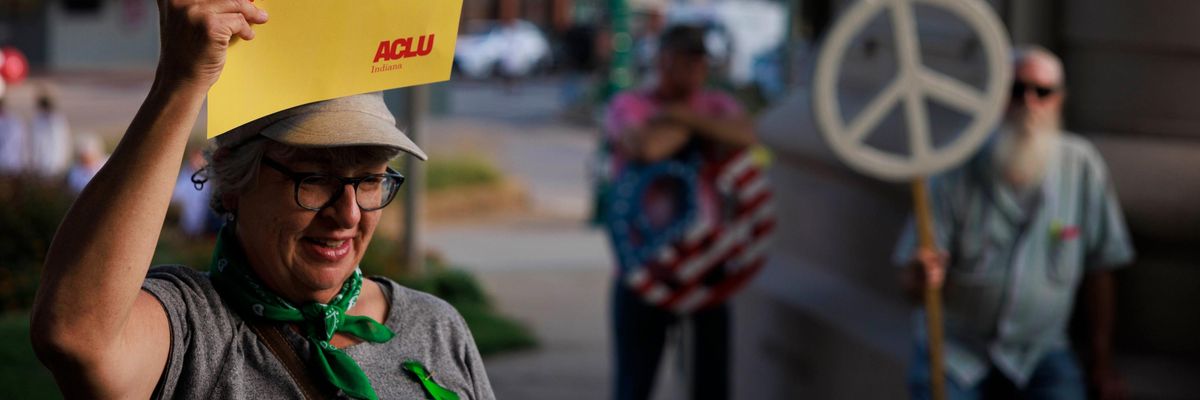
An abortion rights activist holds a placard saying, "Abortion bans replace freedom with force," in Bloomington, Indiana on September 15, 2022. On Friday, West Virginia Gov. Jim Justice signed a near-total ban on abortion care. (Photo: Jeremy Hogan/SOPA Images/LightRocket via Getty Images)
West Virginia on Friday became the second state in the U.S. to pass an abortion ban into law following the Supreme Court's overturning of Roe v. Wade, one day after Indiana's new ban went into effect.
Republican Gov. Jim Justice abruptly announced at a press conference that he had privately signed House Bill 302, which passed in the legislature earlier this week.
"Is it 'logical' to make patients wait until they're on the brink of death to get a lifesaving abortion?"
"It is absolutely done," Justice told reporters.
The bill will go into effect immediately, and the state's only abortion clinic, Women's Health Center of West Virginia in Charleson, started canceling dozens of abortion care appointments earlier this week following the passage of H.B. 302.
The law bans abortions at any stage of pregnancy and is written to permit abortion care in cases of a fetus that is not medically viable, an ectopic pregnancy, or a medical emergency--exceptions that Justice said qualified as "reasonable and logical."
Recent cases in Texas and Louisiana have demonstrated that in practice, such exceptions can result in hospitals and doctors waiting until a pregnant person's life is in danger before providing care, or forcing them to carry a nonviable pregnancy for weeks.
"Is it 'logical' to make patients wait until they're on the brink of death to get a lifesaving abortion?" asked Alexis McGill Johnson, president of Planned Parenthood Action Fund.
The law also imposes restrictions on people whose pregnancies are the result of rape or incest. Adult survivors cannot obtain abortion care after eight weeks of pregnancy and must report their assault to the police, while minors have until 14 weeks of pregnancy and must either file a police report or be treated for their assault in a hospital--or else they will be forced to continue the pregnancy.
"Most people don't come forward to law enforcement to report rape and incest because, frankly, victims are not believed," Katie Quinonez, executive director of the Women's Health Center of West Virginia, told West Virginia Metro News. "The reporting process is incredibly traumatic, and most people don't want to be re-traumatized after they have just experienced assault."
Planned Parenthood of South Atlantic West Virginia warned that the ban will be "deadly" for West Virginians and condemned Justice for unexpectedly announcing that residents no longer have access to care after signing the bill behind closed doors.
"Banning abortion behind closed doors, days after a nationwide abortion ban was introduced equals being scared of your constituents," said Planned Parenthood Action Fund.
Dear Common Dreams reader, It’s been nearly 30 years since I co-founded Common Dreams with my late wife, Lina Newhouser. We had the radical notion that journalism should serve the public good, not corporate profits. It was clear to us from the outset what it would take to build such a project. No paid advertisements. No corporate sponsors. No millionaire publisher telling us what to think or do. Many people said we wouldn't last a year, but we proved those doubters wrong. Together with a tremendous team of journalists and dedicated staff, we built an independent media outlet free from the constraints of profits and corporate control. Our mission has always been simple: To inform. To inspire. To ignite change for the common good. Building Common Dreams was not easy. Our survival was never guaranteed. When you take on the most powerful forces—Wall Street greed, fossil fuel industry destruction, Big Tech lobbyists, and uber-rich oligarchs who have spent billions upon billions rigging the economy and democracy in their favor—the only bulwark you have is supporters who believe in your work. But here’s the urgent message from me today. It's never been this bad out there. And it's never been this hard to keep us going. At the very moment Common Dreams is most needed, the threats we face are intensifying. We need your support now more than ever. We don't accept corporate advertising and never will. We don't have a paywall because we don't think people should be blocked from critical news based on their ability to pay. Everything we do is funded by the donations of readers like you. When everyone does the little they can afford, we are strong. But if that support retreats or dries up, so do we. Will you donate now to make sure Common Dreams not only survives but thrives? —Craig Brown, Co-founder |
West Virginia on Friday became the second state in the U.S. to pass an abortion ban into law following the Supreme Court's overturning of Roe v. Wade, one day after Indiana's new ban went into effect.
Republican Gov. Jim Justice abruptly announced at a press conference that he had privately signed House Bill 302, which passed in the legislature earlier this week.
"Is it 'logical' to make patients wait until they're on the brink of death to get a lifesaving abortion?"
"It is absolutely done," Justice told reporters.
The bill will go into effect immediately, and the state's only abortion clinic, Women's Health Center of West Virginia in Charleson, started canceling dozens of abortion care appointments earlier this week following the passage of H.B. 302.
The law bans abortions at any stage of pregnancy and is written to permit abortion care in cases of a fetus that is not medically viable, an ectopic pregnancy, or a medical emergency--exceptions that Justice said qualified as "reasonable and logical."
Recent cases in Texas and Louisiana have demonstrated that in practice, such exceptions can result in hospitals and doctors waiting until a pregnant person's life is in danger before providing care, or forcing them to carry a nonviable pregnancy for weeks.
"Is it 'logical' to make patients wait until they're on the brink of death to get a lifesaving abortion?" asked Alexis McGill Johnson, president of Planned Parenthood Action Fund.
The law also imposes restrictions on people whose pregnancies are the result of rape or incest. Adult survivors cannot obtain abortion care after eight weeks of pregnancy and must report their assault to the police, while minors have until 14 weeks of pregnancy and must either file a police report or be treated for their assault in a hospital--or else they will be forced to continue the pregnancy.
"Most people don't come forward to law enforcement to report rape and incest because, frankly, victims are not believed," Katie Quinonez, executive director of the Women's Health Center of West Virginia, told West Virginia Metro News. "The reporting process is incredibly traumatic, and most people don't want to be re-traumatized after they have just experienced assault."
Planned Parenthood of South Atlantic West Virginia warned that the ban will be "deadly" for West Virginians and condemned Justice for unexpectedly announcing that residents no longer have access to care after signing the bill behind closed doors.
"Banning abortion behind closed doors, days after a nationwide abortion ban was introduced equals being scared of your constituents," said Planned Parenthood Action Fund.
West Virginia on Friday became the second state in the U.S. to pass an abortion ban into law following the Supreme Court's overturning of Roe v. Wade, one day after Indiana's new ban went into effect.
Republican Gov. Jim Justice abruptly announced at a press conference that he had privately signed House Bill 302, which passed in the legislature earlier this week.
"Is it 'logical' to make patients wait until they're on the brink of death to get a lifesaving abortion?"
"It is absolutely done," Justice told reporters.
The bill will go into effect immediately, and the state's only abortion clinic, Women's Health Center of West Virginia in Charleson, started canceling dozens of abortion care appointments earlier this week following the passage of H.B. 302.
The law bans abortions at any stage of pregnancy and is written to permit abortion care in cases of a fetus that is not medically viable, an ectopic pregnancy, or a medical emergency--exceptions that Justice said qualified as "reasonable and logical."
Recent cases in Texas and Louisiana have demonstrated that in practice, such exceptions can result in hospitals and doctors waiting until a pregnant person's life is in danger before providing care, or forcing them to carry a nonviable pregnancy for weeks.
"Is it 'logical' to make patients wait until they're on the brink of death to get a lifesaving abortion?" asked Alexis McGill Johnson, president of Planned Parenthood Action Fund.
The law also imposes restrictions on people whose pregnancies are the result of rape or incest. Adult survivors cannot obtain abortion care after eight weeks of pregnancy and must report their assault to the police, while minors have until 14 weeks of pregnancy and must either file a police report or be treated for their assault in a hospital--or else they will be forced to continue the pregnancy.
"Most people don't come forward to law enforcement to report rape and incest because, frankly, victims are not believed," Katie Quinonez, executive director of the Women's Health Center of West Virginia, told West Virginia Metro News. "The reporting process is incredibly traumatic, and most people don't want to be re-traumatized after they have just experienced assault."
Planned Parenthood of South Atlantic West Virginia warned that the ban will be "deadly" for West Virginians and condemned Justice for unexpectedly announcing that residents no longer have access to care after signing the bill behind closed doors.
"Banning abortion behind closed doors, days after a nationwide abortion ban was introduced equals being scared of your constituents," said Planned Parenthood Action Fund.