SUBSCRIBE TO OUR FREE NEWSLETTER
Daily news & progressive opinion—funded by the people, not the corporations—delivered straight to your inbox.
5
#000000
#FFFFFF
To donate by check, phone, or other method, see our More Ways to Give page.
Daily news & progressive opinion—funded by the people, not the corporations—delivered straight to your inbox.
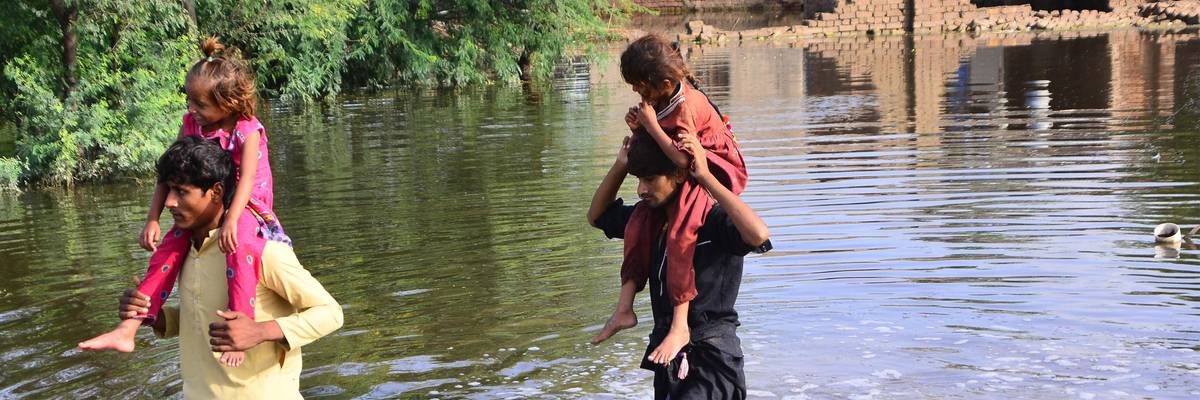
Pakistani flood victims wade through floodwaters after monsoon rains in Matiari, Sindh province, Pakistan on August 29, 2022. (Photo: Shakeel Ahmad/Anadolu Agency via Getty Images)
With hundreds of thousands of people displaced, more than four million crops destroyed, and nearly a million homes demolished or severely damaged, Pakistani officials and rights campaigners on Monday called for a major international aid push following flooding throughout the country fueled by the fossil fuel-driven climate emergency and an unprecedented season of monsoon rains.
"An unrelenting cascade of heatwaves, forest fires, flash floods, multiple glacial lake outbursts, flood events, and now the monster monsoon of the decade is wreaking nonstop havoc throughout the country."
More than 30 million people are in urgent need of help, the International Rescue Committee (IRC) said after conducting a rapid needs assessment three days after the Pakistani government declared the flooding, which has killed more than 1,000 people, a national emergency.
Both the IRC and government officials have explicitly linked the flooding to the climate crisis, with IRC country director Shabnam Baloch noting, "Despite producing less than 1% of the world's carbon footprint, the country is suffering the consequences of the world's inaction and stays in the top 10 countries facing the consequences."
Amid a monsoon season which has so far seen 784% and 500% more rains than average in Sindh and Balochistan provinces, respectively, the IRC is anticipating a sharp rise in food insecurity as 71% of Pakistanis surveyed by the group are already without access to sufficient clean drinking water. The disaster has also left 84% of women and girls without access to hygiene supplies, 63% of pregnant and lactating women "extremely vulnerable," and as many as 40% of people without access to critical healthcare.
"Our needs assessment showed that we are already seeing a major increase in cases of diarrhea, skin infections, malaria, and other illnesses," said Baloch. "The IRC has reached almost 20,000 people with critical food, supplies, and medical support. We are urgently requesting donors to step up their support and help us save lives."
Pakistani Climate Minister Sherry Rehman did not mince words Monday as she pointed out the link between the climate crisis and the suffering of the tens of millions of people directly affected by the flooding.
"This is very far from a normal monsoon [season]--it is climate dystopia at our doorstep," Rehman told Agence France-Presse. "We are at the moment at the ground zero of the frontline of extreme weather events, in an unrelenting cascade of heatwaves, forest fires, flash floods, multiple glacial lake outbursts, flood events, and now the monster monsoon of the decade is wreaking nonstop havoc throughout the country."
The season of what officials are calling "overwhelming" monsoons followed a heatwave earlier this year in which temperatures soared to 116.6degF in Sindh province.
"This is what the climate crisis looks like," former Ohio state Sen. Nina Turner said on social media Monday, posting a video of Pakistanis struggling to walk through rushing waters in Khyber Pakhtunkhwa province.
Many of the hundreds of thousands of people who have been forced from their homes by the flooding are currently staying in makeshift shelters, but Prime Minister Shehbaz Sharif on Sunday announced a $45 million relief fund for Balochistan province, 75% of which is underwater. Sharif added that the government would provide shelter for all those who have lost their homes.
The country's latest climate crisis-fueled catastrophe comes amid an economic crisis, with the annual inflation rate above 38% and sovereign debt exceeding $250 billion.
Foreign Minister Bilawal Bhutto-Zardari on Sunday called on the International Monetary Fund to release $1.2 billion as part of Pakistan's bailout, and the United Nations is expected to launch an international appeal for aid in Islamabad on Tuesday.
"Going forward, I would expect not only the International Monetary Fund, but the international community and international agencies to truly grasp the level of devastation," Bhutto-Zardari told The Guardian. "I haven't seen destruction of this scale, I find it very difficult to put into words... it is overwhelming."
Aid flights arrived from Turkey and the United Arab Emirates on Sunday with tents, food, and other supplies.
Rehman said international policymakers must treat Pakistan's catastrophic flooding as "a global crisis" and invest in helping the Global South to fund its defenses against the climate emergency.
"We will need better planning and sustainable development on the ground," Rehman told Turkish news outlet TRT World. "We'll need to have climate resilient crops as well as structures."
The devastation across Pakistan, said Amnesty International secretary general Agnes Callamard, illustrates that the climate crisis "demands effective, committed global governance" instead of "mediocre, self-interested, selfish" policies from the world's wealthiest countries, which blocked discussions about loss and damage financing for the Global South at the Bonn Climate Change Conference in June.
"Climate injustice is deadly. Violent. Unequal," said Callamard. "It is a human rights issue."
Dear Common Dreams reader, It’s been nearly 30 years since I co-founded Common Dreams with my late wife, Lina Newhouser. We had the radical notion that journalism should serve the public good, not corporate profits. It was clear to us from the outset what it would take to build such a project. No paid advertisements. No corporate sponsors. No millionaire publisher telling us what to think or do. Many people said we wouldn't last a year, but we proved those doubters wrong. Together with a tremendous team of journalists and dedicated staff, we built an independent media outlet free from the constraints of profits and corporate control. Our mission has always been simple: To inform. To inspire. To ignite change for the common good. Building Common Dreams was not easy. Our survival was never guaranteed. When you take on the most powerful forces—Wall Street greed, fossil fuel industry destruction, Big Tech lobbyists, and uber-rich oligarchs who have spent billions upon billions rigging the economy and democracy in their favor—the only bulwark you have is supporters who believe in your work. But here’s the urgent message from me today. It's never been this bad out there. And it's never been this hard to keep us going. At the very moment Common Dreams is most needed, the threats we face are intensifying. We need your support now more than ever. We don't accept corporate advertising and never will. We don't have a paywall because we don't think people should be blocked from critical news based on their ability to pay. Everything we do is funded by the donations of readers like you. When everyone does the little they can afford, we are strong. But if that support retreats or dries up, so do we. Will you donate now to make sure Common Dreams not only survives but thrives? —Craig Brown, Co-founder |
With hundreds of thousands of people displaced, more than four million crops destroyed, and nearly a million homes demolished or severely damaged, Pakistani officials and rights campaigners on Monday called for a major international aid push following flooding throughout the country fueled by the fossil fuel-driven climate emergency and an unprecedented season of monsoon rains.
"An unrelenting cascade of heatwaves, forest fires, flash floods, multiple glacial lake outbursts, flood events, and now the monster monsoon of the decade is wreaking nonstop havoc throughout the country."
More than 30 million people are in urgent need of help, the International Rescue Committee (IRC) said after conducting a rapid needs assessment three days after the Pakistani government declared the flooding, which has killed more than 1,000 people, a national emergency.
Both the IRC and government officials have explicitly linked the flooding to the climate crisis, with IRC country director Shabnam Baloch noting, "Despite producing less than 1% of the world's carbon footprint, the country is suffering the consequences of the world's inaction and stays in the top 10 countries facing the consequences."
Amid a monsoon season which has so far seen 784% and 500% more rains than average in Sindh and Balochistan provinces, respectively, the IRC is anticipating a sharp rise in food insecurity as 71% of Pakistanis surveyed by the group are already without access to sufficient clean drinking water. The disaster has also left 84% of women and girls without access to hygiene supplies, 63% of pregnant and lactating women "extremely vulnerable," and as many as 40% of people without access to critical healthcare.
"Our needs assessment showed that we are already seeing a major increase in cases of diarrhea, skin infections, malaria, and other illnesses," said Baloch. "The IRC has reached almost 20,000 people with critical food, supplies, and medical support. We are urgently requesting donors to step up their support and help us save lives."
Pakistani Climate Minister Sherry Rehman did not mince words Monday as she pointed out the link between the climate crisis and the suffering of the tens of millions of people directly affected by the flooding.
"This is very far from a normal monsoon [season]--it is climate dystopia at our doorstep," Rehman told Agence France-Presse. "We are at the moment at the ground zero of the frontline of extreme weather events, in an unrelenting cascade of heatwaves, forest fires, flash floods, multiple glacial lake outbursts, flood events, and now the monster monsoon of the decade is wreaking nonstop havoc throughout the country."
The season of what officials are calling "overwhelming" monsoons followed a heatwave earlier this year in which temperatures soared to 116.6degF in Sindh province.
"This is what the climate crisis looks like," former Ohio state Sen. Nina Turner said on social media Monday, posting a video of Pakistanis struggling to walk through rushing waters in Khyber Pakhtunkhwa province.
Many of the hundreds of thousands of people who have been forced from their homes by the flooding are currently staying in makeshift shelters, but Prime Minister Shehbaz Sharif on Sunday announced a $45 million relief fund for Balochistan province, 75% of which is underwater. Sharif added that the government would provide shelter for all those who have lost their homes.
The country's latest climate crisis-fueled catastrophe comes amid an economic crisis, with the annual inflation rate above 38% and sovereign debt exceeding $250 billion.
Foreign Minister Bilawal Bhutto-Zardari on Sunday called on the International Monetary Fund to release $1.2 billion as part of Pakistan's bailout, and the United Nations is expected to launch an international appeal for aid in Islamabad on Tuesday.
"Going forward, I would expect not only the International Monetary Fund, but the international community and international agencies to truly grasp the level of devastation," Bhutto-Zardari told The Guardian. "I haven't seen destruction of this scale, I find it very difficult to put into words... it is overwhelming."
Aid flights arrived from Turkey and the United Arab Emirates on Sunday with tents, food, and other supplies.
Rehman said international policymakers must treat Pakistan's catastrophic flooding as "a global crisis" and invest in helping the Global South to fund its defenses against the climate emergency.
"We will need better planning and sustainable development on the ground," Rehman told Turkish news outlet TRT World. "We'll need to have climate resilient crops as well as structures."
The devastation across Pakistan, said Amnesty International secretary general Agnes Callamard, illustrates that the climate crisis "demands effective, committed global governance" instead of "mediocre, self-interested, selfish" policies from the world's wealthiest countries, which blocked discussions about loss and damage financing for the Global South at the Bonn Climate Change Conference in June.
"Climate injustice is deadly. Violent. Unequal," said Callamard. "It is a human rights issue."
With hundreds of thousands of people displaced, more than four million crops destroyed, and nearly a million homes demolished or severely damaged, Pakistani officials and rights campaigners on Monday called for a major international aid push following flooding throughout the country fueled by the fossil fuel-driven climate emergency and an unprecedented season of monsoon rains.
"An unrelenting cascade of heatwaves, forest fires, flash floods, multiple glacial lake outbursts, flood events, and now the monster monsoon of the decade is wreaking nonstop havoc throughout the country."
More than 30 million people are in urgent need of help, the International Rescue Committee (IRC) said after conducting a rapid needs assessment three days after the Pakistani government declared the flooding, which has killed more than 1,000 people, a national emergency.
Both the IRC and government officials have explicitly linked the flooding to the climate crisis, with IRC country director Shabnam Baloch noting, "Despite producing less than 1% of the world's carbon footprint, the country is suffering the consequences of the world's inaction and stays in the top 10 countries facing the consequences."
Amid a monsoon season which has so far seen 784% and 500% more rains than average in Sindh and Balochistan provinces, respectively, the IRC is anticipating a sharp rise in food insecurity as 71% of Pakistanis surveyed by the group are already without access to sufficient clean drinking water. The disaster has also left 84% of women and girls without access to hygiene supplies, 63% of pregnant and lactating women "extremely vulnerable," and as many as 40% of people without access to critical healthcare.
"Our needs assessment showed that we are already seeing a major increase in cases of diarrhea, skin infections, malaria, and other illnesses," said Baloch. "The IRC has reached almost 20,000 people with critical food, supplies, and medical support. We are urgently requesting donors to step up their support and help us save lives."
Pakistani Climate Minister Sherry Rehman did not mince words Monday as she pointed out the link between the climate crisis and the suffering of the tens of millions of people directly affected by the flooding.
"This is very far from a normal monsoon [season]--it is climate dystopia at our doorstep," Rehman told Agence France-Presse. "We are at the moment at the ground zero of the frontline of extreme weather events, in an unrelenting cascade of heatwaves, forest fires, flash floods, multiple glacial lake outbursts, flood events, and now the monster monsoon of the decade is wreaking nonstop havoc throughout the country."
The season of what officials are calling "overwhelming" monsoons followed a heatwave earlier this year in which temperatures soared to 116.6degF in Sindh province.
"This is what the climate crisis looks like," former Ohio state Sen. Nina Turner said on social media Monday, posting a video of Pakistanis struggling to walk through rushing waters in Khyber Pakhtunkhwa province.
Many of the hundreds of thousands of people who have been forced from their homes by the flooding are currently staying in makeshift shelters, but Prime Minister Shehbaz Sharif on Sunday announced a $45 million relief fund for Balochistan province, 75% of which is underwater. Sharif added that the government would provide shelter for all those who have lost their homes.
The country's latest climate crisis-fueled catastrophe comes amid an economic crisis, with the annual inflation rate above 38% and sovereign debt exceeding $250 billion.
Foreign Minister Bilawal Bhutto-Zardari on Sunday called on the International Monetary Fund to release $1.2 billion as part of Pakistan's bailout, and the United Nations is expected to launch an international appeal for aid in Islamabad on Tuesday.
"Going forward, I would expect not only the International Monetary Fund, but the international community and international agencies to truly grasp the level of devastation," Bhutto-Zardari told The Guardian. "I haven't seen destruction of this scale, I find it very difficult to put into words... it is overwhelming."
Aid flights arrived from Turkey and the United Arab Emirates on Sunday with tents, food, and other supplies.
Rehman said international policymakers must treat Pakistan's catastrophic flooding as "a global crisis" and invest in helping the Global South to fund its defenses against the climate emergency.
"We will need better planning and sustainable development on the ground," Rehman told Turkish news outlet TRT World. "We'll need to have climate resilient crops as well as structures."
The devastation across Pakistan, said Amnesty International secretary general Agnes Callamard, illustrates that the climate crisis "demands effective, committed global governance" instead of "mediocre, self-interested, selfish" policies from the world's wealthiest countries, which blocked discussions about loss and damage financing for the Global South at the Bonn Climate Change Conference in June.
"Climate injustice is deadly. Violent. Unequal," said Callamard. "It is a human rights issue."