SUBSCRIBE TO OUR FREE NEWSLETTER
Daily news & progressive opinion—funded by the people, not the corporations—delivered straight to your inbox.
5
#000000
#FFFFFF
To donate by check, phone, or other method, see our More Ways to Give page.
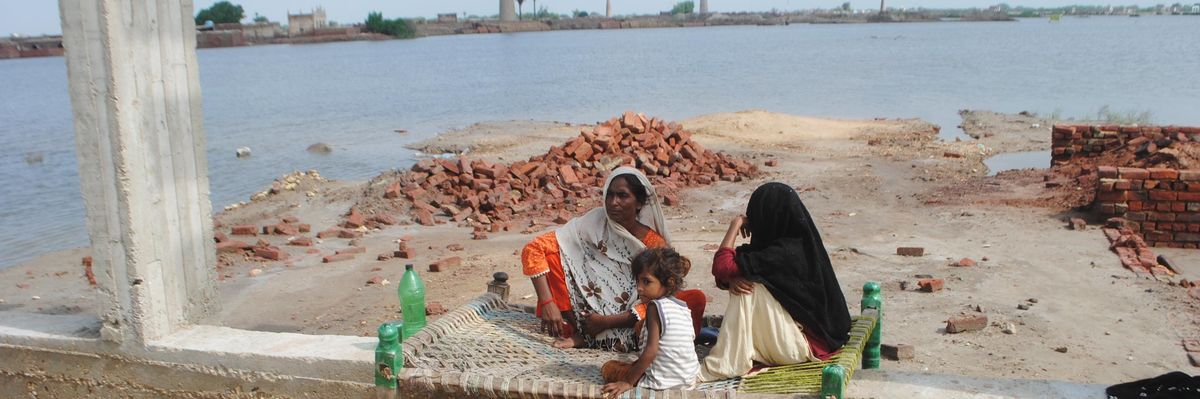
As Pakistan and the United Nations asked the world for $160 million in response to catastrophic flooding in the country, U.N. Secretary-General Antonio Guterres on Tuesday also issued a broader warning about the human-caused climate emergency.
"It is outrageous that climate action is being put on the back burner as global emissions of greenhouse gases are still rising."
"Let's stop sleepwalking toward the destruction of our planet by climate change," Guterres said. "Today, it's Pakistan. Tomorrow, it could be your country."
Tens of millions of Pakistanis are contending with over 1,000 deaths and the widespread destruction of buildings and crops, the result of what Guterres called "a monsoon on steroids--the relentless impact of epochal levels of rain and flooding."
"Millions are homeless, schools and health facilities have been destroyed, livelihoods are shattered, critical infrastructure wiped out, and people's hopes and dreams have washed away," he noted. "Every province of the country has been affected."
Recalling his time as high commissioner for refugees, Guterres said in the aid appeal video that he witnessed Pakistan welcome people from war-torn Afghanistan, and "its breaks my heart to see these generous people suffering so much."
"The scale of needs is rising like the flood waters. It requires the world's collective and prioritized attention," he stressed, explaining that the money will go toward essentials like food, water, sanitation, emergency education, and healthcare.
"Let us work together to respond quickly and collaboratively to this colossal crisis," he declared. "Let us all step up in solidarity and support the people of Pakistan in their hour of need."
Guterres is set to travel to Islamabad on September 9 and spend the weekend touring impacted regions, meeting with displaced Pakistani families, and observing relief efforts.
The U.S. Agency for International Development (USAID) announced Tuesday that it will provide $30 million in humanitarian assistance to support the people of Pakistan affected by the flooding.
"With these funds, USAID partners will prioritize urgently needed support for food, nutrition, multipurpose cash, safe water, improved sanitation and hygiene, and shelter assistance," the agency said in a statement.
A longtime critic of rich nations' failures to adequately address fossil fuel-driven global heating, Guterres pointed out Tuesday that "South Asia is one of the world's global climate crisis hotspots. People living in these hotspots are 15 times more likely to die from climate impacts."
"As we continue to see more and more extreme weather events around the world," he said, "it is outrageous that climate action is being put on the back burner as global emissions of greenhouse gases are still rising, putting all of us--everywhere--in growing danger."
Related Content

The U.N. chief was far from alone in using the tragic conditions in Pakistan to renew calls for more ambitious climate action. As Pakistani Climate Minister Sherry Rehman said Monday, the current monsoon season "is climate dystopia at our doorstep."
Ugandan climate activist Vanessa Nakate noted that "Pakistan is responsible for less than 1% of global greenhouse gas emissions and yet it is among the top 10 most vulnerable countries to climate change."
U.S. elected officials including Reps. Jamaal Bowman (D-N.Y.) and Ilhan Omar (D-Minn.) took to Twitter to urge bolder climate action:
Other leaders around the world, from Fijian Prime Minister Frank Bainimarama to Jeremy Corbyn, a Labour Party member of the U.K. Parliament, also weighed in:
Author and economic anthropologist Jason Hickel tweeted Tuesday that "the only appropriate response to the climate catastrophe in Pakistan is to unconditionally cancel the country's external debts. These resources should be used to support people and ecosystems rather than to service foreign capital. It is a minimal first step toward reparations."
As Pakistan and the United Nations asked the world for $160 million in response to catastrophic flooding in the country, U.N. Secretary-General Antonio Guterres on Tuesday also issued a broader warning about the human-caused climate emergency.
"It is outrageous that climate action is being put on the back burner as global emissions of greenhouse gases are still rising."
"Let's stop sleepwalking toward the destruction of our planet by climate change," Guterres said. "Today, it's Pakistan. Tomorrow, it could be your country."
Tens of millions of Pakistanis are contending with over 1,000 deaths and the widespread destruction of buildings and crops, the result of what Guterres called "a monsoon on steroids--the relentless impact of epochal levels of rain and flooding."
"Millions are homeless, schools and health facilities have been destroyed, livelihoods are shattered, critical infrastructure wiped out, and people's hopes and dreams have washed away," he noted. "Every province of the country has been affected."
Recalling his time as high commissioner for refugees, Guterres said in the aid appeal video that he witnessed Pakistan welcome people from war-torn Afghanistan, and "its breaks my heart to see these generous people suffering so much."
"The scale of needs is rising like the flood waters. It requires the world's collective and prioritized attention," he stressed, explaining that the money will go toward essentials like food, water, sanitation, emergency education, and healthcare.
"Let us work together to respond quickly and collaboratively to this colossal crisis," he declared. "Let us all step up in solidarity and support the people of Pakistan in their hour of need."
Guterres is set to travel to Islamabad on September 9 and spend the weekend touring impacted regions, meeting with displaced Pakistani families, and observing relief efforts.
The U.S. Agency for International Development (USAID) announced Tuesday that it will provide $30 million in humanitarian assistance to support the people of Pakistan affected by the flooding.
"With these funds, USAID partners will prioritize urgently needed support for food, nutrition, multipurpose cash, safe water, improved sanitation and hygiene, and shelter assistance," the agency said in a statement.
A longtime critic of rich nations' failures to adequately address fossil fuel-driven global heating, Guterres pointed out Tuesday that "South Asia is one of the world's global climate crisis hotspots. People living in these hotspots are 15 times more likely to die from climate impacts."
"As we continue to see more and more extreme weather events around the world," he said, "it is outrageous that climate action is being put on the back burner as global emissions of greenhouse gases are still rising, putting all of us--everywhere--in growing danger."
Related Content
The U.N. chief was far from alone in using the tragic conditions in Pakistan to renew calls for more ambitious climate action. As Pakistani Climate Minister Sherry Rehman said Monday, the current monsoon season "is climate dystopia at our doorstep."
Ugandan climate activist Vanessa Nakate noted that "Pakistan is responsible for less than 1% of global greenhouse gas emissions and yet it is among the top 10 most vulnerable countries to climate change."
U.S. elected officials including Reps. Jamaal Bowman (D-N.Y.) and Ilhan Omar (D-Minn.) took to Twitter to urge bolder climate action:
Other leaders around the world, from Fijian Prime Minister Frank Bainimarama to Jeremy Corbyn, a Labour Party member of the U.K. Parliament, also weighed in:
Author and economic anthropologist Jason Hickel tweeted Tuesday that "the only appropriate response to the climate catastrophe in Pakistan is to unconditionally cancel the country's external debts. These resources should be used to support people and ecosystems rather than to service foreign capital. It is a minimal first step toward reparations."
As Pakistan and the United Nations asked the world for $160 million in response to catastrophic flooding in the country, U.N. Secretary-General Antonio Guterres on Tuesday also issued a broader warning about the human-caused climate emergency.
"It is outrageous that climate action is being put on the back burner as global emissions of greenhouse gases are still rising."
"Let's stop sleepwalking toward the destruction of our planet by climate change," Guterres said. "Today, it's Pakistan. Tomorrow, it could be your country."
Tens of millions of Pakistanis are contending with over 1,000 deaths and the widespread destruction of buildings and crops, the result of what Guterres called "a monsoon on steroids--the relentless impact of epochal levels of rain and flooding."
"Millions are homeless, schools and health facilities have been destroyed, livelihoods are shattered, critical infrastructure wiped out, and people's hopes and dreams have washed away," he noted. "Every province of the country has been affected."
Recalling his time as high commissioner for refugees, Guterres said in the aid appeal video that he witnessed Pakistan welcome people from war-torn Afghanistan, and "its breaks my heart to see these generous people suffering so much."
"The scale of needs is rising like the flood waters. It requires the world's collective and prioritized attention," he stressed, explaining that the money will go toward essentials like food, water, sanitation, emergency education, and healthcare.
"Let us work together to respond quickly and collaboratively to this colossal crisis," he declared. "Let us all step up in solidarity and support the people of Pakistan in their hour of need."
Guterres is set to travel to Islamabad on September 9 and spend the weekend touring impacted regions, meeting with displaced Pakistani families, and observing relief efforts.
The U.S. Agency for International Development (USAID) announced Tuesday that it will provide $30 million in humanitarian assistance to support the people of Pakistan affected by the flooding.
"With these funds, USAID partners will prioritize urgently needed support for food, nutrition, multipurpose cash, safe water, improved sanitation and hygiene, and shelter assistance," the agency said in a statement.
A longtime critic of rich nations' failures to adequately address fossil fuel-driven global heating, Guterres pointed out Tuesday that "South Asia is one of the world's global climate crisis hotspots. People living in these hotspots are 15 times more likely to die from climate impacts."
"As we continue to see more and more extreme weather events around the world," he said, "it is outrageous that climate action is being put on the back burner as global emissions of greenhouse gases are still rising, putting all of us--everywhere--in growing danger."
Related Content
The U.N. chief was far from alone in using the tragic conditions in Pakistan to renew calls for more ambitious climate action. As Pakistani Climate Minister Sherry Rehman said Monday, the current monsoon season "is climate dystopia at our doorstep."
Ugandan climate activist Vanessa Nakate noted that "Pakistan is responsible for less than 1% of global greenhouse gas emissions and yet it is among the top 10 most vulnerable countries to climate change."
U.S. elected officials including Reps. Jamaal Bowman (D-N.Y.) and Ilhan Omar (D-Minn.) took to Twitter to urge bolder climate action:
Other leaders around the world, from Fijian Prime Minister Frank Bainimarama to Jeremy Corbyn, a Labour Party member of the U.K. Parliament, also weighed in:
Author and economic anthropologist Jason Hickel tweeted Tuesday that "the only appropriate response to the climate catastrophe in Pakistan is to unconditionally cancel the country's external debts. These resources should be used to support people and ecosystems rather than to service foreign capital. It is a minimal first step toward reparations."