SUBSCRIBE TO OUR FREE NEWSLETTER
Daily news & progressive opinion—funded by the people, not the corporations—delivered straight to your inbox.
5
#000000
#FFFFFF
To donate by check, phone, or other method, see our More Ways to Give page.
Daily news & progressive opinion—funded by the people, not the corporations—delivered straight to your inbox.
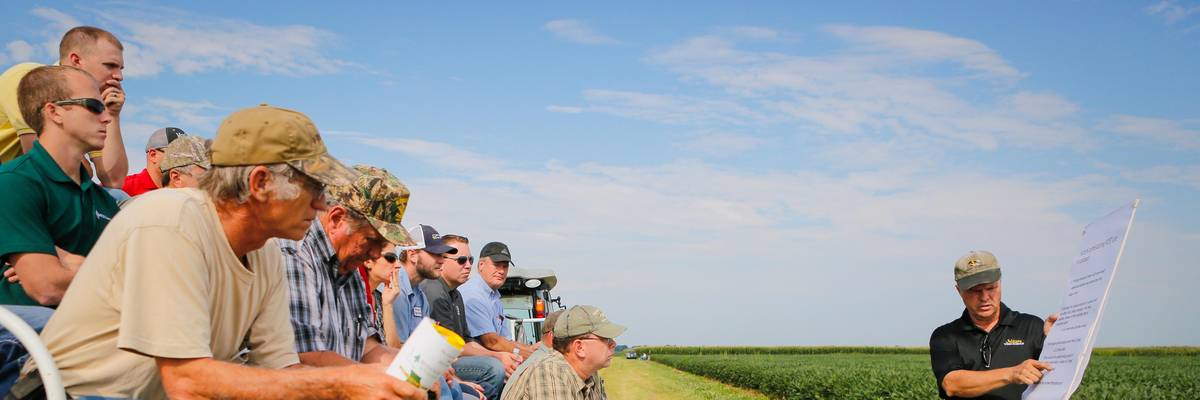
Reid Smeda, a professor of plant sciences, speaks about dicamba to a group of Missouri farmers on August 5, 2014. (Photo: Mizzou CAFNR//flickr/cc)
An advocacy group on Thursday welcomed an appeals court ruling that, while tossing out a $60 million award to a Missouri peach farmer whose trees were killed by the herbicide dicamba, did not challenge a federal jury's 2020 verdict that the weedkiller's manufacturers are responsible.
The U.S. Court of Appeals for the 8th Circuit in St. Louis ruled that chemical giants Monsanto--acquired by Bayer AG in 2018--and BASF are liable for damage to Bill Bader's peach groves caused by dicamba, leaving in place a $15 million judgment for nonpunitive damages.
However, the court ordered a new trial to determine punitive damages to be assessed against each company separately. Punitive damages worth $60 million, a reduction from the jury's original award of $250 million, were dismissed pending the new trial.
"The appeals court correctly held Monsanto and BASF responsible for unprecedented damage to Bader's peach orchard from dicamba drift. But this is just the beginning," said Meredith Stevenson, staff attorney at the Center for Food Safety, an advocacy group that filed an amicus brief in support of Bader.
"The destruction to Bader's orchards provides just a single example of the widespread harm inflicted on thousands of farmers and the environment from Monsanto's negligence and EPA's refusal to cancel its dicamba approval," she added. "We will continue to fight to prevent continued harm to millions of acres of cropland, hundreds of endangered species, parks, wildlife refuges, and other natural areas from dicamba."
The St. Louis Post-Dispatch reports:
Bader's lawsuit, one of more than 100 similar lawsuits over dicamba, went to trial in early 2020. Bayer in June 2020 announced that it would pay up to $400 million to settle the remaining dicamba lawsuits.
Bader, who operates Missouri's largest peach orchard near the Arkansas border, said many trees were killed when dicamba drifted onto his property from nearby soybean and cotton farms...
Monsanto, which is now owned by Bayer, began selling dicamba-tolerant soybean and cotton seeds it developed in 2015 and 2016, respectively, leading to an explosion of dicamba use, Bader and other farmers have said.
A report published last year by the Environmental Protection Agency revealed that during the administration of former President Donald Trump, high-ranking officials intentionally excluded scientific evidence of dicamba-related hazards, including the risk of widespread drift damage, before reapproving the dangerous chemical.
Another 2021 EPA report described the widespread harm to farmers and the environment caused by dicamba during last year's growing season.
Dear Common Dreams reader, It’s been nearly 30 years since I co-founded Common Dreams with my late wife, Lina Newhouser. We had the radical notion that journalism should serve the public good, not corporate profits. It was clear to us from the outset what it would take to build such a project. No paid advertisements. No corporate sponsors. No millionaire publisher telling us what to think or do. Many people said we wouldn't last a year, but we proved those doubters wrong. Together with a tremendous team of journalists and dedicated staff, we built an independent media outlet free from the constraints of profits and corporate control. Our mission has always been simple: To inform. To inspire. To ignite change for the common good. Building Common Dreams was not easy. Our survival was never guaranteed. When you take on the most powerful forces—Wall Street greed, fossil fuel industry destruction, Big Tech lobbyists, and uber-rich oligarchs who have spent billions upon billions rigging the economy and democracy in their favor—the only bulwark you have is supporters who believe in your work. But here’s the urgent message from me today. It's never been this bad out there. And it's never been this hard to keep us going. At the very moment Common Dreams is most needed, the threats we face are intensifying. We need your support now more than ever. We don't accept corporate advertising and never will. We don't have a paywall because we don't think people should be blocked from critical news based on their ability to pay. Everything we do is funded by the donations of readers like you. When everyone does the little they can afford, we are strong. But if that support retreats or dries up, so do we. Will you donate now to make sure Common Dreams not only survives but thrives? —Craig Brown, Co-founder |
An advocacy group on Thursday welcomed an appeals court ruling that, while tossing out a $60 million award to a Missouri peach farmer whose trees were killed by the herbicide dicamba, did not challenge a federal jury's 2020 verdict that the weedkiller's manufacturers are responsible.
The U.S. Court of Appeals for the 8th Circuit in St. Louis ruled that chemical giants Monsanto--acquired by Bayer AG in 2018--and BASF are liable for damage to Bill Bader's peach groves caused by dicamba, leaving in place a $15 million judgment for nonpunitive damages.
However, the court ordered a new trial to determine punitive damages to be assessed against each company separately. Punitive damages worth $60 million, a reduction from the jury's original award of $250 million, were dismissed pending the new trial.
"The appeals court correctly held Monsanto and BASF responsible for unprecedented damage to Bader's peach orchard from dicamba drift. But this is just the beginning," said Meredith Stevenson, staff attorney at the Center for Food Safety, an advocacy group that filed an amicus brief in support of Bader.
"The destruction to Bader's orchards provides just a single example of the widespread harm inflicted on thousands of farmers and the environment from Monsanto's negligence and EPA's refusal to cancel its dicamba approval," she added. "We will continue to fight to prevent continued harm to millions of acres of cropland, hundreds of endangered species, parks, wildlife refuges, and other natural areas from dicamba."
The St. Louis Post-Dispatch reports:
Bader's lawsuit, one of more than 100 similar lawsuits over dicamba, went to trial in early 2020. Bayer in June 2020 announced that it would pay up to $400 million to settle the remaining dicamba lawsuits.
Bader, who operates Missouri's largest peach orchard near the Arkansas border, said many trees were killed when dicamba drifted onto his property from nearby soybean and cotton farms...
Monsanto, which is now owned by Bayer, began selling dicamba-tolerant soybean and cotton seeds it developed in 2015 and 2016, respectively, leading to an explosion of dicamba use, Bader and other farmers have said.
A report published last year by the Environmental Protection Agency revealed that during the administration of former President Donald Trump, high-ranking officials intentionally excluded scientific evidence of dicamba-related hazards, including the risk of widespread drift damage, before reapproving the dangerous chemical.
Another 2021 EPA report described the widespread harm to farmers and the environment caused by dicamba during last year's growing season.
An advocacy group on Thursday welcomed an appeals court ruling that, while tossing out a $60 million award to a Missouri peach farmer whose trees were killed by the herbicide dicamba, did not challenge a federal jury's 2020 verdict that the weedkiller's manufacturers are responsible.
The U.S. Court of Appeals for the 8th Circuit in St. Louis ruled that chemical giants Monsanto--acquired by Bayer AG in 2018--and BASF are liable for damage to Bill Bader's peach groves caused by dicamba, leaving in place a $15 million judgment for nonpunitive damages.
However, the court ordered a new trial to determine punitive damages to be assessed against each company separately. Punitive damages worth $60 million, a reduction from the jury's original award of $250 million, were dismissed pending the new trial.
"The appeals court correctly held Monsanto and BASF responsible for unprecedented damage to Bader's peach orchard from dicamba drift. But this is just the beginning," said Meredith Stevenson, staff attorney at the Center for Food Safety, an advocacy group that filed an amicus brief in support of Bader.
"The destruction to Bader's orchards provides just a single example of the widespread harm inflicted on thousands of farmers and the environment from Monsanto's negligence and EPA's refusal to cancel its dicamba approval," she added. "We will continue to fight to prevent continued harm to millions of acres of cropland, hundreds of endangered species, parks, wildlife refuges, and other natural areas from dicamba."
The St. Louis Post-Dispatch reports:
Bader's lawsuit, one of more than 100 similar lawsuits over dicamba, went to trial in early 2020. Bayer in June 2020 announced that it would pay up to $400 million to settle the remaining dicamba lawsuits.
Bader, who operates Missouri's largest peach orchard near the Arkansas border, said many trees were killed when dicamba drifted onto his property from nearby soybean and cotton farms...
Monsanto, which is now owned by Bayer, began selling dicamba-tolerant soybean and cotton seeds it developed in 2015 and 2016, respectively, leading to an explosion of dicamba use, Bader and other farmers have said.
A report published last year by the Environmental Protection Agency revealed that during the administration of former President Donald Trump, high-ranking officials intentionally excluded scientific evidence of dicamba-related hazards, including the risk of widespread drift damage, before reapproving the dangerous chemical.
Another 2021 EPA report described the widespread harm to farmers and the environment caused by dicamba during last year's growing season.