SUBSCRIBE TO OUR FREE NEWSLETTER
Daily news & progressive opinion—funded by the people, not the corporations—delivered straight to your inbox.
5
#000000
#FFFFFF
To donate by check, phone, or other method, see our More Ways to Give page.
Daily news & progressive opinion—funded by the people, not the corporations—delivered straight to your inbox.
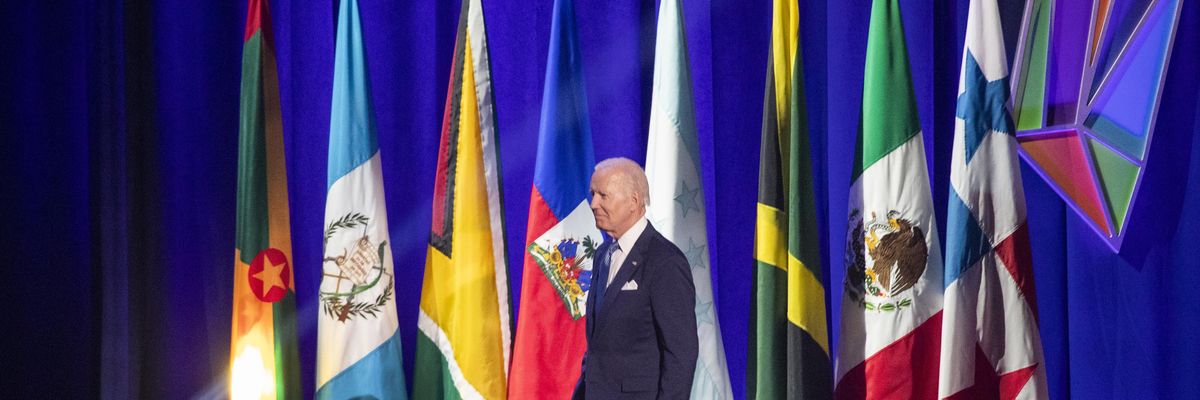
U.S. President Joe Biden takes the stage to speak during the Summit of the Americas at the Microsoft Theater in Los Angeles on June 8, 2022. (Photo: Allen J. Schaben/Los Angeles Times via Getty Images)
In the wake of U.S. President Joe Biden's proposal Wednesday to establish a new policy framework aimed at propelling the Western Hemisphere's recovery from the coronavirus crisis and countering China's growing influence in the region, economic justice advocates are emphasizing that any fresh pact must not repeat the failures of existing "free trade" agreements.
"The corporate-centered free trade agreements currently in place throughout the region have been a disaster for working families both at home and abroad."
Biden announced the so-called Americas Partnership for Economic Prosperity (APEP) during the opening ceremony of the Summit of the Americas. Speaking from a stage in Los Angeles, Biden sought to persuade several of the region's leaders on the need to cooperate just days after his decision to bar Cuba, Nicaragua, and Venezuela from the meeting prompted the presidents of Mexico, Honduras, and other countries to stay home in protest.
If the White House brings this exclusionary logic and sense of omnipotence to its embryonic Pan-American initiative, the results will be less than stellar for the region's workers and environmental justice, Arthur Stamoulis, executive director of the Trade Justice Education Fund, warned Wednesday.
"Whether the Americas Partnership for Economic Prosperity ends up benefiting working people or just raking in more profits for big corporations," Stamoulis said in a statement, "will be determined by the negotiating objectives that the administration prioritizes, the countries involved, and the negotiating process."
According to a White House fact sheet released prior to Biden's speech, the goal of the yet-to-be-finalized plan is to "rebuild our economies from the bottom up and middle out."
After this week's summit, said the White House, the Biden administration intends to "hold initial consultations with partners in the hemisphere and stakeholders" regarding the following issues:
Negotiations are expected to start in early fall, Reuters reported. An unnamed Biden administration official told the news outlet that APEP--which seeks to rejuvenate the region's economy and reassert Washington's clout after China became Latin America's top trading partner during the Trump administration--will initially focus on "like-minded" nations that already belong to U.S. trade accords.
Few other details have emerged to date beyond previous White House statements about "building on the foundation established by our free trade agreements in the region."
However, said Stamoulis, "the corporate-centered free trade agreements currently in place throughout the region have been a disaster for working families both at home and abroad."
"A transparent, participatory process that puts the interests of working people front-and-center could start to correct some of the problems created by earlier pacts," he added. "A positive APEP agenda would begin with renegotiating existing deals to build upon the improvements made in the U.S.-Mexico-Canada Agreement [USMCA], including adding strong, easily-enforced labor standards; eliminating Investor-State Dispute Settlement and expansive monopoly power for Big Pharma to raise medicine prices; and inserting binding climate measures."
"If the Biden administration is serious about pursuing 'worker-centered trade policy,' then any new economic deals in Latin America must first aim to repair the damage from these past agreements."
Melinda St. Louis, Global Trade Watch director at Public Citizen, meanwhile, posed a critical question in a statement released Thursday.
"How will the administration implement a transparent process with oversight from the public and Congress to ensure that Big Tech and other corporate interests do not turn this into another corporate-dominated, wildly unpopular trade exercise like the doomed Free Trade Area of the Americas or Trans-Pacific Partnership?" she asked.
"Any effort to '[build] on the foundation established by our free trade agreements in the region' must take into account how those agreements have panned out for workers in the U.S. and abroad," said St. Louis. "After more than a decade of the U.S.-Central American Free Trade Agreement, the region has experienced hardship for workers and farmers, corporate attacks on health and environmental laws, and political instability leading to deplorable human rights conditions."
For example, "despite continued and pervasive violence against labor unionists in Guatemala and failure to enforce labor laws in Colombia as supposedly required under its free trade agreement, no enforcement actions have been taken," St. Louis continued.
"Meanwhile," she said, "U.S. companies have shamefully attacked legitimate policies to protect health and the environment in the region, using highly controversial Investor-State Dispute Settlement (ISDS) mechanisms in these past agreements, which the Biden administration has insisted will not be included in any future [free trade agreements]."
"If the Biden administration is serious about pursuing 'worker-centered trade policy,'" St. Louis added, "then any new economic deals in Latin America must first aim to repair the damage from these past agreements, including by renegotiating those deals to build on the innovative labor enforcement mechanisms in the USMCA, removing damaging ISDS terms, and inserting binding climate measures."
Dear Common Dreams reader, It’s been nearly 30 years since I co-founded Common Dreams with my late wife, Lina Newhouser. We had the radical notion that journalism should serve the public good, not corporate profits. It was clear to us from the outset what it would take to build such a project. No paid advertisements. No corporate sponsors. No millionaire publisher telling us what to think or do. Many people said we wouldn't last a year, but we proved those doubters wrong. Together with a tremendous team of journalists and dedicated staff, we built an independent media outlet free from the constraints of profits and corporate control. Our mission has always been simple: To inform. To inspire. To ignite change for the common good. Building Common Dreams was not easy. Our survival was never guaranteed. When you take on the most powerful forces—Wall Street greed, fossil fuel industry destruction, Big Tech lobbyists, and uber-rich oligarchs who have spent billions upon billions rigging the economy and democracy in their favor—the only bulwark you have is supporters who believe in your work. But here’s the urgent message from me today. It's never been this bad out there. And it's never been this hard to keep us going. At the very moment Common Dreams is most needed, the threats we face are intensifying. We need your support now more than ever. We don't accept corporate advertising and never will. We don't have a paywall because we don't think people should be blocked from critical news based on their ability to pay. Everything we do is funded by the donations of readers like you. When everyone does the little they can afford, we are strong. But if that support retreats or dries up, so do we. Will you donate now to make sure Common Dreams not only survives but thrives? —Craig Brown, Co-founder |
In the wake of U.S. President Joe Biden's proposal Wednesday to establish a new policy framework aimed at propelling the Western Hemisphere's recovery from the coronavirus crisis and countering China's growing influence in the region, economic justice advocates are emphasizing that any fresh pact must not repeat the failures of existing "free trade" agreements.
"The corporate-centered free trade agreements currently in place throughout the region have been a disaster for working families both at home and abroad."
Biden announced the so-called Americas Partnership for Economic Prosperity (APEP) during the opening ceremony of the Summit of the Americas. Speaking from a stage in Los Angeles, Biden sought to persuade several of the region's leaders on the need to cooperate just days after his decision to bar Cuba, Nicaragua, and Venezuela from the meeting prompted the presidents of Mexico, Honduras, and other countries to stay home in protest.
If the White House brings this exclusionary logic and sense of omnipotence to its embryonic Pan-American initiative, the results will be less than stellar for the region's workers and environmental justice, Arthur Stamoulis, executive director of the Trade Justice Education Fund, warned Wednesday.
"Whether the Americas Partnership for Economic Prosperity ends up benefiting working people or just raking in more profits for big corporations," Stamoulis said in a statement, "will be determined by the negotiating objectives that the administration prioritizes, the countries involved, and the negotiating process."
According to a White House fact sheet released prior to Biden's speech, the goal of the yet-to-be-finalized plan is to "rebuild our economies from the bottom up and middle out."
After this week's summit, said the White House, the Biden administration intends to "hold initial consultations with partners in the hemisphere and stakeholders" regarding the following issues:
Negotiations are expected to start in early fall, Reuters reported. An unnamed Biden administration official told the news outlet that APEP--which seeks to rejuvenate the region's economy and reassert Washington's clout after China became Latin America's top trading partner during the Trump administration--will initially focus on "like-minded" nations that already belong to U.S. trade accords.
Few other details have emerged to date beyond previous White House statements about "building on the foundation established by our free trade agreements in the region."
However, said Stamoulis, "the corporate-centered free trade agreements currently in place throughout the region have been a disaster for working families both at home and abroad."
"A transparent, participatory process that puts the interests of working people front-and-center could start to correct some of the problems created by earlier pacts," he added. "A positive APEP agenda would begin with renegotiating existing deals to build upon the improvements made in the U.S.-Mexico-Canada Agreement [USMCA], including adding strong, easily-enforced labor standards; eliminating Investor-State Dispute Settlement and expansive monopoly power for Big Pharma to raise medicine prices; and inserting binding climate measures."
"If the Biden administration is serious about pursuing 'worker-centered trade policy,' then any new economic deals in Latin America must first aim to repair the damage from these past agreements."
Melinda St. Louis, Global Trade Watch director at Public Citizen, meanwhile, posed a critical question in a statement released Thursday.
"How will the administration implement a transparent process with oversight from the public and Congress to ensure that Big Tech and other corporate interests do not turn this into another corporate-dominated, wildly unpopular trade exercise like the doomed Free Trade Area of the Americas or Trans-Pacific Partnership?" she asked.
"Any effort to '[build] on the foundation established by our free trade agreements in the region' must take into account how those agreements have panned out for workers in the U.S. and abroad," said St. Louis. "After more than a decade of the U.S.-Central American Free Trade Agreement, the region has experienced hardship for workers and farmers, corporate attacks on health and environmental laws, and political instability leading to deplorable human rights conditions."
For example, "despite continued and pervasive violence against labor unionists in Guatemala and failure to enforce labor laws in Colombia as supposedly required under its free trade agreement, no enforcement actions have been taken," St. Louis continued.
"Meanwhile," she said, "U.S. companies have shamefully attacked legitimate policies to protect health and the environment in the region, using highly controversial Investor-State Dispute Settlement (ISDS) mechanisms in these past agreements, which the Biden administration has insisted will not be included in any future [free trade agreements]."
"If the Biden administration is serious about pursuing 'worker-centered trade policy,'" St. Louis added, "then any new economic deals in Latin America must first aim to repair the damage from these past agreements, including by renegotiating those deals to build on the innovative labor enforcement mechanisms in the USMCA, removing damaging ISDS terms, and inserting binding climate measures."
In the wake of U.S. President Joe Biden's proposal Wednesday to establish a new policy framework aimed at propelling the Western Hemisphere's recovery from the coronavirus crisis and countering China's growing influence in the region, economic justice advocates are emphasizing that any fresh pact must not repeat the failures of existing "free trade" agreements.
"The corporate-centered free trade agreements currently in place throughout the region have been a disaster for working families both at home and abroad."
Biden announced the so-called Americas Partnership for Economic Prosperity (APEP) during the opening ceremony of the Summit of the Americas. Speaking from a stage in Los Angeles, Biden sought to persuade several of the region's leaders on the need to cooperate just days after his decision to bar Cuba, Nicaragua, and Venezuela from the meeting prompted the presidents of Mexico, Honduras, and other countries to stay home in protest.
If the White House brings this exclusionary logic and sense of omnipotence to its embryonic Pan-American initiative, the results will be less than stellar for the region's workers and environmental justice, Arthur Stamoulis, executive director of the Trade Justice Education Fund, warned Wednesday.
"Whether the Americas Partnership for Economic Prosperity ends up benefiting working people or just raking in more profits for big corporations," Stamoulis said in a statement, "will be determined by the negotiating objectives that the administration prioritizes, the countries involved, and the negotiating process."
According to a White House fact sheet released prior to Biden's speech, the goal of the yet-to-be-finalized plan is to "rebuild our economies from the bottom up and middle out."
After this week's summit, said the White House, the Biden administration intends to "hold initial consultations with partners in the hemisphere and stakeholders" regarding the following issues:
Negotiations are expected to start in early fall, Reuters reported. An unnamed Biden administration official told the news outlet that APEP--which seeks to rejuvenate the region's economy and reassert Washington's clout after China became Latin America's top trading partner during the Trump administration--will initially focus on "like-minded" nations that already belong to U.S. trade accords.
Few other details have emerged to date beyond previous White House statements about "building on the foundation established by our free trade agreements in the region."
However, said Stamoulis, "the corporate-centered free trade agreements currently in place throughout the region have been a disaster for working families both at home and abroad."
"A transparent, participatory process that puts the interests of working people front-and-center could start to correct some of the problems created by earlier pacts," he added. "A positive APEP agenda would begin with renegotiating existing deals to build upon the improvements made in the U.S.-Mexico-Canada Agreement [USMCA], including adding strong, easily-enforced labor standards; eliminating Investor-State Dispute Settlement and expansive monopoly power for Big Pharma to raise medicine prices; and inserting binding climate measures."
"If the Biden administration is serious about pursuing 'worker-centered trade policy,' then any new economic deals in Latin America must first aim to repair the damage from these past agreements."
Melinda St. Louis, Global Trade Watch director at Public Citizen, meanwhile, posed a critical question in a statement released Thursday.
"How will the administration implement a transparent process with oversight from the public and Congress to ensure that Big Tech and other corporate interests do not turn this into another corporate-dominated, wildly unpopular trade exercise like the doomed Free Trade Area of the Americas or Trans-Pacific Partnership?" she asked.
"Any effort to '[build] on the foundation established by our free trade agreements in the region' must take into account how those agreements have panned out for workers in the U.S. and abroad," said St. Louis. "After more than a decade of the U.S.-Central American Free Trade Agreement, the region has experienced hardship for workers and farmers, corporate attacks on health and environmental laws, and political instability leading to deplorable human rights conditions."
For example, "despite continued and pervasive violence against labor unionists in Guatemala and failure to enforce labor laws in Colombia as supposedly required under its free trade agreement, no enforcement actions have been taken," St. Louis continued.
"Meanwhile," she said, "U.S. companies have shamefully attacked legitimate policies to protect health and the environment in the region, using highly controversial Investor-State Dispute Settlement (ISDS) mechanisms in these past agreements, which the Biden administration has insisted will not be included in any future [free trade agreements]."
"If the Biden administration is serious about pursuing 'worker-centered trade policy,'" St. Louis added, "then any new economic deals in Latin America must first aim to repair the damage from these past agreements, including by renegotiating those deals to build on the innovative labor enforcement mechanisms in the USMCA, removing damaging ISDS terms, and inserting binding climate measures."