SUBSCRIBE TO OUR FREE NEWSLETTER
Daily news & progressive opinion—funded by the people, not the corporations—delivered straight to your inbox.
5
#000000
#FFFFFF
To donate by check, phone, or other method, see our More Ways to Give page.
Daily news & progressive opinion—funded by the people, not the corporations—delivered straight to your inbox.
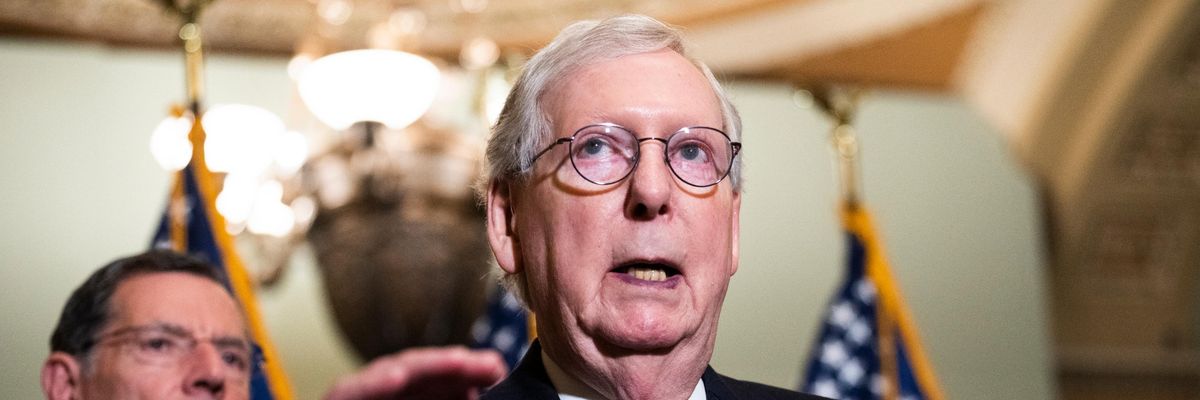
Senate Minority Leader Mitch McConnell (R-Ky.) speaks at a news conference on May 24, 2022. (Photo: Tom Williams/CQ-Roll Call, Inc. via Getty Images)
Less than two weeks after a white supremacist gunned down 10 Black people at a grocery store in Buffalo, New York, Senate Republicans on Thursday blocked legislation aimed at combating domestic terrorism in the United States--specifically the growing threat posed by neo-Nazis and white nationalists.
The final vote on the House-passed legislation was 47-47, with every Senate Republican in attendance voting no. At least 60 yes votes were needed to overcome the filibuster and advance to a final vote on the bill.
Every Senate Democrat who cast a vote supported the Domestic Terrorism Prevention Act, which proposed ensuring that federal agencies have the resources needed to detect and prevent "acts of domestic terrorism and white supremacist and neo-Nazi infiltration of law enforcement and corrections agencies."
Last year, the head of the FBI--an agency that has long been criticized for ignoring rising white supremacist violence--told Congress that white supremacists comprise "the biggest chunk of our domestic terrorism portfolio overall" and "have been responsible for the most lethal attacks over the last decade."
Rep. Bill Pascrell (D-N.J.) called out his Republican colleagues in the Senate over their unified opposition to the Domestic Terrorism Prevention Act:
In a floor speech earlier Thursday, Senate Majority Leader Chuck Schumer (D-N.Y.) framed the procedural vote as an opportunity to "have a larger debate and consider amendments for gun-safety legislation in general, not just for those motivated by racism," in the wake of the elementary school massacre in Uvalde, Texas earlier this week.
"There are a lot of MAGA Republicans for whom no amount of gun violence--whether it's domestic terrorism, a school shooting, a neighborhood shooting, or something else--will ever, ever convince them to take any action," Schumer said. "So if Republicans obstruct debate today, we are prepared to have an honest and realistic discussion, conversation, negotiation for a little more time to see what they can come to the table with."
With long odds of success, Sen. Chris Murphy (D-Conn.) is currently reaching out to Republican and Democratic lawmakers in an attempt to strike a compromise on a gun-safety bill that could include expanded background checks and other measures that are overwhelmingly popular with the U.S. public.
"Neither he nor I have illusions that this is easy," Schumer said of his and Murphy's efforts to find common ground with Republicans, many of whom are funded by the National Rifle Association. "But his view, my view, and the overwhelming view of our caucus is that we need to give it a short amount of time to try."
Following Thursday's failed vote, senators are set to leave town for a 10-day recess.
Dear Common Dreams reader, It’s been nearly 30 years since I co-founded Common Dreams with my late wife, Lina Newhouser. We had the radical notion that journalism should serve the public good, not corporate profits. It was clear to us from the outset what it would take to build such a project. No paid advertisements. No corporate sponsors. No millionaire publisher telling us what to think or do. Many people said we wouldn't last a year, but we proved those doubters wrong. Together with a tremendous team of journalists and dedicated staff, we built an independent media outlet free from the constraints of profits and corporate control. Our mission has always been simple: To inform. To inspire. To ignite change for the common good. Building Common Dreams was not easy. Our survival was never guaranteed. When you take on the most powerful forces—Wall Street greed, fossil fuel industry destruction, Big Tech lobbyists, and uber-rich oligarchs who have spent billions upon billions rigging the economy and democracy in their favor—the only bulwark you have is supporters who believe in your work. But here’s the urgent message from me today. It's never been this bad out there. And it's never been this hard to keep us going. At the very moment Common Dreams is most needed, the threats we face are intensifying. We need your support now more than ever. We don't accept corporate advertising and never will. We don't have a paywall because we don't think people should be blocked from critical news based on their ability to pay. Everything we do is funded by the donations of readers like you. When everyone does the little they can afford, we are strong. But if that support retreats or dries up, so do we. Will you donate now to make sure Common Dreams not only survives but thrives? —Craig Brown, Co-founder |
Less than two weeks after a white supremacist gunned down 10 Black people at a grocery store in Buffalo, New York, Senate Republicans on Thursday blocked legislation aimed at combating domestic terrorism in the United States--specifically the growing threat posed by neo-Nazis and white nationalists.
The final vote on the House-passed legislation was 47-47, with every Senate Republican in attendance voting no. At least 60 yes votes were needed to overcome the filibuster and advance to a final vote on the bill.
Every Senate Democrat who cast a vote supported the Domestic Terrorism Prevention Act, which proposed ensuring that federal agencies have the resources needed to detect and prevent "acts of domestic terrorism and white supremacist and neo-Nazi infiltration of law enforcement and corrections agencies."
Last year, the head of the FBI--an agency that has long been criticized for ignoring rising white supremacist violence--told Congress that white supremacists comprise "the biggest chunk of our domestic terrorism portfolio overall" and "have been responsible for the most lethal attacks over the last decade."
Rep. Bill Pascrell (D-N.J.) called out his Republican colleagues in the Senate over their unified opposition to the Domestic Terrorism Prevention Act:
In a floor speech earlier Thursday, Senate Majority Leader Chuck Schumer (D-N.Y.) framed the procedural vote as an opportunity to "have a larger debate and consider amendments for gun-safety legislation in general, not just for those motivated by racism," in the wake of the elementary school massacre in Uvalde, Texas earlier this week.
"There are a lot of MAGA Republicans for whom no amount of gun violence--whether it's domestic terrorism, a school shooting, a neighborhood shooting, or something else--will ever, ever convince them to take any action," Schumer said. "So if Republicans obstruct debate today, we are prepared to have an honest and realistic discussion, conversation, negotiation for a little more time to see what they can come to the table with."
With long odds of success, Sen. Chris Murphy (D-Conn.) is currently reaching out to Republican and Democratic lawmakers in an attempt to strike a compromise on a gun-safety bill that could include expanded background checks and other measures that are overwhelmingly popular with the U.S. public.
"Neither he nor I have illusions that this is easy," Schumer said of his and Murphy's efforts to find common ground with Republicans, many of whom are funded by the National Rifle Association. "But his view, my view, and the overwhelming view of our caucus is that we need to give it a short amount of time to try."
Following Thursday's failed vote, senators are set to leave town for a 10-day recess.
Less than two weeks after a white supremacist gunned down 10 Black people at a grocery store in Buffalo, New York, Senate Republicans on Thursday blocked legislation aimed at combating domestic terrorism in the United States--specifically the growing threat posed by neo-Nazis and white nationalists.
The final vote on the House-passed legislation was 47-47, with every Senate Republican in attendance voting no. At least 60 yes votes were needed to overcome the filibuster and advance to a final vote on the bill.
Every Senate Democrat who cast a vote supported the Domestic Terrorism Prevention Act, which proposed ensuring that federal agencies have the resources needed to detect and prevent "acts of domestic terrorism and white supremacist and neo-Nazi infiltration of law enforcement and corrections agencies."
Last year, the head of the FBI--an agency that has long been criticized for ignoring rising white supremacist violence--told Congress that white supremacists comprise "the biggest chunk of our domestic terrorism portfolio overall" and "have been responsible for the most lethal attacks over the last decade."
Rep. Bill Pascrell (D-N.J.) called out his Republican colleagues in the Senate over their unified opposition to the Domestic Terrorism Prevention Act:
In a floor speech earlier Thursday, Senate Majority Leader Chuck Schumer (D-N.Y.) framed the procedural vote as an opportunity to "have a larger debate and consider amendments for gun-safety legislation in general, not just for those motivated by racism," in the wake of the elementary school massacre in Uvalde, Texas earlier this week.
"There are a lot of MAGA Republicans for whom no amount of gun violence--whether it's domestic terrorism, a school shooting, a neighborhood shooting, or something else--will ever, ever convince them to take any action," Schumer said. "So if Republicans obstruct debate today, we are prepared to have an honest and realistic discussion, conversation, negotiation for a little more time to see what they can come to the table with."
With long odds of success, Sen. Chris Murphy (D-Conn.) is currently reaching out to Republican and Democratic lawmakers in an attempt to strike a compromise on a gun-safety bill that could include expanded background checks and other measures that are overwhelmingly popular with the U.S. public.
"Neither he nor I have illusions that this is easy," Schumer said of his and Murphy's efforts to find common ground with Republicans, many of whom are funded by the National Rifle Association. "But his view, my view, and the overwhelming view of our caucus is that we need to give it a short amount of time to try."
Following Thursday's failed vote, senators are set to leave town for a 10-day recess.